
Hear us on Apple Podcasts, iHeart, and Spotify Podcasts. Subscribe now!
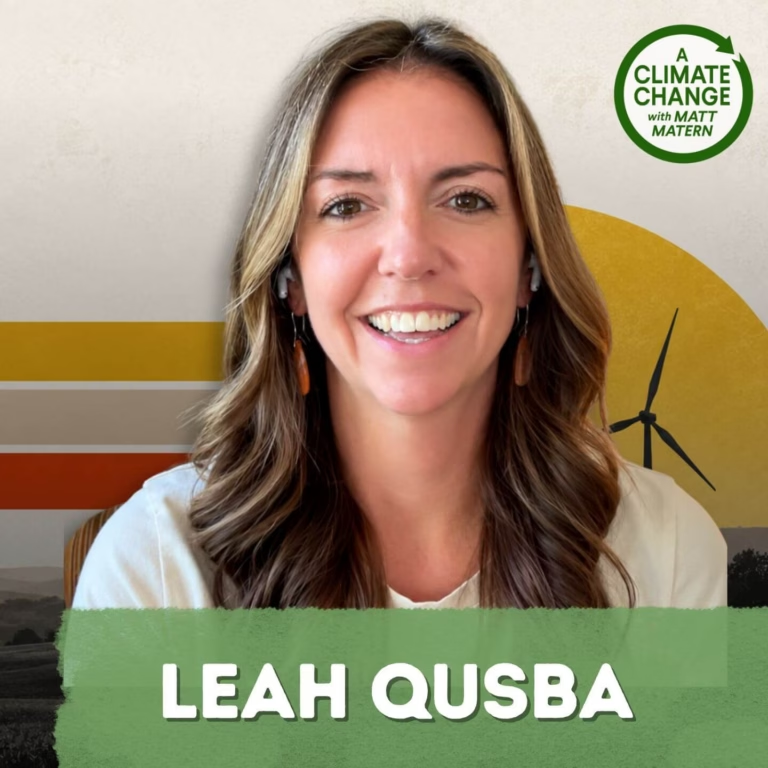
Matt Matern speaks with Leah Qusba, CEO of GoodPower, a nonprofit working to win public support for the clean energy transition. They talk about moving the energy conversation away from sacrifice and toward abundance, where clean energy means more jobs, lower bills, and an economy that works for everyone. Leah shares GoodPower’s polling with NORC at the University of Chicago, which found about half of Republicans still support large-scale solar, rising to roughly 70% when it’s tied to lower energy bills. They also dig into the disinformation targeting renewables, why one in three projects now dies in permitting, and a little-known Arizona utility race putting energy bills on the 2026 ballot.
You don’t have to pay people on Reddit to go talk on Reddit about how much they love driving their EV. They do it for free, just like you don’t have to pay a generational farmer to tell their authentic story about how they now farm 300 acres of solar along with their 3,000 acres of corn and soybeans.
You know, it saved their farms. These are sacred values. You can’t monetize them, and I think lies, on the other hand, and disinformation about these technologies are really expensive and really complicated to maintain. Marketing 101: the more people see it, the more favorable they become to it over time. It’s repetition.
You’re listening to A Climate Change. This is Matt Matern, your host. I’ve got a great guest coming on the program, Leah Qusba. Leah is the CEO of GoodPower, a strategic communication research and campaigning nonprofit. And welcome to the show, Leah.
Thanks for having me, Matt. Glad to be here.
So, as the CEO of GoodPower, it’s a nonprofit doing something in the clean energy movement, which has been needed for years, building the digital infrastructure, the polling muscle, and the AI-powered tools to actually win public opinion on renewable energy, especially in the rural and conservative communities where these fights are being lost currently. So, tell us a little bit about what pulled you in this direction.
Sure. Well, I think GoodPower. We’ve been around a long time. We’re not a new organization. We’re over 18 years old. I’ve been at GoodPower for 17 of those 18 years, and I think you know when we rebranded last year, about this time actually, our GoodPower brand is about a year old. It was under the premise that really, how do people interact with content online?
Why do they seek out content? The realization: the economy right now is just not working for most people. How do we think about the energy transition and climate solutions, and what people are thinking about, and how they’re living their lives, sort of based on those thoughts. And how do we marry those two things, and really create an organization that has a bigger tent for more people, not just in the United States, but in the global markets we work in around the world, that they can get under and think about the energy transition, knowing it’s inevitable.
How do we seize the most opportunity and avoid the most peril, and really help sort of drive this abundance frame around. Hey, we can have clean energy. We can have GoodPower. We can also have more jobs and prosperity and an economy that works for everyone. And we think GoodPower is sort of the brand and the entity that can help deliver that.
Well, I hear that phrase abundance, which we’ve heard a lot of recently from a certain podcaster of note, and I guess book writer. Is that something that is resonating with the wider world, and particularly maybe in more rural and conservative areas?
Yeah, I think so. I think one peril of climate communications that I’ve seen over the last roughly two decades in this work is this deficit marketing that you have to go without, or that you have to give up meat, or you have to change how you live, or not take an airplane, or travel, or enjoy life.
And I think the flip side is actually, could we create an energy system with these limitless energy sources? Right, you can’t price price gouge the wind. There’s no tax on the sun. How do we think about these limitless energy sources and then apply those to the limitless possibilities of how we can live our lives and enjoy our lives?
So I think while our our work is sort of rooted in advancing GoodPower, clean energy, right? The idea behind GoodPower is bigger than that one issue. It’s sort of thinking about the power people have to shape their lives, their communities, their livelihoods, how they choose to live and enjoy life, and sort of influence those decisions, and that we actually can have it all.
Well, I guess you know I I’ll have to push back just a little bit on that in terms of you know whether wind and solar and all that can can power all of our needs. I mean, we currently have such a high reliance upon oil; it’s still kind of shocking, even though the electricity sector has has moved greatly in the direction of renewables.
We still have a lot of power for transportation and things like that that are just based upon fossil fuels. And you know whether or not how how long is it going to take to transition all of those things to renewables, and I mean, I think you hit the nail on the head right there. Time is our greatest enemy. I think the energy transition and the transition away from sort of the the energy legacy energy sources of the past that have really built our economy. Right, there’s no shame in the.
And how we got here, but sort of looking ahead, I think there’s pretty broad agreement that we will get there. It’s a question of time, and if time is our greatest enemy, how do we save time? How do we debottleneck, you know, and remove roadblocks to that transition? So we look at problems at GoodPower. You just mentioned the transportation sector, which actually actually is the largest share of emissions in the U.S.
And so, when we think about decarbonizing transportation, why is there a 30-point gap between Democrats and Republicans in their future purchasing plans of EVs? I don’t really need to spend money trying to convince Democrats to buy EVs. They’re actually adopting them much more quickly than Republicans. So, if we’re going to focus on Republicans, how do we transform how conservatives think about EVs?
They’re not a left Libby thing to do based on values. They’re a cost-saving, pragmatic decision to make for your household. In just about every U.S. state, the five-year sort of cost analysis on a gas-powered vehicle or an EV-it’s actually cheaper now over a five-year period to own and to drive an EV, and then when we think about volatile gas prices, it’s not hard to sell the idea of electric mobility in the global South.
You know, two-wheelers, four-wheelers, or in the U.S. We don’t want gas prices that kind of go up and down like the stock market. People want predictability. They want stability. They don’t want to import that volatility into their lives and sort of into their households?
Well, I think another area you might want to try marketing electric vehicles better is just they’re a lot faster and fun fun to drive. I mean, come on! If anybody who’s owned an electric vehicle knows they can, you know, beat practically any gas car in a race, so not that that’s what we should be doing, but it it is out there.
Oh my! I’m so glad you brought that up because that’s a huge part of the conversation. Like decarbonized technologies, like EVs, they’re fun, they’re joyful. You don’t have to pay people on Reddit to go talk on Reddit about how much they love driving their EV.
hey do it for free because it’s great and they want to share that joy. Just like you don’t have to pay a generational farmer to tell their authentic story about how they now farm 300 acres of solar along with their 3000 acres of corn and soybeans, you know it saved their farm. So solar in that case was life changing.
So I think you know these are sacred values that have no you can’t monetize them, and I think lies, on the other hand, and disinformation about these technologies are really expensive and really complicated to maintain. These other things, once they’re evangelized through credible messengers, sell themselves because they’re enjoyable, they’re fun, and you can’t really put a price on that, right?
Well, I I know researching this a while back, that the average farmer, I think, in Iowa, who has a wind turbine, which many of them do, since most of their electricity is from wind, I think they get like $35,000 a year off of the rights to use their farmland for wind. So it’s a it’s like a substantial piece of income to for them, and they’re they’ve kind of pushed back against the Trump administration that’s trying to reduce the use of wind power because they’re making real money off of this.
I think it’s one of the most actually hotly debated disinformation meta narratives right now in the U.S. around renewables, right? There’s about a dozen of these major meta narratives around disinformation related to renewables that we track. You know, you’ve heard all of them. It’s not reliable, right? Renewables are scapegoated every time the power goes out, and there’s always a kernel of truth, right? There’s the whole firm power argument.
Well, there’s this amazing invention called the battery, right? That’s why we pair these technologies with with battery storage. There’s another one that best battery energy storage systems are highly flammable and explosive, right? Not true in in vast majority of cases. That is disinformation. The one you brought up that renewable energy is not consistent with farming, or it threatens farmland. That’s coming from the administration right now.
That is coming from sort of AI-driven disinformation online, and then you have this counter narrative that’s largely organic. And we’ve we’ve talked to lots of these farmers over the last five years all over rural red America, interestingly, who are like, wait a second, I own this land. We’ve had it in our family for generations, farming it. I would like to make my own decisions of what I do with my own land, and I don’t want the government telling me what I can and can’t put on my land.
I mean, I’m from a rural community. It’s about monetizing. It’s about how much money you can get out of your land? Whether you’re raising animals, you know, you’re growing crops, or in this case, you’re you’re farming solar or wind. And the stories that we hear, you know, from farmers. Oh, I’ve had you know wind on my land for 20 years. It put my kids through college.
It helped us get us through the hard years. I think. Those authentic experiences sort of just crush any disinformation out there around the sort of it’s not consistent or you know compatible with farming that renewables are a threat to farmland.
Yeah, I think it would be great to have more commercials and more ads out there in the in the universe that are showing like real farmers on real land, and you know that they’re making real money off the stuff, and it just kind of like just puncture the the ridiculous narrative that somehow this is some left wing plot to subvert them or whatever.
I don’t know if that’s happening with your organization or with others, I’m not monitoring all ads across the U.S. so I’m not sure what the hell is happening out there. But I feel like there should be more of that.
Yes, well, let me tell you, I would direct people to GoodPowers YouTube channel. You can see some of these stories from farmers. We own 15 global entities and brands. They’re specifically designed to capture these stories, tell these stories, platform these under-told voices.
Right, what you’re hearing in the national narrative in the U.S. does not match the experience of people that are in rural agricultural communities. So, how do we bring those things closer together? Once you hear those stories, you’re like, “Wait, this sounds like a pretty great economic investment. This sounds like a really important thing to do in places that are seeing a lot of, you know, young people leave because there’s no jobs or seeing sort of crumbling infrastructure.
If this is a huge boon for rural America, we do need to tell those stories. We served ourselves organizationally about 300 million ads in organic views last year on those stories. It’s not nearly enough in this noisy media environment, but we’re we’re trying to do our part, and we hope more stories like that can be platformed.
So, how are you working with actual candidates, or do you stay kind of nonpartisan in that respect?
Yeah, we’re a nonpartisan organization, so we don’t see energy as being a political issue. Unfortunately, it is in the same way that climate and other issues that have no business having partisan lines are. But really, when you the the further you get from the top of the ticket, the more bipartisan support you see.
We partnered with conservative organizations last year around the one big beautiful bill and getting Republican legislators in state houses who are very very happy with the investments that have come along with utility scale solar wind and battery storage projects go on camera with us and talk about those experiences.
So the further you get from sort of Congress and the further you get into rural and local communities, and really talking to county commissioners, fire chiefs, school superintendents that have seen crazy benefits and investments into local schools, you talk to neighbors of these projects, landowners that are you know have lucrative long term leases. The conversation is so different.
How do we take that and how do we inject that into the sort of popular mainstream narrative. I think that is really, you know, that’s the trick. And essentially, many of these communities you asked about partisanship, Matt, are rural and red. They haven’t elected a Democrat in 50 years, so these are oftentimes really deep red places, ruby red places, as they call them.
So really thinking about engaging conservatives authentically and on their own terms is a huge growth area for people who advocate for climate and clean energy solutions, and not a community we’ve built a lot of trust with. I think in the mainstream climate movement over the last few decades, I think it’s a major investment priority. But it has to be led by conservatives with conservatives and authentically, sort of in the language and value set that conservatives hold, I think across rural red counties.
Well, that may be one of the long-term genius pieces of the IRA is that it did allocate a lot of money to red communities, and that Trump has canceled a lot of the IRA money, but I was just reading an article in Politico that said a lot of it’s still going through, and that Trump has conveniently canceled a lot of it more in the blue areas, and he’s letting the stuff in the red areas kind of go through. What’s your takeaway on that, and maybe add a little finer point to my rough analysis here?
Oh, certainly. Well, how much more litigation can we all stand? That’s one question. Every just everything is tied up in the courts, and I think it’s a strategy, right? How do we delay, delay, delay? If I were to put my other hat on, and you know, I was an anti-renewable energy advocate, what would be my strategy? I would want more time to delay and soak more money out of the legacy energy sources, not strand those assets. So I understand sort of the strategy.
That court ruling that you saw recently around sort of reversing through litigation what had happened around freezing those grants and that those that grant money now needs to matriculate. I think the other piece is when you look at some of the leadership states around EV manufacturing, or if you look at the top solar, you know, stop solar installed state beyond California.
If you look at utility scale, it’s Texas, right? That’s not a blue state. So when you really look down at the state level, who’s benefiting the most? Who are the primary beneficiaries of the energy transition, other than sort of the collective we as a society? It’s rural red America, right? Georgia, Tennessee. These are some of the biggest EV manufacturers right now in the U.S. Real leaders in that state.
I wouldn’t call those extremely blue or sort of you know progressive environments when we’re thinking about this technology. But that’s the whole frame around the abundance frame, right? Is that we can build an economy that works for everyone. We can have our cake and eat it too. And I think when you really look at the stories of who’s benefiting, it’s it’s traditionally conservative and in rural areas.
Well, to me, one of the statistics that was has not been repeated enough is that we’ve reduced the amount of energy that we put in to our society, and yet increased our economic output, and and that kind of that supports this theory of abundance that we can have both. We do not have to have. We do not have to use more energy and pollute more in order to be more prosperous.
And I think that kind of flies in the face of the current administration’s narrative, which is, you know, we just need more and more energy. Like we can we can do this in a clean way, and and just become more efficient. I mean, partly the efficiency aspect of of the problem is is something that the current administration has attacked as well, which is really dumbfounding.
Yeah, I mean, I think I think the argument around sort of more, more, more is nuanced and quite distinct from this concept of you know abundance, and I think doing things more smartly, more efficiently. I think thinking about sort of the AI enabled space that we now operate in, even as organizations, around how do we advocate, how do we produce fact based information and content, how do we you know figure out where all the disinformation clusters around the U.S. and where’s the conversation.
And how do we get there first to inform people and platform those authentic stories from rural Red America or from conservative America to do the work we need to? I think build the permission structure in the U.S. to allow these technologies to grow and to deploy more quickly and to really accelerate that timeline, and think essentially, you know, a decade ago, this wasn’t like the main issue wasn’t social permission, and I think today, when one in three utility scale renewable projects dies in permitting, and you know, permitting that’s just one of the important steps in the development life cycle of a utility scale project, permitting is so long; it’s so risky.
And a you know one Facebook group, one really active Facebook group in a county could sink an entire project. It’s incredibly expensive. So how do we build the support structure, the social permission locally? There’s a lot of work to do there, and I think in terms of efficiency and thinking about how we do that work more cheaply, how we as advocates harness these 21st century tools to be more efficient with the money we’re spending. I think all of the economic momentum is on our side. It’s just doing things I think more smartly.
Well, a couple things I wanted to turn to, and you can do it in whichever order you want. One is the solar survey that you did with the University of Chicago, and I reviewed some of those results, which are pretty fascinating. And a, how did you develop this relationship with the University of Chicago as a Chicagoan?
I’ve, you know, always am attracted to that, and I was actually on their campus just about a couple weeks ago to visit one of the museums they have on the Antiquities, which is pretty amazing. And if anybody’s in Chicago or visiting, you should go check it out. And then the second thing related to that is Vote Solar, and you did some work in Arizona. It looks like for july 21 primary there for their ACC. I like the acronym Arizona Corporation Commission. Also A Climate Change. So tell us about both those things.
Sure. Well, I lived in. Chicago for a long time, so we’ll have to compare restaurant and neighborhood notes. But I lived in Rogers Park for a long time. I think U of Chicago just and their Amera Speaks product through NORC just one of the best in class sort of bipartisan survey instruments out there.
So when we’re thinking about reaching audiences or oversampling Republicans, for example, and learning more about conservative views, in particular, they’re a really great neutral choice. So we chose that survey instrument because of the neutrality. You know, they’re they’re used by Fox News, but they’re also used by the Associated Press, and they’re used by everybody. And so I think we wanted to choose a survey instrument and partner that was really bipartisan and that the results would be trusted. What we were trying to replicate.
I don’t know if you remember this from this last year-but there was a lot of news around a few conservative polls that came out. One was from Tony Fabrizio, a famous Trump pollster, and the other one was from Kellyanne Conway, which I think is a recognizable name in our space, and basically saying, “Hey, a majority of Republicans still support large-scale solar, not as much as potentially in 2020 when it was really almost an 80-20 issue, bipartisan 80, you know, 80% on either side supported solar, not only supported it but preferred it.
We’ve lost a lot of ground over the last six years, so you know we were trying to replicate with a more sort of bipartisan survey instrument. Could we see what Republican public opinion is? Sort of building on the longitudinal work that Pew Research does as well. So we did that, and I think one of the really interesting things: only about 40% of Republicans are happy with their own party and how they’re handling energy costs. So that was that was a huge finding.
I think the major headline about half of Republicans still support large scale solar, which is probably more than your general American might think, based on some of their rhetoric and what’s in the national news cycle and this sort of all of government attack on wind and solar and offshore wind. And I think it’s-I think the tally has gone up to $4 billion in payments we’re making for these companies to walk away from their offshore wind leases, and that-and that keeps increasing. So we, as taxpayers, are are right footing the bill for this.
So I think you know this was really interesting when you look at how do we increase Republican support. What are the levers of how do how could we communicate about solar in such a way that we could get that 49% or 50% of Republican support up to let’s say 70% So when you talk about it in the context of you know solar is the fastest to power, it’s the most affordable. You know, it could potentially stabilize or lower energy bills.
Support for Republicans jumps up to 70% So connecting it to energy costs and saving money is a winning message when connected to price stability in terms of the global conflict. So I mentioned how Americans are so sick and tired. Guess what? Republicans have to pay their energy bills too. We all do, and so when we think about that, it jumps to 72% Republican support for large-scale solar when you connect it to stabilizing prices in the context of a global global conflict like the war with Iran. People want predictability; they don’t want to import volatility into their households, or their bills are sick and tired of it.
So these are levers we can pull as advocates. Okay, well, how do we talk about these things in a sort of lexicon using vernacular that the Republican Party or that conservatives really want to hear? And these things happen to be true, right?
When you build more renewable energy, and when we’re not connecting fuel costs to far off wars. We can have more stability. We can have more stable, even reduced energy bills. So I think these are big headlines that we got from the survey.
Yeah, I think that that is notable, and and yet I don’t really see big media picking those stories up from my kind of perusal of a pretty wide variety of sources that aren’t really talking about these stats, they aren’t talking about really a a substantial congruence of the country agreeing to to solar, for instance.
I totally agree, and so while these findings I think are extremely compelling, we’ve also we probably have one of the largest bodies of empirical research in the United States at GoodPower around how to build local support and permission connected to a lot of those stories I was telling you about that we collect from authentic, credible messengers locally. You see like huge movement, you know, getting getting 20 points of increased support.
Like, yes, I would welcome one of these projects now that I know what it can do for my community and the economic benefits I could get as an individual or a householder. That my community my community could realize, it’s really a function of paid media resources and how do you compete. Right. If you’re going to do a national campaign and you think you you can break through into the national media, that’s like a minimum spend of you know $20 million to be able to really have influence at on a national stage.
So I think we have to think about whether it’s philanthropy, whether it’s aligned stakeholders in the renewable energy industry, the trade organizations that represent them, who has a stake in advancing and accelerating the energy transition? We really need to think a lot bigger, 10x bigger, 20x bigger around how do we influence the the narrative and the conversation.
All of the stories, everything we need at a small scale is there. The economic momentum is on our side, but we’re really going to need to think about how do we engage in these national media moments, these high attention media moments in the news cycle, and how do we frankly just spend a lot more money on paid media, on creator marketing, on you know smart digital infrastructure? We’ve really, really lagged behind, I think, as a sector on both in the private sector, but also the nonprofit sector on building common sense digital infrastructure fit for you know the year 2026.
We’re kind of using strategies from a decade or even two decades ago, so we need to modernize what we’re doing, and we have to accept that there’s a financial cost to that. And if we want to win on these issues, and again, if our enemy is time, and we want to save time and get to that decarbonized power sector more quickly. We’re going to have to mount a strategic offense here, and it’s going to be costly.
Well, tell us how that strategic offense is going to be effectuated by GoodPower and others. And you talk about congruence with other organizations. I’ve had the Environmental Voter Project on the show before? Think they do good work.
You know, I had David Fenton on the show, who’s also kind of a PR guru, and you know, a lot of things that you’re talking about have synergy with these groups. What are what’s GoodPower doing to kind of you know facilitate this 10x or 100x type change that we need to to break through.
Well, we’re trying to talk to absolutely as many aligned stakeholders as possible. So we partner with over 75 developers now in the utility scale clean energy space. We strategize on how to build local public support and social permission to build these technologies, especially in the context of new large load demand and driving potentially incremental combined cycle gas all over the country instead of renewables. Right, this is a crossroads we’re at.
Will new energy demand drive incremental thermal energy in the form of lots of combined cycle gas, or will it drive incremental clean energy in the form of wind, solar, battery storage, also geothermal, right? Enhanced geothermal, also nuclear, right? All the zero carbon electrons we can get-that’s the crossroads we’re kind of facing. And right now, you’re hard pressed to find a data center in the United States that’s being 100% powered by clean energy.
It is driving a lot of incremental gas, and we’re really locking the country into gas for many decades to come. So I think that’s a piece of it. We really have five pillars we work on with partners. One is really around siting and permitting. How do we, in this moment, well, you know, one big beautiful bill, and then the subsequent Treasury guidance around the PTC and the ITC, these tax credits.
How do we think about that timeline? How do we think about better energy storage? How do we get as many projects permitted as possible? If one in three are dying in permitting, why is that? Well, if it’s public opposition, how do we get communities educated? How do we run interference on disinformation that is being inundated with constantly? How do we build authentic community support so that these technologies have the social permission to get the permits they need, and then you know, be ultimately built. So that’s one pillar. Second, we really have to think about the national narrative.
This is famous longitudinal study that Pew Research does that shows we’ve lost 40 points on wind, over 35 points on solar over the last six years, roughly, mostly driven by views from Republicans. How do we focus on getting that narrative we were talking about into the you know the public narrative nationally. That’s an expensive thing to do. We have to do it. We have to pool resources and we have to strategize across industry, the trade groups that represent them, the nonprofit community.
We need to pull in all of our forces together and think about that challenge. So the national narrative, third, you know, is really thinking about large load. How do we leverage this moment of unique new energy demand to drive incremental clean, not incremental thermal?
Four. How do we build the most, the largest and most substantial conservative messenger network on? Planet Earth, right? How do we do that? We already have lots of stories from farmers and you know fire marshals talking about best safety, and from you know neighbors of projects and school superintendents and county commissioners, all the beneficiaries we discussed.
How do we turn up the dial on that? How do we create a real movement? From where 99% of this infrastructure is being built is rural and red. How do we come to terms with that and invest in the credible messengers that can tell those stories from their own authentic lives and experiences? And then five, and maybe most importantly, because it kind of helps with the other four, is the communications infrastructure investment that we need to make.
We are decades, potentially a decade and a half, two decades behind in our real. You know, organizations like mine were always faced with the choice: do we hire another organizer, or do we, you know, have a product or purchase data or technology?
Right, and we need both, but we’re faced with this impossible decision, and we’re resource constrained, and you know, we always choose, you know, the organizing capacity, and therefore we have we’re really not invested. I think in the communications technology, also in the nonprofit sector, it’s very expensive to recruit domain experts from communications and marketing fields that have advanced. I mean, the internet is almost unrecognizable to what it was just five years ago.
So, if you’re not on the bleeding edge of technology and how to use marketing and communications and you know a sophisticated digital stack to communicate and to track the efficacy of those communications, you can fall behind very quickly.
So, it’s going to take a concerted effort for us to really harness AI-enabled tools build communications infrastructure, build rapid response infrastructure. That’s how disinformation really wins, Matt. It’s in these high-attention media moments when President Trump goes to the World Economic Forum and says on a global stage, “It costs $1,000 every time a wind turbine turns.
Like, what’s our often? What’s our reaction to that? Why are we not all singing from the same hymnal and mounting, you know, every day in the news cycle, mounting a strategic offense to be able to overcome some of the major disinformation narratives that are out there? So the the fifth pillar, I think, is essential. And how do we make investments in sort of critical communications infrastructure?
Well, that’s a lot. I guess you know I see some glimmers of hope for us, and and some you know clouds on the horizon as well. And in like for instance AI, which is is certainly a big situation that we are all up against, and it’s driving these big data centers, and it’s driving the the use of gas turbines and stuff like that.
And you’re seeing companies like Amazon break their promises for going net zero by 2040, and and hooking up gas turbines to their data centers and things like that. And I assume other Fortune 500 companies are kind of doing the same. What’s the work to turn that around? I know there is some pushback even in red states to these data centers, which you know, in part, I I reflexively kind of support because I feel like it’s going too fast, and I’m not so sure that building out 100 data centers is the best way to address the AI problem.
But you know, maybe I’m not the most highly sophisticated person to manage this. But we did have the Manhattan Project years ago, and everybody, all those tech people, came together in one place and and worked on the problem much more efficiently than having what 1015, 100 tech companies work on it, and not very efficiently. I mean, we’re talking about a huge amount of resources building out these data centers that may not be as necessary as these tech titans think they are.
Right, and I mean, I guess lessen my lane on if the data center is needed or not. But let’s just let’s just for argument’s sake say the data center will be built. So, if we’re facing that that possibility, right, the potentiality that a data center will be built, how do we leverage that new large load, that new demand for incremental clean energy?
If you look back historically over the last 15 years, the number one largest global procurer of clean electrons has been the tech industry, so you could tie with a straight line growth of the renewable energy sector to tech. Cloud computing is not new. Data centers are not new. It’s the speed and scale. I have a data center being built in my very own county, Matt. Lucky me, and I under. Standby-they’re not popular. The one that was is being developed in my county, here in Wisconsin, it was done under NDA. There was no community input.
The tax payments for the community are deferred by 18 years. It wasn’t a great deal, and the community was not positioned well. So I think there’s also land use that’s being done responsibly. Like if we look at some of our utility-scale solar and storage partners, for example, community input, public dockets to leave comments, hearings to come and submit testimony, you know, community meetings at a local high school, impressive and lucrative community benefits agreements that the community weighs in on. Those two land use, you know, processes could not be more different.
So I think, from our perspective at GoodPower, if we take the position that data centers, some data centers are going to be built, how do we think about leveraging new energy demand to build and drive incremental clean energy growth? Then we look at okay, well, what would be our success metrics of creating the optimal conditions for this to happen, so that instead of driving incremental gas, we’re driving incremental clean. We look at things like okay, rapid adoption of large load clean energy tariffs, sort of that enable meaningful. It’s called Beyonce, but I think it’s cute.
Bring your own new clean energy pathways for both new and existing large load customers, also maximum ratepayer protections. How do we ensure that your bills do not go up? You know that is very important. There’s some interesting models out there. I’m not sure if you’ve heard of these, but how do we compel hyperscalers or data center developers to actually invest in home energy solutions for the immediate community. Like, if this developer in my county had come to me and said, “Lea, I’d love to give you free rooftop solar.
I’d love to give you a heat pump, and I’d love to give you a battery wall. And guess what? Because of this, you’re going to have lower energy bills. I would have been like, “Okay, that’s a better deal than how it’s being developed now. So I think there’s an argument too for sort of distributed energy resources. Could we get public service commissions to recognize those electrons that are coming from? They’re called virtual power plants, but you know households that have these technologies. Could we get some of the electrons to power the data center from those? Or some really interesting.
I’ll draw the listeners’ attention to homegrown the homegrown policy package that Rewiring America has put together. Some really interesting stuff in there about how do we get more for communities if we sort of come to the understanding that these data centers will be built. How do we maximize ratepayer protections? How do we get the most in driving incremental clean energy?
And we’re really at that crossroads right now. So it’s very difficult decision. I feel like every conversation I’m in has been kind of taken over by data centers and new large load, and and what to do about this at sort of a state policy level. And you know, we’re seeing for our work selfishly a lot of bleed into sort of polluting public opinion around solar and wind and batteries.
If I’m just a community member and I don’t know anything about how this right data center, it’s a big box, and then battery energy storage, it’s like a bunch of smaller boxes, but it’s all boxes, and I don’t want it on my land.
And so I really empathize, and I think about like, oh yeah, I would confuse those if I wasn’t, you know, a domain expert in thinking about these technologies and knew what they looked like. So how do we like research that, and how do we correct the record for people?
Like, no, this is this thing, this is this thing. They’re very different, but we’re seeing a lot of sort of pollution into the public opinion that we’ve worked so hard to build locally for solar winded storage. We’re starting to see the data center, you know, sort of poisoning of the narrative because land use, right? It’s just getting.
You can look at Utah; they had this bill that was just passed. I think it’s a 180-day moratorium on data centers. They’ve banned data centers, but then also lumped in utility scale solar, and so they both are in 180 day moratorium right now. That’s really frightening when you, if you’re a clean energy developer or somebody who cares about building clean energy.
Well, as you were talking, I thought, well, you may object to this, but it seems as though like your highest and best use may be to try to stop all these data centers and use the arguments that you just made to, if not stop, slow down and get better deals for the communities that are being affected by these data centers.
Because I think from what I’ve read, communities are not getting the type of benefits that you’re talking about that they could be getting, and you know Zuckerberg and Facebook are putting Meta are putting in a huge data center. I think in Louisiana that’s supposed to be multiple times the size. Of Manhattan and giving you know crumbs to that community for instance.
I think there’s I think there’s real lessons from the utility scale solar wind and battery sector and all of the growth and thinking around community benefits agreements that’s happened over the last decade and how different the processes I think look like, and what communities expect, and what has been negotiated. I think there’s a lot of lessons to take into sort of the tech industry. And I will just say again, cloud computing and data centers. This is not new technology.
There are communities that have had data centers in their communities for 20 years and are very happy with the infrastructure, and it’s created long-term jobs, and those communities do exist. I think what we’re seeing now is the scale and speed, and I think also people are generally these technologies can be quite terrifying, right?
I, in my own mind, each day I’m like, okay, well, wow, the benefits of using, you know, we use predictive AI technologies at GoodPower to understand where the industry is going, and we use generative AI capabilities like everyone uses on Claude or you know chat around content and creative, and we’re using automation AI capabilities around how do we take tedious tasks that nobody likes doing to free our staff to do more higher level creative thinking and creative tasks.
So it’s like it’s this interesting dissonance, and the way I separated in my mind the difference between the tools and how amazing and cool and life changing they are, and the industry and the growth and accountability moment we’re in of how do we hold these industries accountable to all the promises they made also around decarbonized energy and and reminding you know everyone of the role that I think tech can play and has played in driving growth of the clean energy sector that’s really been lost from the conversation.
And so I think it’s an important just a really important area of work that needs some good thinking I think a lot of lessons around how to do land use with communities in mind, and how do we harness this moment to drive clean energy? I think is what it’s about for us.
Well, a couple things before we wrap up. I did want to go back to that vote solar in Arizona. How did that go?
Yeah, it’s a it’s a little known election. Are you familiar with the Salt River Project? Have you heard of that previously?
I may have heard of it, and it may not be in my frontal brain, frontal cortex now. But refresh my recollection.
Yeah, this is just a little known election, and I, you know, I find it so fascinating because it’s not one person, one vote. It’s actually one acre one vote. So clean energy candidates, just to give you the headline, just won a majority on Arizona’s Salt River Project Board. And you might think, oh, this seems like such an under the radar, sleepy utility board race.
Like, why does it matter? I think it’s such a bellwether of, and we can look back at Georgia and what just happened, you know, with their public service commission. But where are energy bills most likely to sort of be on the ballot and decide races in 26? So I heard I saw some cool podcasts and reporting, but it largely sort of flew under the radar nationally, and it was really around energy decisions in the state that’ll affect about 2 million people in the Phoenix area.
So the public engagement-it was an order of magnitude greater. I mean, this is an election that gets low single digits in terms of of engagement. It has its own voter file. It’s the most odd election ever. Over 22,000 ballots were returned previously in the previous cycle. It was only 7500. So I mean, huge growth in the amount of engagement in this election, and so I think this is a trend, and we’re seeing it in some of the polling.
I just, clean energy. All the the clean energy, clean energy candidates won the majority on the Salt River Project Board. Yes, so they won in a majority that they previously did not have.
Yeah, that’s great news. So, hey, a win. Are you guys familiar with the Environmental Voter Project? Is that something on your?
Yeah, with Nathaniel Stinnett. I think they do amazing work.
Yeah, yeah. I was just reading a book, picked it up a while back, but I hadn’t actually read it before. Is Rules for Radicals by Saul Olinsky? I don’t know if you’re familiar with that one, but I have not read it. Tell me more.
Well, it’s like 1971, and he was basically chastising the you know the hippies of the time, the radicals at the time, saying, “Hey, you, if you want to win these on these issues, you have to kind of do the grasswork, grassroots work, the organizing to change people’s hearts and mind.
And if you go out there saying things like, “I support Mao Zedong, and you know. You know stuff like that. You are losing the people you’re trying to convince. So you’ve got to communicate in ways that actually are going to move the needle versus, you know, self-destructive ways of of communicating your message.
I think that’s absolutely to take it even a radical step further to throw a nice pun in there. I will just say it has to be of the community. Brands need to say less. That’s not the internet environment we live in anymore, and we need to be quiet. Frankly, people don’t trust organizations; they don’t trust institutions online, but they still do trust each other.
Conservative speaks to conservative, rural speaks to rural farmer to farmer, and there are universally credible messengers out there, like a fire chief, right, where everybody really respects and trusts what they say because safety is their livelihood, and you can feel safe in what they’re saying. I think platforming, you know, this rural to rural, conservative to conservative, clean energy community to clean energy community is really the key, and we as brands need to be less precious about our messages and our obsession with message testing.
Just talk to the community; they have all of the answers and knowledge and experience that you need. Platform them to speak in their own language to their own affinity group. We we’ve never been led astray by that strategy, and we’ve really we’re really sure through all of the empirical research we’ve done organizationally, that the strategy is a winning strategy, and and not just winning, it’s the best strategy is to position these community members to talk to each other. And how do we facilitate that better? I think as organizers.
Alittle plug to my friend David Fenton, the Activist Media Handbook. I don’t know if you’ve read it, but I have.
David mailed me. I have that book if Dave is listening, and it’s on my coffee table.
Yes, yeah. So I mean, he he wants people to talk about it as the pollution blanket and use more accessible language because the the language of climate change and renewable-you know, whatever we’re using as environmentalist is not really resonating as well as we might like it to-and and kind of use more coffee table type language versus ivory tower language.
100% I’m probably one of the rare people in sort of the big national climate and clean energy space that’s from kind of rural red America. We got to talk like humans, I think first and foremost. And I think the great analogy we did a piece of research around battery energy storage. What are the best messages in a 15 second animated short? What’s the best way to educate somebody who knows nothing about batteries? What is this? We tested a conservative message.
We tested a national security message, an environmental message, and a grid reliability message, and then just a basic “this is how this works” message. The “this is how this works” like just demystifying what the technology is and not putting any spin on it whatsoever, and having a cute little animated 15 second short to do it was by far the most effective. They were all effective, but just basic education. So I would say he’s right. We need to talk like humans.
We need to break it down into simple terms, and we should not get ahead of ourselves. Like the basic education marketing 101 is the mere exposure effect in social psychology. The more people see it, the more favorable they become to it over line, over time. It’s repetition. That’s how people. That’s how marketers sell Coca Cola, right? And the minute they stop serving you Coca Cola, adds you you buy a Pepsi when you’re thirsty.
So it’s keeping staying on people’s minds, and it’s repetition and the mere exposure effect, probably one of the most you know studied communications techniques there is. It’s the more you see it, the more favorable you become to it over time.
Well, just to kind of put a wrap on this, tell us what things are kind of on your top of your agenda, and what are the things that people can do to support GoodPower and organizations like yours to really push the needle to the next level.
Yeah, absolutely. Well, I would say since we’re about to be in the throes of a major midterm election season, I think you know individual households and community members, every human out there has so much tremendous power in this moment to shape what gets built in their community, what gets built or blocked.
So I think the most, the single most important thing people could do is just realize their own power that they have a say in these decisions, especially with how they vote. Don’t show up to the ballot box in November without having researched the full ballot. I know people are drawn to vote the top of the ticket, right, for Congress, etc. But it’s really about not under voting on your ballot.
Make sure to research, you know, other elected offices that make really important land use decisions about what’s getting built in your community. Exercise that power. We’ve done a lot of research in that. Area to help people not undervote and to vote their full down ballot ticket. Research your candidates before you get to the ballot box, and you know see what their positions are around energy and and how you feel about those.
And I’m sure they can go and check out your website and donate to you to do the good work that you’re doing as well.
Please do: goodpower.org. We would love to see you there.
Okay. Well, thank you, Leah, for being on the show. It’s great talking to you. Time flies. We’ve kind of run through quite a bit. Thank you so much for educating me and and hopefully everybody else as well. Thank you.
Thanks for having me, Matt.
To learn more about our work at A Climate Change, visit aclimachange.com. Don’t forget to subscribe to our podcast on Apple, Spotify, YouTube, or wherever get your podcasts. If you like this episode, please share it with a friend. See you next time.
(Note: this is an automatic transcription and may have errors in formatting and grammar.)