
Hear us on Apple Podcasts, iHeart, and Spotify Podcasts. Subscribe now!
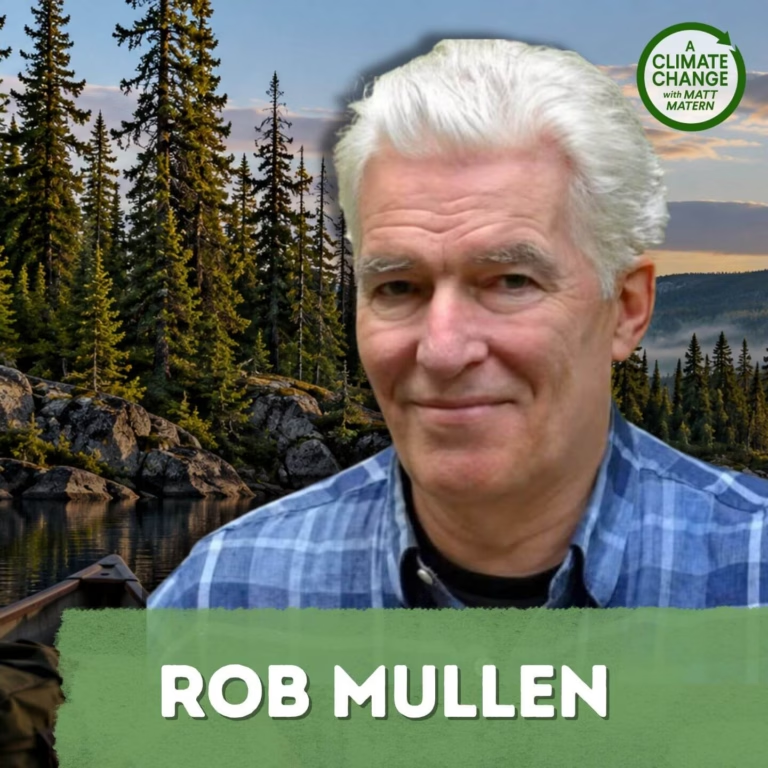
Matt Matern speaks with Rob Mullen – artist, author, and Director of the Wilderness River Expedition Art Fellowship – about the boreal forest, the largest land ecosystem on Earth and one most people have never heard of. Rob explains how a forest three times the size of the Amazon holds roughly 80% of the world’s liquid fresh surface water, why bigger and more frequent fires have flipped it from a carbon sink into a carbon source, and how conservation funding passed it over for decades because it was too big and too empty to fit the “biodiversity hotspot” model.
He also shares the solo canoe trip that changed the course of his life, the cold call to the Smithsonian that launched two decades of wilderness art expeditions, and the number that stopped Matt in his tracks: 59% of the trees cut in Canada end up as toilet paper and paper towels for the U.S. market.
I learned about 9/11 from Cree Indians at a village, Mux River Crossing. I was the first people I’d seen in, I think, 10 days. They didn’t tell me until the next morning, so they didn’t want me to worry overnight. And the whole community-it was just incredible communal act on their part. Fire is an integral part of the ecosystem. Who fire on this scale is not? We’re literally wiping our butts with the boreal forest and flushing it down the drain.
You’re listening to A Climate Change. This is Matt Matern, your host. I’ve got a great guest on the program, Rob Mullen. Rob’s background is artist, author, and director of the Wilderness River Expedition Art Fellowship, Rob’s got a book out, which I just ordered, and everybody should check out. It’s called “Art, Science, and Adventure in Earth’s Greatest Wilderness: The Boreal Wilderland. Welcome to the program, Rob.
Thank you, Matt. Pleasure to be here.
Yeah, looks like an amazing book. I’m from Chicago and spent a little bit of time up in in those areas. You know, in Canada, flew into a lake when I was with my dad and brother on a fishing trip, and in you know there was a place where there were no roads and nobody else for another 100 miles. So pretty amazing wilderness up there.
Yeah, that’s there’s a lot of that terrain up there, and that’s one of the things that first hit me when I. That’s actually one of the things that got the book going was realizing what a wilderness was really in our backyard.
I was checking out some of your stuff, and and one of the things that you mentioned was how how immense this area is, and I think it was what three times the size the Amazon jungle.
Yeah, it’s the largest single terrestrial ecosystem of a biome of any sort on Earth. It’s the largest forest on Earth, about three times the size of the Amazon, and it’s the last. Most of it’s still wilderness, so it’s a it’s an incredible resource that just gets overlooked has gotten overlooked a lot in the last decades.
Now, in the last couple years, there have been some horrible wildfires up in Canada that have, you know, made the smoke and everything has made there made its way down to the U.S. So people in the U.S. have started to kind of like be cognizant of there’s a enormous forest to the north of us and it’s on fire and it normally wasn’t on fire. It’s certainly not in the way that it has been the last few years.
Well, as a matter of fact, the one of the I think it’s I think chapter two or three of the book is architects of the boreal forest and it’s water, winter, and fire. Fire is an integral part of the ecosystem. However, fire on this scale is not, and you’re right in that perception that fire is now coming to people’s attention because they’re becoming much more massive, much more frequent, and the what they call the fire interval-the period of time between fires in a particular area-is shortening, and that is largely ascribed to climate change.
It’s just-it’s a multitude of factors. Rain patterns are shifting, and with less with less rain, the forest is drying, and I’ll tell you from boreal forests are mostly carniferous, your evergreens, and they’re dense. The forest cover quite often is just so thick with trees; it can be hard to walk through. Not always like that. It’s an enormous biome, so the character of the forest shifts a lot, but massive areas of it are very dense, and the understory parts of the trees are covered in little tiny branches.
There’s no easier place to start a fire when you’re camping than you want one. Oreo forest is ideal. I mean, it’s just you crumple up some of the branches are full of resin, so they light up on their own. You don’t need birch bark, though. There’s plenty of that around too. And so, if you want a fire, it’s great. Unfortunately, it it does burn readily, and with the drying of the biome because of climate change, it’s burning much more, dramatically more. They’re losing. It’s become basically a carbon source rather than a carbon sink in recent years.
Yeah, and it’s so hard to stop a fire up in those areas because there is no kind of humans don’t.
What stops? I’m sorry to interrupt, but what stops fires up there is. This is one of the wettest terrestrial ecosystems in the world. In fact, it it probably is. About 30% of the Canadian forest is wetlands. I mean, bogs go. There are bogs in Canada that are the size of small countries. There, there’s the Vasyuginmeier in Siberia is the size of Switzerland. I mean, this is a global ecosystem.
So a biome is what they call a massive global ecosystem. Those terms get bandied around rather; they’re kind of interchangeable. But I mean, these bogs and marshes and swamps and rivers-they’re-they’re and lakes-they’re everywhere. There’s spots where you can. We’ve been up in an airplane flying into the George River and looking out to the horizon, all you see is 10s of 1000s of lakes, and the idea of walking across it is so intimidating. You would need quite the pair of hip boots, and it’s just that’s what stops fires a lot.
Is they run into just the terrain is so waterlogged typically, and now that is becoming less the case. We took a trip across Labrador in 2009. We were on a river. We were recreating a trip. I worked with the Smithsonian’s Arctic Study Center, and friend and colleague of mine down there, Stephen Lawren’s, in charge of William H. Cabot’s book of papers, and he had established a route to go from interior Quebec and Shefferville out to the coast of Labrador. It’s about 300 miles of howling nothing back in 1895, when he was up there.
It’s still pretty much a lot of howling nothing, and which is why we love it. It’s it’s just grand being out there. But we were on a river that was supposed to take us to the ocean, and it went into a boulder field, and didn’t come out. And we were camped by these kettle ponds. They’re clearly little lakes, and they were bone dry. I mean, there wasn’t there wasn’t a a drop of moisture out, and this was something that’s just unheard of up there. It’s just the drying is is it’s not constant. I mean, you know, it’ll it’ll rain and it’ll they’ll be up with lakes again in another year, but they didn’t ever used to dry out, and it’s a real problem. And it’s what’s was it’s why those fires are so noticeable now?
Well, it’s it’s requires a global solution because just a a local solution to a problem like that really isn’t even feasible. It’s it’s like putting a band aid on a gunshot wound. It’s it’s hard to do.
Oh, absolutely. I mean, as far as the treating a symptom, I mean, you can’t get fire crews to most of that forest. It’s a 2 billion acre forest in Canada. Much of it, hundreds of miles, as you whenever you go fishing, hundreds of miles from anywhere. But globally, it’s it’s from fossil fuel burning, and that’s that’s a global. That’s a global issue. We could stop everything in the U.S. today, and we wouldn’t probably solve solve that problem. So we do have to work cooperatively.
So tell us about what led you to be, you know, drawn to the environmental movement and and what path you’ve taken since you’ve been drawn to it.
Well, I grew up here in northern Vermont, and I actually I’ve spent 20 years away, as they call it, around here amongst old old Vermonters, and part of that was in most of that was in New York City, where I was a freelance advertising artist, and four years was in Southern California, but my childhood in Vermont was here in the mountains, where I live now, and you just you’re you’re the middle of middle of it.
Part of it was just my inclinations. My grandfather would take me fishing, and to he would just get these. He just it just disgusted him very quietly. He’s a good gentle. He’s a good Yankee gentleman. He didn’t say anything, but you can see the eye roll when I couldn’t really care less about fishing. I mean, sticking some poor bore him on a hook and sitting there and watching the line in the water was to me the height of boredom and cruelty all wrapped up in one thing. I was much happier poking around the shoreline, looking at the you know the Lilliputian worlds of insects and larvae and beetle. I just I loved all that stuff.
So that that got me into basically wildlife. So I have a degree in biology. You know, it’s just it was a natural fit. But as you know, a kid, I mean, we grew up during the DDT years, and the you know Rachel Carson’s book came out. I read that when I was in high school, and the environmental movement really hit its stride. Ironically. Under Nixon, so I was, you know, I was a, you know, a cognizant and environmentally aware teenager when the the Endangered Species Act was signed and the Clean Water Act and and all those, and I saw my first osprey when I was on a canoe trip on our Manusky River right near the house here.
Saw that finally that was the first one I’d seen in my entire life, and ever coming back because of you know DDT being banned. But it was something I was always aware of, and it’s kind of worked hand in hand with my with my interest in wildlife, which is what led to biology and climate in particular, though northern Vermont in the 1960s, I I was delivering papers, my newspaper as classic, you know, rural kid with my newspaper route, out delivering the Burlington Free Press at 42 below zero, still air temperature at 4 o’clock in the morning. That’s the kind of winters I grew up in, and you don’t see that anymore.
Lake Champlain would freeze over every single year without fail. You never, you never dreamed about it. We’d have to go up to Keeler Bay to put on our used supply fish dinners, mostly yellow hook perch, and we’d have to go out in the lake. It was a chore to us kids because those were just-it wasn’t exactly fun. It’s bone crushing cold. You’re standing out in this open lake, and it was up to us to auger through the ice with a hand auger. So my grandfather figured that beneath him, as two feet thick, so you having to crank through two feet of ice before you can drop. Everybody now with their power augers is great, but we didn’t have one of those.
Lake Champlain used to freeze like that every single year. When I was in college, we ran across to New York State. I was on the track team. I just got it, or I had to run over to New York State because we’re on Lake Champlain, and it was four miles out in the lake. There wasn’t any worry about falling through the ice. My God, you could drive a tank across there. The lumber barons in Burlington used to lay track across in the 1880s and run a locomotive, so they could get their lumber over to the trains in all in Plattsburgh. So, I mean, the ice was like that.
It’s just nobody thought about it. And effective state police, when they were established in the ’40s, their first job was policing the ice roads in the winter time because people just they take shortcut. You know why drive around the lake and you drive across it? Nowadays, I don’t think Lake Champlain has frozen over more than a couple times this century. And when it does, it closed this year.
And a lot of climate denier friends of ours, I don’t plan. They say, “Oh, it closed over this year. It’s just like the old days. Yeah, if you walked across, you’d go for a very fatal swim because the ice wasn’t more than a couple inches thick, and it wouldn’t hold a person, let alone a car. So it did technically freeze over, but it’s it’s still a faint shadow of what it used to be, and that is something that stands above the noise of weather. You know, yeah, you can have.
I have a friend of mine said a Facebook post says one one April morning goes, “Oh, look at the four inches of climate change in my driveway because it snowed. Like news flash, it snowed in Vermont in April. My God, that happens all the time, but that’s the kind of noise that weather can create that get people all distracted. But when you see a big pattern like Lake Champlain, it’s 125 miles long, it’s 12 miles wide, it’s one of the largest natural lakes in the United States. When that doesn’t freeze over anymore on a regular basis, you’ve got something beyond weather. That’s climate.
Yeah, same thing in Lake Michigan and the Great Lakes. I remember freezing over in the 70s. You know, I don’t think it’s come anywhere close to freezing over since then. You know, and yeah, we grew up in in maybe not quite the 42 degrees below zero, but I recall one day it was 25 degrees below zero, and then with the wind chill it was like 6262 degrees below zero.
Well, for clarification, I’d like to point out the 42 below was rather singular. I mean, 25 was our more normal cold winter snap in January. 25 below-that was that was what you could kind of expect. It hit 30 now and then. 40 was like, wow, yeah, that caught my attention.
It kind of-I kind of felt like I was on a different planet at that temperature. I mean, the. The snow is so dry; it’s it’s like sand on Mars or something.
Oh, there’s a real beauty to it because you can hear. I remember when I was a kid, when it was you know 2025 below zero, we had a farm. My best friend’s dad ran a farm, but maybe quarter mile away, and you could hear the cows lowing in the barn because the air is so dense. Sound travels incredibly well. You can talk to somebody, you know, 50 yards away, just like this. You don’t have to yell at them. Just talk to them.
I’ll say, forget that whole part of it. But you’re not usually wanting to be outside for too long to carry on long conversations.
I’m dressing for it. I would never let my kids out out out the door at 42 below zero when they were 11 years old and without guidance. But my parents were like, it was a different age in the 60s, right?
I yeah, I had no no prohibitions on going out in the cold, except for freezing my feet. Then at some point in time, you’d want to come back in. So tell us then, after advertising, how did you pivot into more climate-related stuff?
Well, it was during advertising that I got kind of my literally. I was approaching. I was 29 years old. I had my my first child. I was married, and we bought a you know one of brownstones a whole bit. I was I was mr. Success and doing doing pretty well. Kind of proud of myself, but I hated what I was doing. I was doing advertising art, and it was not. I went down there to do wildlife art after well biological illustration after I was going to be the Audubon of Bugs when I went to New York, and it didn’t pay all that well being the Audubon Bugs.
So I I accidentally ended up in advertising, which paid very well. But I’m sitting there approaching 30, and I’m thinking, this this just this isn’t what I was planning to do. And my brother is well, one of my brothers is a year behind me. He’s in the Coast Guard. He was young Coast Guard officer, same boat. He he just had his first kid. He was approaching 29, and we decided we’d go for a before we came old settled toads. We were going to go for a big canoe trip because I we grew up doing canoeing, and he was actually born in Canada, so we were going to go up to his old homestead and I because I literally I looked to find a nice wilderness river we could do.
There wasn’t one in the United States, not outside outside. We’re going to Alaska, which was kind of out of our budget. So we we found this nice big long blue line of the Missanabe River in North Central Ontario, heading up to James Bay, which is the southernmost extension of the Arctic Ocean. And we thought that’d be fun, and we did that and had a great time, and well, my dad and I did that when Frank came the next year. Coast Guard said he was going elsewhere on that that first trip, but so we ended up doing. I was doing those trips every year, and that got this canoeing thing going. It was just recreational, and but when I computers killed off my advertising business, I very happily transitioned back to nature art, and my wife wanted me to be a lawyer.
My my ex wife wanted me to be a lawyer, but I I passed on that, and so I came up and started doing wildlife art, and I was doing the national show circuit, and I was thinking, well, this is gonna be great. I’ve been doing all this canoeing. I can go out into wildlife art, and kind of fits together. And the irony is, I wasn’t making enough money doing the wildlife art to go canoeing anymore. So, you know, there was the Mister New York City. I’m up there in the wilderness all the time, and Mister Vermont. And like, no, you’re you’re on I 70 heading for Denver, and I got the feeling like a teamster, so I’ve I’ve I just said the heck after six years.
I said now I’m going to go back and do the Mississaugasy source salt as an art trip, and it was purely going to be an art trip. And was but it was on that trip I had a friend of mine who did come along for the first 130 miles, but he had to leave after the last road crossing, so I ventured forward into the. It was a little nerve-wracking at first, but I took off by myself for the last 200 miles up to James Bay, and it’s the solitude that made me realize, you know, we’re really-you get a sense of the world, the earth that just doesn’t care about you, you know.
I think the way I put it in the book was, you know, the earth birth the the enormity and the the silence of it just came in on me, and I realized that the earth births millions of marvels over time, but she’s a. Acid parent, she doesn’t care, and it started to make me realize that the burning and the the clear cutting and the mines that I’d seen over the years when I was doing these recreational trips up in Canada were just ugly. They were they were rash way to treat a huge ecosystem.
I didn’t realize how huge it was at the time, but when I got back from that trip, and that was actually september 11, 2001, was I was in the middle of I was in the middle of the bush. But when I got home, I started reading up on it, and that’s when I actually first read the term boreal forest. I didn’t even know it was that. I was, and it was kind of a shock to me. Was realize with my degree in biology and all this canoeing I’d done up there, and I lived in Vermont, which is on the edge of this ecosystem, and I’d never heard of the dang thing.
I had no idea it was global. I had no idea how critical it was to human, you know, to the wealth, health, and welfare of of us and our civilization. So in the whole, it was critical for carbon and wildlife and water, and and it’s just it’s a long list. It’s a very superlative ecosystem, and it was totally overshadowed by the Amazon, by oceans. I mean, all those are critically important too. But this was right in our backyard, and except for the oceans, I mean, it’s the biggest and one of the most important. And it was just being ignored in 2001, and it’s it’s gotten a lot better attention now.
But when I first started this, it was you couldn’t find anything on you couldn’t find much on it. It took some digging, so that’s that’s and climate was always a part of it because it’s just this was one of the things that I learned about it at that time when I came back to Vermont after that first trip was as a carbon as a car for the carbon balance the forest was critical, and it’s the largest carbon sink in the world, terrestrial carbon sink in the world, second only to the oceans. So, you know, this was this was always an issue here, and that’s basically how I got back into this whole the the broad scope. But you know, climate was always a big part of it.
Oh, it’s yeah, it’s a big deal, obviously. And having seen a bit of it myself, and just seeing the enormity of it, and how these 1000s of lakes just kind of form this almost continuous river down from Canada towards you know the U.S. Like there’s just so much water flow coming down from those lakes. It’s pretty, you know, unbelievable.
I think the the one data point I’d gotten I’m I’m not one to sit here and spout data points, but one that was really caught my attention came from the Canadian Boil Initiative, which was a organization from the Pew Charitable Trust, we worked with them for quite a few years, and they pointed out that, by their estimation, 80% of the liquid fresh surface water on Earth is in the boreal forest.
So, as far as a water resource, yeah, and I’ve I’ve seen things about you know subterranean. There’s not talking about groundwater, and there’s been massive you know deposits of groundwater and supposedly literally oceans under the oceans been discovered in recent years. But as far as easily accessible surface water, the boreal forest is a huge source of of it in general and keeping it clean because it’s a fantastic filtering system. So you get. I mean, we literally when we’re we’re paddling up there.
I I don’t recommend it to everybody because I grew up drinking the water out of the beaver pond behind this house. So I’m I’m probably immune to giardia, but I mean, I just put a canteen cup over the side of the canoe and drink. I I don’t filter it. I don’t treat it, and it’s cold and delicious. And you know, I’ve I’ve never been sick a day on one of these trips. And there’s I’ve spent I’ve done 1000s of miles of paddling through from Labrador to Alaska.
Yeah, that’s my experience of being up in Canada and also at the Quetico National Forest in the border between the U.S. and Canada, at just north and Minnesota’s border, and drinking the water there. It’s just so fresh; you can drink it straight out of the lake, which is a pretty amazing feeling. That it is.
It is. It’s just. It’s such. It’s such a freedom.
It’s pretty amazing.
So for granted, after if you’re some of our trips go for a month, month and a half, and you take it so for granted, and you come back civilization. It’s like, ooh, don’t touch the water.
Yeah, you can’t have that rough. So then you started this river art or expedition art. You know, tell us a bit about that and how it formed and and what’s happened over time with that.
Well, with that first trip, because I was I’ve know paddlers, and paddlers in the paddling community, canoeists tend to be kind of, and the great people, but they they tend to have a certain agenda on a river. A to B, bingo! I did the Missinaba River. I wasn’t going to do that. I was going to paint on the way. It was going to be a painting trip, so I assumed I was gonna have to go by myself because I have an artist itinerary, and that means there is not really an itinerary. I was gonna stop when I felt like it.
But I was at an art show opening in June, the year in 2001, before we took off. I took off, and one of the top painters in the in the country approached me. Actually, his his wife did first, and she’s also a nationally ranked painter. And she said, “John, John’s just come down from Alaska and moved to Vermont. He says, “I hear you’re going on a wilderness trip. I said, “Yeah. He goes, “John missing his wilderness time. He’d love to go if you don’t mind, I said I’m only going alone because I didn’t think anybody else would want to.
So I’m happy to have company. I’m a sociable guy. So John and I went, and having another artist on that trip for the first 130 miles. I mean, I was just going to do as a personal kind of reconnect with my muse kind of thing. But having John there, we just got to talking, and we were thinking what a what a great experience it was. He’s a great field painter. I mean, we were both painting the field a lot, but he’s really good at it, and I learned an enormous amount from him. But we got to talking about how great we have the whole cruise. You know, like an artist crew on here. You know, like four or five people out here just take different people out every year, and but it had kind of art feel to it.
And after John left, and I was by myself on the river, like I said, I had this really kind of this environmental epiphany by myself. Being by yourself for a long period of time is a it’s an experience, and it’s generally a pretty good one, at least as long as things are going well. But when I combined those two, the idea of the art cruise and having this, I decided it really made sense to combine art and science. And because that can be a little boring to some people, and these these river trips did have some real excitement to them at times.
We decided to that was where the whole idea of art, science, and adventure came from. So, you know that that carried on for a few years, got some all sorts of people interested, and that’s when a curator in the business said, “Well, we had Robert Bateman, who’s a top painter. Maybe a few people say top painter in the world. I’d be one of them. Him and Carl Brenders in Belgium were wanting to come on trips, and this curator says, “Well, you’ve got these kind of names. You need a big venue. And angels, you know, fools go where angels fear to tread. So I called the Smithsonian, and the art, the art, their art museum wouldn’t talk to me.
But I called this. I was looking through the Natural History Museum, and they had something called the Arctic Studies Center. I said, “Well, that’s close enough to the boreal, and I read the the bio for the director, Dr. William Fitzhugh, and it said his whole career in science was inspired by canoeing in northern Canada. So what? Sounds like my kind of guy. So I just I I cold called, and he answered the phone, and I no more of a lie. Within 15 seconds, I I blurted out my basic idea, and he says, “I love it.
Let me introduce you to my colleague, Dr. Loring. And it was that easy. Nothing’s been easy about it since. But getting it started was like falling off a log. So you know, I was in with the Smithsonian, and it was it was it’s been fantastic. They’re great guys, great friends, and Bill Fitzhugh is actually the one who suggested I write this book.
Well, that is that’s a tremendous story, and I think hopefully an inspiration to to many to go out there and just make some phone calls and just go do it. Like you know, yeah, you get you egg in your face once in a while, but it’s over a phone that can’t hit you.
Well, it kind of reminds me of that Goethe quote: like boldness has genius, power, and magic in it. So, how did the the book come about? What’s what’s the story behind that?
That’s a little bit of a story in that my original idea was an exhibition. We’ve you know Robert Bateman had a big exhibition at the National Museum of Natural History, which is the Smithsonian’s Natural History Museum. It’s the largest by a factor of four in the world. There’s there’s not the American Museum in New York, which is I’d say a little more famous is 1/4 the size of the National Museum of Natural History, so this is a massive museum down on the right on the Mall there in Washington D.C.
And that was our original focus was a exhibition there. We got it approved, and then the director was had his head chopped off and went rolling down the hall in some big political scandal. So he was gone, but he just approved our our exhibit. So we went into a bit of a kind of a hiatus until make it a really long story much shorter. We ended up. Bill Fitzhugh met me at a paddling conference, and I don’t remember even where it was. But we were both presenting there, and because he’s like I said, his career was started by paddling, so canoeing. You know, he’s a big canoeist. So he was talking about some trip of his.
I was giving a presentation on one of mine, and we met for lunch, and he says, “Rob, I’ve got back channel assurance that we’ve got a major exhibition if we can get the funding. And I said, “Okay, great. You know, that’s we’d been in limbo for a while. Says it’ll be a touring exhibition, not a one-off at the museum. We’re going to tour nationally. It’ll be a, you know, those 5000 square foot major exposition. Holy cow! That’s like huge news. Now, I’m a little barely keep my head above water artist in Vermont, and here’s one of the directors of the Smithsonian. Next line out of his mouth was, “You just have to raise $3 million. Me?
Well, like honestly, it’s like, yeah, sure. Well, what the hell? And he called me back later that night. He called says, “Rob, make that about five. And I said, “It doesn’t make any difference. 3 million, 5 million. How much, you know, how deep’s the water you want to drown in? It doesn’t make. Yeah, might as well ask for 10. I guess that was 2010, and you know we just come through the the whole financial crisis, and the U.S. banks were in tatters. And I’m thinking, you know, the Canadian banks are pretty good. And the stupidest piece of luck again, my wife is the I, the senior vice president of TD Bank. His name was Mullen.
I sent him. I sent his office a cold, cold pitch, and I think probably I have no doubt that probably the fact my name was Mullen is why I got through the through the gatekeepers. They were going to back us for 3 million. We had a big planning conference in Washington that paid for. A representative of the Pew Charitable Trust came up to me during the conference, and again, I’m totally out of my depth here. I don’t. I’m not used to talking to money people, and but he was happily he was a scientist, so it was cool. We had a little bit of a good background commonality. Birds. He’s an ornithologist, and he’s coming. Rob, you know, do you have any backing from two charitable trust? And I said, “Well, I haven’t talked to him yet.
And he says they’d be really upset if they’re not in for as much as TD Bank. I said, “Oh, I don’t want to upset them. So we end up with this massive amount of money. We got full approval from the museum. The New York Times called me up to do an interview and asked if they if I would mind they made me the star of the show because it was I just I’m just a little dweeb from Vermont who started this Smithsonian exhibit and they think it’s really cool story, I did too. I thought it was going to be really nice. I thought was my my ship had arrived, and then Bill FitzHugh called me up. The I think it was the fall of 2012.
It was the year the Republicans won the Senate and the House back, and all of the Smithsonian’s funding comes through Congress. Now we had outside funding for the exhibit, but the museum itself, which had just gotten a new director, had you know he’s got he’s got political considerations. We don’t know what happened. the The official line was he wanted to focus museum resources on renovating the dinosaur hall, and I’m sure he did. He’s a paleontologist, but we got backburnered, kept doing these expeditions, doing every single year. And at one point, Bill was talking. We’re sitting. I go, you know, I got so many trips we’ve done.
There’s some great stories in them. He goes, yeah, you should write a book. We could put the original idea of this exhibition into a book form, and and possibly use it to promote the exhibition down the line, and that’s what. Book is is the original idea of combining art, science, and adventure. Stephen and Bill are both anthropologists, so they had added in the indigenous perspective as well, and that’s why I relied on them in the book for the details on those subjects. But that’s where the book came from was trying to basically resurrect the exhibit. Smithsonian did put one on, but it’s much scaled down through their sites. The Smithsonian Institution Traveling Exhibition Service, but it’s currently touring the U.S. right now.
Well, that’s that’s great that it finally did happen. Did TD Bank and and the two shareable trusts, yeah. Funders are a little sensitive, and when when things went south, that they they went elsewhere. So that money got left in TD TD Bank, and we never saw. Well, they did pay for that nice conference that we two conferences we did, so that was nice. But we didn’t didn’t see any money in our pocket from it. So, and we didn’t get an exhibit.
Kind of a bummer. You were you were at the you know two yard line.
And we were. And my my wife was going, “Aren’t you furious? And I’m like, “I got a lot of great canoe trips out of it, and we’ll we’ll pull something out of this. So I just pick up and keep going.
Yeah, well, that’s that’s the way to go. So, tell us a little bit about the book and and what are the the highlights of it as far as you’re concerned, and what what are your hopes for what it would will do out in the community.
Well, that that first problem I mentioned early on-that this was a an ecosystem that has been very much overlooked. I mean, even when climate change became a more pressing issue, you know, the publicity machine, the the big the big NGOs, conservation NGOs in the world, like in our world, they do fantastic work. I belong to half of them. I has no no word of criticism. It’s just a matter of the dynamics here.
They focused on you know biological diversity and hotspots, and by definition, the definitional parameters they use; these are areas where there are a large number of endemic species have had a lot of habitat or habitat loss and are at risk of extinction, and they like a small area, and that’s exactly what the boreal forest is not. So when you were all the funding, this became a funding model for you know world for all the big boys and all the money for conservation went into these basically these hotspots, which are all stretched. Of course, where you’re going to have endemic species disappearing is where there are a lot of people destroying habitat.
So the boreal forest doesn’t have a lot of people. None of those far northern regions do, and they’re huge. So they just they just fell off the map for money. And even when climate change became a big issue, and the North was focused on because of the disproportionate effect of climate change on northern latitudes. The publicity machine right went right to polar bears in the Arctic and totally skipped over the boreal forest. Polar bears are fantastic and they’re they’re at risks. I’m not putting down polar bears, but it was just unfortunate that we totally ignored this huge giant of a of an ecosystem staring us right in the face.
So that’s what I’m hoping. Now the situation has improved since I started this project 24 years ago, but I’m hoping this book will continue that that process of bringing it to the public’s attention in a way that’s digestible. That’s why, from the beginning, I wanted the exhibition and this book to be a combination of art and science. The art is kind of the eye candy that gets you to stop and look. The science we made that decision when we were talking about this.
I would write it because I have enough of a background in science to write intelligently about it, but I am not a PhD, so I won’t typically get into the weeds and and technicalities that will just make it incomprehensible to the average reader. I mean, I’m hoping anybody with a you know eighth grader could read this and probably get something out of it. Somebody in first grade can go through and look at the pictures and get something out of it.
And if you’re in college, you probably get something out of it. And it’s even some academic stuff in there for people who’ve got a higher degree. So there’s a it’s a broad I hope a broad appeal and will bring this incredible ecosystem to a wider audience. That’s for that we need to sell a few books, but you know, or get on some podcasts.
So there you go.
We’re not proposing solutions here. We have a few small ones in the back. NRDC has sponsored some of our trips, and working with them, I mean, we find out like 59% of this is math 2 billion acre forest in Canada. 59% of the trees that are cut are turned into toilet paper and paper towels for the U.S. market. It’s Kimberly Clark. I think is working on a substitution fiber for that, which would be a game changer.
There’s you know bamboo substitutes and such like that, which are I guess market wise not that important yet. But if we could shut that off, that would be enormous. I mean, it’s one of the biggest, you know, the biggest drains on the forest as far as direct human impacts, aside from forest fires, which which I that’s kind of indirect. But I’m sorry, I interrupted you.
No, no, I I had never heard that 59 % of the forest cutting up in Canada is for paper towels and toilet paper. That’s toilet paper.
Yeah, as as NRDC says, we’re literally well, they put it a little indelicately. We’re literally wiping our butts with a boreal forest.
Yeah, and flushing it down the drain. Well, I guess that everybody buys one of those toilet seats that, as the water thing, you know, you can get rid of the toilet need for toilet paper.
Well, it it would be a help in areas where you’ve got you know, and I don’t. I guess they’re designed so they don’t actually use that much extra water. These little things could make an enormous difference. It’s kind of like the boreal forest that way, any one tree is you know transpires water, produces oxygen.
One spruce needle, a minuscule amount, but that one tree has hundreds of millions of spruce needles, and there are a couple trillion of those trees. So all of a sudden, you take these itty bitty tiny little individual efforts, and you multiply them by trillions, and you have a global phenomenon. They’re not happily not quite trillions of people, but similar similar kind of math is at work.
Right. Well, also using like hand towels in the kitchen instead of paper towels. I’ve kind of gone to that, and it’s amazing how few paper towels I ever have to use because you got you got other things, cloth towels. They actually work, you know.
It’s the it’s yeah. Your grandma had that. I had that right.
Yeah. Somehow we survived.
They didn’t have paper towels in my grandma grandparents’ house.
You happen to have some great artists do the the the paddling with you and the canoeing. What were the types of aha moments that you had? Great paintings that came out of these trips that you’d like to share about.
Well, we we have 3035 artists. I’m including six photographers, or I get the exact number. There’s, I think, 28 painters or sculptors in this. Every one of them is a superb artist. There’s, there’s not every single one of these artists. Not to boast, is a nationally or internationally known painter. They’re all professionals, and I, I picked them where they were people who recommended to me. My friends of mine, and there, there’s not a bad, bad one in the bunch.
They’ve all turned out some amazing work. John Pitcher, who’s another Vermont artist, and was the guy who came with me on that first trip, is probably first among equals, and churning out some phenomenal pieces of artwork for this. It’s a lot of his work is in the book, obviously a lot of mine because I had easy access to it. But John had one piece, Land of the Canoe, which is just an evening shot over the Mississippi River. If you wanted a painting that just encapsulates the boreal forest in one image, that one is is high on the list. I was actually proposing as a cover for the book, but they went with my September 11th dawn instead with the Sandhill Cranes.
I had just gone through four days. I was by myself on the Missanabe. I was about at that point. I think about 80 miles from James Bay. The river flows north, so it’s a it’s an Arctic watershed stream. I’d been through four days of horrific just rain and. Sleet and just nasty, nasty wind. And the last day, the third, was a full-on gale. I was battened down in camp and torn half of my my rainfly down. I had quite an adventure of just getting through that for the evening. I got to a more secure camp that night, and that was the 10th of September, and on the that morning, I woke up and it was dead silent. And when you, I realized what that meant. It meant it wasn’t pouring rain.
And as I opened my eyes up, I realized I could see light, and that meant the sun was coming up. I mean, I just I can’t. I just getting out of that. I wanted to not miss any of the light, so I was bailed out of that tent as fast as I could go. Grab my camera, running for the bank, and I couldn’t come to a stop. I almost lost my balance. Couldn’t come to a stop. There were three sandhill cranes right next to my canoe. You know, just foraging by the boat, as you can see. I don’t know if you have a copy of the of the cover there, but that is what I saw. It was under this gorgeous sky, and that’s like I said. I understand how sun worship started. It was just, it was.
I mean, I had no idea, of course, what was going on back home, and I mean, to me, I was just-I was transported. It was just the most incredible, and the whole thing just came together. I got to do this, and but I hadn’t learned about the boreal forest yet, but but that’s why I dug into it. Is is this all came together? All those things I’ve been thinking about on the river came together, and in that moment, so that painting was very much probably the heart and soul of of the whole program, which is why the publishers felt it should be on the cover. I learned about 911 from Cree Indians at a village, Moose River Crossing.
The next day, I was the first people I’d seen in I think 10 days, and they they knew of it, but they didn’t tell me until the next morning because they didn’t want me to worry overnight. I thought that was in the whole community. They agreed there was just incredible communal act on their part, and so that’s that was hats off to the Cree. But that that was one big one. Another pair was just funny. Was John Pitcher from the same trip earlier? We’d gone, we’d had lunch at a place called Double Shoe Pack Falls. It’s just a gorgeous little rapid. It’s runnable, but not in the water levels we had. So we’d push around, and it was raining. So we we sheltered under an overhang.
We had our lunch, and the two of us went out and started doing some sketches and photographs. And the rain eased up, and you know, then we carry on the trip. And he, John, had to go back in Montece, Ontario. I hadn’t seen him since. And a gallery up in Montana was interested in doing a show on the artwork we’d done, so we sent some paintings off. I sent mine. John sent his. Didn’t think about it. And the gallery owner called, goes, “Oh, this is great! This this is fantastic! What you guys did! He said, “What what’d we do? Well, I’m glad you liked it.
He says, “Yeah, those two paintings of Devil His Shoe Pack Falls, the the the people coming to the gallery-they just loved seeing two artists do the same painting, and they-they both sold too, which was makes makes our day. But yeah, we we’d done very very similar pieces, and John and I paint in very similar ways, but even so, there are a lot of subtle differences between the two. And apparently, there was a it was became a sport in the gallery of finding the differences between the two paints. So that was that was kind of fun.
I mean, I’ve there’s a lot of them. We could spend the rest of the time you got talking about like we want La Colline Misertuk on on the George River up in Angava, and we’ve got several paintings of that. One that George Jean-Louis Courte did, much more dramatic scene than I did. I’m a little more of a literalist kind of guy, and but mine had a. We’d seen several golden eagles, and I was, I, you know, we’re talking about it with each other. I said, “I’m gonna put a golden eagle over that mountain, cruising over the river, and and so Jean Louis, when he did his, he titled his “Eagle’s Peak. No eagle in it, but he entitled “Eagle’s Peak, and I called mine.
I think Nunavik gold because we’re in the province of Nunavik, which is Quebec above 55 degrees latitude, which is is managed by the Inuit and the Cree and the Inuit, and so that was that was a fun little pair of paintings. They were and they’re you want John and I paint for. Similarly, Jean Louis and I do not. Jean Louis is an impressionist, and his his is a little more artistic license taken with the drama of the peak.
But so there’s a lot of that. But that’s part of what we wanted to do when we were juxtaposing these paintings. Is just I didn’t ever want this to be a book of my artwork. I want it to be a a real assortment of my friends’ artwork too. And because if these people weren’t friends before I took them on a trip, they were all friends afterwards. So, and it’s a great group, really fantastic group of artists.
Oh, what a what’s an incredible story, and and talk about channeling, you know, your desire to do good in the world and be in alignment with what your values are, and all this all comes together. And everybody should go out and take a get a copy of this this great book that Rob has been telling us about art, science, and adventure in Earth’s greatest wilderness, the Boreal Wilderland. Rob wrote it.
Foreword by Robert Bateman, also a great painter, as as Rob has told us about. So I’m looking forward to looking at my copy of it when it comes in short order, and everybody else should take a look at it, and maybe more importantly, get involved and start doing things to help the environment, and you know talk about this issue and the Great Boreal Forest, and ask our representatives to to take action on this type of stuff.
Well, that was that was one of the ideas. Is we need to create a a constituency for this area, and the there’s a bonus chapter which is not in the book. It’ll be in the online appendix, and I’ve been preparing that as being there, and it’s just that it’s just trying to build that constituency is by giving people what was it this book signing the other day, and one of the questions I got was, where can I go nearby without taking a bush plane?
I said, well, the beauty of it is the boreal forest literally starts about an hour north of Montreal, and you can go to Love Island. There’s all sorts of reserve phoniques in Quebec, which are set up with set up for canoeing, and into very remote and very wild areas. And you, but you won’t have to deal with white water as long as you have some basic safety and outdoor skills. You’re fine. There’s all the provincial parks in Ontario. They’re gorgeous, and you know Wabakimi, Tamaskimi, Algonquin, which is kind of full.
You have to reserve tent space in Algonquin. I would recommend others first. Woodland Caribou Provincial Park is over, I think, 2 million acres of nothing. It’s just rose trees and these beautifully interconnected lakes and waterways with easy, easy rivers in between them, and just wildlife, wildlife, and wildlife. So, Chatlo Game Preserve up in Ontario is the largest game preserve in the world, and I mean we’ve paddled up there, and it’s just moose and bears and wolves and everything else you want to see. So, this is this is something I’m making. Like I said, we didn’t have room for it in the book. I had it set up with chapter 10.
The publisher said, “Nope, you’re cutting you off. It talked too much. So putting it, I said, “Well, can I do an online appendix so I can put all the stuff you guys are making me cut out. I can put it where people can see it anyway. So that’s that’s where it’s going to go, and hopefully get some people out there. I mean, you don’t need you don’t need to be a crazy you know you don’t need to be sponsored by you know was it Flying Bull or Red Bull.
So you just be a my dad and I went in ’86. We just went in a grumming canoe with some rudimentary gear. Had a had a great time, so it’s great. Yeah, it is an adventure. I I was lucky enough to be taken to the the park the boundaries when I was like nine years old, and so we we paddled in there for I think it was nine days or something like that.
Oh, your your your your parents started you right.
Yeah, that was that was quite an adventure. No motors up in that area, just hand powered.
Yep, there’s still still still a way. Yep, it’s a. By the way, when you look at the book, you’ll see the the the big the big title is Boreal Wilderland, and that does come from Tolkien, the Hobbit. I don’t know if that everybody thought I should call it Boreal Wilderness, and I thought that was kind of well tame. And when you’re up. There and I’ll close with this because this was kind of foundation of the book, and I just forgot to mention when we’re sitting on the George River, and you’re these little these this a ribbon of dark spruce forests along the water because it’s sheltered.
You’re down in a valley, but the tundra hills that rise up are just these dramatic rocky crags, and I was walking by a campfire of a couple friends of mine, and it was John Louis actually and Lee Kromchroder, and I heard him talking about and going, “Oh, this is so Tolkien-esque here! It’s like it’s like Middle Earth, and it is-it’s just this this land. It’s just magical. And when I was casting around for a title here, I just got to think of it. What the hobbits called the the dangerous and exciting wilds east of the Misty Mountains was Wilderland.
It was Wilderland, and the elves call it Rovanian, but you know the the hobbits, who were everybody’s favorite characters, called it Wilderland. So I decided this was a boreal Wilderland, and also it it was a way of marrying the forest and the tundra, the because it’s it’s an inseparable interfacing biome up there, so that’s that’s that’s explained the book. It’s it’s more accurate to consider it one giant boreal Wilderland because you can’t really prise those two apart. But I like the there’s a couple other allusions to Tolkien through the through the book. I grew up on the Hobbit and the Lord of the Rings.
Sure, I did too, and you know, I was just thinking you could have a little audio there and throw in Zeppelin’s Misty Mountain Hop in there.
Oh yeah, now you’re talking.
So thank you so much for being on the show, Rob. Really enjoyed chatting with you, and appreciate the great work that you’re doing, and you know, love have others check out your book, get a copy, support this cause, and in all the different ways that we can do it, like using less paper products, for instance, would be a service to the forest.
Absolutely, and this is this has been it’s been really fun. I I decided not to prep for this at all and just wing it because I I can talk about this all day as you can probably figure out, and that’s worked out well. It’s been it’s been really easy talking to you.
So and and the book is available. I mean, just Google Boyle Wilderness. It’s the marketing people have done a great job. It’s available through Macmillan, so it goes on. It’s on, it’s on everything. Google and I mean Amazon, whatever you want. But so it’s it’s easy to find.
Yeah, I found it in less than 10 seconds. So it it is it is easy to find. So everybody, go check it out. And again, thanks, Rob.
Matt, I want to thank you. This was you’re my first podcast, and it makes me want to do more. This is this is really fun.
Learn more about our work at A Climate Change. Visit aclimatechange.com. Don’t forget to subscribe to our podcast on Apple, Spotify, YouTube, or wherever get your podcast. If you like this episode, please share it with a friend. See you next time.
(Note: this is an automatic transcription and may have errors in formatting and grammar.)