
Hear us on Apple Podcasts, iHeart, and Spotify Podcasts. Subscribe now!
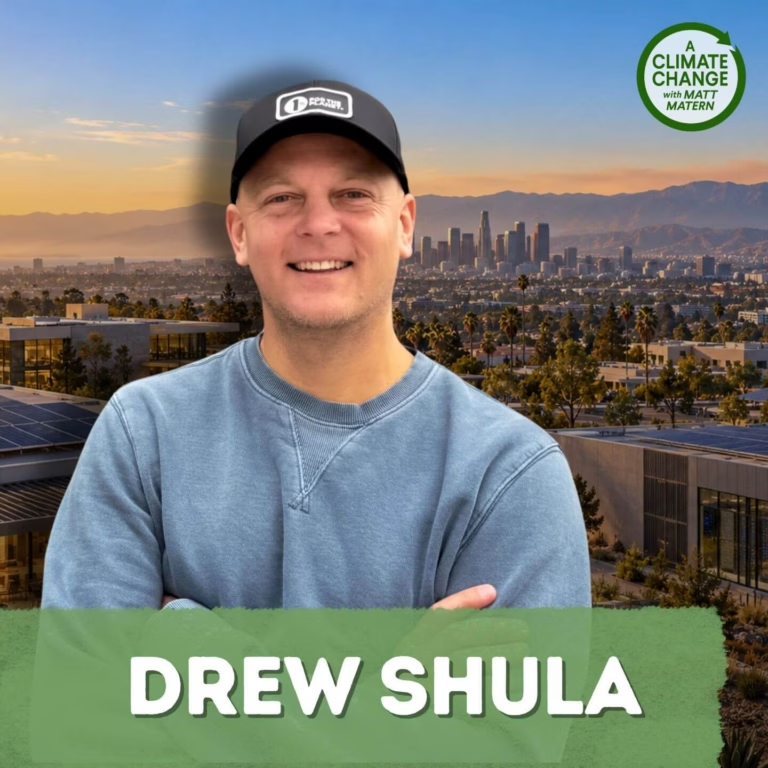
Matt speaks with Drew Shula, trained architect and Founder and CEO of Verdical Group, about the part of the climate problem hiding in plain sight: the buildings we live and work in, which account for roughly 40% of global carbon emissions.
He breaks down the two halves of a building’s carbon footprint, the energy it burns and the materials it’s made of, and makes the case that we already know how to build net zero today – almost nothing requires it, which is why net zero is still less than 1% of construction. He and Matt also get into the LA fires, where Drew was displaced from his own home for six days, the city’s decision to waive its all-electric requirement for rebuilds, insurance pulling out of fire zones, and why he thinks AI data centers get unfairly singled out.
Most people don’t understand the ins and outs of buildings. They just hear that data centers are bad. I feel like people are like think they’re the Death Star or something from Star Wars that are they’re somehow going to attack you and hurt you. It’s just a building that looks like a warehouse, typically that has a bunch of computers inside. In most cases, what’s happening? People aren’t installing enough solar panels to zero out the energy use to get to a net zero building. We have a lot of other buildings that are are very high energy uses as well. If you think about like a refrigerated warehouse or a grocery store that has a bunch of refrigerators or a hospital building, these are very high energy use buildings, similar to the data center.
You’re listening to A Climate Chnage. This is Matt Matern, your host, and I’ve got Drew Shula on the program. Drew’s the founder and CEO of Verdical Group, a national leading consulting firm that specializes in green building certification, engineering, ESG, net zero strategy. Has worked with a lot of great institutions like NASA, Google, Meta, and Apple. So welcome to the program, Drew.
Thank you. Happy to be here, Matt. Thank you so much.
Well, one thing I read about in your bio that I don’t want to let slip is that your great uncle was the great Don Schuh of the Miami Dolphins. That’s something.
That’s true. Yeah. So a football family for me. Yeah, my dad’s uncle, so my great uncle, coached the Dolphins in Miami for about 25 years, and he had a illustrious career. He’s in the Hall of Fame, the winningest NFL coach of all time, and definitely a family claim to fame for us. He passed away a few years ago now, but thank you so much. I love to fondly remember Uncle Don. Thank you.
Yeah, absolutely. I do have one little bone to pick with his legacy: is that he beat the Chicago Bears their only loss the year they went and won the Super Bowl. So he took away the undefeated season from the Bears, so that the Dolphins played a hell of a game because they were keeping their undefeated records. Oh, really?
Was it the same year, the 1972? No, it was .
Okay, yeah, the…
Only that’s another one of his records. Is it still stands today? The only undefeated season in NFL history. Yeah, but sounds like the Bears were knocking on the door.
Close, but anyway, we digress. We got bigger fish to fry here, and so we’re gonna we’re gonna talk about the environment and tell us what your trajectory was. I know that you got a degree in architecture from Notre Dame, and what what led you into the environmental space?
Yeah, absolutely. And honestly, starting mentioning Don Shula there honestly has been a big inspiration in my life. Of course, he’s in the family, but thinking about him as a head coach of a football team and what that looked like in his work, and how he was able to really inspire many people around the country through the game, and then what that how that translates into my work leading my team and trying to inspire others through the Net Zero conference as well. Um, has had a really big inspiration and impact on me. But, but yeah, my career path. I studied architecture in college, and that’s how I got into the building industry.
I grew up in a real small town in Maine, though. Born and raised in Belfast, Maine, and I always attribute my sort of connection to nature to that. I grew up on 40 acres of land with a beaver pond in the woods behind my house, and foxes that lived across the street that I would go and watch. And going on to college out in Indiana in the Midwest, I ended up in the architecture program there, and that’s what then launched my career in the building industry. I worked in architecture for a couple years in Venice, where I understand you you’re sitting today, and in the LA area. And I worked there for a couple years, and then got into a couple other jobs within the building industry on the real estate development side, and then also consulting, doing more than sustainability consulting work that I do now. Before I I went out on my own and launched Verdical Group in 2012, so about 14 years ago now.
Wow, that’s that’s a while. Yeah, just for the uninitiated, I think building industry’s impact on climate is sometimes unappreciated. I read somewhere recently it’s around 38 percent of all of the environmental impact of pollution comes from the building industry. Is that a roughly correct, or is it less or more?
Yeah, absolutely. That’s 40% of global carbon emissions can be attributed to the built environment or buildings and infrastructure. So it’s we’re a huge part of the problem, which also, of course, makes us a huge part of the solution. It’s so exciting. That’s what I’ve dedicated my career. I’m mid-career now, so I’m now I’m thinking about the second half of my career and what kind of positive impact I can make over the next couple decades.
I’ve had guests on the program who trying to work on cement that has less carbon. It’s less carbon intensive. And other building materials that are less carbon intensive. What are the types of things that you’re focusing on, or you’re looking at all of the above in in terms of making a greener, healthier building?
Yeah, great question. It’s a it’s the all of the above approach because there are very different impacts from buildings. We usually talk about it in two parts. Embodied carbon is the materials in the building, and then operational carbon is the energy used to turn on a light switch or run your HVAC. And collectively, all those sources of carbon combined are where you get the the 40% of global emissions, but historically in the building industry, for a long time over the past 30 years since the LEED Green Building Rating System came out, we really were mostly looking at operational carbon running the building.
But the past five years or so, we’ve started to look at embodied carbon more here in California, where I’m located. There’s even new building code now that has requirements around embodied carbon, so it’s looking at it’s doing a life cycle assessment is the service that I provide through my company Verdical Group, where we’re looking at the materials and finding low carbon options, like you said, for cement or any other building material that might be going into the project. And then on the the energy use side, the operational carbon, it’s designing a mechanical system that just uses less energy. So it’s all about just energy reduction, essentially, and of course replacing fossil fuel energy with renewable energy.
So in terms of the the work that you’re doing, are you primarily doing it here in Los Angeles? Are you all across the country, all across the planet?
Yeah, Verdical Group. We’re primarily a green building consulting firm, so we’re we get hired by architects or building owners or builders, like the general contractor for the building. We started in Los Angeles in in 2012, 14 years ago. So historically, our early projects were mostly around the Southern California area, but since then, we’ve expanded.
I think we have projects in around 25 U.S. states and five or 10 countries globally. Definitely looking to continue to expand that as we go. But it’s been great to see that this work is definitely global. These same issues worldwide, country to country. Lead started in the U.S. but there’s now through the U.S. Green Building Council, a nonprofit here, but now there are other green building councils in many countries around the world. I think at least 30 or 40. So yeah, it’s something that is happening globally. We do lots of different project types as well. Everything from education buildings, like a library on a campus, to an office building to an industrial warehouse building, or the or AI data centers, all all these different building types all need to be greened as as much as possible.
So, what kind of positive results are you seeing in the buildings that you’re working on in terms of reduction in embodied carbon and operational carbon?
The positive results, yeah, we can we know how to build what we call a net zero building today, just in in our market. The problem is that there’s no requirement for net zero. Most building teams just meet the the the base level of the required building code, and they’re not going above and beyond that, but we have the ability to do that to build a net zero building today, and you can think of that as a building that generates enough renewable energy on its site to offset however much energy it’s using. So you’re zeroing out the energy use with typically with solar panels on site. Pretty straightforward approach, you know, to kind of just think about it in that in those simple terms.
So what’s happening right now is that buildings typically consume far more energy than they’re producing on their site. They don’t even if they have solar panels, they don’t have enough to zero out all of their energy use. But that’s something that is happening more and more frequently. I think net zero buildings are still less than 1% of total construction, so a tiny percent still. But with the climate crisis, with these growing concerns into the future, we expect building codes will continue to become more stringent every couple years as new building codes come out, inching us closer and closer to net zero over time. So in the coming decades, net zero hopefully will become the standard for all all construction in the future.
Now, in terms of net zero for the operational carbon, the power I see that seems doable. How do you get to net zero for the embodied carbon for the materials?
Yeah, so there are there’s the way to think about the embodied carbon footprint is coming from the production of a material in a factory somewhere. There’s energy used to create that, run it through their system, create a product, and then the second part of it is then shipping that product from wherever it’s manufactured in Asia, in Europe, where. Whatever it might be, has to ship to the building site, which then also creates another embodied carbon footprint from the emissions created from shipping it around the world. So the the ways to reduce that carbon footprint or get it to closer to zero are first to use local materials is really important to reduce that that that need to ship at all as much as possible.
And then what we do is what’s called a life cycle assessment, where we’re analyzing the material and looking at other options in the market to find similar similar options that just are lower carbon in their production, and so these are market incentives which are great to to the manufacturers are hearing this to understand that okay, people are looking for this now. When architects are specifying products in their buildings and their design, they’re going to be looking for lower carbon options, which then hopefully creates a virtuous cycle of the product manufacturing companies wanting to put low carbon alternatives into the market that they’re creating on their end, so over time, that’s how we’re shifting the market towards net zero.
So, in terms of the last year and a half or so of the current administration, have you seen slowdown in the amount of companies and individuals that are building net zero buildings or buildings that are low carbon, either embodied and operational.
I think the current federal administration in the U.S. the Trump administration, has impacted us overall in the building industry. I think, for my company, just as an example, Verdical Groups sales have definitely gone down a bit since the Trump administration came in, but not a huge amount. We’ve always got ups and downs. I think the the some of the other factors are just in the macro economy around inflation and gas prices also drive up material costs. They have an impact in the cost of materials, which then private developers tend to either put a project on hold or not do it at all as their as their costs are shifting in the middle of trying to build a project, and so it kind of has an effect of slowing down the overall building industry, which is ironic because Trump is comes out of the building industry himself, his background, and some of his choices seem to have negative impact on the overall economy.
But to me, I’m a business guy. I’m a CEO of my company. I’m looking at numbers all day long. And climate solutions, to me, I love the the phrase becoming a climate entrepreneur or climate startup. And these climate focused for profit businesses that address issues with carbon reduction, decarbonization, water use reduction, whatever it might be, to help the environment, there’s a lot of opportunity to make money to to to do good and make money doing it at the same time with a climate focused for profit business. So I’d really like to see incentives put into place to help promote these types of businesses growing and not slowing this, but I’m glad you brought up this. The federal administration issues are huge. You know, the swings that we have in the U.S. from the Biden administration to the current Trump administration-they’re really big swings that change the tone of the country overall.
And the focus on sustainability and green building and everything related to climate does have a an impact on everybody, but at the same time, there are just market forces around cost savings that you know that’s mostly what drives decision making is cost, right? So as as long as climate solutions are also the best market solution, then it’s just undeniable. If we’re saving building owners money, reducing their utility costs, reducing their energy and water bills-they’re saving money. Then these these solutions are just the the best answer, no matter what. That’s what we’re kind of trying to get to.
Yeah, I think that that’s where the big wins are, and that’s why solar has done as well as it has in recent years because it’s just cheaper than and any other form of power, so I think that those are the wins. And tell us about the Net Zero Conference that you’re the founder of, and it’s coming up soon, right?
Yeah, the Net Zero Conference is at the LA Convention Center in just a couple weeks, October 7 and eighth, 2026. Check out the website netzeroconference.com. But yeah, it’s something we’ve done. This is our 13th year, and it’s a great sort of climate-focused convening of leaders. Matt, gosh, would love to have you there if you can make it. Of course, with both of us being here in LA, but it’s about 1000 attendees, and it’s mostly building industry-focused. We do have some talks from other industries like tech and fashion, and we try to have these learning opportunities across industries to address climate issues. But it is mostly building industry focus, so there’s lots of architects and engineers and utility folks there.
And like we talked about earlier, 40% of global carbon emissions are from the industry that I’m working. In the building industry, so this is a convening to try to address that and inspire change and educate people. I think education is our way through this, right? As as soon as we get enough people educated and on board, that’s what’s going to allow us to solve the overall global global climate crisis in the decades ahead.
For me, it always comes back to one idea: community makes the planet better. At my firm, we’re out volunteering with local organizations all the time, and I’ve seen just how much one dedicated person can do for the place they call home. And that’s exactly what the Cox Conserves Heroes program celebrates: the local heroes and organizations making a real difference and inspiring the rest of us to step up for nearly 20 years, and through the generosity of the James M. Cox Foundation, Cox Conserves Heroes has recognized the volunteers and nonprofits who put the environment first, awarding $150,000 in grants every year.
This year, after hundreds of nominations, nine finalists have been selected, each with a chance to win up to $30,000 for their favorite environmental nonprofit. And now the grand prize winners are up to you. From September 28 through October 4, you can cast a vote in all three categories-youth, adult, and nonprofit-it’s easy and it only takes a few minutes. Visit Cox Partners slash CCH to meet the finalists and vote today. Don’t forget, voting closes october 4. That’s C O X dot Partners slash C C H. You talked about building codes, and my understanding is up in Lancaster under the mayor there, Rex Paris, that they’ve helped the building codes to encourage like net zero housing or certainly housing stock that’s going in that direction. Have you worked up in that area, or are there other cities that are following that path?
Absolutely, great thing to bring up. So, Mayor Rex Paris has been a past a keynote speaker at our Net Zero conference previously, and so yes, he’s a great leader, great example of decision making at the local level, you know, in in smaller towns and cities, to incentivize this type of change. So, I think policy and building code being a being an example of policy is the key moment we need to get to. So, through educating as many people as possible, that will allow us to vote in the policy changes that we need to require these these changes of the market, and that’s what then we’ll solve. As soon as everybody has to meet the building code, and if it’s a net zero building code, and every building has to be net zero, we’ve solved the issue.
That’s what’s going to allow us to get there. So Mayor Paris is a great example of that, and City of Santa Monica is another local Southern California city that has always been a leader in that space. They had the first ever residential net zero building code that I think went into effect at least five years ago. Now Berkeley has been another big leader. California as a state overall has been a leader with the California’s Green Building Code. It’s called Cal Green. You hear that frequently that California tends to kind of lead the way environmentally with policy, and that’s certainly true in the building industry.
And in terms of cost and price and affordability, how does that affect affordability? Does it make it less affordable, or does it make it more affordable to have a net zero house?
There’s a payback over time, and it typically the first cost tends to be an issue because you might have to spend a little bit more upfront to put in more solar panels, as an example. But then you’ll have the payback over time, where your utility bills are then lower because you’re generating your own energy. But that payback is sometimes too long for the developer to accept, and they’ll choose to not put in as many solar panels.
So, but the cost of solar panels has been coming down dramatically in recent years. It should continue to come down in the future. Whereas similarly, the cost of fossil fuels is will likely continue to rise as they become more and more scarce. I think inevitably, it just becomes the. I believe already solar is the lower cost option in most in most scenarios. If you look at the long term savings, it’s just that first cost can still be an issue.
What are the types of things that you see we can do in municipalities and at state level that would move the needle to help our address this issue about the building industry and the 40% of all carbon that is being used in the building industry.
Yeah, I think before we get to a code that would be net zero for all buildings, I think there’s a couple stepping stones along the way. Now before we get there. I’ve seen the the U.S. Green Building Council’s LEED rating system, L E E D. It stands for Leadership in Energy and Environmental Design. I’ve seen LEED is by far the most widely used green building rating system, and it takes a holistic look at the building, everything from energy use to water use to indoor air quality materials, the site, everything you can think of related to building, and it’s a points-based system. The more things you do, the higher score you get.
And there’s levels of it. There’s four certification levels in LEED: certified silver, gold, and platinum. And there’s many billions of square feet of LEED certified space out there, far more than any other rating system. And it’s administered by this nonprofit called the U.S. Green Building Council, so a lot of the work that I do through Verdical Group is leed certification work, and it’s also been it’s so widely used around the U.S. that cities in other large groups like community college districts and things like that will use the LEED rating system as a requirement to help increase the sustainability attributes of their buildings. For example, you could say all new construction in our school district will be minimum leed gold as a standard, and that’s super effective.
A great way to think about it. It’s already the most widely used system out there. It’s been through multiple iterations of development over the past 30 years, and it’s just a really effective way to think about the environmental performance of buildings. So we don’t. There’s no need to really reinvent the wheel. I think that would be the first thing I’d recommend is just tie tie your code to the leed rating system, and it’ll after leed gold, then you require leed platinum, and then you require net zero. It’s it’s there’s sort of some stepping stones along the way that that will get us there.
So, in terms of what happened to California after the fires, you had worked with Mayor Bass and the City of LA was tending towards requiring all new construction to have electric without fossil fuel power in the new houses after the fire, I think they backtracked on that, right?
Yes, that’s been a interesting thing happening in LA, where Mayor Karen Bass is our current mayor. The fires now were about over a year and a half ago now, getting closer to two years ago, in Altadena and on the west side of LA, and that was a huge deal. I mean, I was displaced myself. I had to leave my home for six days, and the fire was about a mile from my house. Thankfully, my my my home made it through. But 1000s, if not millions, of people around LA were impacted by those this natural disaster that was related to the climate. And so, Mayor Bass, it was a very intense situation for her, for your listeners, and other places around the country.
She was under a lot of pressure and really received quite a bit of criticism for how she handled her handled the fires in that whole situation. And then the environmental kind of fallout afterwards was also not ideal. We had a net zero requirement in the city of LA for new construction, in an attempt to help people build back easier and faster. Mayor Bass and in the that administration elected to allow homes that were being rebuilt from that were lost in the fire to not have to meet those requirements, and that was really unfortunate. I wish that they hadn’t made that change because it would have been a great opportunity, right?
Because, of course, coming out of this disaster, which was so horrible and devastating for so many people, there could have been this silver lining of at least as we build back, we can build back all these amazing green and sustainable buildings to replace all the building stock that was lost that was very inefficient in old buildings in a lot of cases, so that was too bad in that situation. But we did recognize Mayor Bass at the Net Zero Conference last year. I feel like she’s in a very difficult position, and we want to help having her at the event last year, we hope she was getting educated herself too, and we want to help to inspire her towards a net zero future as well. And of course, she has lots of other environmental policies as well that she’s working towards. Yeah, it’s been a bit of a roller coaster ride with what’s happening in LA around around the wildfires.
I guess it’s an example of tough political decisions, and sometimes they don’t go your way. But you have to kind of pick up, and probably helps to reengage with Mayor Bass to see if hey we can continue to work with her to roll out programs in the future that are positive. So you don’t want to burn your bridge with somebody who probably has some willingness to work with you.
Yeah, it’s an interesting overlap. You know, in the industries that we work in, trying to address the climate crisis from the business side of things, where I’m on, right, for-profit business, but knowing how important the policy side is, and in government. But also at the same time, not wanting to politicize the issue, it shouldn’t be a left-right thing. Should just be thinking about the science of it, right? And it shouldn’t be politicized at all. So, as you well know, and so I think that’s just this big hurdle of like, how can we start to tackle environmental issues and climate issues in a really depoliticized way. Get politics out of it.
Focus on the science. Get more people under the tent and on board with climate solutions that impact every. It’s like the weather, right? We don’t have a different weather forecast depending on if you’re Republican or Democrat, right? It’s all the same weather. That’s climate, right? The science science drives what’s happening. So I’m a big advocate of talking about things in that way, trying to find, trying to make sure we’re really focused on unity in this. It’s impacting everybody. This is not about two poles and fighting it out. It’s coming together, and this is where everybody benefits from solving these issues together, no matter where you sit politically.
Absolutely, and we certainly have yet another example of challenges coming down the road with a big El Nino coming, and it’s going to hit the West Coast probably pretty hard. And I don’t know what effects it’s going to have here, or possibly further inland in the country. But I think it shines a light on what the challenges are, and we just had the disaster in Nepal a couple weeks ago, where there was a a piece of a glacier fell off and caused that mudslide that that impacted 1000s of people. There are real people, just like you and me, humans in massively impacted areas all around the world that are literally dying from climate impacts today. This is not like a future scenario. This is happening today, and we are projecting that global climate will continue to rise. The temperature will continue to rise, which will exacerbate these impacts in the coming decades. So, it’s something that is time sensitive. The faster we can reduce carbon in buildings and in every other industry, the faster we’re going to solve it.
Tell us about the Jerry Brown water story and what does that teach us for how fast behavior can change.
Oh, that’s a great one. Yeah, Governor, the previous governor in California, Governor Jerry Brown, when he was in office, gosh, this was maybe 10 years ago or so. But again, we’re both based in California and LA, and we frequently get into water drought situations when we don’t get enough rain. Very arid Mediterranean climate here, and so you’ll have a couple year period. You don’t get enough rain, you start to have a drought. the The water goes down, and all the reservoirs it becomes a, it becomes more of a crisis situation when that starts to happen over a long period of time. Eventually, we always get a bunch of rain and the reservoirs fill back up again. But sometimes you have a year or two there where it’s really hard.
So we were in one of those periods with Governor Brown, and he implemented a statewide whole California, which is what the fifth or sixth largest economy in the world, statewide water restrictions, and overnight water use dropped 30% in the entire state of California immediately, and that that’s from a policy decision, right? Requiring it statewide from the government. It just goes to show how incredibly effective policy is. As soon as we get to the point where we can vote policy in, and everyone is forced to make the change, and it’s not voluntary anymore, we get there. So I think that’s how I think about what I’m working towards in my career is in the educating the market side of things is how we can get as many people educated to then vote and get those policies into place.
Yes, in the coming in say the coming years, what are some of the the issues that you’re strongly strongly supporting that you think will have an effect on the building industry?
To be perfectly honest, it’s just like even beyond all industries, right? I think these ideas around how we can find common ground are with people who have different views from us is like the most critical piece of this. How can we stop the echo chambers? Right of just talking to ourselves all the time and and get more people under the tent in the building industry specifically. Net zero buildings are the goal and the dream in the future, and of course, what we’re focused on at the Net Zero Conference in a couple weeks. Beyond that, I think we’re just making incremental improvements every year. Like it’s, we’re never going to get to net zero immediately.
But the COVID disaster that happened what six years ago now was a was another great example of how quickly when there is a global crisis, how fast humanity can adapt? Right, we made massive changes really quickly as a human species all around the world to address that catastrophe, and we haven’t hit the moment, the tipping point moment yet, where enough people. Are on board with the science to get there on climate yet, but every year we’re inching closer, and it’s getting getting to be more of a critical situation where eventually we’re I think we’ll hit that tipping point and we will solve this issue. I’m optimistic about that. It’s just a matter of how fast we do it.
Yeah, and unfortunately, humanity tends to need major disasters in order to wake up. Not that I’m wishing any disaster, but it’s-is this the disaster that’s finally going to wake people up, or is it going to take something more serious? So, tell us about the Malibu High School and what makes makes a building be able to survive a wildfire and then shelter a community.
Oh yeah, Malibu High School was a project our Verdical Group team worked on to to make as sustainable and green a building as possible. And this ties multiple parts of our conversation together today because that that is in the the Palisades fire zone where the part of the L.A. wildflowers were a year and a half ago, the school did not burn down during the fire, but it it had been pre-planned to be built before the fires happened. But it was designed and built to be a safe space for in a disaster situation that would be able to be stay up and running. It was designed with fire safe materials around the exterior, fire-safe landscaping strategy to mitigate those risks of where it’s located in that fire-prone zone, Malibu right on the coast there, and a very successful project.
It’s beautiful. It addresses the environmental concerns, and is it is also a net-zero building. It’s the the owner of that building is the Santa Monica Malibu School District, and so huge shout out to them. They put up the additional cost. It meant that there might have been some additional first cost to do this building that would then be a safer, better outcome for their community for many years, many years ahead. And it’s been a a great project. I got to talk about it on National Public Radio recently. It’s getting quite a bit of media attention and is a wonderful example of what hopefully all future buildings will look like in the years to come.
Well, that’s great to create that template, and kudos to you and your team to do so. And making those investments pays off in the long run, and in so many different ways. Next question is about insurance pulling out a fire zone, and how is that going to reshape what gets built? And sounds like what you did in with the Malibu School really helped, so that maybe they can get insurance, whereas some other buildings that are not so well designed are going to be riskier.
Yeah, absolutely. What’s kind of crazy about the the LA wildfire situation is that we’re building back in all the same areas. There’s no new regulations preventing building back on any of these sites that burn down. There’s also no massive change for to prevent these fires happening again in the future. There’s nothing new that that couldn’t cause the same disaster to happen again. Which, of course, the insurance companies know this and are looking at this. And insurance, I think, is super interesting to look at related to science and market factors, business influences on how we address climate issues, and that’s where I sit and want to see that happening.
I love when we’re able to actually price the risk, and then it forces people to change in that in the context of money. Right, it changes decision making. So, yeah, we do see insurance companies pricing the risk of wildfire areas or other natural disaster areas, which are exacerbated by climate, and then we’re able to-it becomes part of the conversation around how we address these issues. But yeah, I do see really big challenges for in the future for how we prevent the exact same disaster from happening again. And next time, maybe there aren’t maybe all these homeowners don’t have insurance that are impacted, which is really scary because they’re unable to get home insurance.
That’s happening to a lot of people in Southern California who live in the hills and in these areas where the wildfires spread. If you live right up against that hillside, you might not be able to get insurance. Your property value might then plummet when you go to sell your home down the road, or you could potentially lose it in the fire in the future. So, that relationship between buildings and insurance is a very critical intersection.
Yeah, I tend to think that it should be waking up more people because it’s happening not only in California but in Florida and other places, probably along the coast in the Gulf of Mexico as well as on the Atlantic coast, where they get hit with a fair number of hurricanes, as well. Though it doesn’t seem like it’s caused as much of a policy change as you might think when people are paying 1000s or maybe even 10s of 1000s of dollars more. Because of these insurance premiums going through the roof, because of all the disasters that we’ve had in recent years.
Yeah, yeah, I agree. We’ve seen in in New York City, I think it was Hurricane Sandy, where they had a lot of flooding that happened, and then they did. I think they were working to build up the the seawall around Manhattan to prevent some of that flooding in a similar situation in the future. In Miami, down in Florida, like you said, there’s constant flooding issues. It’s common to have days where the the areas of the city flood with the sea rise, sea level rise. LA, we’ve got the wild wildfires. All it always is, and of course, globally, same thing.
Every country around the world has various climate related impacts that are just going to continue to get worse and worse, and I think this is the conversation of the future. That the risk has got to be priced in. Insurance companies have to price that in, or they’ll go out of business. They’ll become bankrupt if they fail at modeling that out correctly. So it’s over time, it will change where people live. It’ll force people to move and find more affordable housing in a less risky environment, we might not be seeing it quite yet. People adapting in that way, like what you’re saying, Matt. But I think we will see that more and more in the years ahead.
So you’ve worked with NASA, Google, LAX, Apple. What do the most ambitious clients ask? The rest don’t ask. And relatedly, are any of these institutions walking back from commitments that they might have made 345, years ago to become net zero? Are they still marching along the path to to get there?
Yeah, we’ve been lucky enough to work with a lot of great clients who are pushing forward with their environmental goals, and a lot of major companies have commitments to get to net zero in the future. The way things have been tied to politics sometimes that sort of gets quieted a bit during different federal administrations. There might not be as much public focus on it during the Biden administration. Though it was super common for tons of large companies to be publicly putting their net zero commitments out there. The IRA funding happened, which was the the largest amount of climate funding ever. Which, unfortunately, since has been rolled back some now. But these these shifts are really big changes in the market. I’m trying to get back to your original question, Matt. I apologize. What was it again?
Basically, are net NASA Google LAX what commitment? Oh, why?
Like they’ve made commitments, and what are they? They’re your most ambitious clients, maybe. What are they asking that the rest don’t ask? And have they changed course since you might have started working with them?
Yeah, I think a lot of the the biggest companies in the U.S. the tech companies and others, they tend to have aggressive climate goals. A lot of a lot of them do with net zero targets, and most of them I don’t think have dropped them entirely during this federal administration, but they might be quieted a bit. And I think in the future, like one one huge move happening right now is around AI with these AI new crop of AI companies sprouting up, and they’re such new companies that some of them do not yet have climate commitments. But I do expect them to follow suit of the other large tech companies like Meta and Salesforce and Google and Apple.
They all have really progressive climate commitments. I think we’ll see that more and more. Yeah, there there’s great benefits to these decisions. For of course doing the right thing for the environment, but beyond that, the benefits for your hiring, your talent attraction and retention is great. And then of course the operational cost savings of saving money on your utility bills if you have a more efficient building for your energy and water savings. So, it’s a pretty straightforward no-brainer business case that makes sense in in most for most companies.
So, why is getting methane gas out of buildings such a fight, and where is that fight being won?
Yeah, great question. I think so. Methane gas, other otherwise known as natural gas, in is used a lot in various markets. Sometimes some markets not at all. And but in Southern California, as an example, it the the local utility is SoCal Gas, and almost every building is connected to the gas grid. And this is a fossil fuel. I think part of the disconnect is that lots of people recognize oil and get and coal as fossil fuels, but not necessarily natural gas or methane gas. And but it is a fossil fuel. It’s coming out of the ground. We have to drill for it, and and it has massive carbon emissions. Where the in the climate, the climate crisis in the building industry, the most critical thing we’re trying to address is getting fossil fuels out of buildings to power the energy for our buildings. If we can power them with renewable energy from the sun with solar panels, this is where the the the by far the largest chunk of reducing carbon is happening.
Getting natural gas or methane gas out of buildings is really critical to reducing that 40% of global carbon emissions from the built environment. It’s starting to happen more and more as we start to have net zero codes. We will be getting gas more and more out of buildings. The gas utilities are having to adapt because they can see that their future will look very different than it does today, as there’s more and more regulation around this, we should see the gas utilities really shrinking over time. I do think that’s something to watch. I would not, if for the folks out there listening, I wouldn’t be investing in any gas or fossil fuel companies, as we we definitely expect those to be declining over time in the future.
So, tell us about the elephant in the room in AI data centers, are you working with any? And are they? Are you finding some open to designing green buildings versus super polluters?
Yeah, great. I’m so glad you brought that up. I feel like they’re scattered so much media attention on this issue right now. It’s just this peak moment around. I can’t go to a dinner party anywhere without talking about a. Everybody’s talking about it everywhere, and I have a bit of a different take on this. I think because of course I’m a huge nature and environmental enthusiast, but I. It’s not that a that the data centers are the problem in themselves. If you build a green data center, you’re totally fine. So it’s it’s the fact that you’re not building a sustainable green building that’s where you get the massive energy and water use, which of course is certainly true for a data center.
But I guess my thought on that is that we have a lot of other buildings that are very high energy uses as well. If you think about like a refrigerated warehouse or a grocery store that has a bunch of refrigerators, or a hospital building. These are very high energy use buildings as well, similar to the data center. People just there’s so much misinformation, or just most people don’t understand the ins and outs of buildings. They just hear that data centers are bad, and I I feel like people are like think they’re the Death Star or something from Star Wars that are they’re somehow going to attack you and hurt you, but it’s just a building that looks like a warehouse typically that has a bunch of computers inside, and so it’s the building itself is not evil or bad. It’s that it’s you’re not in most cases what’s happening.
People aren’t installing enough solar panels to zero out the energy use to to get to a net zero building, and so we do need we need that. So that’s it’s great that companies are hiring us Verdical Group to help them green their data centers. We are working on a large data center project now for one of the big tech companies, and you know so they’re thinking about it. They’re trying to address these issues, and that’s great, and to be praised, and we just need more of it, right? I think they need to adapt and get there as fast as possible. I don’t think they’re moving fast enough now, but I think that I think we’ll, I hope, and I think that we’ll see that their impact continued to grow in the future.
It would make such a difference to have policy change of saying, okay, you guys can build these data centers, but they’ve got to be net zero, and figure it out. And yeah, I think they could if absolutely,
Absolutely, yeah. It’s literally just even if it had to be a very large solar installation at a nearby site or something, if you couldn’t fit enough solar panels on the, or you would not be able to fit enough solar panels on the roof of a data center to fully net zero power the whole thing. You would need some other site as well. That’s what I’m we’re advocating for, and what we want to see happen is for the data center developers to recognize the massive energy and water use of these buildings into, and then to build that into their design to to zero those out, it’s very possible. We know how to do it today.
So tell us, you’ve been going at the Net Zero Conference for 13 years. How has the conversation in the room changed since year one?
Yeah, great momentum. Year 113, years ago, about 100 people showed up. We just did a small event, and it’s just grown and grown through the years. It’s about 1000 attendees now. It’s one of the larger green building and sustainability focused conferences in the U.S. And it’s been so inspiring and so great to get our community together. There’s just there’s wonderful momentum. There’s a lot of people focused on these issues around the country, and we just we educate each other, we inspire each other, and we’re all focused on moving the needle and creating positive impact as much as we can. Everybody that attends the conference is then going home to their respective firms and offices in trying to implement these ideas to create positive impact in their building projects that they’re working on. Again, net zero buildings are just less than 1% of buildings today, but all the folks that are at the net zero conference are really rallying around trying to figure out how to make net zero the norm as quickly as possible. So that’s what we’re really focused on.
Well, that’s a great conversation. What does success look like for the built environment? 2030 or 2050?
Yeah. And the net zero that that term right is is so critical. Beyond net zero, it that’s an even better future, right? Net positive. So also very doable today. Just you’re installing more renewable energy generation, renewable energy generation than you even need on the projects. Then you you have a net surplus of energy. So you know we’re in an age the age of AI right now feels anyway like a massive moment of change that’s happening. And I think that of course we need to make sure we address all of this very real and significant safety issues around this. But there’s also an incredible amount of opportunity and hope around what AI could bring as solutions to the climate crisis as well.
So, I am really excited about that. I think one thing there could be a massive change in in in energy source in the future if we figure out fusion or something like that. Right? There could be unknown developments that come out of AI that allow us to move much faster than we have recently in the past couple decades. So it just feels like a moment of massive change. I am very optimistic overall, even though change can feel slow day to day. We actually are making really fast change globally and across every industry over the time, we really have to think in terms of decades to to as we course correct this, and if we are able to do that in the next couple decades, we’ll in actually course correct, we’ll eliminate the worst possible outcomes. But you know, the longer we wait, the worse it gets. So I’m just hoping we all move the needle quickly together.
Okay, well, true. great work that you’re doing there at the Verdical Group, and everybody should check out the Net Zero Conference and follow Drew with the Verdical Group. Thanks for being on the program, and look forward to seeing the the work that you’re doing going forward.
Hey, thank you, Matt, I’ll, and I’ll see you around the Venice Boardwalk over at the skate park over there. Okay, sounds good. Thank you for having me. Yeah.
To learn more about our work at A Climate Chnage, visit aclimatechange.com. Don’t forget to subscribe to our podcast on Apple, Spotify, YouTube, or wherever you get your podcasts. If you like this episode, please share it with a friend. See you next time.
(Note: this is an automatic transcription and may have errors in formatting and grammar.)