
Hear us on Apple Podcasts, iHeart, and Spotify Podcasts. Subscribe now!
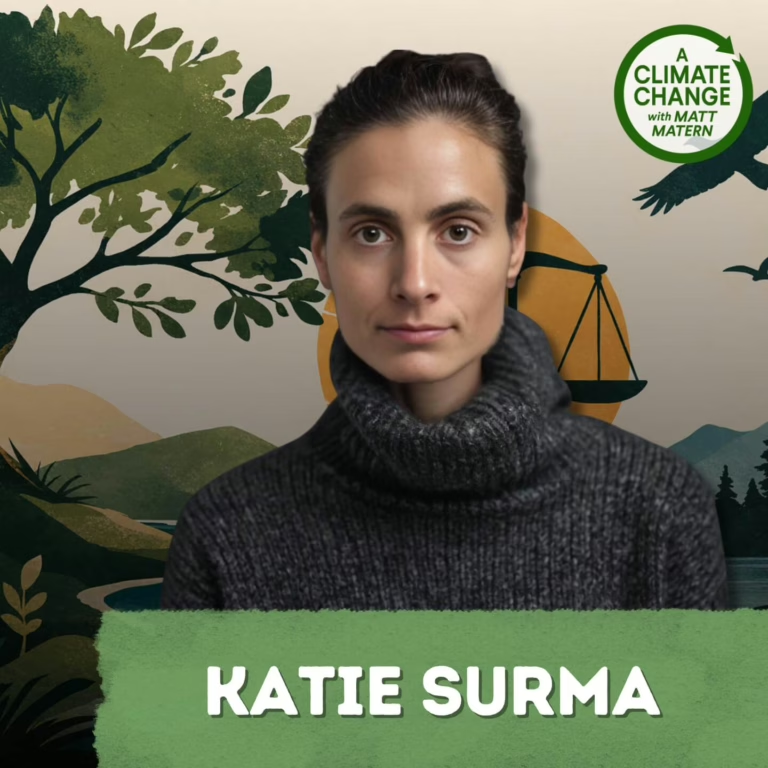
Matt speaks with Katie Surma, reporter at Inside Climate News and one of the world’s leading journalists covering the rights of nature movement. Katie has covered the movement across four continents, and in this conversation she and Matt take stock of where things stand: the wins, the rollbacks, and the road ahead.
They discuss the groundbreaking Indigenous-led treaty recognizing whales’ rights in New Zealand, scientists using AI to decode sperm whale language, and how Ecuador’s constitutional rights of nature have survived repeated political attacks. They also dig into why rights of nature laws keep getting preempted in the U.S., what a private attorney general model for nature’s rights could look like, and Katie’s recent reporting showing communities of color lose access to green space at three times the rate of white communities. Plus: what’s happening in Argentina under Milei, and where Katie is headed next on her reporting trips to South America.
Want to boast to your friends about trees named after you? Help us plant 30k trees? Only a few trees left! Visit aclimatechange.com/trees to learn more.
Nature is a subject of rights. It’s not property, it’s not an object, it’s not a thing like a microwave, but it’s something inherently worthy this new New Zealand legislation that if passed into law, would recognize things like a whale’s right to migrate, the European Convention on Human Rights has recognized Non Humans as rights holders, so corporations. I think we’re just going to see this movement continue to advance. It’s the fastest growing legal movement in the world. If you get it in the state constitution, if you can amend the California State Constitution, that’s probably the strongest way to move forward on it.
Welcome to A Climate Change I’m your host, Matt Matern, today I’m joined by a returning guest, someone who’s been one of the leading reporters in the world covering what may be one of the fastest growing legal movements on the planet, and a topic that I’ve wanted to dig into more for a little while. Can nature itself have rights under the law? Can a river Sue? What about a whale? Are parts of the environment entitled to legal personhood under the law? These are the questions we’re exploring.
And since Katie Surma first joined me back in 2021 these questions have gone from the fringes of environmental law to the courtrooms in Ecuador and on constitutional ballots and now the halls of the United Nations. So today, Katie and I discuss some of the fascinating new frontiers indigenous led efforts to give rights to Wales in New Zealand, the idea of a general model to enforce nature’s rights in the US and hard reality that communities of color are losing access to green spaces at three times the rate of white communities.
We also get into the political headwinds from Ecuador’s right word shift to Javier malaise oil and gas push in Argentina, we cover a lot. So hope you enjoy. Without further ado, here’s my conversation with Katie Surma. Katie, welcome to the program again. Thank you for having me back. So tell us a bit about what drew you a into the environmental space in general. And then what drew you to covering rights of nature issues?
Yeah, so I’m a lawyer. Also my background, I practiced law as a commercial litigator for 12 years, about 12 years, but I made a mid career switch into journalism and went to inside climate news and wanted to do international human rights type of coverage related to the environment. And inside climate news is the kind of organization that you kind of thinks big, and they gave me the opportunity to do that, and my timing just happened to coincide with the rights of nature movement kind of exploding, and I’ve taken that on as a dedicated beat, and it’s a fascinating area to be covering.
Yeah, tell us a bit about one of the things that caught my attention a recent article you wrote back on February 22 how a groundbreaking indigenous treating on Wales rights could change national laws, and it was interesting to see what they’re doing and back, I think that was in New Zealand and protecting Wales. And tell us what your what your findings were, and why you think this could be groundbreaking, maybe for for not only New Zealand, but across the planet.
Yeah, well, so, I mean, the the how this all kind of came into being is interesting in and of itself, because it was inspired this new New Zealand legislation that, if passed into law, would recognize whales rights, things like a whale’s right to migrate. It was inspired by this intra indigenous treaty among Pacific indigenous people, so people Maori in New Zealand and other parts of the Pacific. So that, in and of itself, is quite interesting to have indigenous nations enact a treaty and then that inspire national law.
I mean, you just don’t hear of that happening. And it’s not just that. It’s inspiring New Zealand law. You have an indigenous led organization, kind of behind this. It’s called Hine mohano Halo, and they’re now working with New York University’s law schools. It’s called the more than human life program, and this scientific body called the cetacean translation initiative, and they’re using kind of cutting edge science to decode whale communications, which sounds. As wild as can be, they’re using artificial intelligence to decode sperm whale language essentially.
And then I think the plan is to kind of leverage that science with these innovations in the law, and get countries along whales migration corridors in the Pacific to recognize their rights, and it’s a real frontier for the movement, but also just in ocean governance more broadly.
Well, I noticed something. I think it was in your article saying something that whales and humans share some common ancestor 90 million years ago. So we’re we kind of are connected to whales, and in more ways than one.
100%. I mean, I’ve done a couple stories around this. And I mean learning about sperm whales in particular, because that’s who SETI. SETI is the cetacean translation initiative. Who they study, or what they study. They have grandmothers. They, you know, transmit culture. It’s not like some inherent like drive to learn how to forage for food. They’re actually taught this from older generations. We have so many things in common with them.
It’s, it’s fascinating to dig into it’s sort of mind bending. And I understand said he has some interesting research that’s going to be published soon. We’re going to learn even more about these creatures. Past research is we know that they have vowels in their language, so you can imagine what may be coming.
Yeah, that is fascinating. One of the things that I was looking at as I was researching this a bit was how many times ships are striking whales and causing 20,000 deaths a year due to ships running into whales. And I was looking at it further, and was like, how do whales get hit by ships? And I guess they were saying, whales, you know, evolutionarily, have not kind of adapted to this new threat. Ships of the size and speed that we currently have are are relatively new to their environment, so they just haven’t fully adapted to this danger and and they also, the sounds of the ships are such that they confuse the whales, and so they end up getting hit by these whales are getting hit by these ships, which are, you know, killing them, right and left?
Yeah, there’s, I mean, you can look pull up ship trackers, and in some of these corridors, I mean, like a little dot will represent a ship. And there’s so many dots of ships, the blankets, the seascape there. You know, we don’t think about that every time you buy something off of Amazon or whatnot, it’s likely being shipped around the world and and I think the vast majority of shipping is like oil and gas being pushed around, and those are the vessels that that cause these killings. You know, there’s something that’s interesting to think about with the like the ship sounds.
A lot of people don’t think about noise bothering whales or other cetaceans. It’s this concept called the umwell, which is, you know, humans, our understanding of the world’s come, understanding of the world comes through our senses. But other beings, other species, they have different ways of understanding the world. Like birds can sense the Earth’s magnetic pool. Bats echolocate like whales, and we can’t conceive of what that sensory experience of the world is like, and yet our actions really impact them in harmful ways.
And so part of like the work that setti is doing and the rights of nature movement, more broadly, is just trying to bring awareness to the fact that we’re this dominant species, and we’re having this outside impact in ways that we can’t, we don’t even know. And I think that’s kind of an interesting aspect of all of this.
Well, the good news is that they have found that just slowing ships down will reduce the amount of strikes. So if they I know off the coast of California, they’ve tried to get shipping lines to reduce their speed to 10 knots or 10 miles an hour, and and that has reduced the amount of whales being killed or injured by the ship. So it’s like, it’s a doable fix that we could, we could resolve this, or certainly mitigate it substantially.
Yeah, yeah, that’s right. And you know, in some of the rights of nature jurisprudence that I’ve, I’ve reported on, and it’s mostly in Ecuador. Are the case laws evolving. You know, the fixes are not like, we’re killing this project completely. It’s like, let’s take this road and move it out of this endangered species habitat. It’s, you know, there are fixes that we can adjust our behavior in certain ways, like having guard rails up that make life more, you know, bearable for for Non Humans, right?
It’s it. You know, Southern California has not suffered because ships have slowed down to 10 miles an hour. Actually, it’s said that we now have less nitrous oxide, which is an incredibly damaging chemical to the to the, you know, to the planet you know, being spewed out by these ships when they slow down. So it was something equivalent to 580,000 cars, the emission, the reduction in emission. So it’s like a win win situation. We’re helping the whales and we’re not killing ourselves with this incredibly toxic pollution.
Yeah, I didn’t know that. It’s interesting.
So tell us more about kind of how this is evolving. I guess I’m kind of thinking, how does this potentially map into the US and maybe California or other states? And I know that there have been native tribes, say, up in Minnesota, that have said that their rice, their wild rice, was covered by rights of nature. And so I think that it could be very valuable concept to and how maybe using the indigenous communities here in the United States to be at the forefront of of this, just like the Maori have been in New Zealand. Yeah.
I mean, just stepping back and looking kind of at the landscape of this movement, since I think we talked, there’s been hundreds of developments around the world, and that’s everything from binding laws to court rulings to, you know, declarations to Like related laws, like things like ecocide, criminalizing environmental damage, and where most of the action has been has been in South America, and that’s largely because of the strong indigenous movements there in the United States. You’re exactly right.
A number of Native American tribes have enacted some sort of legislation around the rights of nature, and in the in the wider United States, like Orlando, various other counties or communities have tried to either by ballot referendum or, you know, legislating 10 act rights of nature laws, and they’ve been overturned, often by what’s called state law preemption, which I don’t have to explain to you, but just so listeners would know, a lot of conservative state lawmakers will say, you Know, local, we have jurisdiction over this and local municipalities or counties can’t legislate in this area, and the laws get snuffed out.
There was a another ballot referendum very recently in Washington state about the Sonoma river basin, and it was an over, you know, wide majority of voters went for it, but a court, lower court, just overturned it. I think it was on like vagueness grounds. Forgive me, I’m not remembering exactly, but it’s being appealed. But all this to say, in the United States, it’s had a really hard time getting a foothold, but there’s some state law legislation pending New York State, I believe in North Carolina as well.
And the advocates who I talk to say they really see the state law like getting a state law put in place is going to be the first brick. And to do that, they probably need Democrats, you know, in power in the state. So New York may be a, you know, maybe, maybe the one, possibly, yeah.
Well, I was thinking that be somewhat miraculous if the state of North Carolina did, yeah, yeah. But, you know, I guess there are people who love the environment in North Carolina. And maybe that would happen.
Maybe it’ll, you know, it’s, it’s surprising, like, I mean, with the MaHA movement, there’s a sort of interesting convergence around these ideas, not to mention the very first, you know, sort. Mainstream rights of nature law was in Tamaqua, Pennsylvania, which is like Trump country. Obviously Trump wasn’t around back then, but this is like 2006 and it was very conservative, so you just never know.
Yeah, I think that people who live out in nature are certainly probably the most likely people who see the value of preserving this and, yeah, I think, I don’t know how conservative northern Minnesota is, but they, they are the that’s the area where the wild rice and the, I think tribes up there, and people who live up there big fishermen and hunters, and so they’re very cognizant of the dangers of destroying this environment.
Yeah, you saw something similar when the Keystone XL Pipeline was in the works. And one of my sources is Casey camp Hornak. Who was very involved in that, and, you know, she called it the cowboys and Indians, because the people opposing the pipeline were like rural farmers and the Native American nations kind of came together to try to oppose that. So you do you get these coalitions around these issues?
So where do you see this going next? And in particular, in Indonesia, and maybe, you know, talk about some of the other developments in other parts of maybe South America, where some success is being had. And one of the things that I’ve noticed you not mentioning is say in Europe, which we normally think of Europe as being kind of a leader in all things environmental.
So there is stuff happening in Europe. Spain, first of all, has a national law recognizing Mar Manor, which is like a salt water lagoon, recognizing its rights. And there’s litigation happening around this, both in Spain, but the you know, in Europe, you have the European Convention on Human Rights, and that convention has recognized Non Humans as rights holders. So corporations have brought cases before the European Court on Human Rights. Well, Matern menor is bringing a case against Spain’s government about, like, denial of its rights.
So there’s really fascinating stuff happening in Europe. In the UK, there’s a lot of coalitions around rivers in Germany as well. So there’s, there’s a lot of stuff happening that maybe just, you know, it’s not, not widely known. South America again, you know, Panama has two national laws, one recognizing the rights of nature as a whole, and one recognizing the rights of sea turtles. And they’ve done a number of things to implement it. A marine biologist was, you know, largely involved in this. And those laws are very deeply scientifically written. I mean, there’s, there’s a number of rulings in Colombia.
There’s a push to have the rights of the Amazon recognized as a whole, and sort of a treaty among Amazonian countries, which likely will not, not happen anytime soon because of the politics you see South America doing taking a very right word swing. I mean, there’s a rights of Wales case in Mexico. I mean, I could keep going. There’s just, there’s a lot, lot happening, a lot of conversations happening on the African continent as well. So I think we’re just going to see this movement continue to advance. It’s the fastest growing legal movement in the world. But it’s not, it’s not just that. It’s also doing something with culture.
I think, you know, when people start seriously engaging with these ideas, it tends to change their thinking about the ecosystems where they live, they go out for a walk and they, you know, they think of themselves as as being integrated in this place where they live, as being a part of it. I hear that often from readers or from sources. But there’s also a piece of this about environmental defenders, you know, in South America in particular, people are killed every week on average, like these, like three people a week for defending peacefully, nature in some way, defending their territories and the rights of nature, just the language around it that nature is a subject of rights.
It’s, it’s not property, it’s not an object, it’s not a thing like a microwave, but it’s, it’s something inherently worthy. It gives them, you know, strength. It gives them sort of a legitimacy to what they’re doing, to protecting it, as opposed to just the status quo, which is a. Of laws and systems designed to facilitate extraction. So, yeah, I’ll leave it there.
No, I think that’s touched on a lot of fascinating subjects I’d like to follow up on. One is the cultural shift, and I think I personally experienced it when you were talking about whatever, five years ago with me, because I hadn’t, you know, thought about it a whole lot before we had that conversation. And I think it’s a shift kind of mentally, okay, yeah, ship people have rights. We give corporations rights. Ships have rights. Ships are citizens.
And that’s kind of like a mind blowing thing, like most of us don’t think about that. I certainly had never thought about that. But yet, why? Why don’t environmental things like whales or mountains or rivers have rights as well? And you know, it’s just a consciousness shift. It’s a cultural shift. And I think it’s, it’s profoundly important for us to start thinking about, you know, our environment, more holistically. And that’s that, to me, is extraordinarily important to shift the conversation.
Yeah, yeah. And I think it is, I mean, I think it just, it reaches people, you can’t. I mean, everyone drinks water, you know, everyone’s breathing the air. And you when you look at the science around what’s what’s happening. I mean, just put climate change aside and thinking about species loss, water scarcity, you know, these things touch upon people’s lives, and one of the you know, my mind, at least, why, I think another reason why this movement has is so strong in South America is because a lot of people just live very closely to the land where they live. Their campesinos, they farm, they live in the forest. Obviously, a lot of people live in cities, not trying to paint with a broad brush there. But when you live close to nature, you, I mean, you, you feel this.
And well, you know, of course, you go to Brazil and you’re in Rio, and it’s a city of 11 million people, but if, like, you’re in a jungle, I mean, there’s so much nature surrounding everything there.
Yeah, yeah, yeah. And, you know, the big, you know, one of the big developments in this movement is the rush of scientists into it, and those scientists who I’ve interviewed who are joining into this, they say, you know, just this way of thinking is scientifically more accurate an ecosystem. You know, you can’t just look at a river and regulate how much you dump into it and say you can dump X amount, you know, every two weeks regulate the pace and amount. You know, the system is integrated. You mess with one part. It messes with another part. You have to understand all of these different pieces and rights of nature, laws or ways of thinking match that, you know, and so they are drawn to it because they see it as more accurate and a better way of managing, you know, our home, the planet.
Well, something that you said kind of triggered a legal concept that we have in employment law, which I practice in a lot, is we’re sometimes made private attorney generals, so that as attorneys, kind of stepping in for the state to enforce the rights of of the state when the state doesn’t have the attorneys Present to do the work, right? Because there aren’t that many attorneys working for the State of California, or what you name, the governmental entity, so that it would, in Empower attorneys to actually prosecute these rights.
And I think that, you know, it’s creating some law that that does that kind of takes those two things and melds them together to say, hey, if you’ve got a beef with this company, you can you would have the right to enforce this law and protect the environment, would be a powerful thing.
Yeah, so are you getting at like, you know, sort of like guardianship, who has the means to sort of stand in to enforce nature’s rights, right?
Because right now, like, say, in the US, there’s sometimes it’s like the EPA has the ability to do certain things. But. Nobody else can, can do it. It’s and if the EPA is not doing it, then it just doesn’t get done.
Yes, yeah, yeah, it that’s a crucial point. And so with these laws that are being enacted, that’s that’s really important. And there’s the like Ecuadorian model that gives standing to anyone who can step in and say, you know, I’m bringing a case on behalf of this river, or this, this wild animal, the New Zealand Wanganui river case is different. Is different that law. It sets up a board that’s sort of CO managed by some Maori iwi, which are like tribes and the government.
And a lot of people, the majority of people I talk to, argue in favor of the Ecuadorian model. I think, for the reasons you’re saying that anyone should be able to stand up, and if they can make the case that, you know, nature’s rights are being violated, then they should be able to do that.
You know, I kind of want to pivot to something that you’ve written about before, which is you had an article about how China is silencing environmental reporters beyond its borders. In particular, I think you were focusing on Africa, and that China is developing a lot of projects over there, and they’re polluting, and when reporters are questioning them, you know, as you said earlier, some of these reporters are getting killed, which is extraordinarily, you know, bad. And you can imagine, if reporters are getting killed these the the voices of the people are not being heard.
Yeah, yeah, yeah. So beyond reporting on the rights of nature, I do investigative work, and my colleagues and I did a series this year on the environmental impacts of China’s overseas investment that a lot of people know as the Belt and Road Initiative. And while I was reporting on this catastrophic tailings dam collapse. A tailings dam is a waste pit at a mine.
It’s a Chinese company. I came to understand that, you know, reporting on these types of things is being suppressed, and started talking with journalists a lot in Zimbabwe, but from across the continent who have reported on Chinese companies, and the stories I heard were just horrific.
I mean, it ran the gamut everything you know. Journalists in Zimbabwe, I think you know, may make like $1,000 a year, 2000 something like that. And they they’re getting paid $100 sometimes $1,000 to kill a story. And it’s just, it’s, it’s an extremely repressive environment. And beyond that, you know, China has flooded the zone with state media. You know, has bureaus across the continent, around the world, but, you know, I was focusing on Africa, where it’s pumping out good news stories about its companies.
And so, you know, the question we have is, you know, the public doesn’t know, how can, how can people make decisions that are right for them? How can governments make decisions that are right for their people? And this is a huge problem, and it has been made worse by the US cuts to Voice of America, to USA ID, to these programs that were helping to combat that.
Yeah, that’s just incredibly damaging. And I guess the question is, are the stories getting out in some other way? Because we have, we have other potential media sources. People could be doing it on YouTube or doing it, you know, but as I understand, there’s certainly some really impoverished areas, and you don’t necessarily make much money publishing things on YouTube. I can attest to that,
Yeah, yeah, and that’s what I heard from a lot of folks, but there’s some incredible journalists and news organizations, independent news organizations, on the continent, just really, really doing fantastic work, and they they need support.
Well, that’s that’s yet another thing that people should be looking out for to help these different organizations. I know your organization inside climate news also, I think, seeks donations as well. So people should to donate to inside climate in news to help get the news out there, because these these issues, don’t investigate themselves. It takes a lot of work by reporters like yourself to go out there and dig, dig and dig.
Yeah, thank you. Yeah. That is nice of you to say, yeah. It does take a lot of time.
So tell us what’s next on your agenda as far as things that you’re looking at covering specifically.
Yeah. I Gosh, got some reporting trips planned this year to South America, more on the rights of nature, and my colleagues and I are doing a China year two series. So there’ll be more coming out on China’s overseas investments, and more on the ways it’s impacting the environment and human rights.
Well, tell us some of the the feel good stories, to give us a little bit of hope as to what, what’s working out there, and what do you think is really moving the needle in, say, the rights of nature area?
Yeah, I should say is, you know, journalists, we don’t always get we don’t do a whole lot of puff pieces, not what we get paid for? But really, I mean, some of the cool things I see are just the sort of alternative economies that people are are, you know, bringing into being, finding alternatives to extractivism, you know, because in South America it’s sold to a lot of these communities that we have to do mining, we have to do oil, and they say, No, we want to protect our forests. We want to do things like agroforestry or ecotourism or things like that.
And so these communities sort of having sovereignty over their their lives, their choices, and finding their own way forward is is really inspiring, and a lot of times it’s led by women. The women in the communities are the ones who are kind of on the front lines of of all of this. So there’s a lot, I mean, a lot of cool things I get to see. But that’s, that’s definitely up there. That’s, that’s tops.
Which, which countries are you going to visit in South America?
I’ll, for sure, be in Argentina and Ecuador. Ecuador is a common stopping point for me, because they have a constitutional rights of nature, but potentially others.
What’s going on in Argentina now, because we know that Malay is in power there, and I don’t know what his environmental agenda is, but I’m not, I haven’t heard of it being particularly Pro Environmental.
Yeah, yeah. So if people don’t know Javier, Malay is Argentina’s president, and he’s libertarian times 1000 he’s very good friends with Elon Musk and a Trump ally. And Argentina is home to the largest, or second largest shale oil and gas reserves in the world. It’s called vaca muerta, or dead cow. And you know, they are extracting at breakneck speed, they’re building export terminals where whales migrate, by the way, and it looks like data centers are going to be going in.
And this is in Patagonia, which is beautiful area Argentina has also signed up to be doing critical minerals cooperation with the United States, and Malay has been weakening environmental protections, including around glaciers, which are critical water sources for that air part of the continent, lithium mining going off in the north, and that lithium triangle with Chile and Bolivia in Argentina. So there’s enough. I mean, there’s a lot happening in Argentina.
Also, I think there’s, like, very few Jaguars left there. And, you know, agriculture is, is expanding into their, their their habitat. So Argentina is a very important country for nature, and for a lot of reasons, geopolitically. So there’s, there’s some good reporting to be done there.
Not necessarily good news for the environment, but good stories to dig up about what is not necessarily going right in the environmental movement. Yeah, yeah, yeah. Well, you’re talking about areas where kind of communities where they’re indigenous folks or people who aren’t white and them being treated differently than than other communities, tell us a little bit about what your reporting has found on that front.
Yeah, that did a recent story. It was a report that came out, and it was, it was from a left leaning group, but they found in the United States, I think it was that communities of color face environmental destruction or degradation at three times the amount of non white communities, and it was also sort of similar numbers for poor people, regardless of their race, which isn’t, you know, surprising in the US, the environmental justice movement sort of coalesced around this reality.
And and have been, you know, making ground, fighting back, for instance, around the sighting of polluting plants, there’s there’s black communities in our country, cancer alley in Louisiana, for instance, that just has chemical petroleum, like other refineries just cited around them, and that progress has stopped under Trump, who’s just unwound pretty much every, every law or policy or or you know, attempt to to start to reverse those that discrimination.
Well, let me ask you, in terms of something we were talking about earlier, which was, you know, and related to your recent comment about Trump rolling things back the endangerment finding, and if, in fact, that was found to be proper, that the EPA was allowed to strike, that endangerment finding Wouldn’t that potentially open up to the states an area that they could regulate? Because the EPA is saying, Hey, we don’t want anything to do with this. This is not our area, doesn’t that, doesn’t that say that the state should be allowed to regulate this?
Yeah, so Well, let me say this is not my area of expertise, because I do not focus on us. Climate law, my colleague, Mary Ann Labelle would be the one to talk with you about this, but the lawyer in me says, Yes, logically, that makes absolute sense, that it would be an issue going to the States, but I can’t foresee this Justice Department not allowing states to legislate in that area.
I mean, they’ve been going after states for trying to legislate, you know, on the in the environmental arena, in ways that would have, you know, impact nationally. So yes, on paper that you that what you said sounds right, but I don’t know if, in practice, the federal government would let that happen.
Well, certainly they would argue against and the Supreme Court’s not necessarily leaning in the favor of the environment either. But if they were intellectually honest, if the EPA says it’s not within their purview to regulate this. Then whose purview is it within to regulate it? Somebody. But I guess the one of the things we talked about already, but I kind of want to circle back to, is trying to find a way in which the rights of nature could be enacted here in the States, locally or on a statewide level. And I know there’s been some activity in that area. Have you seen, have you seen anything kind of wend its way through and not be struck down?
God, well, I mean, that lawn Tamaqua from 2006 is conceivably still on the books. I don’t think it’s been touched, but it’s just kind of dormant, you know, I think it’s the state. It’s the state. Legislation is what it seems to me, would have to take place, unless you had a very liberal state that, you know, had a liberal court, liberal legislature that would allow sort of local communities, municipalities or or the like, you know, start to to put local laws into place and build momentum.
I know in Washington State, there’s talk around that to try to get more and more action at different localities, to kind of put pressure on the state legislature to to move on this. So Washington State stole a place to watch, even though that law got overturned. But I’ve also sort of stepping back from like the legal process I’ve seen a number of environmental justice communities. So, you know, black communities in the south start to talk to the rights of people in the rights of nature movement in South America. So you have these sort of international coalitions forming, and they learn from each other. And that, to me, is interesting, because I think there’s going to be some information sharing.
And any sort of activist in this area who wants to learn how to do it should look to the Ecuadorians, because they’re up against a really difficult situation there. I mean, just attacks on environmental defenders, people getting killed, weaponization of the law the military being put on them. Yet they they prevail time and time again. So, you know, those kind of, those groups work together, maybe, maybe something happens. I’ll be watching it for sure, as a, you know, covering it.
So in terms. Of Ecuador. Why, why do you think that that movement has had some success and and what do you see as the next steps in Ecuador that will keep this moving forward?
You see two things. One is their constitution allows for popular referendums and so and the grassroots groups are so good at getting their message out using the arts, having these campaigns, they were behind this thing called the Yasuni ITT Initiative, where they voted like it was like 62% I may have that wrong of the country, voted to shut down oil operations in a part of the Amazon. It’s like unheard of that that could happen. And so it’s that popular referendum mechanism has been really useful for them.
And then it’s, you know, they rewrote the constitution in 2008 and got these really formidable rights, rights of nature, indigenous right to consultation, right to protest, and they’ve hung on to those and used those, and so far have had a constitutional court that’s been pretty fair. That country has also taken a hard right wing turn. Another Trump ally is in office there, and mining is pushing mining really hard, and so they have a huge battle ahead of them, because the US also just signed a critical minerals memorandum of understanding with Ecuador, and has been wanting to send the US military into the country to, you know, combat drug trafficking. But activists there see it as a way to kind of put down these movements to expand mining.
That’s certainly scary and unfortunate. Well, I I was wondering, you know, from California’s perspective, we have a popular referendum movement, and whether or not anybody might be pushing to put something on the ballot here, and if they were what would be the way that they could do it most successfully? Is it to protect certain rivers, or what are the types of things that could be put in a statute that that would protect the rights of nature in a way that wouldn’t be likely to be struck down?
Yeah. I mean, that would be an illegal analysis that, for now, is above my pay grade. I mean, I think you’d have to, you know, put a lot of people on that to study.
Let me get some free legal advice. Come on, yeah, what, what that would look like?
But I, actually, I talked to some people about the different ballot referendums, like, you know, it was looking at Chile, uh, California, Ecuador. And the model is different in California than in Ecuador. And I think part of it is, like the amount of money, and who can dump money into referendum issues in California? So there’s, there’s something a little bit different, but, or at least, sort of the political calculus on that. But I think those are interesting questions that you’re that you’re posing.
Well, maybe it’s something a broad right of nature, where, that way, you know, you have a lot of like, you know, you have a lot of things that fall underneath the umbrella, because the more specific it is, the harder it is to kind of enact it versus, you know, I have a right to clean water and clean air and a clean environment and and then if you have this broad umbrella, then, you know, you have A constitutional right like they found in Montana. I think the US Supreme Court had said, hey, well, you know, you’ve got a right in the Montana constitution to whatever it was, clean air, clean water. And you know, that’s something that people in Montana said was okay.
Yeah, no, exactly. I mean, that’s the human right to, you know, a healthy climate or healthy environment. But you know, rights of nature is a little, little different nature having its own rights. But, yes, I mean, if you get it in the state constitution, if you can amend the California State Constitution. I mean, that’s probably the strongest way to move forward on it, right?
Well, lots of work to be done. Katie, pleasure talking with you again, glad to hear that progress has been made on this front in many different places. And obviously tons of work needs to be done. Good luck on your travels down to South America and and exposing these important developments that are going on, and making sure that there’s light being shown on these areas so that you. Maybe things are done in a better way than if they’re done in the dark.
Yeah, no, thank you. It’s always a pleasure to talk with you. Really enjoyed it.
Okay, well, thank you very much, and we’ll look forward to following you on inside climate news and checking out the latest that you’re reporting.
Thank you.
And that was Katie Surma reporter at inside climate news. You can read her reporting at inside climate news.org and follow her at Blue Sky. At katieserma, dot B, s, k, y, dot social.
Katie, thanks for coming back on A Climate Change. To learn more about our work at A Climate Change, visit aclimatechange.com – don’t forget to subscribe to our podcast on Apple, Spotify, YouTube, or wherever you get your podcasts. If you like this episode, please share it with a friend. See you next time.
(Note: this is an automatic transcription and may have errors in formatting and grammar.)