
Hear us on Apple Podcasts, iHeart, and Spotify Podcasts. Subscribe now!
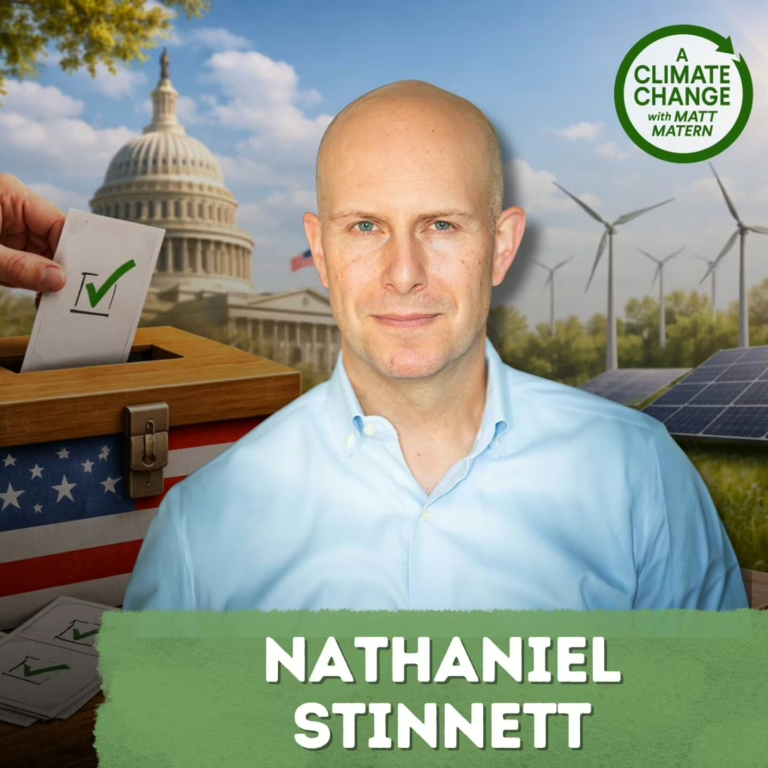
Matt speaks with Nathaniel Stinnett, returning guest and Founder and Executive Director of the Environmental Voter Project (EVP), about the climate movement’s political power problem. Nathaniel explains why tens of millions of environmentalists don’t vote — and why the number one answer people give for how to address the climate crisis is recycling. He shares how EVP uses predictive modeling, randomized control trials, and behavioral psychology tools like peer pressure and endowed progress to turn non-voters into habitual voters. They also look ahead to the 2026 midterms, where EVP is targeting 3.4 million first-time climate voters across 21 states.
The fossil fuel industry has done a very good job with very sophisticated and expensive PR campaigns convincing us that the climate crisis is a suicide rather than a homicide. And it doesn’t surprise me one bit that if in our heads we think, Well, you know, the only way to start changing our approach to the climate is to blame myself and try to fix myself? Well, yeah, of course, we’re going to be paralyzed.
Welcome to A Climate Change, the podcast where we tackle the world’s most urgent environmental issues and show you how you can do something. I’m your host. Matt Matern, the 2026 midterms are right around the corner, and for the climate movement, the stakes couldn’t be higher. Federal climate policy has been getting rolled back at a rapid pace, and the question now is whether environmental voters will actually show up when it matters. Because here’s the truth, the climate movement still doesn’t have nearly enough political power, and a lot of people care a little bit about the environment, but not enough.
Well, my guest today has spent the better part of a decade working on exactly that problem. He previously joined us in November of 2024 he is the founder and executive director of the environmental voter project, which uses data science and behavioral psychology to find non voting environmentalists and turn them into habitual voters. Today, we talk about what went wrong in 2024, why the climate movement still thinks recycling is the most important environmental issue, and what the environmental voter project is doing to mobilize the three point 4,000,001st time environmental voters ahead of November. Here’s Nathaniel Stinnett, welcome to the program again.
Well, thanks, Matt. I am really excited for our conversation. And, yeah, it’s a big election year.
So tell us a little bit about, well, just for the uninitiated, what the environmental voter project is all about, and and how you started it, and what, what you guys have been doing.
Thanks. Yeah, so we are a national nonprofit that is laser focused on finding people who care deeply about climate and the environment who don’t vote, and then turning them into better voters. And that sounds pretty narrow, and it is. It’s focused, but it turns out there are 10s of millions of these non voting environmentalists, Matt and so this is a huge pool of potential political power that the climate and environmental movements are taking advantage of and as far as how I came about to start this organization, I come from the world of politics.
I’d always cared deeply about climate and the environment, but I was always kind of frustrated on campaigns because we couldn’t justify talking about it that much. And the reason we couldn’t justify talking about it that much is we’d look at all of our polling data and we’d see, okay, one, two, maybe 3% of voters list climate as their top priority, and when so few voters prioritize an issue, it’s just really hard to spend a limited amount of time and money on such a low voter priority.
But what led to the starting, the founding of the environmental voter project, is this realization that, yeah, there’s a small number of voters who care deeply about climate and the environment, but there’s a much larger group of non voters who care a lot about climate and the environment. And so it dawned upon me, and a lot of people I was working with, that maybe the climate movement doesn’t have a persuasion problem as much as we have a turnout problem. And don’t get me wrong, it’s always important to change people’s minds and get them to care more about climate, but we’ve got a whole lot of people who already are there. They already care, and we just need to get them to the polls in every election. And so that’s what we focus on at the environmental voter project.
Well, I hate to bring up bad news, but 2024 we kind of voted in this guy who doesn’t really care that much about the environment. So, you know, I don’t want to say you guys effed up, but you know, like, how did we fail so badly on this front?
Yeah, so, you know, it is not news to me. I was already aware of it, but you’re right. It’s not necessarily good news. So. So obviously, there are a few things that happened, but I think the most important takeaway, and this might not make a lot of people who feel that climate change is important, you know, might not make them feel happy, but we just need to realize that the climate movement doesn’t have nearly enough political power. It’s just so important. You know, we’re used to pounding our chests and pretending like, oh, you know, if you if you cross the environmental movement, Watch out, buddy. And that’s what most advocacy groups and most issue constituencies do.
They want to seem strong and scare people into doing what they want, but Matt, we’re not doing ourselves any favors by pretending we have more power than we actually have. The simple truth is that right now in the United States of America, a lot of people care a little bit about climate change, but almost nobody cares a lot about it, and that lack of political power is a real problem that we need to address as soon as possible. And yeah, that’s a lot of what you saw in 2024 and that’s a lot of what we continue to see in a lot of elections, which is that the climate movement isn’t yet strong enough to bully politicians into doing what we want, like, say the gun rights movement is, or some other issue constituency groups are.
Well, I mean, I would imagine the gun rights coalition is, you know, fairly narrow compared or, you know, I guess, or tell me, what’s the what are the numbers for the gun rights crowd versus the environmental?
Yeah, yeah. So I’m glad you asked that, because it’s pretty striking. Now, you know the the NRA isn’t necessarily a great proxy for the entire gun rights movement, but it’s an okay proxy. So let’s take the NRA. Most estimates have the NRA having five to 6 million members, actually, in the grand scheme of things, grand scheme of like, big national elections. That’s not an enormous number, but Matt, they vote like it’s their job. I mean, if you care deeply about gun rights right now in the United States, you will like show up for library trustee and dog catcher elections. You never miss an election, because you understand at a very intuitive level that this issue you care about is synonymous with political power.
If you don’t have the power to pass certain laws and affect societal change, then all of these things that you care about are going away, and we in the climate movement, we haven’t made that connection yet. We still think of climate activism as often being apolitical things, you know, we think of it as, you know, let’s change how I eat. Let’s change the electricity I consume. Let’s change how I get to work. All of which are really good and important, but they’ve got nothing to do with politics.
Well, it just, I think there is a persuasion problem too, which is say, in 2024 environmentalist candidate did not make a strong pitch during the one and only debate regarding environmentalism. I mean, I don’t think during the campaign, a strong pitch was made as to why this is important, because voters probably need some degree of education on it, and it wasn’t being given, and I think it was because of a poll driven politics which says, Oh, it doesn’t poll well enough, so let’s just assign it to the sidelines and pretend like it’s not there.
I think that’s right. I think that’s right. And listen, it’s always very hard when doing post mortems on elections to say, you know, this is what led this one thing is what led to everything bad that happened, because you can’t rewind the tape and run it 2 million times and figure it out. But I do feel pretty confident saying that each of the following things are true. One very few politicians are courageous enough to talk a lot about climate change, and I use the word courageous very deliberately, because you’re right that there aren’t that many polls that show voters are begging for politicians to talk about climate change. So So politicians need to go out on a limb and say, Hey, I’m gonna, I’m gonna use some of my precious time to talk about this issue.
And so, yeah, that’s. One thing that is problematic that is keeping some of these climate voters on the sidelines. The second thing is certainly mobilization efforts. A lot of people who already know that they care deeply about climate change are staying on the sidelines, and some of some of that is due to not being inspired by candidates. But another part of it is we don’t have a big and robust enough campaign operation to mobilize those voters, and that’s part of the problem that we at the environmental voter project are trying to address. And I think the third problem is, and I alluded to this a few minutes ago, is that most of us who do care about climate change don’t even make the connection to politics yet. And this is something that we’ve uncovered in a lot of our polling at the environmental voter project, which is…
when you ask that’s kind of mind boggling.
It is. It’s totally mind boggling, right? But, I mean, you can see it in this polling data because, because what we did was we did a very unique poll and a very expensive poll where we asked open ended questions, so we didn’t give people lists of responses to choose from, and we had what’s called split samples. And I don’t want to get too nerdy here, Matt, but very briefly, what split samples are is we only asked one group of people just about gun violence, and another group of people, we only asked them about climate change, and another group of people, we only asked them about abortion, and we did the same thing for a whole bunch of issues. And the reason we were splitting them up like this is we wanted to ask people about these issues in sort of a natural setting.
We didn’t want them to know that it was a political poll, because we wanted to figure out, okay, how do people go through their day thinking about immigration or thinking about climate change? And what we realized is when we asked people about gun violence and immigration and education and abortion and all of these political issues, and we said, Hey, Matt, what are a few ways that you can think of to address x issue and by a four or five. And for some issues, even a 10 to one margin, the answers they came up with were completely political. It was pass this law, change this regulation force people to do X or Y. But for climate change, it was the opposite by a four to one margin.
It was completely individual things. It was, and I kid you not, this is going to depress the hell out of you. Matt, the number one answer people gave when we said, what are some ideas you have to address the climate crisis? It was recycling, recycling. And then they said, Oh, you know, let’s buy different things. And I mean, I mean, I don’t want to poo poo like consumer behavior, but like, we aren’t viewing this as a political problem yet, and if we don’t view it as a political problem, we’re certainly not going to think of political solutions like voting.
That is wild. Yeah, the communication in the climate area is astoundingly not effective, like it just isn’t being heard. Well, it is a con there. I think there’s a lot of complex issues out there, and quite frankly, there’s one that cuts against, you know, pretty much everybody out there, which is driving gas guzzling cars or gas using cars kind of creates this, you know, hypocrisy, or this, this challenge. I’m trying to think of the right word for it, but like, cognitive dissonance between we know that that’s probably not good for the environment, but we have a car that uses gas, so, you know, you don’t want to look at that, versus, oh, it’s easier to look at recycling, which is, you know, kind of an easier or, like, plane travel or, you know, things that guzzle a lot of fossil fuels. You know, people don’t really want to look at those issues, because those are, those are tough issues.
They are, they are, Matt, and you’re absolutely right to put your finger on that, but I would suggest that maybe we shouldn’t even be looking at any of those issues, because what all of those issues have in common is self blame? Is people looking to themselves as though they are at fault for the climate crisis? And I don’t want to claim we are faultless as individuals, but this is not a problem that we are going to solve through. Our individual behavior change alone.
In fact, I would claim you cannot think of a more global, systemic failure than the climate crisis, and I’m sorry my plastic water bottle is not nearly as much to blame as the coal fired power plant back there, and the fossil fuel industry has done a very good job with very sophisticated and expensive PR campaigns convincing us that the climate crisis is a suicide rather than a homicide. And it doesn’t surprise me one bit that if in our heads we think, Well, you know, the only way to start changing our approach to the climate is to blame myself and try to fix myself. Well, yeah, of course, we’re going to be paralyzed. But if instead, we realize, like
both and that, hey, we can send signals as consumers. Just like there was a big signal to Tesla, people stopped buying their cars in in the US and and and in Europe, or certainly slowed down their consumption. And maybe, you know that may not change their behavior immediately, but it, it’s, I think it was a strong signal of we’re dissatisfied with your product.
And I think that if we did that more, then there would be better signals out there in the market to say, hey, we’re not taking we’re mad as hell, and we’re not going to take this anymore, even if the politicians don’t get behind us. So I get that it’s both, and I get that, you know, the fossil fuel industry is incredibly powerful and and have done a great job at messaging that, you know, hey, if we just took out our trash more effectively, you know, the environmental problem might be solved.
Yeah, and it’s, and it’s beyond PR, it’s also just sort of the the the bones of society. Now, I mean, there was, there was a study done at MIT now about 15, maybe 20 years ago, and I really wish they would redo it and update it, but what they realized was, if the average American gave up all their worldly possessions and literally lived as itinerant monks, we would still have a carbon footprint that is two and a half times the global average, two and a half times. Have we all lived as itinerant monks?
How it how is that possible? What, where would cause…
Because the electric grid, the transportation system, our building codes, everything that we live with is so carbon intensive that that we’re in this like fossil fuel straitjacket that no amount of individual like individual behavior change could get us out of. Now, don’t get me wrong. I think it is very important, for the reasons you brought up, to send signals to the marketplace through individual behavior change, but when every pipeline that’s built guarantees profit for 30 years with a locked in Monopoly contract, or when you have transportation systems that build in subsidies for people to live 40 miles away from their jobs, like these are things that don’t respond quickly to a Change in marketplace dynamics. They’re really, really slow moving, and that requires systemic political change.
For sure. So let’s, let’s turn to how that’s done through the environmental voter project and and what are your keys, and what have you seen as results? I mean, I guess I have seen in the most recent elections, in the last year, there has been this swing towards, you know, probably the Democratic Party, of 10 to 14 Points. Now, is that result of environmental things, or is it just kind of, well, the natural swing of politics, we have pendulum, the swing right, and then it swings back left, and you know, where, where does the environmental voter project kind of come in and accentuating a swing?
Yeah, it’s a great question, and there are a few things going on here. I do not think it is appropriate to claim that that that swing is happening in part because of the environmental movement. Again, I’m a big fan of like, if you want to solve a problem, you need to admit the problem and. So the big problem we’ve got to face right now is that we are not politically powerful enough. I think a lot of what is happening with the swing is first just basic changes in the sort of thermostatic opinion. So when you have an incumbent political party by definition, the population is going to swing against them, and we always see that.
So that’s one thing that is going on. But we would normally expect anywhere from a six to 10, maybe at most, 12 point swing, and we are consistently seeing much, much more than that. So something else is going on. It’s not just sort of the typical thermostatic dynamics that you would expect from a from an electorate, I think in particular progressives and Democrats, but also a lot of independents are really, really angry at Maga Republican policies, and yes, I include the climate movement in that, but I don’t want to pretend that the climate movement is at the front of this parade, dragging everybody along. We’re not that powerful yet. We need to get that powerful, but we’re not there yet. But you’re right in diagnosing this pretty significant sea change in the electorate that seems to be happening over the last year and a half.
So where do you guys come in, in accentuating that swing to you know, because it’s going to take a very big swing to to really change the dynamic in Congress, given that there’s so many incumbent protections and there’s been a ton of gerrymandering on both sides, that make really altering the equation pretty challenging.
That’s absolutely right. That’s absolutely right. Gerrymandering is getting worse, not better, on the other hand, because the electorate is more fluid over the last year and a half than we’ve seen for a while. What we don’t know is how smart that gerrymandering was. Maybe some of those gerrymandering decisions were made based on false premises that are going to come back to haunt people. But regardless, what we are focused on at the environmental voter project is trying to have record high turnout from climate voters this midterm.
And in particular, what we’re looking at, and as I think you know, Matt and maybe some of your listeners know, we individually identify low propensity environmental voters at the environmental voter project, and then we canvass, call mail and send digital ads to these voters, all just focused on making them more likely to show up, and in particular, rolling into this election year, we’re now working in 21 states, and we’ve identified by name and street address, 3.4 million environmentalists who were aggressively mobilizing to the polls this year. And none of them, not a single one of them have ever voted in a midterm election before. And just to give you an example of two states, in Texas, we’re mobilizing 430,000 of these potential new climate voters. In North Carolina, we’re mobilizing over 150,000 those are two crucially important states for the US Senate.
So, you know, I just truth in labeling here. I did make some calls for the environmental voter project and 2024 and you know, it was, you know, it was eye opening in that it’s challenging to get the voters on the phone for the first piece of this puzzle, and then when I did get a number of people on the phone, they had been hit hard. You know, I don’t know if it was just your organization or other organizations in Arizona that were probably calling the hell out of, you know, everybody and their brother, you know, it’s hard to break through. How do you guys break through to these, these voters that you know may be hearing it from? I don’t know how many organizations there’s so much money in politics these days, the campaign ads are crazy.
Yeah, so it’s a great question, and we break few, I’m sorry, we break through by using a few, I think, really unique approaches. The first is, unlike a lot of Morgan. Organizations, we are only targeting unlikely voters. Now that doesn’t mean that we’re the only organization to talk to them, as you experienced when you made calls, especially in a presidential election, it’s very hard to find someone who no one has spoken to, but we are reaching fresher, more virgin voters than most organizations, because we’re talking to these less likely voters. The second unique approach that we take is because we’re not doing persuasion messaging, because we’re not twisting someone’s arm to say, hey, vote for this person or hey, you should care about this issue. It’s a much easier ask. So chances are, if you were making calls, you said something like, Hey, Matt, it’s Nathaniel from the environmental voter project.
There’s an election on Tuesday. Are you going to vote early, by mail or at the polls? A very, very simple question, but there’s a lot of sophisticated behavioral science in there, because what you’re doing is you’re framing the question in a way that gets someone who has never voted before to say, you know, I guess I’ll vote on election day, thanks. And then, chances are they’ll hang up, but that’s like you just set a trap for them, because then we can call them back the night before the election and say, hey, just a reminder, a volunteer spoke to you last week. You said you were going to vote on Election Day, and tomorrow’s your opportunity to follow through on that promise, which is another unique thing we’re doing. We’re using behavioral science and the idea that people want to keep their promises as a way to get them to the polls.
And finally, I’ll just say, Matt, unlike almost any other organization out there, we do not measure our impact by just looking at the people we contacted and then seeing how many of them voted, and then patting ourselves on the back. Of course, we know there are other campaigns out there, and of course, we know that just because we spoke to someone, we shouldn’t take credit for that. And so instead, we run what’s called randomized control trials, where we randomly set aside a group of non voting environmentalists and never talk to them, and then after the election, we compare turnout among the people we did talk to to the people in that control group, and only then can we measure and see whether we had a statistically significant impact on turnout while controlling for what all those other campaigns did, and we consistently get some incredible results.
Yeah, that’s that’s very powerful, and that I think was one of the things that drew me to your organization, is what you’ve done in terms of modeling and the behavior, I guess I just question in terms of tracking the voters and making sure you have good data, and making sure that you’re not Double calling or triple calling, or all the things that annoy voters. What are you guys doing to make sure that you know when they hear the phone call from environmental voter project, they’re now I called me 27 times, and you know, stay away.
Honestly, Matt, I don’t care. All I know is that our randomized control trials show that we are dramatically boosting turnout, and if annoying people does that, I’m going to start annoying them some more. Now, don’t get me wrong, it’s not our goal to annoy people, but you should never trust what a voter says. You should trust what they do and whether you vote or not, that’s public record. It is public record after every election, we can see on public records which of the people we contacted voted and which of them stayed home, and what we know is that our messaging is boosting turnout when compared to randomized, controlled groups. And so again, it is not our goal to call the same people who other organizations are calling, and because we’re only talking to low propensity voters, that happens less likely, less often than with other organizations.
But I will also freely admit it’s not my goal to be that non voting environmentalist best friend either. If he gets a letter from us and it embarrasses him because we let them know that we know that they’re not voting in previous elections, they might even get angry at me for sending them that letter. And Matt, I freely admit I don’t care. I don’t care the democracy crisis and the climate crisis are too big. And when we find something that works and something. That can dramatically build political power for the climate movement. Man, I’m not just going to double down on that. I am going to triple down on it.
I hear you. I hear you. Oh, I’m just reading this book on Thomas Paine and and his two pamphlets of common sense, and then the second one blanking on the name. But essentially they were to stir the nation towards action. And, you know, he was, he was going after the the Tory sympathizers, to to say, Hey, do you want this kind of, you know, situation where the British Crown is ruling over you and essentially coming in and controlling you, and their soldiers coming in and raping the women and all this stuff like, what? Who are you? What are you going to stand up for yourselves or not?
Yeah, and listen. I mean, we spent the first, you know, few minutes just sort of bemoaning the lack of creativity and experimentation in climate communication. And the truth is, like none of us should be patting ourselves on the back the climate movement like has not been getting an A plus for the last 40 or 50 years, and we need to be experimenting with different types of things to see if they work, and that’s what these randomized control trials allow us to do. And I want to be clear, it’s not that we’re just trying to be aggressive with voters. We’re also we try things that are funny.
We have mailers that have, you know, giraffes peeking over the neighbor’s fence saying, like, your neighbor knows whether you vote or not, make sure to be a good voter. And then we test sending smiley faces to people in the mail saying, like, this is what it feels like to vote. Like we test lots of weird things, and we publish our results so that people can learn from them, because we know that no matter how clever we think we are, what we are not is the average likely voter. And so you always need to experiment and figure out what’s going to actually work and what isn’t going to work.
Yeah, and I guess if we go back to Thomas Paine, the thing that seemed to work is very direct language, very simple, very relatable by the average person, versus kind of talking over their heads with jargon and stuff like that that Just might just not hit.
absolutely and one thing we’ve realized, and I use we in the humblest, broadest sense, like not just us at the environmental voter project, but the entire community of behavioral scientists and academics who work on behavior change messaging have come to realize that human beings are much more social animals than we are rational animals. And if you ever find yourself having an in depth conversation trying to rationally convince somebody to do something, chances are you’re going to fail, and if instead you’re trying to leverage how they view themselves as a member of society and the things that they think are important, it’s going to be much, much more powerful.
And that’s something that 18th century revolutionaries like Thomas Paine understood, you know, trying to leverage how people felt as members of the colonies or as members of their communities, and are you going to let these outsiders do these things to you and challenge who you are and how you think of yourselves? And it’s something that we need to learn in the climate movement.
Yeah, I was, I was just struck by how effective he was. And really the author was saying, hey, this was a an acceleration of the movement. It didn’t create it, but it was an accelerant to moving the needle towards independence. And, you know, wasn’t quite clear that we were going to to move towards independence even months before the Declaration of Independence was written, there was a lot of like, maybe we should negotiate with the British to, like, have a like, a better deal with them. And then after he wrote that, it kind of set fire and and Thomas Jefferson really lifted a number of things right, out of common sense and put them into the Declaration of Independence.
Huh. I didn’t know that. I didn’t know that. Huh.
Right? So, you know, it’s kind of interesting how fluid it was, right, right, very interesting. So we just, I think we need better communication, kind of simpler communication. And communication that really hits people in the heart versus the head. And I think a lot of people in the environmental movement are, you know, science oriented, which is very heady, and, you know, it’s smart, like, you know, need, you need to know that stuff. But it doesn’t necessarily hit people where they need to be hit to take action.
I think that’s exactly right.
Matt, so what are we going to do? You know, you’ve talked about a number of things that you’re doing that are hitting people, hopefully in the heart, you know, where do you see this moving and and, you know, what are the what are the things that you found are most effective having tested lots of different theories out?
Yeah, so one thread that goes through successful messages that we see really in any communication mode, whether it’s canvassers knocking on someone’s door or direct mail or phone calls or digital ads, is taking advantage of societal norms that people buy into. So basically what that means is everybody walks around with an idea of the human being that they want to project to the world, right? Maybe you want to be thought of as smart, maybe you want to be thought of as honest.
Maybe you want to be thought of as a good father or a good friend, whatever it is, or a patriot, whatever it is, there are a lot of these things that are important to you as a person, and you want the world to see you that way. And that might seem shallow, but we are an almost pathologically social creature, and we’re always looking around for cues to figure out what is the right behavior to project that I’m an honest person or a smart person to the world? Okay, enough with the academic stuff. Let’s get to the actual examples.
Here. We use that to boost turnout, using things like basic peer pressure and Matt, I mean, you ask for simplicity. There is nothing more simple than this. We will literally call people up and we will say, Hey, Matt, did you know last time there was an election, 107 people on your block of Main Street turned out to vote? No, that has nothing to do with climate change, right? Nothing at all. But I already know, because this is what the environmental voter project does. We identify people who care deeply about climate. So I already know you care about climate.
Now I’m making a purely behavioral intervention, and the only question is whether I’m going to get your butt out the door on election day to vote. And one of the best things I can do is revert back to like the fourth grade playground and use like, juvenile peer pressure, and be like, hey, all your neighbors are voting that you really gonna be the last person left alone in the middle of your street on election day. It is so powerful. It’s so powerful.
So that’s one of the best tools in the toolkit.
It’s one of the best tools. Now here’s another thing, another one. And I think this will will hit home, because chances are, Matt, you and many of your listeners have experienced this before. It’s a behavioral science concept known as endowed progress. And the idea is, if someone has never done something before, like, say, voting. You want to endow them with a sense of progress towards their goal, so they feel like they’re almost there, rather than back at the beginning. So what’s an example of this? Have you ever gone to a coffee shop where they’ve given you one of those frequent customer cards, and if you buy enough coffees, they stamp it off and you get a free coffee.
So a very famous behavioral economics experiment was done about a decade ago where a huge coffee chain realized, okay, if we get people to buy five coffees, it makes sense to give them a free coffee, because then, like they’re hooked and they’re going to keep on coming back. So what they did was they said, We need to figure out. How do we do this as quickly as possible. They gave half of the people who came to buy coffee a card that had five circles on it. You bought a coffee and they stamped it, and they said, Okay, Matt, buy four more coffees. You got a free one. The other half of the people, they gave a card with 10 circles on it. You bought a coffee, and they went, boom, boom, boom, boom, boom, and they gave you six stamps. And then they said the same thing. Here you go, Matt, four more stamps. You get a free coffee.
It. Now, both groups of people just had to buy four more coffees to get a free coffee, but one of them felt like they were only 20% to their goal. The other group felt like they were 60% to the goal. And sure enough, that other group bought those four cups, four cups of coffee, two and a half times faster. So how do we use that? With voter turnout? There are a whole bunch of people who care deeply about climate and the environment who have never voted before, and we don’t want to make it seem like they’re going from zero to one. We want to make it seem like they’re already almost there at the finish line. So we send them direct mail or digital ads that are almost like, exactly like that coffee card.
It says you’re registered to vote, and then it checks a box, you’re active on the voter rolls, and then it checks a box, and then it says the last step is being a voter, and there’s an empty box there. It makes them feel like they’re two thirds of the way there, and it is so simple, but in our randomized control trials, sometimes it boosts turnout as much as two percentage points, which might not sound like a lot, but ask Kamala Harris how big a deal 2% is, and she’ll tell you like it is everything in this Business, everything, right?
That’s pretty remarkable. Yeah, I was, I was saying, going back to the Thomas Paine essays, and, you know, he was saying, Hey, we’re, we’re on the verge of kicking the British out, you know, even though they were kind of, you know, with their backs against the wall and narrowly defeated, you know, like, we’re almost there, you know, like, just Buck up, you know, we’re going to gather this army of 80,000 people when they were down to 2000 right? And we’re going to throw these bums out, like, just come on, we can do this thing. We’re almost there. Just drive, you know, the next, you know, mile, and we’re going to get there. And I think it was kind of, he was on the cutting edge of endowed progress.
Thomas Paine was a behavioral scientist before people even had the term, I guess that now it’s great.
Yeah, so I think you know, these are, these are basic human rules, I guess that persuasive writers have known, or, you know, maybe intuitively have known would move the needle.
Yeah, but, but we’re, we’re stuck in this understandable sort of enlightenment mindset that, of course, the only way to change someone’s mind is to rationally argue them into seeing things your way and to convincing them to take a particular action because of some cost benefit analysis that you’re going to force them to make and like I get why we think that way? We’re rational beings who have to go around doing rational things all the time, but nine out of every 10 decisions we make are not based on that stuff. And all you need to do to see how true that is is to turn on the TV or watch something on YouTube.
I mean, when was the last time you saw a beer commercial where they told you the ingredients and the price and convinced you to buy the beer like, no. Instead they just say, like you want to look like this dude, buy our beer. You want to play basketball like Michael Jordan, buy this $200 shoe like it is all about who you are and who you want to be, and how can I help you achieve that, that that position in society by selling you this product? Yeah.
Oh, fascinating stuff. I was thinking of one other thing, which is storytelling is is particularly effective at communicating these things. What kinds of stories are you telling to these environmental voters?
Yeah, so you’re absolutely right that storytelling can be a very effective communications tool. But this is where we get into the difference between behavior change communications and sort of mind changing or opinion changing communications. What stories are extraordinarily good at is getting people to think about an issue a different way, changing their opinions, changing their minds a little bit, and that’s different from what we’re trying to do with the environmental voter project. And so I don’t deny the power of storytelling.
It is something that climate communications professionals do far too little of, but I would argue that type of persuasion, messaging, that sort of opinion, changing mind, changing messaging, is the harder stuff. It’s the fruit that’s higher up on the tree. What we’re trying to do it at the at the environmental voter project, is get the low hanging fruit. It. We don’t want to change people’s minds. We’re going after the people who are already with us. They are dyed in the wool, super environmentalists who, if you shake them awake at night, Matt, they’re going to scream, climate change.
They’re just not voting. And the behavior change messaging is much, much simpler, which is good, because in the context of an election, as you know, from someone who’s done some phone banks with us, you often don’t have an opportunity to tell a story. You often only have an opportunity for five or six seconds to maybe impart some information and get someone who has never voted before to say, Okay, I’m going to vote. But that’s enough. That’s enough if you’re relying on these very sophisticated behavioral science tools. So that’s the approach that we take. It’s not that storytelling is unimportant. It’s very important, but that’s for a different type of communications goal. If that makes sense.
Let me, let me back up a step and just ask, how do you identify that these voters are environmentally leaning and active?
Yeah, so what we do is, first, we’re not just identifying people who are environmentally leaning, we’re identifying people who are likely to literally list climate or the environment as their number one priority, and that’s an important thing just to lead with, because we want to be that certain that it is a high priority for them before we decide to bypass all the persuasion and education stuff and just focus on turnout.
Okay, now to actually answer your question, how do we do that? Well, we build predictive models on voter files, and I’ll explain what that is. But first, let me just say this is the same technique that sophisticated political campaigns like presidential and Senate and gubernatorial campaigns now use to target voters. No one targets by demographic group anymore. They build these predictive models that allow them to individually identify voters very briefly. This is how we do it, Matt, we start off by working with data scientists and polling huge numbers of people. Like, if your typical political poll is six or 800 or 1000 people, we’ll poll 10,000 people per state, like huge, huge numbers, but we can get away with it cost wise, because we’re only asking one question.
We’re saying, Hey, what’s your number one, most important political priority? And let’s say in Pennsylvania, we poll 10,000 people, and 800 of them say climate change or clean air or clean water. Well, then we identify those 1000 individuals on voter files, and we can say, Okay, what do we know about these people? What do we know about these 1000 people who just raised their hand and said, Yeah, climate’s my number one priority. What data is there on voter files? What census data is there? What publicly available behavioral or consumer data is there? We only use publicly available data, but there’s a lot of it out there. And then what we’re able to do is get a really rich understanding of who these 1000 people are, and then start trying to find other Pennsylvanians who are like them, and maybe we see, okay, huh?
We’re seeing a pattern here. If you bought an electric vehicle three to five years ago and subscribed to National Geographic, and have two kids in the public schools, and you live within five miles of Pittsburgh, you’ve got an 87% likelihood of listing climate is your top priority. And maybe here’s a cluster, and there’s a different cluster and there’s a different cluster, and then we start testing those next groups of people, and we call them up because we think, you know, maybe they list climate as their top priority. And sometimes we’re wrong and sometimes we’re right, and it’s a long iterative process, but at the end of the day, what we’re able to do, Matt, is we’re able to literally assign a score from zero to 100 to every individual voter in each state voter file, telling us how likely they are to not just care about climate, but literally list it as their number one priority. Then the final step, this is the most important.
When we’re done, what we do is we say, okay, thank you very much. Data scientists, we now have, we’ve assigned a score from zero to 100 to every voter in the voter file. We’re going to take the top 15% the people who we think have at least an 85% likelihood of listing climate as their top priority. And we’re going to give that list to one of your competitors, to a different group of pollsters and data scientists, and we’re going to ask them, Hey, can you poll these people and ask them, off the top of their heads, what their number one, most important political priority? Is. And every time we’ve done that, at least 85% of the respondents have said, Oh, climate change.
Why do you ask? That’s how precise these models are. And I’m not saying that to show that we’re particularly good or bad at it. It has nothing to do with us. It’s just where this type of data science is it’s an enormously precise way to identify not groups but individuals who are really likely to list climate as their top priority,
having having run a little bit of a political campaign, I was, you know, exposed to the amount of data that that these, you know, political organizations have like they they’ve access to so much, it’s kind of incredible and scary. Quite frankly, I think they, some of them, I think, had some access to, like credit card files that are publicly available, or whatever. It’s like, a crazy amount of data that is publicly available and attached to voter files. And, like, you know, every call that’s been made to to this voter is recorded in there, and every response and every like the, you know, it’s, it’s pretty, pretty rich source of information.
It is a rich source of information. Now I want to be clear. It is illegal to access people’s credit card information. You’re right that, like one or two organizations have done that 10 years ago, and they’ve been been fined, and some of them jailed. And when you say conversations recorded, you don’t mean like actually recorded, you know, notes being taken in, right?
But you’re absolutely right that there’s a lot of publicly available data out there, and it is a little creepy. But again, I would suggest the democracy crisis and the climate crisis are a hell of a lot creepier. And there are these tools out there.
Hey, the bottom line is, it’s available. And you know, if you’re not gonna use it, somebody else will. So that’s right, not saying don’t use it. I’m just saying for the average person out there, I don’t think they understand how rich a source of data exists about, you know, pretty much all of us out there in the world, it’s, it’s pretty unbelievable.
That’s right. And a lot of political journalists don’t understand it either. And so you still see a lot of articles written that make it seem like, you know, it’s still 2004 and campaigns are targeting, you know, soccer moms or NASCAR dads. And the truth is like, if Joe Smith on 123 main street gets a mailer, it’s because the campaign decided to send that mailer to Joe Smith at 123 main street. I mean, the level of individualized targeting that can go on. Many campaigns aren’t sophisticated enough to take advantage of it, but that can go on is truly extraordinary..
And that’s why we at the environmental voter project, thinks, think this is such a high leverage opportunity, because there are all these people out there in the world who, yes, we could try to persuade them to care more about climate. But what if we can just find the ones who are already with us, who aren’t voting, and send them this messaging that we can test with public voter files to get them to vote? It’s such an easier, cheaper, low hanging fruit, and we’re really, really excited at the environmental voter project, that we’re able to take advantage of these cutting edge tools and get these results.
Yeah, well, the type of data surveying that you’re talking about is very, very sophisticated. I’ve I’ve done some data surveying for employment law cases that we’ve been involved in, so we’ve had survey experts involved. So I have some degree of, you know, understanding of the sophistication of what it would require to do what you’re talking about. And it is a very high level of sophistication to do like three different cuts of this and surveys of 10,000 plus people. It’s just yeah, a imagine you sunk a bit of coin into that.
Yes, but I want to be clear. I mean, we, we are really good bang for your buck. I mean, the story that always sticks in my mind, I’m sure you remember, and many of your listeners remember, after the 2020 election, when two us. Senate races in Georgia went to runoffs, and control of the United States Senate was going to be decided in Georgia with these two US Senate runoffs that ended up being won by Jon Ossoff and Raphael Warnock. So the eyes of the world turned to Georgia, $1 billion with a B, $1 billion are spent on those two combined races.
We at the environmental voter project, spent 500,000 not a small amount, but compared to 1 billion, it’s nothing we could see after the election in these randomized control trials that we had what’s called a statistically significant impact on turnout, which means we could prove that it was not due to random occurrence, and we boosted turnout among the 300,000 voters we were targeting by almost one full percentage point. That means 3000 climate first voters showed up on election day in those elections, and we could prove that they wouldn’t have shown up without us. Now, 3000 was not enough to swing the election.
I’m not claiming that, like we solely, you know, won or lost those elections for anybody. But boy, is that a really, really cheap way to create crucially important political power for the climate movement amidst elections where literally billions of dollars are being spent and so, yeah, we do sink a decent amount of money in some of this data research, but it is enough compared to what falls out of the pockets of these Senate and presidential campaigns on a daily basis? I mean, nothing compared to that.
Well, and I would say it is money well spent. I’m just saying that for the listener, it’s it is a sophisticated project. I’m curious. I’m going to ask another follow up question, because I’m just Yeah, can’t help myself as to whether what role AI’s is AI is playing in in this process in your organization.
Yeah, so AI actually does not play a part in our voter identification. It may at some point, but it currently does not. Now, machine learning does. Machine learning is different from Ai, but, you know, it sort of runs in parallel a bit. And by that, I just mean oftentimes, when, you know, we’ll poll 10,000 people and we’ve got 6000 data points on each one of them, there’s no way that the human brain is going to be able to figure out what all the patterns and correlations are, and we need some type of iterative process that’s able to sift through all of that data and start testing and retesting various assumptions in that way.
Yes, machine learning absolutely helps with that, but not AI, I will say that on our messaging side. So once we’ve identified voters, how do we message to them? There we are using some AI now, not in the actual content that we deliver to people. We would never do that, but before then, when we as a staff are trying to figure out, Hey, what are some messages we should test? Well, we know a lot of the behavioral science that’s out there. We know some things that have worked in the past, and oftentimes we’ll create prompts and we’ll say, Okay, we are looking for 15 different mail piece ideas that are based on endowed progress behavioral science, and we want to send them to young black voters.
And these are our previous 800 randomized control trials who have targeted young black voters, spit out some ideas for us there. Yes, AI is enormously helpful. It’s enormously helpful. Now. We then look at those options and we decide, okay, let’s mock up something like this with our mail house and run a randomized control trial with it. And so like we always have multiple points of human diagnosis and control and decision making between AI and sending stuff to voters, but yeah, we absolutely use AI to help us come up with options, because we’ve got so much rich data that there’s no way my brain or any of my staff members’ brains would be able to sift through it in a gazillion lifetimes and come up with the options that AI. Good for us, but then, yeah, we use our brains to figure out what to actually make and test Sure.
Yeah, I was I was impressed by just seeing one of the best trial lawyers in the country was given a presentation that I saw a few weeks ago and and he was saying that he uses AI to help him in voir dire and opening statements and closing arguments to do kind of similar to what you’re saying. It’s like, throw in some prompts here. What are some iterations? How can you make this better? And it gives some useful ideas. Obviously, he’s got the last say in what he’s going to say to the jury, but it just is a force or force multiplier to be used so, you know. Thanks for sharing your tips from the front as to how you’re using it.
Yeah, sometimes I almost think of it as like, you know, imagine you get an intern who you know is so much smarter than you, but they have no experience in your field. Well, you’re not going to just take what they give you and run with it and, like, publish it right? Like, no way, but maybe they’ll come up with some things that you’ve never thought of in, like a first draft. That’s how I that’s how we, like, think of AI. It’s like, okay, let’s see what this really smart thing can come up with for us, and then let’s quadruple check it.
Absolutely. Well, Nathaniel has been great having you on the program again. I appreciate the great work that you’re doing, and never more important than now. So please keep up the great work, and we look forward to seeing your results in November and maybe before November. So again, keep us posted as to what’s happening.
Well. Thank you so much, Matt, and thank you for everything you do. It’s such a pleasure talking to you.
And that was Nathaniel Stinnett, if you want to get involved, whether by volunteering, donating or just learning more about how the environmental voter project is building climate political power ahead of the 2026 midterms, head to environmentalvoter.org That’s environmentalvoter.org. To learn more about our work at A Climate Change, visit aclimatechange.com. Don’t forget to subscribe to our podcast on Apple, Spotify, YouTube, or wherever you get your podcasts. If you like this episode, please share it with a friend. See you next time.
(Note: this is an automatic transcription and may have errors in formatting and grammar.)