
Hear us on Apple Podcasts, iHeart, and Spotify Podcasts. Subscribe now!
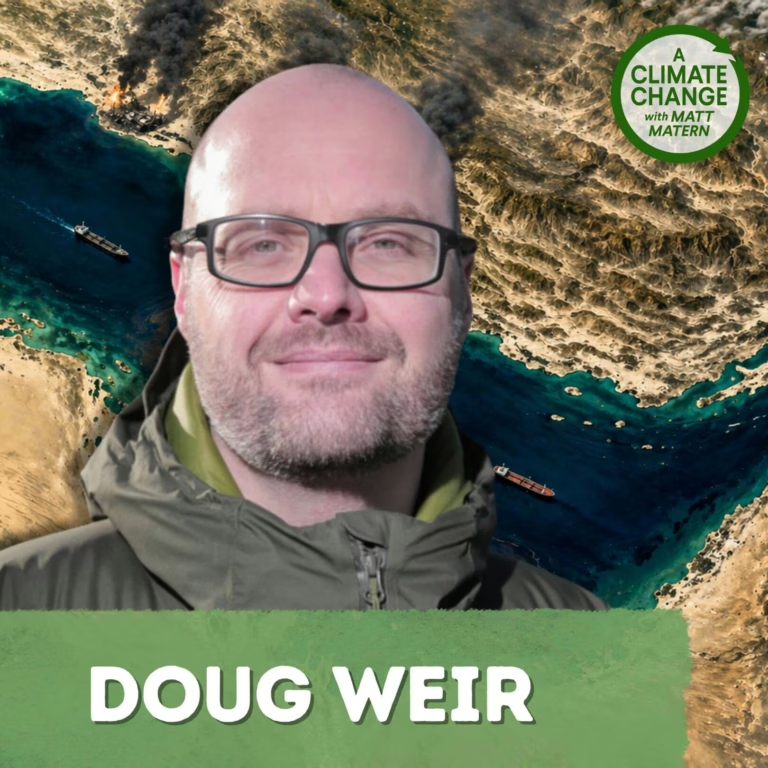
Matt speaks with Doug Weir, Director at the Conflict and Environment Observatory (CEOBS), about the environmental toll of armed conflict – and why it rarely gets the attention it deserves. They cover CEOBS’s real-time tracking of 300+ environmental incidents from the Iran war, including the Tehran oil fires and threats to the Persian Gulf’s fragile marine ecosystems. Doug also explains how rising military budgets are quietly undermining global climate progress, why the “military emissions gap” is a major blind spot in international climate accounting, and what it would take to hold governments accountable for environmental destruction.
You can still see the environmental impact of the battlefields in northern France. There’s area contaminated by an exploded ordnance, there’s area contaminated by heavy metals. So these legacies last a long time. We haven’t seen a huge amount of success in terms of regime change wars historically, both for the people, but certainly for the environments of those countries. We need to rethink what our national security is and where it comes from, because at the moment, we are increasing military spending in a way which is undermining our environment and ecosystem as we depend on and also impacting our ability to transition to a more sustainable future.
You’re listening to A Climate Change this is Matt Matern, your host, I’ve got a great guest on the program, Doug Weir. Doug is, you know, has a long background in the environmental movement. He is a director at the Conflict and Environmental Observatory. Doug, welcome to the program.
Hi Matt. Thanks for having me.
So Doug tell us a little bit about the conflict in environmental observatory.
So we launched Conflict and Environment Observatory (CEOBS) in 2018 and one of the key justifications it’s a charity in the UK, a 501, c3, and one of its main objects is to try and make environmental dimensions of armed conflicts and military activities more visible. And it’s one of the issues of the environmental field where there’s been a lack of data, a lack of attention. And our idea is that the more we can bring to policy debates and the more we can bring to the public, the more likely we will see actions to produce the environmental toll of conflicts and increase assistance post conflict for affected communities and ecosystems.
So what, what drew you to the environmental movement in the first place?
Well, I originally studied geology back in the day, and kind of wanted to, yeah, make some change for the environment took a bit of a winding path to get there through journalism and writing, and then, yeah, started working on depleted uranium weapons and toxic elements of war, yeah, around 20 years ago or so, and that kind of set me on the path looking at conflict pollution. And then along the way, when you’re working in these policy spaces, it’s kind of becomes clear that there’s just not enough data being brought to these spaces, because studying the environment in areas affected by conflicts is difficult because you don’t have access, but with better access to satellite imagery and open source intelligence through social media, all of a sudden we could start telling these environmental stories and getting them into policy spaces.
Well, tell us. I mean, obviously we’ve got numerous conflicts raging around the globe, two biggest ones that we’re aware of or focusing on, in the US or Ukraine and in Iran. So what? What have you found in both those conflicts, and how you know the effect, the environmental effects, on those societies and societies outside of the conflict areas?
Yeah, that’s a big question. So we were working on Ukraine prior to full scale invasion, and we’ve been doing a stack of work since February 22 I think one of the key things with Ukraine is just the scale of the damage. You know, you have this front line, which is hundreds of kilometers long. It’s slow moving, so it’s kind of this grinding damage across critical ecosystems, but also across really hazardous areas with the high density of industrial objects.
And this legacy in Ukraine’s east of 200 years of coal mining and heavy industry, and that’s kind of where conflict and front lines have chewed across in the history of the conflict in Ukraine, both prior to 2022 and now and then, we’ve also seen these attacks on cities and energy infrastructure. We’ve seen these really high profile issues, like the ongoing military occupation of the zaphirish nuclear power plant, which we’ve never seen that in a conflict before. We’ve seen the destruction of the kahovka dam, which obviously led to huge downstream impacts and also enormous upstream impacts for agriculture and irrigation and communities.
But I think one of the sort of really key things, and maybe that links us through to Iran, is around the profile of the environment in the conflict. So the environment in conflict, it’s like this whole cliche, but it’s like the silent victim, because we focus on the humanitarian impacts primarily, which is completely understandable. And so the environment has always been this kind of tertiary almost concern. And what we saw in Ukraine is that we had a country experiencing massive environmental damage, which had a really robust and vocal environmental civil society, the government elected to push environmental narratives, and also there’s a lot of support from the international community as well in terms of documenting harm.
And so what we saw with Ukraine was this incredibly high profile for the environment compared to most conflicts, and that’s now three. Add into sort of interesting trends around what recovery should look like in Ukraine, this idea of a sustainable recovery that speaks to addressing climate change and biodiversity loss and a sort of a positive, sustainable way to recover from conflict, using it as this inflection point. Interestingly, skipping to Iran, and so we’ve been monitoring the damage in Iran and across the region, and again, that’s at a really high profile in the media.
Like we’ve done a stack of work with journalists, and there’s been a lot of journalists coming to us asking, some of those are people we’ve spoken to about Ukraine. So there’s a sense that there’s a generation of journalists who are increasingly sensitized to these stories and how to tell them, but also, obviously, environmental concerns and awareness is rising across all these issues. So the damage which we see in conflicts links into those kind of meta narratives around climate crisis or biodiversity loss. In the case of Iran, we’ve seen these really high profile incidents.
So in Tehran, Israel bombed for oil storage and processing depots in and around Tehran, which is a city which is really predisposed to poor air quality. It’s backed by mountains, and particularly at night, pollutants are pushed down into the city. Obviously, you attack these oil sites overnight, and the city is just filled with pollution, with millions of people exposed. And that really caught the world’s attention as a particular incident. And that’s often the way when we think of these conflicts is that they all have their individual narratives of environmental harm, and it’s interesting which particular instance capture the world’s attention, or which particular narratives sort of become used by journalists or by civil society as like a shorthand for the damage in the conflict.
Yeah, particular that targeting of the oil depots there, and how long would that condition last for? I mean, obviously the pollutants are going to come down into the water stream and all kinds of other things. So it’s not fully measurable at this point in time, but at some point, the kind of clouds cleared and people may hit air quality may have returned to something more resembling normal, I assume.
Yeah. I mean, this is one of those kind of ephemeral impacts of conflict, in some respects, in terms of, like, the initial air quality impacts. You know, these sites were smoldering for a number of days, and that’s actually when you can get quite a lot of pollutants at ground level, because they’re not lofted up high into the atmosphere. But obviously, then we also had all this fallout from the plumes which will impact soil and impact groundwater potentially.
So yeah, it was kind of a short lived, very high intensity impact, but it’s actually part and parcel of the much wider suite of impacts. Now, some of these are long term, some of these are short term. Some have short term effects and also long term effects. And it’s sometimes a real challenge to try and sort of map and pull apart and tease out all these different sorts of potential impacts.
Well, it’s definitely a value shift, and that, you know, I was growing up in the midst of the Cold War and and, you know, we were hiding under our desks waiting a thermonuclear attack. I don’t think hiding on our desk would have done a whole lot of good for a thermonuclear attack, but that’s what we did. And the focus was on the totalitarian regimes that were oppressing people, and that was the primary concern of, you know, the West at that point in time, there wasn’t a, it wasn’t really a conversation around the environmental devastation of a society during wartime. You know, you know, I don’t recall ever hearing or reading about like World War Two environmental damage. You know, it may have occurred like fire bombing is, you know, a horrendous thing, but, you know, you didn’t hear about, oh, what was the fire fallout of that environmentally
Yeah, yes, no, I think some of that is down to Yeah, attention and narratives and focus, but some of it’s just down to lack of data and lack of research as well. Research as well. You know, there are interesting environmental narratives from these conflicts. So in World War Two, we had this Operation Tidal Wave, where the US and others destroyed a lot of Romania’s oil production facilities. And then years later, in Syria, when they’re doing a similar thing, attacking Assad’s oil facilities, it was Operation Tidal Wave Two at that point.
So yeah, there is kind of echoes through history. When we look at World War One, you know, you can still see the environmental impact of the battlefields in northern France. There’s area contaminated by an exploded ordnance. There’s area contaminated by heavy metals. So these legacies last a long time, even if we’re not necessarily able to sort of name it, or have sufficient research for it, or get it into those wider public consciousness. Similarly, you know, we can look at the Vietnam War, particularly as this turning point in terms of a legal framework.
That was the first point where international humanitarian law started really addressing the environmental impacts of conflict in a meaningful way. And we also had the N Mod convention. Which was around criminalizing the potential use, or expanding the potential use of the environment as a weapon of war. So that was kind of the sense of emergence, like in that sort of early 70s period, when we first started sort of thinking about the environmental consequences of conflict and trying to do something about it from a policy perspective, I guess, kind of putting a finer point on it.
You know, there are a lot of people in the Persian community here in Los Angeles who are kind of aching for regime change in Iran. And certainly there are millions of Iranians in Iran that are aching for regime change. And, you know, I guess, what is the, how to balance the the value of them fighting for, you know, maybe potential personal freedom in in Iran, versus the environmental damage, you know, how do we weigh that, the calculus of of those two value sets?
I mean, we can maybe look at the past history of interventions and regime change wars in terms of their success, in terms of regime change, but also in terms of environmental legacy that they generate. We look at Libya. We can look at Iraq, both countries where regime change wars have destabilized the country. And it kind of points to one of the aspects of environmental damage, which we don’t necessarily focus on as much like we look at the direct damage. Primarily it’s the things that are burning in the papers that are photogenic and get our attention, like here at wildfires in Iran.
But actually with most conflicts, when we look at them, we also see this huge collapse in environmental governance, like there’s not money for the environmental things which governments do. There’s not the capacity for it. There’s not necessarily access and security in all parts of the country. Countries drop out of like the international system when it comes to funding and support for environmental work. And these impacts on indirect impacts on environmental governance in countries have this incredibly long tails of impact.
Like we look at look at Libya, we look at Iraq, and there’s wartime environmental degradation, and then also this sort of compounding impact of weak environmental governance, which has this huge impact on the civilian population. So I think we need to be careful about what we kind of wish for, and think about quite carefully about the tools that we use to get there. Like we haven’t seen a huge amount of success in terms of regime change, wars historically, both for the people, but certainly for the environments of those countries.
Yeah, of course. You know to talk about the regime in Iran has kind of been an environmental disaster for that country in terms of water mismanagement. I think that they have, you know, they’re on the verge of having to evacuate Tehran because of, you know, poor water management. You know, were they really effectively managing the environment in Iran pre war?
No, I think there’s huge issues around, yeah, sort of compounding impacts of climate change and also of poor environmental governance. But it’s kind of an open and interesting question about what we’ve seen now, whether this is going to improve environmental governance in Iran, where we’ve actually seen a more hard line regime, potentially now in place, potentially even more constraints on environmental civil society in Iran, certainly on the activities of the many Iranian environmental experts who’ve been trying to work on these issues over years with facing a really sort of problematic system of government, have been trying to do it. So again, it’s like, Is this really the solution which is going to bring about improved environmental governance in Iran? And I think every conflict we look at suggests that that isn’t going to be the case.
Yeah. I mean, I I hate to be the devil in this conversation, because it is. I don’t necessarily agree with what’s happening over there, but I’m just kind of taking a different perspective and saying, Hey, what about this? Because I believe the current administration is completely botched whatever operation they’ve had over there so far, but I really dislike the current regime in Iran. So it’s kind of torn between these two poles that that are neither of them are particularly good.
Yeah, no, I think it’s important to answer these questions and think about these things, because then it lets you opens up those doors to think about, well, what happens to environmental governance in Iran? What happens to regional environmental governance? What happens in the countries in the region like Lebanon, where you know, you see this conflict in Iran, there’s almost like cover for severe environmental damage in Lebanon, a country which has experienced cycles and environmental damage for decades.
So, yeah, I think it is important to question and challenge these things and see whether you know this is an illegal war. You know there was no legal justification for it, and we can see that it’s having this kind of spiraling pattern of environmental impacts domestically in Iran. And but also more broadly across the region, and it’s critical that we sit back and sort of challenge these and interrogate them.
I think, well, certainly one could argue that if they’d gone directly to maybe a blockade, that would have been a a less invasive and, you know, you know, less problematic way to deal with this than a full on bombing of the country that may be the case, or even some strategic patience. Let me Ayatollah was 84 years old, so didn’t necessarily have that long left in him, and you may have had some organic regime change potentially, or at least some tweaks on the regime, but I think it’s also a mischaracterization or misunderstanding of the regime as a single person from the US, whereas actually what we’ve seen is around that you have this structure of the rev created by the revolution, which is actually incredibly complex with various layers, and it’s not about one man and removing one man. And I think that’s seems to be some of the misunderstanding that the US has had.
Right, right. I mean, you have the Revolutionary Guard that has, you know, its tentacles and half the economy, so you’re really rooting them out. Is an extraordinarily complex process, and it might, yeah, it might take decades. I don’t know it. They’re as firmly entrenched as Stalin was in Russia or in the Soviet Union, so, or maybe even more firmly entrenched, they’ve, they’ve been governing for 47 years.
Stalin only had, you know, 15 or 20. You know, I was thinking, though, there is there a silver lining to this for the environmental movement? And maybe that’s hard to say at this moment, but in terms of oil prices going up, it may make people less interested in using oil going forward, and maybe be a boom for the solar and wind industries that hey, you don’t want to rely upon oil coming from the Persian Gulf or anywhere else, if you can avoid it this, this would be a good time to pivot away from fossil fuels to something cleaner.
Yeah, I think on a quite a narrow and simple level, you know, we saw this at the oil shock at the time of the full scale invasion of Ukraine, that it had these short term impacts which may have generated emissions. So, for example, you saw Germany increasing coal use. For example, for energy as German as Russian, gas was less in the mix. And with, you know, over the longer term, we saw policy changes within EU which are driving decarbonisation.
And I think what we’re seeing with this new oil shock is that again, it has refocused. And we saw ursch Liv under Lyon yesterday making statements about the importance and criticality of Europe, for example, pushing its renewable energy transition at a faster pace in response to this oil shock. So I think that is good. But actually, when we scratch below the surface, and this is an area which doesn’t really get enough attention, because it’s so complicated when we look at these different interactions of how these kind of events impact the environment and environmental transition. So for example, the sulfur which is a byproduct of oil production and gas production in the region is a critical component for batteries.
And so it’s not just about reducing oil from the economy. Actually, our energy transition materials and production is still intimately linked with our sort of legacy hydrocarbon production. So while we have seen increased oil prices pushing green transition issues, actually, it’s still not quite possible to delete the two, and we’re going to have an impact on battery prices and battery battery availability, even as consumers are rushing to buy their EVs and early sleep on the lines of this world, are pushing policy changes on regional levels. So it’s a really complicated picture, and it’s one which wasn’t doesn’t really get quite enough attention at the moment.
Let’s go back to the Straits of Hormuz and marine pollution caused by the things that are going on in in the Persian Gulf right now.
Yeah, I think this is one of the big concerns throughout the conflict. So the Persian Gulf is like no stranger to oil pollution, whether it’s just on a daily basis from the amount of oil traffic that it gets, but also when we looked at linked to conflicts. So 1991 Gulf War pipelines were opened, and we had one of the biggest oil spills in history in the Persian Gulf. Saudi Arabia was still cleaning up beaches up until recently. So is this big concern also in late 80s in the Iran Iraq war there, when you had attacks on offshore oil infrastructure and tankers. So again, huge oil spills nowadays.
Yeah, there’s a huge number of issues over all these desalination plants, for example, around the Persian Gulf, which can’t function properly when there’s oil in the water. But we also have critical. Ecosystems within the Persian Gulf, which you know somehow still survive despite all these sort of anthropogenic pressures. So we have resident humpback whale population, which sticks around the Persian Gulf. We have dugongs, we have sea grass beds, we have coral reefs. And we know from past conflicts that oil spills and spills are extremely likely. So we saw all these attacks on Iranian naval vessels. So there are a lot of sunk vessels currently leaking oil.
There was this drone carrier beside Bagheri, which is currently run aground quite close to an important ecological area. And you can see oil coming out of this thing. And we saw a lot of attacks on coastal and port facilities, and we tend to see oil spills and chemical spills associated with these kind of events. What we were really concerned about, obviously, was sort of attacks on some of these very large tankers carrying oil, because that obviously creates the spectra of huge oil spills at a time when the response capacity isn’t really there to respond to them properly and appropriately, because the big drones flying overhead and the rest, we haven’t seen that yet.
We saw a couple of tankers off Basra which were hit and which were on fire whilst they were transferring oil between themselves. But thankfully, that’s kind of been the limit so far. But yeah, there’s huge potential there. You know, if we see an escalation, if we see attacks on cargo Island, there’s so much potential for miscalculation and so much uncertainty around the trajectory of a conflict and how things are going to work out. It’s something which we really need to keep an eye on. So the Iranian attacks on on the tankers thus far, haven’t sunk any tankers. Is that correct?
No, we’ve seen quite a few hits like the a lot of it takes have been cargo vessels. Some of them have been tankers. Those that have been hit, we tend to see sort of hits above the water line, for example, in the superstructure, rather than attacks below which have caused oil spills, apart from these two off Basra, which, yeah, we did see a big firefighting response to those, but I think most people were burnt off in that situation.
So where do you see this going, in terms of, if you had to prognosticate as far as where this war is going, and what are the likely outcomes of it, given your current perspective,
I guess so difficult to say, and that’s been the issue throughout when we’re trying to sort of plan our monitoring work and what capacity we would need and how long we’re going to be able to sustain it for, in addition to doing our projects and other work. And it’s it’s just really unclear, because the there was so little strategic justification for it, the objectives have changed as the war has gone on. Obviously, the Iranian response wasn’t really planned in for by the US.
Israel is doing its own own thing, mowing the lawn as it does, and so it’s really difficult to see how this is going to work out. People are going to have to back down. There’s going to have to be compromises. Iran’s potentially been left in a stronger position. Certainly, the regime has been left in a stronger position than it was before, potentially. So yeah, it seems really unclear. And then, while we’ve had this big attention on the environment, how those environmental issues which have been generated by this conflict again, to be addressed also remains incredibly unclear.
When you know, as we discussed, it’s not a positive space for environmental governance around there’s lots of technical experts there, but this centralization government and this kind of lack of transparency and openness around environmental issues mean it’s a really difficult space to try and imagine how we’re going to get these pollution risks which have been generated by the Conflict addressed properly, and that has implications for public health and also for ecosystems as well. So, yeah, huge question, Matt.
I think, well, I recall that Israel struck one of the major petrochemical plants in Iran and and that Iran has a pretty substantial petrochemical industry that generates, I think, almost as much revenue or secondary to its oil industry. What? What’s your understanding of the nature of that damage and and how it affects the environment?
Yeah, I think this maybe speaks to some of the challenges we’ve had with this conflict in terms of data availability, we’ve seen quite a lot of satellite imagery providers restrict access to data or put in delays on the data that’s released. So the picture which we have is very partial in terms of what has been made available to the public for review. We conduct remote environmental assessments of these conflicts, so we’ll use satellite imagery, but also whatever open source intelligence we can find in terms of video footage from the ground on social media, for example, that inevitably means there are limits to what we can say in most conflicts.
You know, you can’t really validate these things until you get on the ground and take samples if and when that becomes possible. Available, but at least you can help to point to the sites where attention is needed, I think, in the case of this conflict and impacts like that on the petrochemical sites, you know, we can’t say a huge amount at the moment in terms of environmental risks and public health risks. We can see how long the fires have been going there. We can see which bits of the processes on these very large industrial sites have been hit, but in terms of actually being able to give meaningful intelligence about the personalized health or environmental risks it’s it’s been really difficult in the context of this war.
Well, kind of looking at this thing through a political lens. We recently had the, what I would call a semi totalitarian regime in Hungary fall, a victor, or bonds government lost a recent election. I’m curious as to what his environmental legacy was. You know, they don’t. I haven’t read much about it here in the States, but I kind of look at other totalitarian groups, such as Putin’s government in in Russia, being a really horrendous polluter and allowing tons of methane to be emitted when better technology is available in the oil and gas industry. In the US, some of the US majors have adopted and, you know, reduce the amount of methane, whereas kind of the rogue producers aren’t doing those kinds of things. Is there some kind of assessment as to totalitarian governments, you know, effect on the environment versus democratic systems?
Interesting question. Yeah. I mean, I’m just thinking, in Hungary’s case, there’s a few ways of looking at it. You know, from a European perspective, we’ve seen the role that Orban has played for years in blocking EU progress on issues, particularly with respect to support to Ukraine, for example, and helping to prolong the conflict there by blocking weapons transfers and also funding for recovery and reconstruction and things.
We can also see the kind of impact that the populist right across Europe which orban’s regime was supporting. So for example, we have people in the UK on the populist right who had been supported financially by Orban at CPAC as well, I think, which is being supported by them. And so you have these kind of tentacles of right populism in the across the EU which are very much opposed to and linked in to any sort of environmental progress you know about the climate now that they’re supporting, for example. And also we’ve seen sort of governments reacting to this right wing populism by perhaps dialing back on environmental policies like net zero policies and things like that.
So it’s it’s played a role in creating this kind of quite toxic environment for environmental progress across the EU which has been linked to right wing populism, which has been linked to this wider web which connects JD Vance and his visit to Hungary and to Putin as well. So, yeah, I think it was a really significant moment. I was watching it on the TV, and, you know, the celebration of Peter Magyar.
And it just felt incredible that this relatively small country in Europe had had this sort of global impact in terms of its connections to the US, in terms of connections to Putin, and the impact that it was having on the EU and just incredible how somebody can be such a stick in the wheel of environmental progress and Democrats and democracy, I think, across such a massive area, it was, yeah, potentially, like hugely significant moment, I think for a lot of our countries, right, right?
And I kind of look at, you know, Putin has also caused, you know, something that I think you’ve written about is the increase in defense spending and how that may affect the environment and and certainly, Putin’s invasion of Ukraine has ratcheted up defense spending dramatically in the EU, you know, for good reason to protect themselves. But it was probably it was not necessary, if he had not invaded Ukraine, which was, you know, a debacle, both for him and the Ukraine.
So now everybody’s going to spend trillions of dollars more on defense than we could have spent on the environment. So that’s a disaster, you know. Kind of the exception to the rule, I guess, is China, in part in that they, well, at least, are pushing environmental progress, which is very much. You know, kind of counter what we would we look in in all other totalitarian systems, from what I can tell.
Yeah, I guess in terms of the energy transition and energy security, China is pretty progressive, but I don’t think. Necessarily the full story. You know, I’m just thinking of like the South China Sea and the small islands which they are currently concreting over to turn into military bases and facilities. So, yeah, just for clarification, order of the Chinese government, you know, all their coal plants, or, you know, you know, tons of other things they’re doing, but that, you know, there is at least some thing going on that’s positive regarding the environment there, whereas in Russia, I can’t see, like, anything happening.
No, I think, yeah, I think that’s a fair analysis. So as far as Russia is concerned, I think maybe coming back to the impact of Ukraine and the geopolitical situation and the diversion of support for environmental activities, you know, we’ve seen that so clearly in the UK, like the government has been incredibly explicit about it. Of you know, just the other month, saying we are cutting funding to overseas find aid to climate transition and for support for climate adaptation. In global South, we are cutting money towards conservation projects and biodiversity because we are going to use that money to increase our defense budget.
And it’s completely explicit in the UK, and again, it speaks to this question, like the populist right, but it’s for Labor government saying, what is the kind of messaging which the rights who we’re trying to attract will support and as well, cut the aid funding and direct that money to defense. So we see that on kind of the domestic level, more globally, obviously, there’s this huge military spending globally. At the moment, it’s increasing year on year. We know, for example, it’s, you know, Rob’s money for environmental progress and from sustainable development. We can also see it’s going to have this huge carbon impact as well.
Like all of these dollars spent on military activities, come with a carbon cost, which at the moment isn’t really documented properly, because we have this military exemption under the UN Framework Convention on Climate Change, where countries only voluntarily have to report their military greenhouse gas emissions. So we are seeing countries within the EU and others, and even the EU itself, sort of making these huge pledges to increase military spending, but it’s completely de linked from their climate policies, because it isn’t necessarily captured within these climate plans.
And ministries always kind of enjoy this exemption from environmental norms and environmental governance, which is incredibly unjustified in places. And so we see this kind of disconnect between security policy and environmental policy, and that comes despite, you know, 1520, years of this sort of focus around climate change and security and various people, particularly in the US, pushing this agenda that climate change is a threat multiplier. It’s something militias have to be aware of. It’s got military attention. But as soon as kind of push comes to shove, we just see this grotesque increase in military expenditure globally, which is coming completely expensive global climate action.
Yeah, it’s it’s scary and it’s unfortunate. I This isn’t exactly on point to your area of study, but the the pressure to drill in the North Sea, or duro more in the North Sea, is something that’s playing out in the UK. I’m curious as to, you know how that you know that certainly is related to the military issues. Because if there weren’t such pressures on the Persian Gulf and the oil prices rising, there wouldn’t be as much pressure to drill in the North Sea, right?
Yeah, yes. I know. I think it’s it’s one of it’s one of those conversations which has been really tainted by the populist right who have this kind of nativist argument around you know, we can’t rely on these imports of fossil fuels. Therefore, we need to drill more and sell more of our own fossil fuels, and it’ll also reduce our domestic energy prices. And they completely ignore the fact that the energy prices are set on the international market, and whatever you’re paying in the UK is set beyond the UK, so it’ll have no impact whatsoever on our prices.
Similarly, it’s a declining basin. We have rinsed it for decades. We have spent all the money on tax breaks. We haven’t been like Norway, who screwed it away in their sovereign wealth fund very smartly as a nest egg for future generations. We didn’t. We just did tax cuts with our oil profits and revenues. Actually, what we need to be doing with the North Sea and is kind of what we’re doing a reasonable job of as well, which is expanding sort of offshore wind in that region, looking at interconnectors with the EU, looking at trying to make the most of this kind of European wide renewable energy network, which will give us this genuine sort of energy security and stability, and really to accelerate the transition as well.
So yeah, again, it’s part of this sort of legacy fossil fuel thinking, which we see a lot from the populist right of immediately grab for more resources and not actually deal with the structural issues around. Around our fossil fuel dependence and our fossil fuel insecurity that comes from that dependence.
What percentage of electricity is generated in the UK from renewables at this point?
So yeah, this is quite exciting, actually, just looking at the grid. So there’s a nice little app you can look at to see what the split on the grid is and yeah, the other weekend we had some windy weather and some sunny weather just start of April over Easter, and I think we were on 94% non fossil energy. So a chunk of that small chunk of that was nuclear, but the rest of it was wind and solar and some hydro as well.
So I think it was like 4% on gas, and there were a bunch of people on social people on social media waiting for the moment where we went 100% or over 100% or exporting as well. But so on a windy and sunny day, we’re not doing too badly in the UK, which is positive. I think, yeah, still the way to go.
Yeah, that’s, that’s very impressive. I guess Denmark has gone over 100% on occasion, and has said that they want to be kind of, you know, the Saudi Arabia, of hydrogen in creating a bunch of green hydrogen to to export. And that I had, I’ve had two hydrogen cars, so I’m kind of a proponent of hydrogen. So is there a potential in the UK of greatly expanding solar and wind to the point where, you know, 100% of electricity, but also creating enough green hydrogen to to fuel a substantial amount of vehicle traffic?
We have a huge wind capacity here, right perched on the edge of Europe. Scotland in particular, has a lot of wind capacity. Solar is not too bad down south. I think more of the issue for UK is that we’re still way behind in terms of our EV use, and then also in terms of our home energy use as well. We have 26 million homes in the UK, and a really small proportion of them are properly insulated.
Still have, yeah, huge amount of use of gas borers. We’ve seen a lot of issues around air source, heat pumps and some sort of misinformation around them. So in a general sort of we’ve had about 14 years of Conservative government where we didn’t see enough investment in this energy transition in the UK, too much reliance on fossil fuels. And so we are sort of behind the curve, but definitely been changing under the Labor government and Ed Miliband, who’s, yeah, it’s been pretty impressive on some of these things, but we’re still way behind. So while we’re maybe generating a lot of energy, we still have sort of real deep city structural issues to address in terms of home energy use.
For example, who do you see as the country that is maybe furthest along in this green energy transition that maybe is the best model for countries going forward?
Yeah, I don’t know. I wouldn’t like to speculate out my my focus area.
Yeah, yeah, I was curious. I mean, I was talking to somebody recently about Costa Rica, and then they’re pretty far along and I mean, but they don’t have an industrial society, so it’s a little bit different in terms of the industrial needs of energy and and how, you know, AI is, is kind of warping the curve in terms of catching up with it seems like, Okay, we creating a lot of green energy.
And now AI is saying, Well, you know, you’re going to have to increase that by X percentage more, which is, which is challenging, and how much of that AI is really necessary. It’s kind of, it’s almost like a AI war is going on with all these data centers being built, which probably are not all necessary to have to have 10 companies or 100 companies building out these things, is that? Is that really necessary for the the environment, or for even for the progress it’s allegedly going to be made here?
Yeah, it’s big questions. I guess, from our perspective, it was interesting to see our first targeting of data centers in Persian Gulf during the conflict with Iran. That’s been a new thing. I think maybe on the other angle as well, around kind of energy and security, and thinking about which countries are doing well from a European perspective, it was noticeable to see Spain being quite well buffered and insulated from the energy price shock because they had pushed so hard on solar in particular, but also wind as well, and they’ve been doing really well from European level in terms of energy prices which are. In this current price shock.
I mean, what’s also been interesting for men as well, when you look at the military and security spending. So NATO has this 5% target, right? And three and a half percent of that is on hard military stuff. And then there’s one and a half percent which can be on security infrastructure more broadly. And it’s been interesting to hear Spain’s perspective on what that 1.5% of resilience and infrastructure can be spent on and to them, it’s renewable and energy infrastructure which is part of their perceived as part of their sort of national security. So I think it kind of speaks to this question around energy and national security, and what genuinely brings countries security in this day and age, it’s probably not building loads of data centers and then trying to energize them.
It’s thinking sort of more risk terms about what are the security threats that countries face. Like another example in the UK, we recently had a leak of this risk assessment, national security risk assessment around biodiversity loss, and it had been drawn up by some experts and by some spooks in the ministry, and it essentially talked about the national security risk to the UK from global biodiversity loss and ecosystem collapse. And it was pretty explicit that we face a number of risks, whether it’s risk to our food security, whether it’s risk linked to other ecosystem services provided by nature.
And there are obviously solutions in there which are protecting nature globally and strengthening international protections for nature and for ecosystems, and putting more into that. But actually, the debate we ended up having was really ill informed. And we had these kind of people in our upper house, our house of lords, our unelected house, and they say, Well, yeah, we better buy more frigates to protect ourselves when there’s issues around food security, and it’s these kind of maladaptive knee jerk responses to security threats, so like, more militarization, more securitization, and not dealing with the root problems of the threats that we face, whether it’s climate change, whether it’s biodiversity loss.
And it speaks to this question of like, we need to rethink what human security is and what our national security is and where it comes from, because at the moment, we are increasing military spending in a way which is undermining our environment and ecosystems we depend on, and also impacting our ability to transition to a more sustainable future. Yeah, I’ll leave it there.
I have thought for a long time that the US would be far better served of going down the path of renewables, because then we would no longer be dependent upon foreign oil. Now this was kind of pre Permian Basin drilling and in the fracking. But the fracking has its own set of costs, which are extraordinary, of the pollution that that has caused, and we would have been far better off kind of using the path that Jimmy Carter was kind of leading us down, which is going putting solar on the White House in 19 whatever that was 7879 and saying, Hey, let’s, let’s wean ourselves off of fossil fuels that will actually make us a lot more secure.
And unfortunately, that way of thinking didn’t go too far. You know, it’s, it’s heartening to hear that Spain is actually being thoughtful about this and saying, Hey, that 1.5% we want to make ourselves more secure, so that we’re not as reliant upon fossil fuels and we’re we’ll be okay, regardless of what happens. Are any other countries in the EU thinking that way?
Or, yeah, maybe not quite the same esthetic name, and there’s interesting thinking going on. So for example, Latvia in the Baltics, they have been they share a border with Russia. They formally part of the Soviet Union, and they’ve been thinking about how they can defend themselves. And one of the things they’re looking at, at the moment is rewetting peat bogs along the border region to stop mechanized advances of tanks and things you can’t drive tanks over peat box, obviously. Now that brings you security. It also brings you carbon sequestration.
It brings you wider ecosystem benefits as well. And it’s kind of just a conversation which is picking up at the moment around this new, I guess, version of environmental security in terms of other countries. I mean, what’s interesting in the next week or two, we’ve got this conference kicking off in Santa Mater, in Colombia, this coal town around fossil fuel Non Proliferation Treaty, or process to wean countries off fossil fuels and take a process outside of the UN Framework Convention on Climate Change to try and get states to sign up to reducing fossil fuel usage.
My colleague Annie is going over. She does our work on military and conflict greenhouse gas emissions, just to try and make sure that there’s conversations around the military contribution and military use of fossil fuels are in the mix, and also these conversations around fossil fuels and security and. Different dimensions of this, right when we think about the experience we’ve seen in Persian Gulf at the moment, where we have blocks and military action which affect fossil fuel availability and the supply shocks and price shocks that we see. But there’s also huge questions for fossil fuel producers, like countries like Iraq, where you have an economy which is like 90% plus dependent on fossil fuels, and what happens in those countries, those rentier economies, when you try and wean them off fossil fuels? What happens to those societies?
What happens to the economy? What happens to their stability? So there’s lots of different things which need to kind of be discussed in the context of this transition away from fossil fuels, and it’s really exciting. I think that conversation hopefully will be starting in the next few weeks, and it will be interesting to see where that goes, and the process as a whole, takes something from some of the processes in humanitarian disarmament. So the Treaty of banning landmines, treaty banning cluster munitions, or recent treaty on nuclear weapons, they have been taken out of the consensus processes in the UN because when you have consensus processes, you have countries who can block it, right?
And that’s the problem with the UN Framework Convention on Climate Change, that it’s a consensus process like most the environmental agreements are, and that means you’re always playing to the lowest common denominator. You’ve got Saudi Arabia and others in the room saying, Yeah, we don’t want any progress in this space whatsoever. And so what a bunch of countries and civil society are potentially doing is having a conversation outside of that space, particularly focusing on, how can we reduce fossil fuels and wean the world off them?
And it’s going to be super interesting and exciting to watch. I think. What happens when you have a bunch of states? How many states do you need buying into this idea to create that kind of norm that shifts the economic picture and changes the sort of path around our future and fossil fuels. So yeah, it’s going to be really interesting space to watch.
I think it is. I know in Colombia that and some other South American countries, they’ve kind of eschewed further oil development. And, you know, that’s fascinating. It’s kind of like unilateral disarmament and so and kind of on a related note was, you know, traveling a little bit in South America last year, I just noticed the it’s just not as militarized as the US, like they, they haven’t fought many wars down there over the last number of years.
I mean, there have been some, you know, civil, internal conflicts, not not great, but you know, for the US, the amount of money that we spend on preparing for war is ginormous, I mean, and and it’s only allegedly going to increase. And you look at what’s happening around the world, this bellicose kind of talk and action is just rate continues to raise the temperature so that everybody the next country has to get more weapons to just, you know, to balance the threat from wherever it’s coming from, which is not a very virtuous cycle. How do we get ourselves out of that one?
Yeah, I think that’s a really good point. You know, when you look at the region and there’s a reason that Costa Rica has a very high standard of living, right? It’s because they don’t have a military, and they haven’t spent all that money on their military historically, yeah, I think it goes back to this question of, how do we reconceptualize national security and human security and environmental security? What genuinely gives us security and makes us secure? It’s not necessarily investment in huge militaries.
I mean, the US is obviously an outlier in terms of the scale of the military budget, in terms of the degree of the extent of the relationships between the private sector and the state, and the amount of money being spent and funneled to various areas of the US and various industries. But at the same time, you know, we’re seeing defense budgets increasing globally as well.
So we are on a sort of worrying transition point, what is worrying trajectory, and at a time where we need to be taking urgent action on these existential environmental threats, on climate, on biodiversity, on pollution, and yet we are seemingly funneling billions more in funding towards militaries and towards an idea of security which won’t really genuinely meet our security needs. So yeah, we need a huge rethink. I think. How would you get that rethink? Yeah, that’s a difficult question.
Yeah, well, in the US, like we’ve, we had George Washington was saying, Hey, don’t get involved in any conflicts outside the US, like, stay within our borders. And almost immediately they, they threw that to the wind. I mean, he was, he was the leader. He was the one who said. The standard, and, you know, set a good example in so many ways, but that particular axiom has been ignored almost entirely by the US government ever since Washington uttered the words.
But you know, we could probably be well served if we went back to that, that model, because it, we’re, we’re creating a whole lot of devastation by by attacking other countries. It’s, it’s, hasn’t worked as well as we look we would have liked, I guess.
Yeah. I mean, there’s a lot of straight lines and instability around the world as a legacy of the British Empire, as well, as, to be said, those suspiciously straight lines you see across the Middle East, which had no reflection whatsoever on the people who actually lived there, and, yeah, been the cause of friction and tension for hundreds of years. Yeah, it’s not a great legacy for UK here for I think.
Yeah, well, I guess kudos to you and your group for documenting what’s going on out there in the world and put shining a light on it. You’ve been involved in the UN environmental assembly process on protecting environment war. Do you think those legal frameworks have any teeth, or are we walking away from the UN in serious ways over the last few years or longer?
Yeah, I think what we’ve seen over the last two decades is a real reappraisal of how we can develop legal protection for the environment in relation to armed conflicts. And there’s maybe three trends at the moment which are kind of of interest. So one has been an update to international humanitarian law. So that’s been really interesting to look at how some of these quite old rules and international humanitarian law can be upgraded and re understood for the contemporary age of like and how our understanding of the environment has changed and how the rules need to change to reflect that.
The second one was a sort of process which was initiated by UN Environment Program and then led to the UN’s International Law Commission, which is kind of its legal making body, undertaking a 10 year process to develop principles on the protection of the environment. Of the environment in relation to armed conflicts, and one of the key ideas was that international humanitarian law only applies during conflicts, and its environmental provisions aren’t particularly strong. Actually, it’s not the only law that applies during this time.
And so the International Law Commission looked at human rights law, they looked at security law, they looked at international environmental law for guidance and principles that could help offer protection the environment before, during and after armed conflicts and also in situations of occupation. Fast forward a little bit to today, and there’s a lot of folks at the moment in terms of environmental accountability, and so we have this huge conversation around developing this national crime of ecocide, adding it to the Rome Statute of the International Criminal Court, for example.
A lot of momentum and interest around that. And then the other interesting element, I guess, is recent work of the International Criminal Court itself, which is so it has its Rome Statute crimes, so things like crimes against humanity, war crimes, genocide. And so they have gone and had a look at like, okay, how can we bring the environment into our work on these crimes? So can we look at how one actor might devastate the environment to try and drive genocide a region? And so they’ve just been developing their kind of guidance. They’re also looking at guides of how they collect evidence, like potentially the role of civil society and other stuff.
Other stakeholders in supporting the court in these processes. And so, yeah, you can look at a situation like Iran, where belligerents just seem to be acting completely outside of any legal norms, but at the same time that, yeah, it’s easy to kind of give up hope and to ignore the fact that there is an amazing amount of work that has been done over the last couple of decades to try and develop and strengthen these legal frameworks. And ultimately, you know, we have a lot of law there. It comes down to a case of political will. We don’t necessarily see this when it works.
We just see it when it doesn’t work or when it’s ignored. But yeah, the tools are increasingly there around accountability and around strengthening protections for civilians, but also for ecosystems as well. And obviously it’s two sides of the same coin that you can’t protect people without protecting their environment, because we have so many different dependencies on that.
So yeah, it’s been an interesting space over the last couple of decades, and we’ve come a long way since the late 60s, early 70s, I think the lawyer in me wants to ask some follow up questions on that, you know, how do we define ecocide? And has there ever been a trial where somebody was charged with that? And, you know, what? How has it played out? Real Time. You know, it seems like that is a very challenging thing to define. And you know, what may be Ecocide in your mind may be, you know, something different in somebody else’s.
Yeah, I think it’s interesting the Ecocide debate, and I think there’s a big gaps between kind of public understanding of the term and how people are using it, with respect to Gaza, for example, and actually what the reality is and the current limits of the law. So stop Ecocide international the NGO, they brought legal scholars together and came up with a definition, proposed definition for ecocide, which is the one they would like the International Criminal Court to adopt.
At the same time, there are a small number of states who have Ecocide in their national statutes. Ukraine and Russia both have ecocide. So quite a few of the former Soviet Bloc countries have Ecocide in their statute books. And so, for example, Ukraine has been putting together Ecocide cases under domestic Ukrainian law, which has its own definition, to try and bring Russian military personnel to justice. So for example, for destruction of a Kafka Dam and the people who ordered that. So they have a number of cases which they’ve been pursuing.
So yeah, it’s an interesting one. We see some actions being brought on domestic cases for ecocide, but we’re still lacking this kind of international crime of ecocide, and yet the public is increasingly looking at environmental damage in conflict areas and going, that’s ecocide, irrespective of whether you have a legal definition that’s sort of well understood by the public, but it’s almost become this popularized term in some respects.
Well, I guess I look at it from a kind of real politic perspective, and say, you know, say there’s a settlement between Russia and Ukraine eventually, chances are they’re going to allow, you know, not the Russians are going to say, I’m not signing off on any settlement which says that you Get to prosecute me for Ecocide or war crimes or any of that.
You know, what’s done is done. And we kind of wash our hands and say, you know, it’s it’s a done deal. I assume that’s the only deal they’re going to sign off on which would allow them to walk from their crimes, unfortunately, but I it’s hard to imagine that they’re going to agree to let themselves be prosecuted going forward. What are your thoughts on that?
Yeah, I think, I think a lot of time when we talk about these and think about accountability, it’s not a case that we lack the legal tools. Ultimately, it’s these are political questions at the end of the day, and you’ve seen it in terms of the arguments around environmental reparations for Ukraine as well. You know, there was a lot of hope and anticipation at the start the war that Russia’s frozen assets of the EU and others were holding could be used to pay reparations to Ukraine for the damage. There is precedent for this.
We had the UN Compensation Commission after the 1991 Gulf War, which was a UN Security Council mandated thing where countries impacted by Iraq’s invasion of Kuwait, including Kuwait, could pursue damages, and there was a class of those damages right at the very end, for environmental harm. Similarly, we were hoping to see something along those lines for Ukraine, but obviously it was never going to happen for a UN Security happen for a UN Security Council Resolution. Now, at the moment, the Council of Europe in the EU, they set up this register of damage for Ukraine, which is gathering evidence of damage, around deaths, around civilian loss, around damage to property, impacts on businesses. For example, they’re just about start looking at environmental claims as well.
But, yeah, it’s this question of like, is money ever going to be available to compensate for these acts? And I think there’s, you know, we have to pursue these sort of high level accountability processes. We have to develop norms. We have to strengthen norms. We have to figure out how to do the data collection, how to do the evidencing of these things. We can’t not do it, but at the same time, we shouldn’t let this sort of quest to high level accountability obscure other questions around how accountability can sort of exist.
So for example, what is the accountability if you’re an affected community in Ukraine from Ukrainian government for environmental support and response, irrespective of whether Russia is going to pay something out there’s like the authorities in Ukraine have some responsibility for their people, certainly from a human rights perspective, and so we need to start thinking in terms of these other things. Of like, what are the immediate needs of these affected communities and affected ecosystems?
How can we ensure technical support or financial assistance is available to these people. They’re not going to have to wait for these kind of high level, long term legal processes for some justice or accountability. So there are other ways of looking at these things, as part of transitional justice mechanisms, as part of these pragmatic and practical approaches which we can take to support conflict affected communities.
Well, you know basically what? You’re describing is evidence collecting for a potential trial or recompense. And that’s that’s really important work, because then hopefully you’ll get some of the money from the Russian assets to give Ukrainian communities some measure of justice post conflict, I mean, and having the evidence allows for that argument, or supports that argument much more strongly and maybe to get in line, instead of all that money going to maybe the Ukrainian Armed Forces, maybe some of that money to actually go to the environment and protect the communities there that have been so adversely affected, yeah, and it’s an interesting question of how we do that.
So you know, since the start of the full scale invasion in Ukraine, we have developed a database methodology for collecting evidence of damage. So from open source intelligence and from satellite remote sensing, it’s called wizen, which is the wartime incidents to environment database. And it’s essentially a multi stage, a three stage methodology, basically, which allows you to track damage to facilities and incidents where there might be environmental harm. So, for example, damage to a chemical works, and through the process, you can take a broad brush by identifying as many damaged objects as possible. And then you can narrow in on particular sites.
You can look at their proximity to people, to agricultural lands, to protected ecosystems. You can identify those whether it’s the greatest degree of environmental risk, and then kind of do a super deep dive on these facilities, bringing in as much information as we can whether it’s the satellite information, the remote the open source intelligence, whether it’s documentation of what has happened at the sites historically, we can look at what’s happened during the conflict. So obviously, war in Ukraine has been going on for a number of years, so things have happened at these sites.
And we can collect all this stuff. We can add a cryptographic hash to this evidence on a daily basis, and we archive it with an organization in the EU. We are hopeful that this is something which would be useful for accountability purposes for Ukraine, but it’s very much kind of like an emergent field of using this kind of data in these cases. So we’re still flying a little bit in the dark, but yeah, in terms of the process. We deployed it for Iran. We’ve been using it in Sudan as well. And it’s not just about legal accountability.
By identifying these sites of environmental risk, it also allows you to prioritize assessments on the ground. We can use it for advocacy purposes, and ultimately, we can use it for norm development around not causing these types of environmental damage. So yeah, it’s an interesting and emerging field, and it’s one where new technologies and new data are affording us new opportunities to try and nudge Vidal and accountability, to try and increase assessment, and certainly try and bring more attention to these dimensions of conflict.
Well, it’s something that a fascinating thought as to what is the cost of the damage that US and Israel is causing in Iran? That might be an accountability that we might have to face for US citizens, Israeli citizens, down the road in a court of law, like if, if, if we ever came to it, I don’t know. We haven’t seen that day coming. Usually it’s the victors who, you know, decide these questions, and the US has not ever paid the cost, essentially, of of destroying something. But you know at some point in time that that field of play may change, and there’s actually a thoughtfulness about, hey, if we’re going to go into war, what, what is the downside risk of doing this?
Yeah, just a couple of angles. I mean, one thing we quite interested in is in the work that we do, try to make sure that those who are considering war are considering all the costs. And, you know, we look at the financial costs writ large. We look at the civilian costs potentially of conflict. We are increasing looking at environmental costs of conflicts. We are now posted Ukraine, starting to think about the climate cost of conflicts. But when we think about kind of the reparations and remediation costs, it’s, yeah, it’s super complicated.
You know, there, there are companies out there who do focus on environmental economics and who do do these valuations for liability cases and things it’s less developed for conflict contexts. And one of the things which is really problematic in many cases that we don’t necessarily have baseline data of these sites. You know, for example, there’s sites in Ukraine where you’ve had a chemical works operating for 70 or 80 years under questionable environmental regulation. We know these are already areas where there’s environmental damage, and to what extent has the conflict created new damage? And it’s not obviously the case that we have the baseline that we need to be able to determine what. New damages and what the cost of that would be.
Similarly, there’s no standard model for how we value these things, and this was something which Ukraine kind of grappled with early on in the conflict. That their parliament put out a call to all parts of government to get them to develop dollar values for all the damage that was being caused. And so the environment ministry brought together scientists. They were like, Okay, we need to have methodologies for valuing damage to the atmosphere, from missiles to forests, from impacts from agricultural land. And so, yeah, they went away and they tried to come up with these methodologies for putting a hrevna dollar value on things.
And that became part of the conversation around the conflict and accountability. You know, the ministry environment administrative environment is putting out dollar prices for the damage that are being caused. But at the same time, it was approaching it from quite a Eastern European, Eastern Bloc sort of approach. So it differs quite a lot to that the European and US approach, where you look at environmental liabilities and compensation, and it’s for the price of fixing the environment. And actually in Ukraine historically, it was more about a fine issued to an industry, and that money would go to central government, who may or may not spend it on addressing that problem.
So you have these two different kind of liability regimes which we’re meeting and clashing in the narrative around accountability for the conflict. So yeah, it’s an interesting space, but it’s not one where we have a standard rule book or guidance for valuing environmental damage. And it’s not an area where the UN for example, would want to take a position.
Yeah, the World Bank do some stuff for their damage and needs assessments, but UN Environment Program, for example, they’re like, we don’t really want to talk about accountability militarization question, because it’s, yeah, it’s a difficult space to work on. It’s difficult for them. But yeah, I think increasingly we will see more calls for payment for damages over over time.
I think, yeah, particularly it’s not going to come from the UN because Russia has a veto, and the US has a veto, and China has a veto, and you can’t see any of them kind of allowing themselves to be taxed for environmental damage they cause. So it’s going to be, it’s going to have to be through other systems. I was thinking, well, if they had a judgment even in Iran that you know, would that be enforceable as to US assets or around the region, or maybe through a block, maybe the BRICS group says, Hey, we’re we’re going to allow of judgment in our member countries to be enforced against entities that are maybe non member countries, that may cause a conflict in and of itself, but it might also cause some degree of accountability that you can’t just destroy something and just kind of walk away from it.
Yeah? I think it remains a really cool question. Yeah, we have precedent, legal precedent from various cases. There was a case for International Court of Justice, or Costa Rica Nicaragua, for example, which again, set some of the legal framework in place for this. We had the UN Compensation Commission. We had claims between Ethiopia and Eritrea, famously.
So the legal precedent is there, as you say, it’s one of real politics, and it comes down to these questions of how you try and hold these influential actors to account. I mean, a good example from the Mediterranean for Lebanon was 2006 when Israel bombed power plant GIA in Lebanon, leading to this enormous oil spill. And for years since, Lebanon has kind of been pursuing Israel for accountability for the financial costs of the cleanup from this massive oil spill through the UN General Assembly. Obviously, it’s non binding, and so it’s been this ongoing process. But you know, we have all these kind of examples of where states have tried to seek accountability for wartime environmental damage, but ultimately we need something more structured in place.
But yeah, as I said earlier, it’s like we shouldn’t fetishize this kind of high level accountability process whilst ignoring the sort of immediate needs of communities and how we can ensure they get that whether it’s through support for monitoring and understanding the environmental change they’ve been affected by, whether it’s by ensuring that local capacities are there and expertise is there to help address environmental issues, whether it’s about making the connection between environmental harm and health problems, which is something we don’t really do very well at the moment in respect of conflicts.
If we can do better in that space, that would, yeah, be really impactful. So we need progress across all these things, but we shouldn’t fetishize the top level accountability, particularly, you know, where we are locked out of it by real politics in many cases.
Well, Doug, thank you for enlightening us quite a bit, and appreciate the work that you’re doing out there, and it’s a. It’s the start of the process of just accounting for the level of environmental damage so we can at least see it.
And I think, as we were talking, you know, going back to conflicts of old, those those effects weren’t even measured, or mostly not. And the better we are measuring it, the better we are to understand it and see what the true costs are of going to war and and what we’re all what we are all paying for this, this, these conflicts. So great work, and keep it up.
Cool. Thanks a lot. We shall do our best.
To learn more about our work at A Climate Change, visit aclimatechange.com. Don’t forget to subscribe to our podcast on Apple, Spotify, YouTube, or wherever you get your podcasts. If you like this episode, please share it with a friend. See you next time.
(Note: this is an automatic transcription and may have errors in formatting and grammar.)