
Hear us on Apple Podcasts, iHeart, and Spotify Podcasts. Subscribe now!
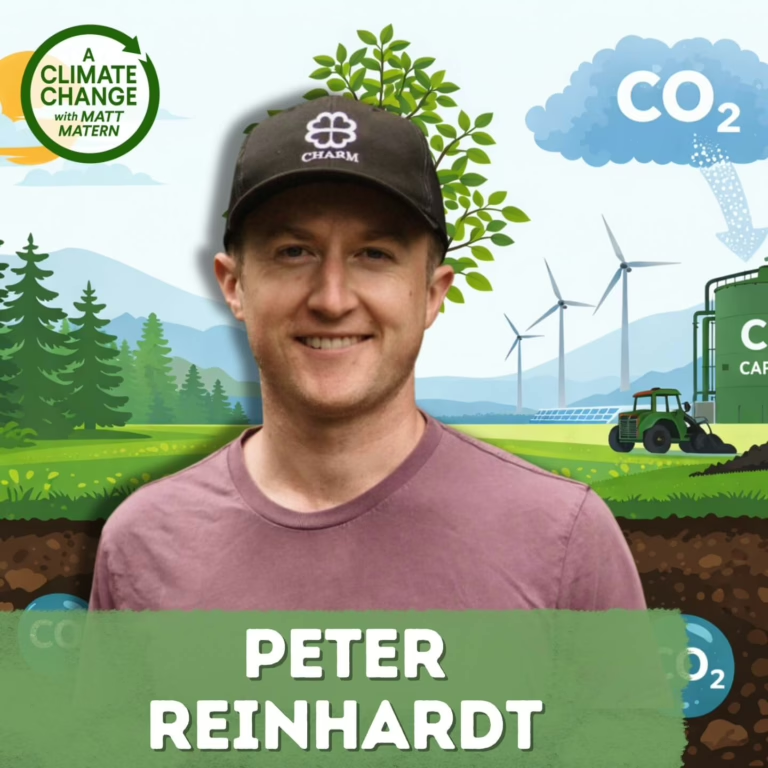
Matt speaks with Peter Reinhardt, co-founder and CEO of Charm Industrial, about one of the most ambitious bets in climate tech: putting carbon back underground permanently. Peter explains how Charm takes wood from wildfire thinning projects in the Colorado Rockies, converts it into bio-oil through a process called pyrolysis, and injects that carbon-rich liquid deep into sandstone formations in Louisiana — where it stays for millennia. They discuss the cost curve challenge, why most carbon offsets are ineffective, what it actually takes to scale carbon removal, and the bipartisan legislation that could unlock wildfire biomass as a climate solution. Peter also shares why California’s regulatory environment has been a barrier, how AI is helping Charm’s frontline teams, and where he sees the industry heading by 2030.
The reason people are still pulling out oil and gas is because people want oil and gas because they’re using it in their cars. They’re using gas to drive their stoves. They’re using gas for ammonia fertilizer. We’re using gas and oil to make plastics. And until someone comes up with a better way to do those things that actually is cheaper or better, you’re just not going to change that. Like you can scream and shout into the wind all you want. It’s not really going to change going to change anything, because you haven’t fundamentally changed what most people want, which is cost effective products, many of which are made with our own grass today.
Welcome to A Climate Change. I’m your host, Matt Matern. Here’s a question worth sitting with. We’ve pumped hundreds of billions of tons of CO two into the atmosphere over the last 200 years. What would it actually be like to put it back into the ground? Well, today’s guest has a literal answer. Peter Reinhardt is the co founder and CEO of Charm Industrial, a company that takes wood From Colorado’s wildfire prone forests, converts it into carbon rich liquid, injects it permanently underground, no offsets, no accounting tricks, just carbon in the ground, measured and verified, sounds Charming, right?
Well before Charm Peter co founded segment, which was acquired by Twilio for $3.2 billion in 2020 he could have done a lot of things after that. He chose this. He chose helping the whole planet. We talk about how the technology works, what it takes to scale from 1000s of tons to billions. Why California’s permitting process has effectively shut Charm out of the state that needs it most, and what a new bipartisan Senate bill could mean for wildfire treatment across the West. Please welcome Peter Reinhardt, great to have you on the program.
Thanks for having me – excited to be here.
Well, Peter, tell us a little bit about your background and what led you to the environmental movement?
Yeah, I studied aerospace engineering at MIT, which was sort of often, often left field from from the environment. But I then a very cliche Silicon Valley story, dropped out with my roommates and started a software company, and as we built the company, I started to feel like the environment was a place where we could have impact and sort of do right in the world as we as we built a pretty successful software company, and so we started buying clean power and carbon removal and and so on.
But over time, I started to realize that the carbon credits, the carbon renewables that we were buying, were really low quality and weren’t really having the climate impact that I wanted. And so that led to a new adventure eventually, which was starting Charm Industrial in 2018 focused on really high quality carbon removal and industrial decarbonization. And I ran segment the old software company and Charm for about four years in parallel, and then full time on Charm.
So what? What led you to the industrial processes that underway the Charm offensive here, as opposed to other other ways of doing the same thing?
Yeah, I started researching carbon removal pathways in 2017 I think. And basically every Saturday, I’d just go into the office, I didn’t have kids yet, go into the office and spend all day Saturday researching different pathways for carbon removal. And I was really looking for pathways that would take an existing industrial process that, instead of being carbon emissive, like burning coal to make steel, or burning coal to drive cement kilns instead of emitting CO two in the process, some version of the process where it would sequester carbon instead.
And there’s a few interesting examples of this Brimstone concrete is really interesting example where they changed the mix in concrete, and it ends up being a carbon sequestering form of concrete instead of emissive. But the pathways that I found in 2017 and that we settled on were effectively refining waste biomass that would otherwise rot or burn into useful things, and either shoving that carbon underground or using it in industrial processes.
So why don’t you walk us through how does that work? To I read that you convert the biomass into Bio Oil for carbon, secret, carbon sequestration. How does that actually work in the real world?
Yeah, the process that we run today is we take carbon that’s been captured in the Front Range forests of the Colorado Rockies. So these are forests that are over dense. They’re deeply at risk and of burning in an intense, catastrophic way that destroys the forest. And so there’s the government is driving lots of forestry wildfire thinning projects. Because there’s so much biomass coming out of the front range that needs to be disposed of, they don’t know what to do with it.
So it either gets sort of masticated in, rots as wood chips on the forest floor, or it gets pile burned. That’s a huge waste of what’s an incredibly valuable captured carbon, potentially valuable feedstock for things. So we take that wood, instead of it burning and rotting, and at our Colorado facility, we do what’s called pyrolysis. We heat it up, and that converts it into a solid bio char, which is a wonderful field amendment. And we also get out, unlike most others, we also get out a liquid called Bio Oil, and that liquid is actually the active ingredient in barbecue sauce.
It’s the smoky flavor that you’re used to, used to eating. And that Bio Oil is the char does some carbon removal and is really wonderful for the soil. But the Bio Oil we actually take to our injection well, right now in Louisiana, and we inject that carbon, rich fluid, deep, deep, deep, into the into the subsurface, into an old oil bearing formation where it remains sequestered for millennia.
Okay, well, yeah, I’ve heard of those, those salt, I don’t know if it’s, it’s one of those salt caves down in Louisiana, or just a, you know, an old oil…
Just sandstone. Counterintuitive, actually, that sandstone has that much sort of porosity. It’s like a sponge basically.
Interesting. Well, I guess the other question is in terms of cost curve and declining, and whether or not this is going to be able to scale at the level that it’s going to be required, as in your on your website said you’d like to get us back to 280 parts per million on the CO two level, which was kind of pre industrial, you know, are we seeing that kind of Cost Curve like we’ve seen on solar dropping so that that is a feasible proposition, is a proposition.
Yeah, we’re just at the very beginning of that cost curve, so I don’t have the data points to show you exactly like, oh yeah. Look, it declines by 20% every year like clockwork, right? We’ve only been we’ve only been operating for a few years, but there are a lot of signs, I think, that we will hit a cost point that is, that is quite compelling. To give a sense of scale, we currently put order of magnitude, like 10,000 tons underground per year, and that needs to grow by about a factor of almost a million, right?
So we, you know, we need to go from 10,000 tons a year to about half a billion, or, sorry, five, 5 billion tons per year, something like that, by 2050 so there’s about 25 years to do about 1,000,000x scale up. Because the good news is that the early part of that scaling curve is, is, can be very, very steep, right? So, for example, between now and 2030 we’ll probably get well ahead of a sort of straight line schedule on that, just because we’ll be entering the first sort of production of, like many of these units coming off. So right now, we operate a small fleet, about five machines. We’re actually going to bigger machines and fewer in number over the next year or two, and then we’ll really start ramping the number of machines.
And so the part of the cost curve that we’re on now is just every time we do a new generation of machine, we have the same number of operators operating a machine with higher throughput. And so the cost comes down. The nature of the cost curve is going to change in about a year or two, when it starts becoming that the machines are more automated and that the cost of the individual machine is less, and we realize regulatory efficiencies in the permitting of the wells. So the nature of the cost curve changes. But I think we’re going to be on quite a steep curve over the next four or five years, at which point it becomes, how fast can you turn the crank of of building these machines for a capacity perspective?
So are you building the machines or you’ve outsourced it to another company?
We’re extremely vertically integrated, and I think that’s true of most successful hard tech companies. Is if you’re doing something really innovative, the like, other parts of the supply chain like don’t really exist. So we design the machines and the fundamental chemical processes that drive it. We manufacture the machines, we operate the machines we own and operate the injection wells. And candidly, we’re debating a little bit whether we should also get into the forestry biomass sourcing side, because there’s capital constraints that are limiting the supply kind of scale up, even though it’s just needed from a wildfire treatment perspective. So, yeah, we’re very vertically integrated.
And I’m kind of fascinated by that last piece about the forestry integration. Why is it that you’re. Or, I guess, maybe limited by to get the the wood chips that you need, or, you know, trees that you need.
Yeah, most of the most of the operations that do wildfire thinning in the West are severely under capitalized, so they don’t have the capital necessary to buy all the equipment to do all the fuel treatment that the government and Park Service and Bureau of Land Management and so on would Forest Service would like to see? So we’re actually really behind as why we have so many catastrophic wildfires, because we’re really behind on the forest fuel reduction. And those catastrophic wildfires end up being incredibly destructive.
Of the ecosystem is incredibly destructive of like, human communities that are that are living in the wild, urban interface. So it’s a big problem, right? And that’s why there’s, like desperation to try to figure out how to treat all these things. And there’s basically, we think that there’s two fundamental bottlenecks on getting that well, three fundamental bottlenecks on getting that fuel treatment done. One is a regulatory one, where the regulatory review burden to just plan a fuel treatment project is absurdly long, including NEPA and so forth, and so that’s that’s a silly waste, right? We’re just burning up our forests for silly tripping over ourselves.
Reason, the other is that these are largely pretty small operations, and they don’t have the access to capital that would allow them to buy the equipment to scale up to serve the serve the demand efficiently. And the third is that there’s not really anything to do with the biomass, right? You like pile burns are your alternative, is a pile burn, right? But a pile burn also is a slow permitting process, so you can cut it, but then you still have the fuel sitting in the forest. So we need more things to do with the biomass, and we need sort of better capitalized operators, and then we need some more regulatory acceleration.
Wouldn’t they take some of that and use it for lumber? Or is it just too low grade of wood to be useful?
It’s too small and it’s too low grade, it’s often crooked. Yeah, sadly, there’s, there’s, it’s, it’s called un merchantable timber. It’s all like sub eight inch, because they’re not trying to cut down the tall, like crown trees. They’re trying to remove the ladder fuels that are, you know, cause the fire to go from the forest floor, which is healthy, and and ladder up into the into the big old trees. You need some smaller trees, obviously, because there’s some replacement rate, but it’s really the latter fuels that are the target of the fuel treatment and don’t represent any kind of merchantable use.
Yeah, certainly. When driving around Colorado or in parts of California and you see these ginormous forests, and you know, you don’t see anybody out there kind of managing it, and think, Wow, this is a huge job that there would probably have to be 10s of 1000s, hundreds of 1000s of people on the ground to do that work is, is there some way to automate it? Or what are, what are your thoughts on doing it maybe a little bit more efficiently, because it it seems like it’s a it’s a gargantuan task.
Yeah, I think there’s some challenges in access to labor, but I actually think the other three challenges dominate more. And there are some folks that have done really interesting approaches to potential automation, companies like Kodama or burn bot, and I think some parts of the operation they’ve they’ve introduced really interesting automation, like, you know, managing some of the robots that can do some of the burn ground burn operations afterwards, and so on. But I actually think it’s dominated by the other three factors, far more. Like, automation doesn’t really tackle the the the real bottlenecks on the problem. Today, which are the regulatory capital access and off take of the of the material.
So how are you using AI to to help increase the efficiency of your operations, to make all these machines and do all this inventive stuff that you’re doing?
Yeah, that’s good question. The most visual one is actually just estimation of our inventory. So like, our site has large piles of these un merchantable small logs. And so how much do we have in inventory? Versus when do we make a call to a forest operator and say, Hey, we can take some more wood off your hands? It’s an interesting, interesting problem, and nicely, labor saving. We are also doing a lot on the measurement reporting and verification side. So there’s a huge amount of documentation that has to get generated for the carbon accounting. As you might expect, we’re purposely, intensely rigorous about our carbon accounting, partly because I was really pissed off with the quality of the carbon accounting in the old products.
I felt like I’d been scammed. And so it’s near and dear to my heart that we do a really rigorous job of the carbon accounting and but that’s a huge amount of documentation and so on, which, yeah, it can be quite helpful, actually, in. In drafting and pulling together different pieces of it. A third place is as we’ve pushed Claude code out into the rest of the team, what we started to see is that there’s a lot of operations, a lot of areas in operations where we wouldn’t have been able to afford to make software before, but cloud code has made it so cheap to make software like custom workflow apps, basically, that the operations team themselves, from my coo down to like frontline operators, actually are building apps that help them in their actual workflow document things.
And you could never do that if you had to build it with a software engineering team, and so we’re also building sort of an internal platform called Gaia that all these apps can live in such that all that data ends up in a data warehouse, and then you can trivially tell the AI to analyze it. So we’re pretty excited about that. That’s a little more nascent, but we’re seeing an explosion of small apps built internally by people at the front lines to make their own jobs easier, and trying to figure out how to like best, empower that while centralizing all the data that comes off of it so that we can see and analyze what’s happening across the across the operation.
That’s fascinating, you know, just kind of backtracking for a second for the audience’s sake. You previously co founded segment, which is a customer data platform, and it was acquire, acquired by Twilio for, I believe, 3.2 billion in 2020 so congratulations on that. So is that what funded your ability to go in and start Charm?
Certainly helped in the early stages. I in the early stages, I put in about half the capital, but at this point, we’re funded by a really awesome set of investors, from general catalyst to thrive to ilad Gill and lower carbon and chenovic and so on. So traditional like institutional venture capital investors, some of whom were along for the first journey and some of whom are new. Yeah, pretty amazing set of investors that are excited to see our impact in the world, both on the climate side as well as the sort of industrial resilience side. We haven’t gotten to the industrial processes, but we’re excited in the future to power much of these industrial processes with the biomass that we’re refining.
And so there’s a big resilience component there, as well as just wildfire resilience on its own is, is, I think, something we’re really excited about. So, yeah, at this point it’s mostly outside funded.
So what’s the story that you tell your investors is, in terms of you invest this money with us and this is going to be a good return on your on your investment dollar, yeah.
I mean, we have well north of $100 million worth of off takes of carbon removal credits from a number of amazing customers. These are primarily technology companies, folks like Microsoft and Stripe and Shopify and Google and meta and and so on. Some amazing banks like JP Morgan and MTD bank, and bunch of amazing consulting companies and advanced manufacturers, folks like Boeing and McKinsey and so on. So these are these customers I think, are really leading the way and thinking pretty far ahead honestly about what kinds of commitments regulators and others are going to be asking them to make in the 2030s as these problems get more and more obvious and less and less debated, and so they’re investing catalytically in purchases that are going to enable our capacity to be present when they when they need it.
And many of them have made, you know, 2030, or beyond kind of net zero commitments that they’re trying to build capacity for. So it’s on the basis of those customer commitments, as well as other markets that open up as we come down the cost curve. From an industrial perspective, that investors are looking at it saying, it’s pretty exciting, actually, like, you know, this is, this is something that customers want, and it’s and it’s something that’s going to be able to expand it to other
markets over time. Let me ask you the tough question of I’ve heard from some environmentalists, I think Al Gore among others, who’ve kind of pooh poohed carbon sequestration, saying, hey, it’s if there aren’t a lot of money at it over the years and haven’t been able to bring down the cost curves. Now, maybe he wasn’t speaking specifically to the types of stuff that you’re doing, but maybe you probably familiar with these comments, and he be great to hear what your response is.
Yeah, much respect for Al Gore and maybe pushing some of the right priorities A while ago, but I’m not sure that he’s that sharp on this particular part of the market. I think, I think his criticism is probably most purely directed from thinking about director capture specifically, but labeling it more. More broadly as carbon removal. And I think if I were to put words in his mouth, like the criticism that that he has there is like the power consumption for direct air capture is significant and competes with other, you know, use of renewable power.
hat’s not true of all carbon removal methods by any stretch of the imagination, right you have, we’re not using that much power by comparison. We’re primarily using we’re preventing other environmental climate problems by with our feedstocks, right? In this, in the wildfire sense, we’re cleaning up orphaned oil and gas wells as we inject into them. So these are very different, the sort of CO benefits. I think direct air capture, in some sense, has sort of CO negatives, if you will, especially around its power consumption, which is quite significant and hasn’t demonstrated that much in terms of deliveries or cost care of over the last few years. Maybe it needs more time.
It’s also the original carbon removal technology, so it’s had the most time. There are other technologies like biochar, Bio Oil sequestration, we do both of those enhanced rock weathering, and a number of others that don’t have those co negatives. They actually have co benefits in terms of crop fertilization and so on. And so I think I suspect he’s just not aware of these things or simplifying, but I don’t think that carbon removal broadly. I don’t think it’s correct about carbon removal broadly.
I think he may be talking about the efforts of the oil companies to engage in carbon sequestration efforts. And maybe you can differentiate your processes from what the oil companies are doing.
Yeah. I mean, generally speaking, a number of people are excited about what we call CCS, as opposed to carbon removal. CCS meaning carbon capture and sequestration, where you’re doing flu stack capture of carbon dioxide and putting it underground. I think the challenge, I think CCS, from like, a scientific perspective, is actually, like, is quite legit. Like you, you take carbon dioxide, you put it into a class six. Well, we’ve studied these. We’ve studied these. Wells a ton. They’re they’re working in the North Sea.
They’re working in Illinois, they work well, you know, now, have there been some spectacular failed field projects? For sure, is that because of the technology, I don’t know, I think, and I think deployment of CCS, hey, if it’s getting carbon dioxide out of the atmosphere, seems fine to me. I think that the challenge is that I’m seeing with the actual deployment rate of it is that communities don’t want it, and a lot of in most cases, right? So in like Louisiana, there’s a huge anti CCS movement, and that’s because they’re worried about carbon dioxide coming back up and sort of affecting their water supply, and they’re worried about pipelines leaking, which did happen, I forget, is Louisiana, Mississippi.
So, like, there’s some prior art that’s a little spooky there. Some people died, and people are worried about eminent domain around the pipelines through the property. Like, I get that, you know, and maybe communities don’t want it. And, like, that’s kind of a problem, right? I think that ideally, the economic benefits for those communities outweigh it, right? And so I hope that the sort of CCS companies are able to overcome that in the long run. I’m excited actually about Bio Oil being used in industrial processes, where flu stack capture could then become double the impact, right?
Where you’re not only decarbonizing an industrial process, but if you are able to capture the CO two off the back end and capture it, you’d actually have a carbon removal so you could, you could flip a process like iron making, for example, from being massively emissive to being a massive Remover of carbon. That’s a ways out for us, but so scientifically, I don’t think there’s a federal I don’t have any issue with it. Like, I think, I think, I think the I think there, but, but I think the community challenge is real.
Yeah, I think part of the argument that he makes and others make are kind of like, well, if you focus on this, they will say, Hey, keep drilling oil like crazy, because we can just deal with it with carbon capture and sequestration, and therefore, kind of oil companies just keep going full throttle.
Which, yeah, I just think it’s a really like, misunderstand, deep misunderstanding of the system, which is, like, the reason people are still pulling out oil and gas is because people want oil and gas because they’re using it on their cars. They’re using gas to drive their stoves. They’re using gas for ammonia fertilizer. We’re using gas and oil to make plastics, like we’re using all these things, and until someone comes up with a better way to. Do those things that actually is cheaper or better, you’re just not going to change that.
Like, you can scream and shout into the wind all you want, which is a little bit what he’s become, I think, over the last few years. To be candid and like, it’s not really going to change anything, because you haven’t fundamentally changed what most people want, which is cost effective products, many of which are made with our own grass today. It’s like that’s the thing that requires us as entrepreneurs, to be founders, scientists, to be incredibly creative and come up with better ways to do that.
Yeah, I think that is true. And I’ve talked to a number of people, and their argument is we have to come up with products that are cost effective, or even beat the current set of products on a cost basis, and that’s why there’s obviously a lot of excitement about solar and EV stuff, and that the price of solar energy has has gotten below that of gas and nuclear and coal, so It kind of beats those technologies on the cost curve. So ultimately, it should win the battle.
That’s right, it will win. It’ll take some time. There’s some markets where it does better, other markets where it does worse. If you’re farther north, the winter is actually pretty hard to bridge, even with solar and battery. So, you know. But in Texas, there’s a reason it’s blowing up on ERCOT, right? There’s a reason that ERCOT is like the Texas grid is like installing so much battery and solar capacity, and that’s because it’s, one, it’s a very open market, it’s less regulated.
And two, it’s farther south. It has a ton of sunshine, a ton of wind, and so, yeah, I think it’s happening market by market, by market, jurisdiction by jurisdiction, but that part is happening, and we need the same level of creativity and and and breakthroughs in any other areas.
Let me ask you about the IRA and and did the IRA help your firm? And now, have there been any changes in the last year or so that have changed the IRA vis a vis your company.
Yeah, the IRA did not, did not help us. I would say it cemented, rather frustratingly. I would say it sort of cemented oil and gas subsidies. What’s a tax credit called 40 5q which gives a tax credit for carbon dioxide sequestration, which really is CCS or director capture. It didn’t, it didn’t anticipate or think more broadly in terms of any of the other pathways I mentioned, Biola sequestration, biomass, carbon removal and storage, etc.
We now have a bipartisan group that has co sponsored and introduced a bill in Congress to include other technologies in 40 5q it’s a it’s a bill that’s focused primarily around wildfires, and so therefore it’s expanding 40 5q to apply To biowall sequestration and a number of others that can use wildfire thinning residues, introduced by Senator Tim Sheehy from Montana, who has like wildfires as one of his top priorities, which is amazing and co sponsored by by Cantwell in Washington, and a few other co sponsors signing on now.
So that’s pretty exciting, and I think could have a huge impact on on wildfire prevention and and and restoration and ecosystem protection across the across the US West. So really excited about that. It’s not the IRA, right? It’s a, it’s a, you know? It’s a new bill now being advanced by by a bipartisan coalition, but honestly, have led to a significant degree by GOP Senator Sheehy.
Well, that’s exciting. I mean, certainly harken back to the days of the early environmental movement in the 70s, where those bills, clean air and clean water, passed with practically unanimous support from both parties, I think one of them did pass with absolutely unanimous support in both House and Senate. And you know, it’s kind of mind blowing that we, we were at that place, and we’ve kind of shifted quite a quite a distance from that. So to the extent you’re weaving together a bipartisan coalition to solve some of these problems is fantastic. So, great work.
Yeah, I mean, I think I mean credit to that, credit to the senators here, right? Like, I think they have a long history, actually, of maybe off the off the polarized political media, like getting stuff done and in a pretty bipartisan way. So yeah, we’re excited to work with those. She and Kent kentwell and others here and on those states.
I’m curious about California in terms of We’ve certainly had our share of wildfires that have been devastating. Have you worked with anybody in California regarding thinning the forest to the reduced risk.
Yeah, we have. We actually did a demonstration deployment in your National Forest, just showed that we could operate safely out there and effectively. And came to a landing in the in your national forest with as much stuff to process they didn’t know what to do with. And so did a demonstration out there a couple of years ago that said, for like, bigger deployments in California, we really would need the ability to inject in California.
And we have been led to understanding by both the regulators and the and consultants that the timeline to permit an injection while in California is probably about 10 years. So sort of sad to say that I’ve found the regulatory state. I mean, I live in California, but I’ve found the regulatory state in California deeply blocking of the things that we say we want to accelerate, which is quite frustrating. So I hope that changes, and it’s certainly something we’re working on, but we’ve had to, had to deprioritize California for that reason, despite the fact that California needs it desperately in terms of offtake of these kind of feedstocks.
Yeah, I was talking to somebody who was developing kind of a kelp forest type technology. And the kelp forest around the California coast has been kind of devastated by the the Ag waste that has gone out the rivers and gone out to the ocean, and they were saying, to get something permitted, they had to go through 16 or 17 governmental organizations to get the thing permanent. So just this minefield of regulatory stuff that just hinders any kind of innovation.
Yeah, that’s right. I’m also deeply involved with a electric long haul freight company. And, yeah, I think it was, we counted up the jurisdictional approvals that we needed, or different like jurisdiction bodies that had jurisdiction in California. And I think it was, it was similarly 16 or 17 to approve what’s effectively an electric vehicle. And one of them was actually requesting that we do $25 million worth of testing to show that it didn’t increase emissions. I was beyond furious, and anyway, we got them to back off. But it was, it was a heck of a fight over nine months. So hugely, hugely silly, wasteful, self defeating, bureaucratic state in California right now?
Yeah, I think that a wake up call is needed, and that I think you can have good intentions, but if you put up so many roadblocks that you make those intentions impossible to reach, you know, what use are your good intentions?
Yeah. And what ends up happening is this insane loop where the regulatory barrier gets created very high, and then the only way to overcome that is by creating a subsidy. And so we’re in multiple ways, subsidizing our regulatory incompetence round and round and round and round. And so, for example, you could say, like the Tesla semi, which is rolling out. Pretty exciting. Where is it getting deployed? Southern California. Awesome. Why is it getting deployed there? Is it because electricity is cheap and diesel is expensive?
No. Electricity is crazy expensive. Reason it’s getting deployed there is because there’s subsidies, HVAC program, South Coast Air Quality Management District, whole bunch of the subsidy programs that effectively lower, the lower, the lower the cost. But the only reason those costs are higher to begin with is because of regulatory stuff in the first place. So it’s a crazy, crazy loop.
Yeah, well, I kind of, I, I will benefit the subsidies to a certain extent, because they did kind of help the the EV business get off the ground first. Yeah, you know, at some point in time, they do have their purpose, but certainly a lighter regulatory load would would also have its purpose. So it would be a bigger win for for everybody, and that’s why you see Texas deploying so much more solar and and batteries and so on than California now.
Yeah. So where do you see your your firm moving in the next three to five years?
And yeah, we’re really excited about sort of scaling up capacity, which will mean more wildfire treatment in Colorado, which are really excited about, and more carbon tons underground. We’re looking at trials of a few different industrial processes as well. We’re looking at a planned cement trial. We’re looking at some trials in and around steel using our biochar in both those applications. So starting to sort of look at a broader set of things that we can power from an industrial perspective with the biomass that we’ve refined, as well as just scaling up our capacity.
So, you know, we’ve gone, in the past year, we’ve gone from one machine operating to five machines operating all sort of one ton per day scale. Now we’re going to go to the now we have a machine operating at three ton per day scale. Later this year, we’ll be at five ton per day scale, etc. So we’re. A sort of a flowering of use cases and and a dramatic scale up on the capacity side.
Do you have other I was going to say the word competitor, but I’ll say just other companies that are in this space that are also doing similar things to you and and do you see the space growing substantially with lots of companies that do the types of things that you’re doing,
Yeah, compatriots in the in the fighting and to scale carbon removal, yeah. We Yeah. And I know many of them well, many of which have very cool sort of products and companies and approaches. I think that there was a huge, broadly speaking, there was a huge flowering of approaches in roughly the 2020, to 2022, kind of timeframe that was sort of peak climate focused investing and a lot of pre purchasing, big like ramp and pre purchasing happening frontier climate was starting to purchase carbon removal for the first time.
So there was, you know, we were in a part of that. We were in the part of the hype cycle, if you will, then where, like, a huge number of companies were getting formed. I think now we’re probably more of like a consolidation part of the life cycle, where companies that either didn’t quite figure out the commercial side or had an interesting technology, but it didn’t turn into like full operation, all those kinds of things are starting to consolidate a little bit more.
So I expect the next few years they’ll actually probably be fewer companies. But that’s like a healthy part of the healthy part of the life cycle as well. And then we’ll probably see those sort of beginnings of scale and and and clear winners and like the 2029 plus kind of timeframe.
So give us a sense of how large is your organization right now, just from like a head count to…
Yeah, we’re about 100 people. 80% of that is in is in Colorado, which is both our pyrolysis operation and engineering, most of the company, and then small, small team here in San Francisco, and an operations team in Louisiana as well.
So how are you seeing that kind of scale up in terms of head count? Do you see it in 510, years being 10 times as big or…
Yeah, I’d say from here we’ll do a little scaling on the engineering side and probably around manufacturing, but the bulk of head count scaling going forward is going to be in and around operations with pyrolysis and injection so injection operations will start scaling up in other geographies. We’ve filed a few more permits to operate in other places. So you know those will be new operations teams.
And then as we scale up our pyrolysis operations to convert biomass, to buy oil, you know, that’ll be, that’ll be probably the bulk of hiring. That’ll probably be roughly in the Colorado Great Plains Front Range kind of, kind of area as well. So, yeah, it’ll probably be dominant by the time it gets like 2030 plus, the team, from a percentage perspective, will be dominated by by operators.
Well, Peter, great to have you on the program. Really enjoyed our conversation and really appreciate the great work that you’re doing with Charm Industrial, and it’s a fascinating story. And, you know, it’s inspiring to see people take their fortunes and do good in the world. So kudos to you. And if anybody wants to follow Charm Industrial or follow you, where should they go to check you out?
Yeah, Twitter or x or LinkedIn, either one.
Okay, well, thank you very much, and we’ll look forward to maybe having you on in the next year or two and checking back with how you guys are doing.
Sounds good. Thanks so much, Matt.
And that was Peter Reinhardt, CEO and co founder of Charm Industrial. To learn more about Charm’s work on permanent carbon removal, visit charmindustrial.com. To learn more about our work at A Climate Change visit aclimatechange.com. Don’t forget to subscribe to our podcast on Apple, Spotify, YouTube, or wherever you get your podcasts. If you like this episode, please share it with a friend. See you next time.
(Note: this is an automatic transcription and may have errors in formatting and grammar.)