
Hear us on Apple Podcasts, iHeart, and Spotify Podcasts. Subscribe now!
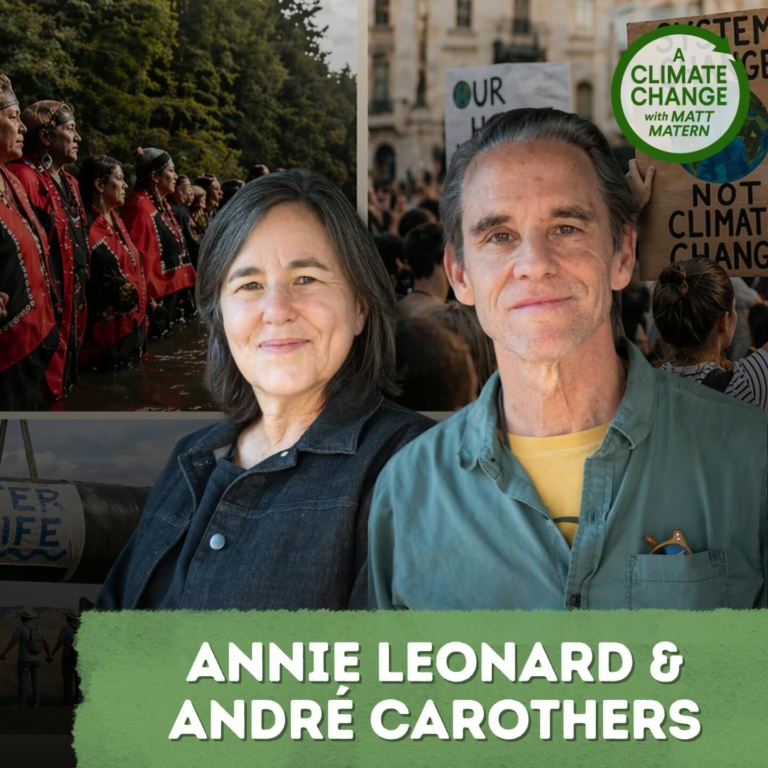
Matt speaks with Annie Leonard and André Carothers, co-authors of Protest: Respect It, Defend It, Use It, published by Patagonia Books. Annie is the creator of The Story of Stuff and former Executive Director of Greenpeace USA. André is a four-decade activist and co-founder of the Rockwood Leadership Institute.
They discuss why peaceful protest is foundational to democracy – and how it’s under unprecedented attack. They break down the surge of anti-protest laws across 49 states, the fossil fuel industry’s use of SLAPP suits to bankrupt activist groups (including a $660 million verdict against Greenpeace), and what it means for the climate movement when the right to dissent gets criminalized. They also talk about the legacy of movements like Earth Day and Standing Rock, why the climate movement needs to build broader power coalitions, and how anyone – regardless of experience – can show up in this moment.
Pick up the book April 28th at your local bookstore or Pre-order now at theprotestbook.com!
There’s so many different kinds of protests. What we’re talking about is peaceful protests. People are taking a stand, doing something to act on their values, to stop a harm or advance a good. That’s why this book, with our 42 protests, I I call it a protest tasting menu. There’s big ones and little ones and serious ones and funny ones, and there’s, you know, students in Tanzania that are risking being beaten and jailed for fighting a horrific fossil fuel pipeline. And then there’s act up that put a giant condom over Jesse Helms house that says protection against deadly policies. There’s Bree Newsome who climbed the flagpole in front of the South Carolina State House to take down the Confederate flag with just a small support team, and then there’s a million immigrants who march through the streets for A Day Without Immigrants.
You’re listening to A Climate Change. This is Matt Matern, your host, I’ve got a couple of great guests on the program. I’ve got Annie Leonard and Ándre Carothers, they’ve written a great book. It’s called Protest: Respect It, Defend It, Use It. Annie has a long background in the environmental movement. She did the story of stuff, animated documentary with over 40 million views. She was the director of Greenpeace from 2014 to 2023 she co launched the Jane Vonda climate pack. She’s testified before Congress, and she was named by Time Magazine, hero of the environment. Welcome to the program. Annie.
Thank you so much. It’s great to be here.
And then we’ve got Ándre Carruthers, who is an activist, writer, organizer for decades of work in this space, worked at Greenpeace and also co author of the book, welcome, Ándre,
Thank you. Nice to be here.
So tell us a little bit about why the book. But maybe first I always like to ask the lead in question. I’ll start with you, Annie, as to what led you to the environmental movement in the first place.
That’s a good question. I think really the environment led me to the environmental movement. I was very lucky to grow up in the Pacific Northwest in a very sort of outdoorsy family and and context. And so I grew up really loving the forests and the oceans and the rivers. And if you love something, then you care when it’s under threat. And so I saw the clear cuts firsthand. I saw the fish kills firsthand. And as a young child, I got very interested in this. So I’ve actually never been anything except an environmentalist. I went to college and studied environment, and then I’ve worked for various environmental organizations for my whole life. Had a brief stint waiting tables in graduate school, but other than that, I have never done anything else.
Well, that’s a great story. Ándre what, what about you? What brought you to the environment?
So I grew up in Washington, DC, and so politics was sort of in the air as a child. When I was 11, I was at the corner of Ward circle in Washington, DC when the anti Vietnam protest blew up, and I was tear gassed as a 10 year old and went running home to hide under the bed. It was a atmosphere that was very alive for the for that period, I went into writing. And I got really lucky, because Greenpeace needed a writer in 1984 and so I went down and to walk back to Washington, joined Greenpeace as a writer, and was just transformed by the experience Greenpeace in the 80s and the 90s was an amazing place to work. The campaign savvy and the protest energy and the way they move the needle on so many issues was just delightful and inspiring to be part of. So it’s been part of my life ever since.
Well, you raise a very interesting point is that the environmental movement had incredible amount of momentum back in the 70s, clean air, clean water, passed with almost unanimous support in the House and Senate and and certainly, lots of things were done in the 80s. Maybe, you know, into the 90s, not that nothing has happened since then, but you know, it’s certainly gotten a lot more difficult in my read of this. What? What do you think the environmental movement has run into that has made it more challenging?
Many thoughts, and I’d love to hear what Annie has to say. I’m not sure that we are seeing less interest in the environment. What we’re seeing is a wider palette of things that people are connecting across silos. The issues of racial justice and equity and economic opportunity for everyone is become so. Extricably linked to environmental issues. It’s really impossible to disarticulate them. And I think one of the one of the benefits of being part of this Matern movement is it does see all the connections between this and is fighting along a common front. So environment is part of a larger palette of activities.
Annie, what’s you? What do you say about that?
Definitely agree with that. I think there’s more to it as well. One is that the context has changed a lot. Then from the 80s, when Ándre and I came of age as environmental activists, is the political context is so fully captured by corporate interests now much more so than it was when we were growing up. So in the 1980s when I first moved to Washington, DC to become an environmental activist and met Ándre, I think in 1988 is when we met and have been working together since back then, there was a real sense of possibility, legislation, good science based legislation could be introduced and was passed.
You had the environmental protection agency created by a Republican president. We were coming out of the highs of the post Earth Day era. And this interesting, the Earth Day is actually the largest protest stay that the United States has ever had. We hear a lot about how No Kings was No Kings was the largest political protest. But on the first Earth Day, do you know how many people participated in that first Earth Day? Just take a guess. Knowing that there was no Facebook events, no Twitter, no cell phones, how many people nationwide participated in that first day?
I’m gonna guess, but I think I’ve been fed the answer by my producer earlier on your bios. I think it was 20 million or something, or…
20, 20 million piece of people participated, not in one place. And sometimes it was a march, sometimes it was a setting up, a recycling drive, like it was all different kinds of things. But if 20 million people participate in something the list of environmental regulations, major Cornerstone bedrock laws that were passed in the decade since Earth Day. It’s really exciting. So when we came of age as environmentalists in the 80s, our mentors, our supervisors, our teachers, had actually passed legislation, there was such a sense of possibility, and especially since Citizens United, it is, you know, the political system is just so captured by special interests. So that’s, that’s one challenge. Another challenge is that while part of the environmental movement has broadened its analysis and absolutely realizes that we must embrace racial and social and gender justice and these broader issues, and we must build power. Another part of this, the movement has become more technocratic.
I like to say that a lot of environmental activists, including a lot of climate activists, are trapped in the myth that the truth will set us free. And we just look at the data and we think, Well, of course, of course, you will pass laws to solve this. Of course, you know, and when Congress doesn’t respond to the data, we make three dimensional charts and we issue reports and we make documentaries and, you know, we just keep yelling the truth because it is so compelling, but the truth, absent a strategy to build and exercise power, sadly, is not enough. So I think those are some of the changes that has been hard for the environmental community.
Well, certainly corporate strategies have gotten way more sophisticated than probably they were back in the 70s and 80s and and now they have got data on everything and everybody, which is far more powerful than maybe they had before. So and and more ruthless in the way that they’re pursuing it than ever before. So I guess let’s kind of turn to your book. And one of the things that is discussed, I think, in the book, is, well, all the different laws that are being created. 350 anti protest bills introduced in the US since 2017, 55, of them now law. And these anti protest laws are now enacted in 49 states, including slap suits from fossil fuel companies, which are escalating. And ultimately, I believe that was what hit Greenpeace.
Correct. Yep, so this is actually how Ándre and I got interested in this is that we’ve seen over the last decade increasing attacks on the right to protest. And I think one reason that there’s so many attacks on the right to protest is that protest has proven over and over, literally, for centuries, and a. Around the world to be an effective core democratic right that is available to people to advance progress. And because protest works, certain political leaders, you know, authoritarian tendency, political leaders and and certain corporations want to shut it down. And so there they have a multi pronged effort to shut it down.
One is what you mentioned is slap suits. Slap stands for strategic lawsuit against public participation. These slap suits, which are really growing, are meritless lawsuits that are not actually intended to win in court. They’re not actually intended to make it to court. They’re often multi million dollar lawsuits to force critics to stop their campaigns. They aim to intimidate, silence, bankrupt critics that are exercising their First Amendment rights.
So Greenpeace was slapped twice while I was the executive director, once by a large Canadian forestry company that was unhappy with Greenpeace’s campaigns, and then one spy energy transfers, which is the energy company that built the Dakota Access Pipeline. And in that slap, which was absolutely crazy, it was a $300 million slap suit against Greenpeace, accusing Greenpeace of orchestrating the entire Standing Rock protest and of engaging in violence there now Greenpeace, like Ándre and I, are fully committed to nonviolence, and the lawsuit was absolutely baseless, but it was a $300 million lawsuit.
I mean, Greenpeace did choose to fight it, but most organizations don’t have the resources to fight these slap suits. So slaps are one way that polluting corporations are seeking to silence dissent, and then the other which you mentioned are the anti protest laws. These laws are absolutely terrifying, because what they do is they criminalize constitutionally protected first amendment rights. They criminalize protesting near fossil fuel pipelines or other so called critical infrastructure. Some of them provide protections for drivers who run over protests. They criminalize long proven tactics like marching down a street together, the same kind of tactics that were used so successfully in the civil rights movements, in the women’s suffragette movement, in in protests our lifetimes and long beyond them.
So these anti protest lawsuits and laws combined with, you know, vilification of protest, violence against protest, is creating a chilling effect overall, where the stakes of exercising our First Amendment rights are higher than ever, at a time when we need to do it more than ever. So that’s why Ándre and I were inspired to write this book.
Now I’ve been involved in some anti slap motions, because as an attorney, that’s sometimes it comes up, and usually it’s done by the defendant in a case, and they bring emotion, saying that this is affecting their rights to assemble, or, you know, these primary rights. So was it, was it energy transfer that was suing Greenpeace, or was it Greenpeace suing energy transfer.
The original case was energy transfer suing Greenpeace, and just like the prior case was a Canadian company called resolute Forest Products suing Greenpeace, that the resolute slap suit was heard in California, and there, there is anti slapp legislation, and so Greenpeace said, just what you said is we said it’s we were exercising our First Amendment rights. The judge did throw out the case, and also called it a slap suit. So Greenpeace was awarded a million dollars, which was a fraction of the legal bills, but it was nice validation.
So that was determined to be a slap case, and Greenpeace won the energy transfers case, however, was heard in North Dakota, and North Dakota does not have anti slap legislation, and is a very oil friendly case. There was a very oil friendly jury, and in that case, the jury verdict came back for over $600 million and found Greenpeace liable. So green beans is continuing to fight that, but it shows why we need federal anti slap legislation, which has been discussed and Representative Raskin from Maryland has proposed that which we’re big supporters of, absent some anti slap legislation and protections anybody is vulnerable.
I mean, bottled water. Corporations have slapped working class homeowners in Northern California who are concerned about their local springs getting tapped for bottled water. Oil companies and pipeline companies have slapped grandmas who don’t want a pipeline through their backyard. It’s a really it’s a kind of corporate legal bullying, and we need to have some. National Protection against it.
So yeah, I thought that I had not followed the case extraordinarily closely, but it seemed as though the North Dakota case could be turned over by an appeal. But you know, you never know it’s in North Dakota. So good luck, I guess. But what’s the status of the appeal?
Currently, Greenpeace is appealing it, and I certainly wish them well. I’m not with the organization anymore, but I’m cheering them on from the sidelines. There was, interestingly, an independent trial monitors group that attended the entire hearing in North Dakota, including very high level lawyers from around the country, and at the end of the trial, one of them Martin Garbus, who was a Nelson Mandela’s lawyer, you know, he’s been around the block many times, he said that it was the most unethical, corrupt case he’d ever seen. It was just really rigged against Greenpeace. So I certainly do hope that they succeed in the appeal not just for Greenpeace, but for the broader movement and the right to free speech and peaceful protest.
Oh, absolutely so. I guess that brings us to your back to your book, and which profiled 42 different protest campaigns, from 1738, to 2025 Boston Tea Party, Rosa Parks, the first Earth Day, Standing Rock youth, climate strikes, etc. What? I guess there’s so many questions to ask about that, what do you think are the types of protests that are going to be most effective in 2026 and what are your What are your thoughts on that you want to take that one?
Ándre maybe we can back into that by talking about a few of the protests, because we chose, we chose them in a certain way. We were looking for things that were innovative, that were that move the needle on an issue, that were creative, that were inspiring. There is no absolute clear thread through them all, except for the fact that they are worthy of attention, that they are acts of civil, non violent civil disobedience that we believe can be inspiring for people to look at, inviting for people to understand. The suffragettes in 1913 some 800 women marched on the Washington the Capitol in Washington, DC, demanding the right to vote.
And what was fascinating about that moment was first, it was the first time that any March had arrived on the steps of the Capitol. So it was an unusually telegenic moment for the movement. The second thing was that the campaign for the women’s right to vote was sort of moribund. At that point. They’d been working super hard on various tactics, and they weren’t getting where they wanted to go. The strategy had contracted to, we’re going to bite off state level efforts to get women the right to vote, and they’d essentially abandoned the national approach. And the organizers said, No, let’s bring this effort back into the public eye.
So with a march to the steps of the Capitol the day before President Wilson’s inauguration, up to 1000 women, beautifully dressed, marching down Constitution Avenue. The march was surrounded by some 200,000 people, mostly men, many of which actually attacked. The protesters, threw things, spit on them. There were 100 more than 100 people went to the hospital. What ended up happening was that this protest got national news, and it brought what was, again a sort of a niche issue at that point to public attention. It never left Capitol Hill.
From then on, the effort to make a national change in how the voting system in this country works resulted in, seven years later, the 19th Amendment of the Constitution. So I mentioned this because these kind of efforts really do move the needle on issues, and we are chose. We chose them because we think that we want people to know about this. We want people to reimagine what protests could do for them today.
Well, it’s kind of shocking that we were 138 years into the formation of the US, you know, government, and there had never been a march to the Capitol. That’s just kind of mind blowing. What comes to mind the reverse of that is that we probably have marches to the Capitol, you know, quite regularly nowadays. Yes, and so it’s kind of blase. So What? What? I hate to be a naysayer, but just like I want to ask the tough questions. And my listeners are probably thinking like, Well, what do? What do we do? That’s kind of akin to that march in 1913 to to wake people up. That’s a tough question. Hey, this is my job.
Well, two thoughts for me, and I’d love to hear what Andy says. One is, we, we face this remarkable atomization of the media. You know, when I was a kid, it was Walter Cronkite at seven o’clock telling you what was going on in the world and the ability to break through was both constrained, in a sense, because he gets to, he got to choose what got into the news. But at the same time, there was a common touchstone for what people in the American public understood to be true. Now we have a whole different media environment, where we have the internet, we have bloggers, we have social media, and of course, we have the dominance of Fox News, which is a far right media outfit that is in lockstep with the Republican Party.
So there are challenges that are unprecedented to getting the word out in this country. But I want to make sure that people understand that that assertion that we face an overly daunting task is not necessarily true, that what we’re seeing from from No Kings is a succession of very public events, from 3 million a year ago to 7 million last October to 8 million last week that is designed to crack through, that is designed to get people’s attention and to help move the needle on an issue, of course, democracy in the United States, which is important. Annie, what do you think?
I agree.
Annie, what do you think? Well, we do this a lot. We go back and forth with each other.
You know, many people refer to the moment that we’re in right now as a poly crisis, like we have major crises that we’re facing. The climate crisis, as you certainly know well, and the window to avoid worst case climate scenarios is closing. We have the democratic crisis, the Democratic backsliding the US has been experiencing, and the dismantling of democratic institutions and norms and practices that we’ve all grown up with, and I know I certainly sort of took for granted. And then we also have our communities under assault, whether it’s neighbors being abducted, families being separated, growing inequality, all of these different problems. Can you imagine if people did not protest, if we did not gather?
I live in the Bay Area, and Ándre and I were speaking at UC Berkeley the other day, and a student said to us, of course, San Francisco doesn’t like what’s going on. Of course, they’re anti war. Do we really need to protest there? And we said, can you imagine if San Francisco was silent at this moment? Protest is a way that we signal, not just to the leaders, but to the observers, to each other, that we are not okay with the direction that the country is going in, that we want to see something different. So protesting is absolutely essential. I don’t know of any case where protest alone solved a problem or won a big victory on its own.
I often describe making change as laying a stone path through a garden, and a protest might be every fourth stone or eighth stone or 200 stone, and we have research and public education and lobbying and lawsuits and so many other things. But over and over again, we’ve seen how protest elevates an issue on the public agenda, strengthens the movement, grows the movement, getting more and more people out there, signals to the protest curious, I call them, who are watching and maybe aren’t happy with what’s happening, but not sure what to do signals a way for them to get involved. So absolutely, we should still protest, and protesting on the Capitol will never be blase to me every time I see it, it warms my heart that said we do need to evolve our protest strategies and tactics with the times and Ándre and I grew up protesting under a, you know, an imperfect, but a relatively stable democratic context.
And in a democratic context, we’ve developed a set, you know, we, the broader climate and other movements, have developed a set of tools that worked, persuasion, advocacy, you know, gathering petitions, doing permitted marches, all the different things that we have done for decades and and advanced progress in an authoritarian or less democratic context, those kinds of protests prove less effective. But. And so we have to evolve our approach to protest with a change in context. So it is important to realize 2026 is very different than 1990 or 2000 or even 2024 and we need to evolve our protest accordingly.
Well, I guess a number of things you brought up that I would love to ask you about. One is the current war in Iran and causing kind of even more environmental damage. And in some respects, not that I you know you wish harm on people. But the fact is that all this harm has woken people up to a certain extent, to the downside of using basing our economy on fossil fuels and and all the rest. Is this a pivot point for the movement, and is this potentially Trump kind of seeding his own downfall by by the method by which he’s conducting himself now?
Well, you’ve certainly touched a nerve there, Matt. I mean, in 1980 when Ronald Reagan took the solar panels off of Jimmy Carter’s White House. What 50 plus years ago? 40 plus years ago, that was the beginning of what we’re seeing now. Imagine for a moment if the United States had decided 40 plus years ago that we were going to start to insulate ourselves from dependence on oil, we would be in a different universe. The fact that your GOP has blocked every effort for a generation, plus to wean ourselves from oil is a shocking and dismaying fact, and the fact that we are once again at war in the Middle East to, in some ways, simply support the domestic oil industry and its allies in government, is a shock.
Well, it’s interesting though. You know it’s it’s these anomalies that occur. Is that Texas is kind of leading the way on solar and wind. And Iowa gets something like 60% of its power from wind, the wind. So it’s some of these GOP states that kind of are, you know, leading the charge on actually, or at least citizens in those states, you know, and I understand it’s creating some backlash within the Trump administration that they are seeing, hey, we can’t really block wind and solar. And Trump said something positive about solar recently, because, you know, with all this move to build out data centers and stuff, we just don’t have enough power, and it takes forever to build a nuclear plant or to build a gas turbine plant.
So it’s kind of a complex web of things going on here, is what I’m trying to say. And so it’s not so obvious. You know, where the fault lines kind of occur? And you know, my hope was that, well, because you have these large constituencies within red states that are benefiting economically from solar and wind, that somehow they would push back against this narrative, that they that solar and wind should be kind of dismissed. What are your thoughts as to how that’s penetrating the consciousness of the GOP? If at all?
Well, logic and reason has never been part of the Republican agenda,
but there is something very different now compared to other times that we have had major wars for oil and price spikes and all which is that the alternatives are readily available and cheaper. I mean, I have a little used Chevy Bolt. I haven’t been to a gas station in a year, you know, so I drive by and see I’m in California, so that it’s now over $7 a gallon on the on the gas station I pass on the way to the park every day, and it doesn’t hit me in the pocketbook the way it hits others, because the alternatives are cheaper and available.
At this point, it takes a real ideological rigidity and commitment to continue to advocate for fossil fuels, even if you didn’t care about climate, even if you didn’t care about the millions of people whose lives are cut short by fossil fuel pollution, is that the alternatives are available and are cheaper, and at some point that’s just going to have to win out.
Well, I do think that that is the winning message here. Is it just a pocketbook, common sense thing? Because they say the election in 2024 was swung by the cost of eggs and things like that, which to me seems somewhat insane that you know the climate is in crisis and the price of eggs are going to drive the election, that just is mind blowing. But hey, if that’s the case, well, then maybe the environmental movement should be arguing kind of the price of electricity and the price of insurance in Florida and California and things like that, that these pocketbook issues are what sells and and at least to kind of middle America voters.
Well, what’s certainly true is that the fact that renewables have penetrated in the market despite the disincentives that are being put in place, is a tribute to the power of renewables. And I just want to remind us all that the United States government has put its weight behind various things in the history of the United States, to promote certain technologies, to promote outcomes in the private sector that they supported. So again, if the US government had advocated and taken the constraints off of solar, wind and other alternatives, we’d be in a different universe right now, and the fact that it’s penetrating the market is a miracle in some ways, and a tribute to the power and the economy of these technologies
right and now China has gotten so effective at producing them, they are running away with the clean energy market because of our own stupidity. It was the technology we created, and somebody else is making the money off of it because we weren’t smart enough to see the writing on the wall. Agreed. I mean, there is some upside of China actually producing the hell out of this is that it is producing a lot of green energy for the rest of the planet and and I believe that countries all over the world are adopting clean energy, because they see what’s happening in the Persian Gulf, and they’re saying, Hey, we’re we’re far better off creating energy from solar and wind than when renewables than we are from, uh, from being addicted to fossil fuels. And
Speaker 1 32:29
I just want to add that, while the market is certainly going in the right directions and has a inevitability about it, which is fantastic, activists still play a role too. So for example, there’s a campaign called the United to end polluter handouts, which is a really great, broad campaign with environmentalists, but also tax fairness groups, economic justice groups, faith groups, all different kinds of organizations that are fighting against state and federal subsidies for fossil fuels, because, as Ándre mentioned, how the government gets behind certain things.
The government, our federal government, is still giving over $20 billion a year. I mean, some estimates are much higher, depending on where you how you define it on direct subsidies to keep fossil fuels afloat, even when they are so beaten on economically by the alternatives. And so, yay for the market. And let’s not forget the free speech and peaceful assembly that our First Amendment allows us, that is enabling activists across the country to put more brakes on the fossil fuel industries in other ways.
Yeah, that sounds like a fantastic organization united to end polluter handouts. Everybody should be supporting that one. And that’s the kind of thing that I think we need to kind of reach across to to create majorities. That’s the bottom line is. The problem is the, you know, environmental movement hasn’t created enough majorities, enough independent voters. Independent voters, I guess, are the largest block of voters these days, and the environmental movement needs to do a better job of reaching those folks. What are your thoughts on on how to do that? I mean, this one you just gave me is brilliant, but you know, we need 10 more.
Yeah. Well, this campaign, you notice, they don’t have the word climate in the title. And you were saying, why is it that that people are so concerned about economic the price of eggs rather than climate, when the threat of climate is much larger than the price of eggs? But I just saw a study the other day that how much people believe something is directly related to how many times they have heard it. And we have this whole, you know, Fox News and that whole media ecosystem that is just just vilifying climate over and over, vilifying, discrediting, etc, over and over.
So the word climate now comes with all this baggage which is not actually about climate, but is, you know, weight that that the opponents to climate action have attached to the word. Yeah, and so this campaign united to end polluter handouts, doesn’t even mention climate it’s not framed as a climate campaign, and that’s why you’ve got all these Tax Justice people. And the other interesting thing about this campaign is it’s not saying, instead of giving the $20 billion to fossil fuels, give it to renewable energy. What they’re saying is give it to the public good, and yet, let’s use our democracy to figure out what that would be.
So teachers are getting on board, because it could be used for schools. Nurses are getting on board. It’s just so many different people want to be a part of this, because it is absolutely irrational at this point in our society to be giving $20 billion a year to these industries that are making record profits and literally killing us. So it’s interesting, they don’t take climate so that’s one of the ways they’re building a broader base. Earlier, I said about how some of the climate groups are trapped in the myth that the truth will set us free. Others are realizing no actually what we need is power. We have the truth, and that’s good, but what we really need to do is build diverse, broad based constituencies that want to contest for power in the public arena and advance what’s good for everybody.
And if we can recruit and engage more people in this work, then we will win because the kinds of things we’re advocating for, free and fair elections, political system not dominated by corporate money, an energy system that doesn’t threaten the planet’s ability to support life. You know, water that that does not is not laden with hazardous chemicals. These kinds of things most people want them. So if we can inspire people to go from being alone and concerned to together and active, we are most people, we could actually get all of these things, a couple of things.
One, as you’ve kind of inspired me to change the name of the show from a climate change to something. But, you know, maybe I’ll talk to you later about rebranding. But the other part is power and constituencies. And you know, as much as I agree with every point that you made, those arguments were made in 2024, and, and need I repeat, we lost. So, you know, it’s like we’ve got to do a better job of communicating these ideas because, and quite frankly, I thought Kamala Harris didn’t do a very good job of communicating those ideas on the debate stage. She she just kind of sloughed it off and didn’t make the argument that could be made, and was too afraid of the polling to engage on important issues they you know, I guess the polling data said not enough people care about climate and the environment, so just pretend like it doesn’t exist.
I think that absolutely we have got to get better at communication, but we also have got to get better at addressing the long term, sort of systemic the inequities and the problems that created such a situation where people were just ready to take a risk on burning down the whole system rather than voting for the Democrats who’ve let them down over and over. We can’t our goal cannot be to go back to 2020 or, as Maga would like to to go back to 1950 our goal has really got to be to stop the democratic backsliding, secure our democratic rights, and then use these democratic processes to build something better than we’ve had before that is more equitable, more healthy. Otherwise these you know, the simmering discontent is going to get in the way of all kinds of solutions going forward. So we Yes, we have to get better on messaging, but we have to get better on a lot of other things too.
Well. You two have spent decades tracking waste, running Greenpeace, creating the story of stuff, and now writing about protest itself. What made this book the book for the moment?
You know, we are seeing in the best I mean, the most gentle word I can use, is backsliding on the safety of the public square. Now, it’s definitely true that there are populations black Americans and others who have protested against the United States government, who have never felt safe in the public square, but we’re seeing a whole different complexion now, where, as Annie mentioned, the legal and rhetorical infrastructure around the public square is being shut down by this government.
So the book is first a reminder that protest is a long part of the American tradition. You know, we begin, we almost begin with the Boston Tea Party, and we go through to a protest that took place last August in the United States. And so we’re trying to re enshrine protest as a very American, very patriotic tradition in the United States. And then this. Second thing we’re trying to do with the book, as Annie said, is remind people that we need protest more than ever. As Timothy Snyder famously said, protest now so you can protest later. Because if we believe that protest is a lever that works, we need to make sure that it’s available to us going forward. And this book is, in part, a call out to people to say, let’s save this right while we can.
Absolutely you know, I was recently reading this book, Tom Paine’s war, and, you know, he was fascinating character, and that he was only in the US for less than two years before he wrote the pamphlet common sense. And it was a clarion call to why the US should break free from Britain. And it was, you know, it seemed like there was still kind of wobbling on that issue in 1775 whether or not that was the direction we were going to go. And it was kind of testament to essentially an effective protest and a written protest. Do you do you talk about kind of written protest as distinct from protesting as in groups?
We use the term protest very broadly in this book. We know that you know sort of deep scholars and practitioners of the pedagogy of protest, divide up protest, civil disobedience, free speech, non cooperation. There’s all these different ones, which we touch on a bit, but we’re using the public’s word for all of this, which is protest. And we say that protest can be marching down the street with signs. It can also be singing the national anthem in your mother tongue. It can be in some places, wearing a certain garment. I have many friends from Burma, and they were not it was not safe for them to protest the dictatorship.
So if they were wore green lunji, that was their protest. In other places, protests can be taking a garment off, like the women in Iran who took their hijabs off, which is also in the book, protests can be going on a hunger strike, a labor strike, changing where you invest your money, canceling your Disney subscription when Disney caters to Trump’s demand. There’s so many different forms that protests can make what we’re talking about is peaceful protests. That’s peaceful in means and ends, and we’re talking about the commonality is that people are taking a stand, doing something to act on their values, to stop a harm or advance a good.
But there’s as many different forms of protest as there are people in the world. That’s why this book, with our 42 protests, I I call it a protest tasting menu. There’s big ones and little ones and serious ones and funny ones. And there’s, you know, students in Tanzania that are risking being beaten in jail for fighting a just horrific fossil fuel pipeline. And then there’s an act up that put a giant condom over Jesse Helms house that says protection against deadly policies. There’s Bree Newsome who climbed the flagpole in front of the South Carolina State House to take down the Confederate flag with just a small support team. And then there’s a million immigrants who march through the streets for A Day Without Immigrants. There’s so many different kinds of protest
Well, I think that was that was really helpful to talk about all the different things that we can do so everybody can find a niche, and hopefully more than one, which you we all can engage in on a daily basis. You know, not buying products from major polluters is a form of protest. I wanted to have you comment upon this Rules for Radicals by Saul Alinsky, you know? I guess you know, it was written really for left of center folks, but my understanding is that the right wing took, took the messages from that book, and have used them maybe more effectively than the left in recent decades. I don’t know if you two are familiar with that book, but you know what? What are the ways that you know you kind of have to jiu jitsu your opponent sometimes? What are your thoughts as to how to do that through protest?
Of course, we know that book because we all read that in college, and it was deeply influential, especially the fountain of creative ideas that Saul Linsky had for protests. There’s another one that’s come out more recently, I recommend, called Rules for Revolutionaries by Becky bond and Zach Exley, which is a great successor to that. One. So I recommend that the model that saulinski uses of sending organizers into different communities and then organizing those communities did prove very successful for a lot of organizations on the left and has proved very successful for organizations on the right. There are things to be still cherished from saulinski approach, and then also we need to move beyond his approach, and that’s what the Rules for Revolutionaries does. So I encourage you to check that one out.
Okay, I will. And so kind of for action, and hope we ask every guest kind of what someone can do today, someone who’s never protested and feels intimidated, what’s the on ramp?
Well, on ramp one is to look out your window and see who else is protesting and join the protest. One of the wonderful things about what No Kings is doing and the other groups that are filling the public square right now is they’re making it obvious and safe that nonviolent protest is available to people so as a rung on the ladder of engagement, just walking out your front door and joining the nearest March is step one. What studies show is that when someone is willing to put their toe in the water for something that they care about and notice that people around them are caring as well, then they’re probably more likely to be knee deep next time the opportunity arises. So my first recommendation is to go out the front door and join a protest.
People often write and say, I I really care, but I’m only one person. What can I do? And I always say, Okay, well, stop being only one person. Get get a friend. You’d solve that problem. And if there isn’t a protest right outside your door today, just go online and find the local, indivisible group, public citizen group, 50501, group, the individual groups are fantastic all around the country. They have new members meetings. They have really safe, welcoming ways to get involved. Just go get go, get with others. It’s more effective if you’re with others. It’s safer and it’s more fun. You know, we build our social networks.
Yeah, I’m not familiar with this group, Indivisible, you said.
Yeah, they’re a fantastic organization. They’re one of the main leaders behind the No Kings March. And they have local groups around the country that, I mean, like, literally all over the place. I think there’s like, threes in our town. There’s so many, and they really welcome people to get involved. They have in person, meetings, in person protests. They have trainings. Indivisible also has a bunch of online videos and tutorials, which are fantastic ways to get involved. They have videos on what to do if ice comes to your town, how to do ice watching, how to protest safely. How to understand the difference between protesting in a democratic versus an authoritarian context? It’s all online. It’s all super welcoming. They’re really a fantastic organization.
Well, you’ve Annie, you’ve said that choosing hope is an act of resistance. What does it mean in this political moment?
Well, I feel very strongly about this because the big polluters and the anti democratic forces in our government have taken many, many things from us, right? They have taken the swimming hole that I used to love to swim in as a kid that I can’t swim in anymore. I’ve spent a lot of time studying toxic chemicals, so I know about the hazardous chemicals and breast milk and they took from me that the opportunity to breastfeed my daughter without fear, like they’ve taken a lot of things from us, and so I have drawn a line in front of me, and I said, I will not let them enter my psyche.
I will not let them dampen my joy for the planet and for being alive and my sense of hope for what I can do every day. And that’s my ultimate bottom line form of resistance is that I will wake up every day grateful for my community, for the planet and for my ability to work for a better future, and I will never let any autoCrat or polluter take that from me.
That’s great. Ándre what gives you confidence that protest is still working in 2026 and what are the protests that you think are going to be most powerful in the coming year?
Well, spending a year and a half writing this book certainly helped me understand the power of protests through history. I am more than convinced, even after 40 years of doing this kind of work, that being in the street and making a fuss for things that you care about is a really powerful lever for change. I am also inspired by the work of groups like indivisible and. Kings and their allies and Public Citizen, because what they’re saying is we’ve reached a point in this country where we need to be in the street, and we also need to understand that a authoritarian government cannot exist without our cooperation, that unless and if we withdraw our cooperation, whether as unions or simply public workers or government employees or even artists or teachers almost any community of work.
If we withdraw our participation, the dictatorship cannot stand. The Trump administration cannot stock shelves, they can’t bail hay, they can’t turn on and off switches, they can’t write checks. They depend on us to cooperate. And so what your listeners are going to see when they go to the our book website, in your show notes is a whole page of opportunities and encouragements and background on how to be engaged in this moment. So I encourage people to take a look.
Yeah, thank you for that. Ándre I appreciate that. And you know, kind of in closing, I kind of want to bring up Frederick Douglass, you know, speaking about going through tough times. You know, clearly our forebears went through, some of them went through far tougher times than we did. And, you know, and it kind of encourages me to keep, keep trudging forward, even though sometimes it seems a little tough.
Yes, absolutely, giving up would be much tougher. That would be intolerable.
Right, right? And kind of related to Annie, your comment about giving up hope is that, you know, giving in to despair is is losing essentially, to these folks that do not have our best interests at heart. And that’s it’s sad that fellow citizens are the CEOs of fossil fuel companies that are spewing out balloons that kill people are endangering, endangering our environment, and they know it, and they’re still doing it. And I guess my hope is that litigation will eventually also help another of the multi prong fronts that that potentially getting taking their money the one language that they they really relate to. I’m hopeful that we can start taking some of their money away from for all the harm that they’ve done to our country.
So I think it’s both so much we have to make polluters pay and stop paying polluters both. We have to do both sides of the coin, hold them accountable, to make them pay and stop giving them our public money. So make polluters pay and stop paying polluters.
Absolutely and they they owe quite a bit of money for the damage that they’ve done, probably in the trillions of dollars. So eventually they’re going to have their comeuppance. But it’s unfortunately the legal world moves insanely slowly. So we’re marching at a pretty slow pace, but March we will nonetheless. Thank you so much, Annie Ándre for being on the show, and everybody check out their new book, dropping April 28 protest, respect it, defend it, use it and tell us where people can get it from.
The book is being published by Patagonia. So Patagonia is going to have a sales link from Patagonia books, and we really encourage people to buy it from their local bookstore. If you go into a local bookstore and say, I’m looking forward to this book coming out, they will stock it for you.
That’s a great idea. So yeah, everybody, go to your local bookstore. It’s It’s always wonderful. I just went to mine a few weeks ago and picked up seven or eight books. And it’s great to be involved in connecting to our local economy as well. So thank you again, and we’ll look forward to, you know, connecting with you in the future and hearing how protests have gone in 2026 maybe we’ll come for like a wrap up in November and see how we did.
Maybe we’ll see you out in the streets.
To learn more about our work at A Climate Change, visit aclimatechange.com. Don’t forget to subscribe to our podcast on Apple, Spotify, YouTube, or wherever you get your podcasts. If you liked this episode, please share it with a friend. See you next time.
(Note: this is an automatic transcription and may have errors in formatting and grammar.)