
Hear us on Apple Podcasts, iHeart, and Spotify Podcasts. Subscribe now!
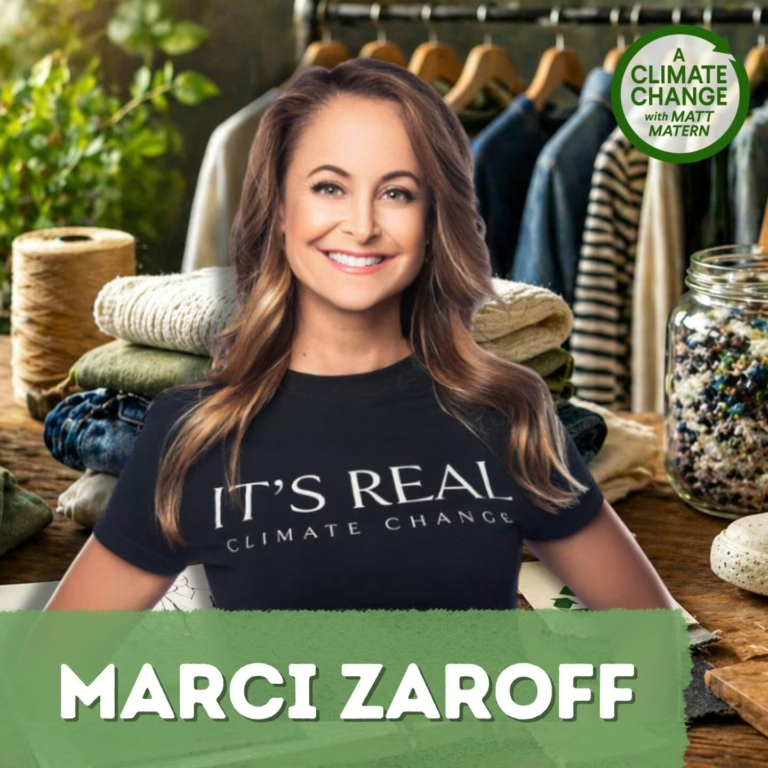
Matt speaks with Marci Zaroff – founder of ECOfashion Corp and one of the pioneers of the sustainable fashion movement – about the real cost of what we wear. They cover how 60% of the cotton plant ends up in our food supply, why organic and regenerative fibers matter for human health, the difference between greenwashing and genuine certification, and how the industry is shifting toward traceability and outcome-based standards. Marci also shares how she helped build the Global Organic Textile Standard (GOTS), what ECOfashion Corp is doing today with artists like Billie Eilish, and why she sees this moment as a turning point for the whole industry.
Learn more about Marci’s work at marcizaroff.com and ecofashioncorp.com.
Third of the plastic pollution in the oceans is actually from textile microfibers. It’s one of the largest end users of fossil based plastic. The proliferation of plastic in our microfibers when you wear synthetics and then you put them in your washing machine, and they shed all these microfibers that then go into orbiters, that then go into our oceans. Two thirds of the world’s textiles are synthetics. 14% of total global plastic production is textiles. 90% of fish have traces of microfibers with plastic in them now.
You’re listening to A Climate Change, this is Matt Matern, your host. I’ve got a great guest on the program today, Marci Zaroff. Marci has a long career in the environmental movement. She is the founder and CEO of echo fashion Corp, and she’s been kind of in this field for a long time. Welcome to the program, Marci.
Thank you so much, Matt. Nice to be here.
Well, so tell us a little bit about your journey and what led you to the environmental movement.
Well, I actually started in the food world, where a lot of people do start that journey, you know, learning about what’s in their food and what’s in our soil, and how those things are interrelated. So in 1990 i co founded a school that’s known today as the Institute for Integrative Nutrition, which has certified nearly 200,000 people worldwide as health coaches. And that got my feet wet, kind of really understanding agriculture and popular culture as it relates to, you know, what we all hear, you are, what you eat.
And that led me down the rabbit hole where I started to kind of unpack all the environmental and social ramifications to, kind of the choices that we’re making today out in mainstream culture. And I stumbled upon cotton, where I learned that the cotton, 60% of that plant, actually goes into the food stream. And I had this aha, that food and fiber are connected, both in agriculture and popular culture. And I coined and trademarked the term eco fashion in 1995 and so really, for the last 30 plus years, I’ve been pioneering the space globally, and, you know, really unveiling the human and environmental impacts that are in the fashion and textile industry that really parallel the food and also the beauty industry.
My mentor of 25 years was the founder of Aveda, and so we worked a lot back in the day when I was driving the food world, and he was driving, you know, personal care, and we learned about all that interconnection. And so we started to collaborate, and that, you know, continued to put me on the path to learning what’s next, what more, and I see that same evolution in consumer so I’ve committed my life for the last over three decades to driving environmental awareness through the power of business and products.
Okay, I’m curious as to who that was at Aveda. Was that the founder horse?
Yes, horse was a very, very close friend, one of my best friends, and I even got married at his house and spoke at his funeral when he passed away. And I wrote a book called Eco Renaissance, co creating a stylish, sexy and sustainable world. And Horst wrote the foreword. It was the last thing he wrote before he passed away.
I had the pleasure of meeting him as well through the Aveda world back and I guess it was the 80s, my ex wife was in that, you know, in that world, and so they were distributing his Aveda products.
Oh, wow.
So, yeah, very fascinating guy who went from a hairdresser to a founder of a company that I think was sold to Estee Lauder for three 50 million or something like that.
Exactly. Yep. And you know, he always inspired me with that premise that if you lead people with a visceral or an esthetic experience, which is very much what they did at a beta you could activate them and engage them and then take them down that sort of proverbial rabbit hole of the why and the what and the how and the where and the when. And you know, we were really always telling the same story, but using different modalities to do that.
And when we sort of uncovered that or unpack that, we realized that one plus one equals 11, right? We’re stronger together than we are apart. And ironically, horse birthday is 1111 and I got married on his birthday on 1111, 11. So we’re the power of that number just represents that we’re much stronger together than we are apart.
That is very cool and very interesting to feel that connection. I still use a. That shampoo, though, I’m not sure it’s as good as it was when horse was running the company. I think Estee Lauder may have changed a little bit. They can’t help themselves to mess with a good thing. But tell me a little bit about the cotton journey, and I this is news to me that 60% of the cotton goes into the food chain. How is that happening?
So when you grow cotton, it grows, especially if you’re growing it organically. It grows in the same methodologies as if you’re growing, you know, organic food, right? So first of all, you’re rotating crops, and cotton is an agricultural product, but when you harvest it, and you actually, you know people when they think cotton, they think of their clothing or their home textiles, but it’s a beautiful plant, and when you harvest it, you have to remove all the seeds, so it goes through a process called ginning, and 60% of the weight of the plant are the seeds and the additional layers and the stems that get removed out of the cotton and they get crushed, and actually the seeds become cotton seed oil, which is very prevalent in breads and snack food products.
And then the seed is the highest ingredient in animal feed, in dairy feed, because it’s very nutrient dense. So you know, my first investor, when I started my first brand in 1996 called under the canopy, was actually the founder of Horizon organic dairy. And so we realized that we were sort of meeting each other in different ways, and that, you know, again, the same story you hear about dairy products being, you know, milk is a natural but when you pull the curtain back and you actually look at the hormones and antibiotics and steroids and factory farming, if it’s not organic, there’s a lot more to it, right?
Same thing with cotton, when you actually look at the way cotton is grown, what goes into the processing of cotton, so it’s one of the most heavily sprayed industries in agriculture, with some of the worst, most toxic, carcinogenic chemicals, right? Because of the boll weevil, which you know, is one of the the insects that oftentimes, you know, is found in the cotton plant. But not only is it so heavily sprayed, but then when you harvest it, you actually bleach it through many layers of processing.
So when you get to an end garment, this shirt on your back that could have changed hands 10 times in a supply chain, from the cotton field to the gin to the spinning to the knitting or weaving to dyeing, to printing, cutting, sewing, packaging, all of the layers that go in, oftentimes, chemicals are added each step of the way. So at the end of the day, you don’t even realize the magnitude and multitude of toxic chemicals in a finished garment or home textile, and people then, you know, when they think it’s made of cotton, they automatically say, Well, it’s a natural fiber. It’s cotton, not understanding or realizing the ramifications of the growing, the sewing and the processing,
right? That’s fascinating. I did, or do recall from, I think it was a prior guest that talking about the amount of, you know, fertilizers and pesticides that grow go into cotton that’s not organic, and it is shocking. I think it was almost like a kilo of pesticides and fertilizers to each kilo of cotton. And then you know that what it does to the to the ground and the so it is really destructive to the to the ground, as I recall, so like really insisting that you buy organic cotton makes a big difference. Is, in my recollection, maybe you can shed some more light on that.
Yeah, it’s Well, first of all, one of the statistics we used to use back in the day, early in the early years of this movement, was it takes a third of a pound of pesticides to in the cotton used in a single t shirt right to grow that amount of cotton. You know, things have evolved and changed through the years, but really, the bottom, bottom line is, to your point, the amount of chemicals that go into just the growing alone.
Not only does that affect soil health and biodiversity, because just like any you know, GMOs and chemical sprays and you know, the chemical cocktails that go in conjunction with the GMO seeds are so toxic that they kill the good organisms of the soil, not just the bad ones, right? And then you have the health of and livelihood compromises on livelihood of the farmers in India. It’s a known thing that every half an hour you. An Indian cotton farmer, conventional cotton farmer is committing suicide. Why? Because they get stuck on what we call the pesticide treadmill, where they get, you know, kind of induced initially, with these like, you know, grandiose dreams of, like, increasing their yields to these astronomical levels.
And so they start to use these systems that ultimately destroy the soil health and the biodiversity. But what they also do is, you know, these countries, especially in India, that are growing cotton, they’re usually doing it manually, unlike in the US, with massive factory farms and machines, and you know, their women are literally walking through the farms and the fields with pesticide tanks on their backs and sometimes even babies in slings on their fronts.
So what happens is, is that the spraying systems eventually the bugs build resistance, and the pesticides, insecticides get stronger and more expensive, and the farmers end up leveraging their farms to banks that are in cahoots with the chemical companies, and over time, they lose control of their farms. The soil is out of control and destructive. Their health, their own personal health, gets compromised. There’s a rise in reproductive and and other illnesses, especially at Spring season. And then, you know, they go into despair, and the way they’re committing suicide is they’re actually drinking the pesticides.
It’s really devastating. So when you look at, you know, really changing the system and transforming the system, you know, we can’t just look at regenerative agriculture, which is right now, you know, definitely all the rage everybody’s looking at regenerative agriculture, we also have to look at, you know what we’re putting into the growing and sowing and processing of these, you know, these textiles, because especially with cotton, you know, if we keep doing business as usual with GMO seeds and chemical inputs, you know, even if we’re changing our practices Around rotating, you know, the crops and less tillage and, you know, cover cropping, we’re still using those chemicals that are destroying the, you know, the microorganisms and the biodiversity. So it has to be looked at holistically.
So is organic cotton that much better than, you know, I mean, a better. But is it something that we should be using anyway? Is it something that we should be looking for as a clothing option, or are there other fabrics that are that better for us?
Yeah. So you know, as I started with, you know, kind of the Hippocratic Oath, right? Let food be thy medicine. And also you are what you eat, right? And we all know that kind of everything we put in our bodies today has an effect over time, right? And that has been, you know, an incredible evolution I’ve seen over the last 30 years where this concept that used to be perceived as very new agey and crazy, organic food. You know, we all knew each other globally, who were in that movement 35 years ago, 40 years ago. And today, you know, it’s become very mainstream.
So similarly, sit, you know, the largest organ in our bodies, and our primary organ for absorption is our skin. And, you know, Horst and I used to share stories all the time when I started eco fashion and under the canopy, because we were telling that story that what you put on your body matters just as much as what you put in your body. So from a human, you know, health and wellness standpoint, which is at the roots of my career, yes, I mean, it does make a difference when you put, you know, massive synthetics on your body. 24/7, or you sleep in microfiber bed sheets that are plastic, and then you wonder why you might have psoriasis or eczema or skin conditions or allergies, asthma, chemical sensitivities. But people are connecting the dots.
They’re thinking still about the environment beyond them and the food they’re eating, and very rarely do they think about the textiles they’re choosing. So yeah, first and foremost, regenerative organic is, to me, like, that’s the premium. You know, of all fibers you know to look at. Are there others? Yes, in the world of sustainability and fashion and eco fashion, we really have two buckets. One is natural fibers that are regenerative and organic, that’s best in class. And then the other is circular, right? As many people know, you know, especially with the proliferation of fast fashion, the amount of impact we’re having on our environment from waste, energy use, chemical use, water use, you know, synthetics now represent 67% of the global market for fiber, right?
So, polyester, nylon, acrylic, you know, all of these synthetic fibers that are fossil fuel based, not only are they destroying our planet because, you know, again, you look at fast fashion that’s gone from, you know, four. Seasons a year in the fashion world to 52 plus seasons a year. Some companies literally coming out with new collections every week. So with that comes this huge impact. So now the second bucket of fiber to look for as a consumer is going to be your textile to textile, recycled fibers, where we’re taking old textiles back.
And I don’t just mean plastic bottles that we’re collecting out of landfills and turning them into R P E T, because that was the first kind of chapter of when you would hear recycled fiber, you know, sustainable fiber, you would hear about R P E T, but that’s a different industry’s waste stream, right? It’s really not solving for our waste stream. So when you look at, you know, the synthetic fiber market, and it continues to grow, we have to figure out what to do with all that waste. So there’s a lot of innovation right now on collecting that waste, sorting it through AI technologies, and then breaking it back down to its original in the case of polyester pellets, because it’s basically plastic, right?
Just realize that every single synthetic garment, I mean, you’re basically wearing or sleeping on plastic. And then, you know, with the natural fibers, recycling the cottons, but removing all of the dyes and the finishes, so that we can kind of start over again and keep, you know, a circular system versus a linear system, where Apparel has become, you know, disposable and ends up in landfills.
I guess my concern is with recycling synthetics is that we’re perpetuating a broken system, and that I I question that seems like we should be moving away from them as much as we can. What are your thoughts on that?
100% agree with you. I mean, I’ve always had a deeper affinity for natural fibers. For me, I am very much, you know, an advocate for the whole kind of organic, conscious, regenerative lifestyle, right? Having said that, you know, as Albert Einstein once said, we can’t solve today’s problems, you know, with the same consciousness that created them, right? And so we have to change our consciousness. That’s fundamental. But as at the same time, you know, if you’re not a part of the solution, you’re part of the problem. And so those synthetic textiles, they exist, they’re out there, right?
I mean, we’ve had generations now of, you know, polyester clothing, especially when it comes to, you know, what people perceive to be performance wear, and it needs it, and we can’t do that with cotton. So, you know, the industry is constantly looking for solutions, but in the interim, we do have to solve for the waste issue. I mean, if you look at the beaches of Ghana, or you look at the amount of textiles that are getting burned, you know.
Just it’s not like we can’t keep doing that. So when I say circular, and I say that keeping the system, you know, going with textile textile recycling, it’s to solve for what’s already a massive issue, but I don’t disagree with you. We want to kind of put a halt on new production of synthetic textiles, and I think the industry, because I’m chair of the board of an organization called the textile Exchange, which has, you know, our board is and has included the likes of H M and Nike and pbh and VF Corp and target and just Patagonia.
I mean, all the big guys are on the board. And I think, you know, we’re all holding hands now from mass to class, literally. And we’re working on, how do we transform the tier four of the fashion and textile industry. Tier four is where fiber and then tier three are fiber and materials, and that’s where 70% of the social and environmental impacts of the fashion industry actually happen. So we have to look at, how can we go from, you know, the conventional old school, you know, cotton production and synthetic production, to more sustainable ways to produce and ultimately, you know, at the source, protect human life and the environment through the choices we’re making.
How are we doing on that front, you had 60% 67% of our closer is synthetic, I guess, on worldwide basis, are we making any dent in reducing that percentage and increasing the percentage of regeneratively produced garments.
So I think we’re at a pivotal juncture in the industry. If I was to answer you today, I would say the what everybody’s been talking about for years. I mean, I’ve been in, you know, in this industry now for over three decades. Debates, and it’s gone through many different chapters. I think we’re at this moment where all that talk, which used to be driven by marketing departments, until greenwashing became a huge underlying issue, and companies just froze and said, Oh shoot.
You know, we can’t talk about anything we’re doing, even if we’re doing good stuff, because we’re in the line of fire now, you know from the social media mafia, so green hushing became the next chapter where they stopped talking about everything they’re doing now, they’re doing things behind the scenes. They’re actually rolling their sleeves up. They’re collaborating and forming coalitions. They’re driving data and traceability in our industry, unlike ever before, it’s becoming an imperative, no longer a choice, right?
And all of these, you know, systems are getting set up so that over the next few years, you’re going to start to see the integration of source and story, right, of production with, you know, being able to talk about what’s going on through, you know, digital technologies and and, you know, transparency that can be verified and measured, and all of that is now coming together in integrated ways, so that not only at textile exchange, but throughout the whole industry. It’s almost as if, you know, it’s not about staying ahead anymore. It’s about not being left behind. If you’re not integrating these strategies, and you don’t have to call it, you know, we used to call our strategy at Tech self change, the climate plus strategy, right?
But it’s, it’s really risk mitigation, it’s resilience, it’s, you know, Nature Plus it’s building back biodiversity and, you know, really, again, regenerating. And so we’re launching an entire initiative, bless you, called materials matter. And it’s the materials matter standard is going to be published this December and next year. It’s really it’s going to go into effect. And so what that’s going to do is it’s going to shift the narrative from everything being very criteria based, like Check, check, check, to outcome driven, where, if you’re actually doing this work, it’s not about saying I did it, Yay, I get a star or a seal on my product.
It’s about talking about the outcomes, the impact that you’ve had by doing that work. And that kind of accountability has never really been in, you know, part of our industry before, and it’s going to be married with policy that is underway, and that’s lighting a fire under the industry. So you’ve got this sort of convergence now of innovation around and technology and traceability and circularity and regeneration, consumer demand. I mean, I don’t know if you have kids, but I do you know they all are thrifting, and they’re talking about secondhand now it’s becoming part of their narrative.
And everyday, you know, lifestyle choices, they’re kind of slowly shifting away from fast fashion, you know, the sheehans and the temus, and they’re waking up, and they’re starting to look more at, you know, repair and remaking and and recycling and, you know, thrifting and vintage, and it’s becoming more of their you know, they’re embedding that more into their culture. And now you have the regenerative, organic movement, which continues to evolve in food and now five in food and beverage and supplements and beauty products. So that whole kind of clean food clean beauty evolution is also now starting to really, you know, get integrated into the fashion textile industry, where we’re looking at the relationship of soil health and human health.
I guess you were talking about being outcome driven. Tell us a bit about what those outcomes look like and how they’ll be measured.
Yeah. So, as an example, at Eco fashion, and we have a program called reset. It’s a cotton farming program in India, and it stands for regenerate, the environment, society and economy through textiles. And we’re measuring, you know, soil health and carbon and water and human livelihoods. And these are all we have a traceability system that is a tech stack that actually is embedded with climate IQ data, so we can actually even splice and dice and you know, for our B to B customers, we’re able to then bring that level of data and traceability, as well as storytelling, into a finished product as a full package, turnkey model.
So from farm all the way to finished product or seed to shelf. So we’re measuring at each step of production what the impacts are and and then. That data is able to be shared, both in reporting as well and measured at each, you know, step of the chain. And there are all kinds of technologies now that are in the industry, including satellite technology at the farm level that can talk that can give you those metrics at the farm gate.
So tell us a bit about echo, fashion Corp, and what you’re doing currently, and kind of what the genesis of the corporation was and what its future looks like.
Sure. So when I sold under the canopy, I wrote a book called Eco renaissance and produced a documentary film series and started a consulting agency with my husband called Beyond brands. And beyond brands has six verticals. It has food, beverage, beauty supplements, plant medicines and spirits, as well as fashion. And it’s really a conscious fractional consulting and operating agency, and with that, I had some of my partner’s clients, friends in the industry, because my roots are in the natural products industry, start to come to me and say, can you make us t shirts for this event or this uniform, or this swag or giveaway?
Or, can you make us, you know, items for our new food online retail store, like Thrive Market. And so I found myself doing these small projects for other brands, not for my own brands necessarily, and but I would still have to put a label on it. So since I coined and trademarked the term eco fashion in 1995 that’s kind of been part of my namesake. So I started using Eco fashion as the apparel side, and I started using farm to home on the home side. I got a trademark on farm to home, kind of the extension of farm to table, right? Because Thrive Market that was their core business was food.
So as I started to develop these different brands and concepts, I realized, okay, I need to roll them all together and really Springboard them out of beyond brands and create its own entity, a separate entity called Eco fashion Corp, which is really a holding company made up of different brands. So it’s got the reset Farm project. It had the brand farm to home. We started a brand for QVC during covid called Seed to style, and it was exclusive to QVC, an inclusive size, inclusive all organic apparel brand, mission statement, which we acquired from Hillary Swank, and with Hillary.
So that’s was a collaboration with her and the brand called Yes, and which we started as a D to C brand that launched right as covid launched, unfortunately, but it really sums up my mantra, which is yes, you can have everything that you want, style, quality, fit, color, comfort, hand and price and a way to make a difference to human and environmental wellness, Farmer and worker welfare and future generations. So it’s about no compromise. And that’s the first chapter of my book as well. That’s the way I approach business. That’s the way I approach life, right? It’s not one or the other. It’s how do you have both?
It’s value and values. And so as an entrepreneur, as a serial entrepreneur, that’s, I would say, my kind of sweet spot, whether I’m in food or I’m in fashion, is to really connect the dots. And you know, because the whole is greater than the sum of its parts, so eco fashion today really is about meeting companies where they are. And as an extension of what was beyond brands, it does the same thing. It’s about serving others, because serving others is serving ourselves. And how do we, you know, unlock all of the transformational needs and complexities by leveraging you know, years and years of you know, hands on experience and spending, as my as an example, spending the last 30 years in the trenches of India, farms and factories and building supply chains, I now can do that for other companies.
And I’ll just end with saying, with eco fashion, one of the most exciting unlocks that we’ve had the seat in the last, you know, three or four years is working with the music industry. So we’re at this moment, at the convergence of music, fashion, sustainability lifestyle to, you know, really empower all these young artists with sustainable merch. And as a starting point, eco fashion made all of Billie Eilish is merch for retail. So target Hot Topic, Urban Outfitters nationwide all launched these programs that we did as 80% certified organic and 20% certified recycled T shirts, hoodies, boxers.
We did for her so and that’s inspired now the whole industry. And so as you know, part of the music industry climate collective, you know, as an advisor there, and as an advisor with the music sustainability Alliance. Now, you know, everyone’s coming together, and it’s very similar to having been kind of very active on the food side, connecting that into fiber and fashion. Now, looking at the music industry and doing the same.
Because, look, everybody doesn’t matter what industry you’re in or where you live in the world, religion, race, color, you know, all of it doesn’t matter. We all wear clothing. We all sleep on bedding, right? It has a massive impact globally. And so it’s about now, you know, driving that into every sector and also telling stories together, so we can continue to activate, you know, consumers along the way.
Well, that’s exciting. I really like the endeavor with the music business, and that certainly that’s where a lot of young people will get their messaging, and some people who are a little bit older as well. You know, it’s just kind of creating a cycle, a virtuous cycle, I guess, to start talking about these issues, start generating awareness, maybe like in the 60s and the music industry was a big driver of social change. What other artists, besides like Billy Eilish, are getting on board this, this process?
Yeah, so, well, it’s funny, because, you know, I just agree with what you just said. The first chapter of my book is, Life is art, right? And the power of creativity to to inspire change. And I have a whole section on musicians, other musicians that have, you know, really moved in this direction. Jack Johnson, Jason Mraz, you know, Dave Matthews. But then when you, when you look at today’s artists, you have, Lord, we had done a program for the weekend.
And Billy Eilish is one of 200 artists at Universal Music Group, which is the largest music management company in the world. And and since you know, they have 200 other artists. They are now on a mission to try to drive sustainable merch into all of their artist programs, not just Billie Eilish, so Billy’s been an incredible voice and catalyst.
But I think what you’re going to see over the coming years is a lot more artists adopting sustainable merch, some by choice, and some it’s just put in front of them, and they love the product, and that’s what you have to lead with, right? You always have to lead with great product. And then it’s Oh, and by the way, it’s also, you know, recycled, regenerative, organic, low impact and all the good stuff.
Well, yeah, for sure, you have to win in the marketplace of touch and feel when you’re selling fabrics. So can you explain what regenerative cotton actually means and how it’s just different from organic?
Yeah? So you know organic is really about avoiding harm, right? It’s about no toxic chemicals when you grow you have no GMO seeds, no chemical insecticides and pesticides and herbicides that are toxic, and you use methodologies that, technically in the certified organic movement, are inherent in organic farming, such as crop rotation, cover cropping, green manure, low tillage or no tillage.
So the regenerative agriculture movement has essentially adopted these methodologies. They really do go hand in hand, but if you look at the lens of organic and regenerative, then now you’re talking about those practices that restore soil, that sequester carbon, right? Because when you build soil health, it’s like a sponge that actually sucks carbon out of the atmosphere, and it improves ecosystems and livelihoods as well.
So there are a few different movements out there that are a little bit unclear to, you know, behind the scenes and consumers, I’m sure, are even more confused if they hear about it, is that there’s a lot of movements now around regenerative agriculture that don’t include the GMO free or chemical free farming methods.
They’re simply the methodologies of, you know, capturing carbon from the atmosphere, but if you’re still using all those toxic chemicals, there’s a bit of a gerbil wheel. So there are different camps of regenerative out there. There’s one that’s conventional farming with now, with these newly embedded practices. There’s another camp that is already organic, that. Is going now and adding regenerative principles, just to make sure they’re part of the system again, for outcome driven approaches.
And then there’s this sort of middle, which is where reset lives, which is the program I started, which is about using regenerative as a lever to organic, because there’s a three year transition from conventional to organic that farmers have to go through, that they don’t get rewarded for that three years, but it’s hard work, because they’re basically regenerating the soil that’s been destroyed from conventional farming.
So if we can build a market of regenerative farming that’s on the path or on the road to rock regenerative organic, that’s a really strong opportunity to start to transform agriculture, where we bring both of those worlds together. But again, you know, just by definition, regenerative really is about the practices regenerating the soil, the organic is about, you know, no harmful chemicals, no GMO seeds and so on. And we need to bring them together. And there’s a lot of excitement right now across all sectors, food, beverage, beauty supplements.
That I saw at Expo West, the big natural products trade show recently that regenerative organic certified, the ROC certification that was started by Dr Bronner’s and Patagonia and the Rodale Institute, of which I’ve been an ambassador for over 30 years, it’s kind of the OG of organic farming and regenerative farming, and now there’s a huge movement across sectors to drive this kind of best in class certification forward in agriculture.
So you helped create the global organic textile standard. Why was a universal certification so critical? And what does it actually guarantee?
Okay, so you’ve probably bought, brought, bought organic food, right? And you, you know the seal that goes on an organic food product, right? The NOP USDA Organic seal. Most people recognize that seal. Now, that seal was developed for the food system, right? So the 5% allowances to be a certified organic product are all food specific, right? The kind of additives or things that make you know that you can’t necessarily get organic.
Unlike food, we have a different set of considerations, because we have to use dyes and finishes in textile production, right? Because if you sell everything as natural, you’re only going to be able to appeal to that many people, right? And so we had to develop our version of the NOP organic standard, still starting at the agricultural product, which is in the case of cotton or linen or or silk or wool, or, you know, or hemp, can be certified organic no differently than any other organic food crop, right? That they go through the same certification practices and requirements.
But then when you start getting into the processing of that cotton or that fiber, and you take it all the way through the supply chain, as I mentioned earlier, you know, bleach is added and and even things like flame retardants and softeners and finishes all kinds of chemicals in a gots or global organic textile standards, certified product. It is fully traceable from farm to finished product. There’s transaction certificates every single touch point of the supply chain all the way to the finished product, where even the packaging has to be post consumer recycled.
But there are no harmful dyes or finishes along the way, they’re only low impact dyes, no heavy metals, no acetone, no chlorine bleach, as well as on the farming side, no pesticides, herbicides, GMO seeds. So it’s a full certification to a finished textile, and it was adopted by the USDA as the counterpart to the NOP USDA Food standard.
How long ago was that and what percentage of production now kind of meets that standard?
Well, we started developing it in the 90s, and I was on the small team of people that that helped develop the got standard, and there were four trade organizations, really that were working together globally. It was one of the most exciting collaborations I’ve ever been involved in. So it was the Soil Association in the UK and Ibn in Germany, and Joker, the Japan organic Association and the and the organic trade association, which I was on the board of directors for many years, and helped launch the organic fiber council.
So we, we all work together to develop this global standard, because textiles cross borders and boundaries every single day. Unlike food, which you can you know, is more of a yes. People buy foods from all over the world. But, you know, agriculture really is very focused, you know, typically in country by country, whereas in textiles, we’re sending things all over, right?
So we all work together. And it took six years to develop the, you know, really finalize the standard. We launched in 2006 and my former company under the canopy worked with Target Corporation, and we launched the very first got certified textile in America at Target, which was certified organic cotton bed sheets. And they flew off the shelves.
And it was a very successful program that they still have organic cotton bed sheets on their shelves today, and it was really because we worked very hard to build from the ground up, from seed to shelf, because it was so early in the industry, and because I had been building supply chains that way my whole career, because I couldn’t go to a factory and be like, Hey, will you make me organic textiles? Because they would look at me cross eyed, like, What are you talking about?
What is that? Right? You had to start at the farm in the early years. But the way that our industry works is everybody gives their purchase orders and their, you know, tech packs to factories, and they rely on the factories to source downstream and to build the supply chains down, right? So when you ask me how big it is today, these standards, like gots or the textile exchange standards, the organic content standard, the content claims standard, and the, you know, global recycled standard, these standards help to actually trace and track the whole supply chain, or parts of it, if you only need parts of it, and to start looking at The source of our fibers.
And so the got standard today. I mean, I know, with the textile exchange standards, we have over 100,000 certified suppliers and partners gots today, I want to say is about 20,000 somewhere between 15 and 20,000 certified gots entities, but it’s growing every year. And that’s because, again, more and more companies in the two and a half, $3 trillion you know, textile industry globally are all now jumping on the train, you know, from even from the she ends to, you know, one of our most active partners, and, you know, big, big buying power that can actually help drive innovation and transformation is H M always at the table.
So, you know, it, we have a lot of work to do as an industry. But you know, these, these standards, which gots, is now on its eighth version, as I mentioned, the MMS, the material matters standard is launching next year officially, and that’s a roll up of all the textile exchange standards, but these are really kind of your platinum standards out there.
Well, I appreciate the education, but even more, appreciate the amazing work that you’ve done across decades to kind of help build this up, and you know, it’s an incredible accomplishment to be a part of that. So kudos to you and to your many partners in making that happen, because it’s one of those things that probably hasn’t talked about enough, but, and just for the listeners, gots is global organic textile standard. So for those of us who don’t hear that every day, so pivoting a little bit to tell us about good catch, a plant based seafood brand, and how does that connect with fashion?
So we actually, my husband and I co founded good catch with a private equity firm. It was kind of the Beyond Meat of the seafood industry, and we sold out in 2019 and sort of moved on, you know, but it was founded from within beyond brands. And I think the most interesting learning for me, since I have my roots are in, you know, eco fashion is that connection of food and fiber, once again, not just in agriculture, and we talked about cotton and 60% of the plant, but the impacts of the textile industry in our oceans, right?
So a third of the plastic pollution in the oceans is actually from textile microfibers. It’s one of the largest end users of fossil based plastics. Right? The proliferation of plastic in our microfibers when you wear synthetics and then you put them in your washing machine, and they shed all these microfibers that then go into orbiters, that then go into our oceans. And as mentioned, you know, the third, two thirds of the world’s textiles are synthetics.
So you know, 14% of total global plastic production, you know, is, is textiles. And you. When you look at looking at fish in the ocean today, they’ll say 90% of fish have traces of microfibers with plastic in them. Now, I mean, so I started learning this as the CMO of good catch, and also that, you know, by 2048 predictions that fisheries will collapse, and all the ramifications of fishing.
And so, you know, it was really, for me, I think, an incredible chapter to to really appreciate, you know, the work that I do, and to really understand, you know, how every choice that we make, whether it’s in, on and around us, has an effect, and how we all have to work together across industries. So, yeah, so good catch. We’ve, we’ve, we’re long out of and moving on, and have continuing to forge ahead and still in the food industry. I still live there through beyond brands and other projects and brands that we’re involved in. My husband is also a serial entrepreneur in the space.
So tell us what the future looks like for you and for this whole area, and what are, what are your kind of big warnings and maybe bright spots as well?
Yeah. Well, I have a lot of hope now. I think that, you know, as we start to see technology enter into our world where people aren’t going to be just duped by, you know, reading packaging and, you know, pretty pictures and great commercials, and they’re starting to actually ask, what’s in my food? Where does my clothes come from? What’s in it? What are the impacts that these, you know, products are having, and it’s slowly continuing to penetrate and evolve into the mainstream mindset, and married with, you know, again, with these technologies now that can prove where things come from, and married with policy.
So I think you know that this moment that we’re in gives me a lot of hope. I just came from a tech stock exchange board retreat in Germany last week, and you know, everybody’s at the table now across, you know, from the investors to all sectors to you know, finance, the business case for sustainability is starting to come front and center, right like business as usual. Can’t continue the risk, you know, levels now, of not knowing your supply chains, where they are, what happens to them with, you know, climate change. How are these things going to be affected in the coming years, if we don’t take action now, it’s moving to a whole different mindset where, you know, risk mitigation has become, you know, such a fundamental part of business in this context, more about that in terms of what risks are companies most keenly concerned about?
Well, you know, supply chains getting decimated. I mean, look what’s happening with the geopolitical landscape now, when countries are too heavily weighted in a certain country, you know, and in for production, and all of a sudden you can’t even access that country. And you know, how about if you’re dependent, you know, many of the brands out there, our favorite brands are 2/3 cotton brands, right?
They’re not big synthetic brands, a lot of our favorite brands, and you know, they’ve got to be looking at where their cotton is coming from, and be able to adapt and be resilient and make sure that they have access to the sources of their products. And so all of these mindsets, you know how nature is now. You know, we’re in partnership with nature, whether we like it or not. You know, it’s, it’s really part of the premise of my book is, through the lens of design, we can change the world if we look through, you know, food tasting good, and beauty products smelling good, as you said, you know earlier, about the Aveda products, or fashion looking good and feeling good physically, right?
We have to be, you know, giving people what they want, but also identifying, you know, the what and the how that’s going into our products. Because if we don’t understand, you know, how to make sure that we’re able to have those ingredients where we’re able to, you know, have access and things. Could just start collapsing, right all over,
I was thinking more in terms of litigation risks. Since I’m a lawyer, I can’t,
Yeah.
wWhat are the litigation risks that are being talked about in boardrooms, in terms of poisoning the environment in, you know, manifold ways, like microfibers in the ocean. I mean, eventually that’s going to be traceable to companies 100% and all kinds of other environmental disasters that are, you know, in our food chain and in our clothes and policy, and that’s where policy comes in. The the EU is really at the forefront of setting policy right now for the global textile industry, but really focused on the EU.
But really, every single global brand that sells in the EU also sells in America, right? So, you know, it’s spilling over where, you know there are now going to be, you know, very strong traceability, transparency, data requirements, reduction of waste claims, all of that’s coming into play, and if you don’t comply, yeah, there are huge legal risks there.
So I think what we’re trying to do at tech stock exchange, but also across the industry, is align policy with the certifications, with our practices, and that goes back to that moment that we’re in because, yeah, it’s for all, all the risks of climate, all the risks of the, you know, being able to make claims where the consumer, you know, risks of of not being relevant, you know, in the future. Because if this is where the world is going, you know, we you know, it’s no longer about, you know, the the alternative, you know, being sort of the alternative, right? It’s about making the norm the alternative and the alternative the norm.
Now, I’ve had a guest on the program who is a big sustainability guru, and his his mantra is kind of like, use a lot less. And where is that? You know, is that resonating at all with anybody or set?
Yeah, well, that’s use more and more and more and more and more. And you know, if we used a little bit less, that would help take the strain off of all of this, right?
100% and I think that’s where you’re, you know, when you look at the circular economy in the fashion industry, it’s not just about circular fiber production and textile to textile, you know, production, it’s also really about, you know, consumer usage. And that’s where vintage, you know, has made a huge comeback and is starting to grow. You’re seeing them, you know, vintage stores, secondhand stores, pop up all over the place now.
Thrifting is all the rage in the younger generations, as I mentioned earlier, that’s all about keeping things in the system, but also looking through the lens of quality, right? And starting to move away from, you know, fast fashion, that is literally just throw it away after one or two uses, which is where things were going. And I’m not saying that it doesn’t still exist.
But, you know, look, consumers have the power to vote with their dollars, and if they start shifting those dollars towards higher quality second hand thrifting away from fast fashion, you know, you know, you’ll start to see shifts that which we’re already starting to see behind the scenes, where there’s, you know, even each of these fast fashion and other almost every major retailer out there now is looking for ways to actually keep their own products in the system, through their own sort of on their websites, or in their store, second hand lanes and opportunities.
Well, we’ve got a long way to go, but I appreciate your incredible work to start this process over 30 plus years ago, to start moving the needle and and the needle has moved, and yet, we’ve got lots more work to do, but thank you for all you’ve done. It’s it’s an amazing career that you’ve had, and I’m sure there’s much more to come. So excited to check back with you in a little while and see see what news has occurred. So thank you, Marci.
Thank you so much, Matt. Have a wonderful rest of the day.
To learn more about our work at A Climate Change, visit aclimatechange.com. Don’t forget to subscribe to our podcast on Apple, Spotify, YouTube, or wherever you get your podcasts. If you like this episode, please share it with a friend. See you next time.
(Note: this is an automatic transcription and may have errors in formatting and grammar.)