
Hear us on Apple Podcasts, iHeart, and Spotify Podcasts. Subscribe now!
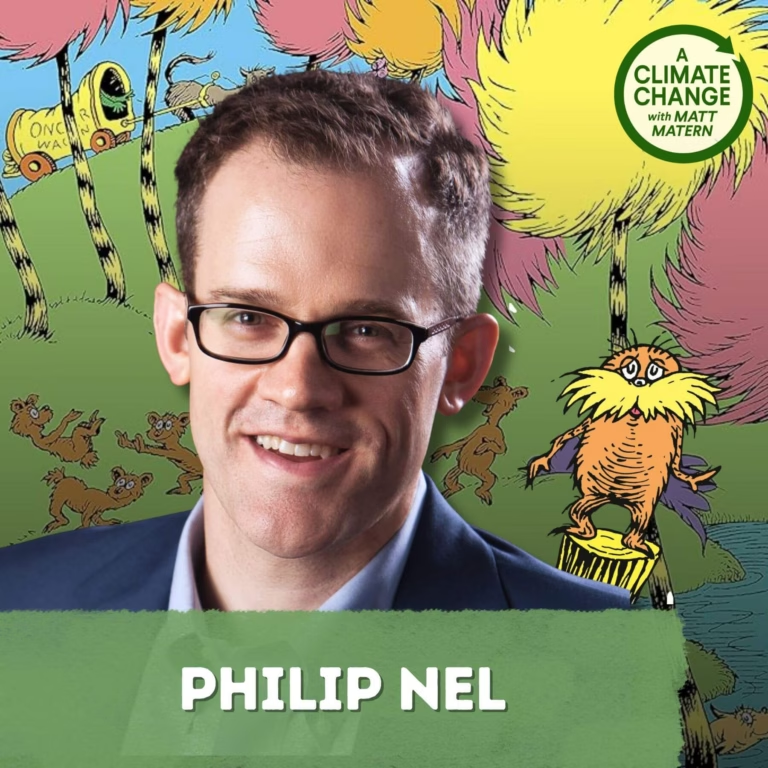
Matt speaks with Philip Nel, University Distinguished Professor of English at Kansas State University and one of the world’s leading Dr. Seuss scholars, about The Lorax and its place in the environmental movement. They trace the book’s origins, from the coastal construction in La Jolla that made Seuss angry, to the trip to Kenya that finally unlocked the story he scribbled on a hotel laundry list. They also dig into the logging industry’s counter-book Truax, why The Lorax keeps landing on banned-book lists, and how Lady Bird Johnson built an environmental campaign around it.
This episode is part of our “250 for 250” series, marking America’s 250th anniversary by revisiting the figures and stories in our environmental history when ordinary people changed everything. Dr. Seuss, and the little orange creature who speaks for the trees, is one of them.
Learn more about Philip’s work at philnel.com.
I think it’s one of Seuss’s most prescient texts. Really, I think it’s more relevant now than when it was published. The destruction of the environment has accelerated in the 50 plus years since the book has been published. So it’s a book that will continue to resonate. Unfortunately, our own planet is under a kind of threat that I don’t think Seuss could have imagined back in 1971 All the infrastructure in the US that was protecting all this is being gutted. We’re no longer, we no longer care about clean air and clean water. Apparently.
You’re listening to A Climate Change. This is your host, Matt Matern. I’ve got an amazing guest coming on the program today, Dr. Philip Nel. He is a distinguished professor of English at Kansas State University. Dr. Nel, welcome to the program.
Thank you for having me. It’s great to be here.
Well, you know the purpose of having you on the show is to talk about the Lorax, and it’s funny that the Lorax kind of ties in with the environmental movement in the US quite, quite nicely, and I was looking at when it was published in 1971 and we just did an episode about kind of how the environmental movement genesis took place in the US, and back in the late 60s, early 70s, is when it really took off. So the author of the Dr. Seuss books was clearly tuned in to what was happening in the zeitgeist, and, and was, yeah, into that audience. There
were a bunch of environmental children’s books published in 71 The Lorax is the most famous one, but there’s also Bill Pete’s Wump World and Charlotte Pomerantz was the day they parachuted cats on Borneo. So it was definitely, definitely in the air at the time. He wasn’t the only one to be thinking about it, but the Lorax is certainly the title that you remember, even though the other titles are both very good, and I would recommend them.
Okay. Well, tell us a little bit about your, you’ve studied this a little bit and written about it. What do you think is the cultural impact of the Lorax here in the US, and maybe abroad, if it’s really taken root outside of the US?
Well, the book is a call to activism, you know. It ends with the Wunzler talking to our narrator, who has learned the story of his repentant ex-industrialists’ destruction of the Truphulia trees and the brown barbaloot bears, and all the creatures who are sent packing thanks to this need factory, but at the end, you know, he, he wants the narrator of the story, he wants the you in the story, who the whole story is addressed to, I should say, he wants the you to do something, and he says, unless someone like you cares a whole awful lot.
Nothing is going to get better, it’s not, and so it is a real call to activism, and I have spent some time in Seuss’s archives, and sure enough, there are kids in 71 and 7273 writing him letters, telling him, you know, they’re planting trees, telling him they’re going to get people in the neighborhood organized, and so it immediately has has an impact. The Keep America Beautiful Foundation gave Seuss award in 1971 For a time, Lorax was the symbol of a group called American Forest, which was a conservation organization. So he has really come to symbolize environmental conservation in the US, and began to do that pretty early on.
I guess the question I have is, are there similar books that are being written now? Is is this kind of still kind of cutting edge, or is this, or do we see kind of a dearth of environmentalist children’s books now?
No, I wouldn’t say there’s a dearth at all. A recent award-winning one, We Are Water Protectors by Carol Lindstrom, is a fantastic book about the environment, you know, about taking on the, you know, the Standing Rock against the pipeline there a few years ago is partly the inspiration of that, and it’s a Native American story too, and the oil pipeline gets figured as a snake in it. It’s fantastic. So, there’s there are plenty of, plenty of contemporary books that are on the subject that are being published, that is the first one that comes to mind. We are water protectors, check it out of your local library.
Sounds good. So, in terms of the Lorax, what, what do you think has it catch fire and become such a hit,
Um. Oh, well, I think some of the same reasons that that Seuss’s books connect in general is that Seuss, Seuss is in a bunch of his books, he has a, he has a moral to tell you, but he tries to tell you that moral in a way that’s engaging and fun. He doesn’t like to be preachy. After the Second World War, he started writing more political children’s books, like Horton Hears a Who, The Stitches, and Other Stories, and after The Lorax, where The Butter Battle Book, but he was always really concerned about telling a good story and not just telling you to do something, and so I think that’s part of what what makes the Lorax work, and it was something that he worked really hard on for this book, he, he, and it was inspired because he was seeing construction along the California coastline.
He lived in La Jolla, California, and we got angry about the construction and destroying the trees and all the environment, but he couldn’t really get a story that worked. It seemed like he called it propaganda with a plot, and so he got stuck, and he didn’t really write it. And then he and his wife, Audrey, like to travel, and they went to Africa, and they were in Kenya, and that’s where he finally got unstuck and was able to write the book. He was in Kenya, and also seeing trees being cut down, and he thought to himself, they can’t cut down my Truphrila trees, and they were actually acacia trees from from Kenya, but somehow that seeing that unlocked the story, and he actually wrote it on a like laundry list paper there at the hotel he was staying at in Kenya.
And had a story, and this is actually a true story about the writing of the stories, Whose often made up stories about writing his stories, because he was more interested in telling journalists a good story than he was in telling the truth. But I’ve actually seen the laundry list in his archives, so I would say that his commitment to telling a good story would be would be big, because nobody likes to be preached to. You like a story, and this is story, and has suspense, and when it ends, we don’t know how it’s going to end, you know. We only know that we need to do something, and that’s that’s a powerful way to end, because it leaves it in the in the reader’s hands to to make a difference, to care a whole awful lot, and to do something.
So, I’d say that’s that’s a big part of it. The rhyme, of course, Seuss’s rhyme keeps you reading the meter of his books, makes it fun to read, makes you want to turn the page, and the art. This is made the first Seuss book to use such a full color palette, the Lorax, and that’s partly due to changes in printing technology that made that commercially feasible. So it’s a really beautiful book, and if you look at the books prior to it, this one has a kind of technicolor vividness to it, which, yeah, is quite, quite striking.
Well, I certainly remember, you know, his books from my childhood, you know, iconic books, and, and that, yeah, they were fun, they were fun to read, they drew you in, so that that makes reading more enjoyable, and rather than trying to read something, see Dick Ron, see Jane, or whatever, it’s like that’s not going to inspire too many people that to dig in, but he, he made it to an enjoyable exercise,
yeah, and that’s one of the reasons he became such an important children’s writer, is in response to the Dick and Jane books. That’s why he wrote The Cat in the Hat. He wrote The Cat in the Hat because people were worried that American children were not learning to read, and we needed more exciting reading primers, and in an essay, and it was Life magazine, John Hersey challenged Seuss to write to write such a primer, and he did, and that, and that is really, I think, what he’s known best for today is as reading teacher via The Cat in the Hat and Green Eggs and Ham and all those other books, but he’s also a political writer, and that is part of his legacy as well, and a mixed part of his legacy.
He is not always, he’s not always fully aware in his books of how his visual imagination is transmitting ideas other than those that he seems to intend, certainly in this representation of race in his books, which isn’t so much an issue in the Lorax, because there are few human characters in the Lorax, and there’s the one little white boy that we see in the book, and that’s about it. The one slitter is just a hand, really. It’s a glove. We never really see him. So, anyway, this answer to your question rambled a little bit, and I don’t feel that I have tied it up well. So, maybe I should stop now.
Well, you know, it’s all important part of the story. We need to get the background, so. So what do you think are the impacts that are still ongoing from the Lorax? Is it still selling? Is it still kind of…
Yeah, not only is it still selling, but, but Random House, some years ago, started printing it in a more friendly way to the environment, so it started printing on a different, different paper, because the book and the way these books were made is not environmentally friendly, and so they actually, they changed the way they made the Lorax to try to make it more in line with the message of the Lorax, which I think is, is pretty cool about it, and you, since you keep coming back to Impact, maybe I can tell you about, yeah, some of the controversies that you know it has been interpreted as against logging.
And there was a period where the, the National Wood Flooring Manufacturers Association was, was upset about it, and published their own anti-Lorax book called Truax, in which there’s a logger named Guard, and actually the logger, excuse me, is named Truax, and then Gard Bark is the environmentalist who’s this caricature of environmentalist, and Truax is this kind white logger who is trying to explain to Guard Bark why it is really good to cut down trees, and it’s told in a, you know, an attempt at Susie in verse.
It’s interesting, you haven’t heard of it for a reason, but which is that it isn’t great, but you know it has been a book that has generated some controversy, because it is specifically focusing on the logging industry, focusing on deforestation, and that upsets people in that industry, so that is, I think, an indication of its impact. When a work of fiction has real enemies, I would say you’re making an impact, and so I would say that about, you know, about Seuss’s book, and he responded to that too, and you know, said that, look, you know, I write books that are printed on paper. I live in a house made of wood, and the book is not against paper, it’s against exploitation, it’s against going, it’s about going easy on what we have, and it’s anti-pollution, it’s anti-greed, it’s not anti-making paper. But anyway, so that’d be another example, I think, of impact.
Well, I wonder, you know, it, the time that I was growing up, when this book was being made, the War Acts, it seemed as though there wasn’t too much, you know, political division on this issue, in terms of, for instance, like the Clean Water Act, the Clean Air Act, with overwhelming majority right under Nixon.
Yeah, right. So the question is, like, are is there division, say, in the red states where you know Lorax sales are low, or something like this, or that environmental children’s books are, you know, kind of under attack, or certainly push back on because they, they’re not in line with certain messages.
The Lorax has certainly been a challenge book. It has certainly faced that at the moment. The real focus from the right is on any representation of minoritized communities, books by members of minoritized communities, books representing queer kids or trans kids or American history accurately. That’s the current focus, the Truax, or excuse me, not Truax, Truax is the book that’s attacking the Lorax, but the Lorax has appeared on on band and challenge lists over the course of its career.
I think it’s got to be one of the Seuss books that has most frequently been in the spotlight prior to 2021 when there was the Six Seuss books that were pulled for their racist caricature. Prior to that point, I would say the Lorax was probably his most controversial book, with maybe the Butter Battle Book as a, as a close second to that, which is the one that’s critical of Reagan’s escalation of the arms race. So, yeah, it’s.. it has, it has faced political pushback at the moment. It is not the scapegoat of choice for, for the right. I mean, could become so. could become so love the new reflecting swamp down there in Washington. I hear it’s very nice, but, but at the moment it’s not, it’s not a focus.
Well, it’s unfortunate we don’t have Seuss to write some more books about what’s happening now. I think he’d probably be very well suited to talk about this moment.
Oh yeah, I think he, he would have a lot to say in this moment, he would be pretty angry, and I can imagine him writing some fairly acid things, and maybe, and maybe even not in children’s books about our current president and the destruction that he’s unleashing upon the environment, the country, the world.
Well, see, I think that’s what you know, quite frankly, maybe one of Trump’s strengths is that he, he almost talks like Scouse in terms of making up silly names and stuff like that, it’s kind of one of his go-to things that the left really hasn’t, hasn’t met that very effective.
No. And you know, the question is to how do you meet that, and who is the right person to meet it in that way. It’s one thing for a political satirist or children’s book, which would be satirical to tell a story, and there are a number of books about number of children’s books about Trump. Yeah, going back to 2017 or actually before 2017, Trump first appears in children’s books. In oh, there’s a book by a book called Christmas in July, where the villain is a character named Rich Rump, and he’s clearly a caricature of Donald Trump.
It’s from the 1980s He also appears in Maurice Sendak’s We’re All in the Dumps with Jack and Guy, sort of obliquely, there’s a Trump Tower in there, and he’s the cause of suffering and of poverty in that, so he has a longer history in children’s literature. But as president, the first children’s books about him start in really 2017 so there’s a number of children’s books that do take on Trump, and I think if Seuss were around, he would be, he would be among those, so yeah.
Well, he probably could give some advice to some of the political candidates who are seemingly incapable of kind of countering some of the Trumpian rhetoric.
Yeah, and you want, you want to think to counter the rhetoric with the truth. You don’t necessarily want to play the game that Trump is playing. I think you want to counter it with the truth, and that’s sort of what I was trying to get at, and saying the person delivering the message matters. If I’m a satirist, that’s different than if I’m a political candidate. I think to use, to use his style against him, I don’t know that that is the right way to go.
I understand the temptation of it. I find it funny, and whatever works, works. If that turns out to be the thing that works, then fantastic. I’m here for it, but I also, I also think you can be quite powerful simply by telling the truth, by not lying, you know, and by pointing out when, when he is lying, and that’s enough, if you can do it in verse, like Dr. Seuss with illustrations, that too is a talent. I’m not sure that’s the talent that you need from the political leader, but it is. It is a useful way of delivering a message about, yeah. Well, it seems an unhinged occupant of the White House. Yeah, go ahead.
It seems though current Governor Newsom from California is trying to match Trump in a certain, certain way, and it seems it, you know, it gets some response in social media, whether or not, does, whether that’s the right way, is a different story.
Yeah, and I don’t know. I mean, if that works, then yes. I, I find them amusing too. It’s fun to see him troll Mr. Trump. I also wonder if I wonder if that is the approach to go, you know, I think about the line that the like a tool of domination cannot also be a tool of liberation, and so I sort of I wonder if I wonder if that’s the right approach. I’m not a political consultant, so do not listen to me or take my advice on this point, but that is what I was thinking about when I was saying I’m not sure if that’s the way to go.
Where do you see the Lorax kind of going in the future? Is it, do you see it continuing to have life in our canon, or is it, is it something that kind of will. Will live on kind of as a history book rather than something that’s as a live text.
I think it’s one of Seuss’s most prescient texts, really. I mean, I think it’s more relevant now than when it was published. The destruction of the environment has accelerated in the 50 plus years since the book has been published, so I think it’s a book that will continue to resonate, unfortunately, because, yeah, our own, our own planet is under a kind of threat that I don’t think Seuss could have imagined back in 1971 so and then you know all the infrastructure in the US that was protecting all this is being gutted. We’re no longer, we no longer care about clean air and clean water, apparently. So, yeah, I think the book will very much continue to resonate, and I wish that were not the case, but I definitely, definitely think it will. Unfortunately, I think that it will.
I mean, it’s interesting that Lady Bird Johnson placed the Lorax at the center of her environmental campaign. What’s your take on that? And how effective was her campaign.
Yeah, that’s that’s a great point, or a great thing to bring up, and a wonderful story. The manuscript of the Lorax is the only one that is not with his papers at University of California at San Diego, because LBJ got it sort of by thanking Seuss for agreeing to donate it to his library. Seuss had not agreed to donate it to his library, but sort of went ahead and did it anyway, and so the Lady Bird connection there is is part of part of why that that manuscript is actually not with Seuss’s papers, it is actually and the LBJ Library, and it’s an also interesting, interesting piece of the books impact that it would be used, and in that campaign, and it did have an impact, as I’m thinking about this now, there’s there’s a line in the book that’s who’s changed in later printings.
It was about Lake that isn’t so smeary. I hear it’s bad up in Lake Erie, and they managed to clean up Lake Erie, and the people who cleaned it up wrote to him and said, “Would you change the line in the book? And he did. So, if you have early lines, if you have an early, earlier edition of the book, it mentions Lake Erie. If you have a later edition of the book, it does not, because they actually, they actually cleaned it up.
Yeah, that’s that’s pretty incredible that we did. We can make positive change. We have done so in the past. We need to keep working at it.
Yeah, absolutely. And that’s why it’s great you’re, you’re doing this podcast and getting people stories. I understand about environmental change, because stories are what shows people that they can change the world. You know, stories give people hope, stories inspire people, and I think that is what art can do, and that is what we need right now. From art, we need that inspiration, because hope is what fuels the fight. You have to believe that it is possible to change the world, and that’s where art comes in.
That’s what it tells you to do, and that’s what helps keep you going, and every, every social movement that we’ve had in this country, there’s always an artistic wing, and there’s always a children’s book part of that, whether it’s the fight to end and slavery, whether it’s the fight for for civil rights, or voting rights, or women’s rights, or LGBTQ rights, they’re always children’s books that are part of that, and that are telling those stories, and that are telling people, here is the hope that you need, here is the inspiration, and go forth and do something, and I think that’s something that the Lorax and the legacy of the Lorax is still, still trying to do.
Well, it’s a great legacy, and we encourage that going forward, and environmentalists need to have optimism that the work that we’re doing is actually going to move the needle, and I do think there’s a fair amount of gloom and doom out there that it might not, and that prevents people from taking action because they feel like screw it, it doesn’t make any difference, right?
Right. And I think despair is a gift to those who would destroy the environment and would destroy democracy, and they deserve no gifts. So any stories that are helping people keep fighting, keep hopeful, all. Are exactly what we need to turn this around and understand that a better world is possible, a greener world is possible, a healthier world is possible. What we’re being sold right now is just not true, and we can make a difference, and we have to believe it, we have to believe we can make a difference to make a difference, and so that’s where that’s where art comes in, that’s where the stories told on his podcast come in, they help people believe, and that’s really important.
Oh, we’re just talking in another episode recently about the campaign in California to preserve 30% of the public, 30% of the state lands that can’t be developed, and public lands, and, and I know there’s other places that are pushing to have 50% of the land designated for public use, and you know, those are the next frontiers, and hopefully our children will get that message to protect this, and we’ll get the message as well to take action to put these lands aside, which, you know, United States was a leader in this back 125 years ago we’d be able to hear again.
Yep, I mean, nobody wants data centers, we want public lands, right? We want, we want our nature, our natural resources, we want our water. No one wants data centers. So that is, that is maybe that, that is a front for children’s books to take on, because that’s something we’re fighting in Kansas, and I’m sure you’re fighting where you are too. They’re fighting it abroad too. I’ve been talking to folks as I’ve been traveling, and it’s everywhere where they want to put in data centers, and people don’t want them, because, yeah.
Think that’s a great book, and I urge you to write it, Philip.
You know, yeah, yeah, yeah. I’m sure. I’m sure somebody’s already working on it right now. We’d rather have water and forests and a healthy environment than the dubious achievement of so-called artificial intelligence, which you know, artificial, I’ll give you, but intelligence.
Maybe not.
Yeah, I would say don’t believe the hype on that one, but that’s not the subject of our conversation today. So I will.
No, I appreciate you throwing it in there, so thank you so much, Dr. Philip Nel, for joining us on the program. I know you’re in Copenhagen, so thank you doubly for staying up late to to share with us about the Lorax and its impact, and hopefully the impact going forward. So…
Oh, thanks for having me. I hope I was at least slightly coherent, and if not, we’ll blame the time difference, even though it’s probably not the time difference, we’ll just blame it anyway.
Well, it was very coherent, and thank you. Good history lesson, and learning more about not only the Lorax, but the whole canon of American literature about that relates to the environment for children in particular. So, thank you for that.
Thank you. And good luck.
To learn more about our work at A Climate Change. Visit aclimatechange.com. Don’t forget to subscribe to our podcast on Apple, Spotify, YouTube, or wherever you get your podcasts. If you like this episode, please share it with a friend. See you next time.
(Note: this is an automatic transcription and may have errors in formatting and grammar.)