
Hear us on Apple Podcasts, iHeart, and Spotify Podcasts. Subscribe now!
Note: This episode was recorded on March 23, 2026. The situation is fast-moving — some details may have evolved, but the underlying story hasn’t.
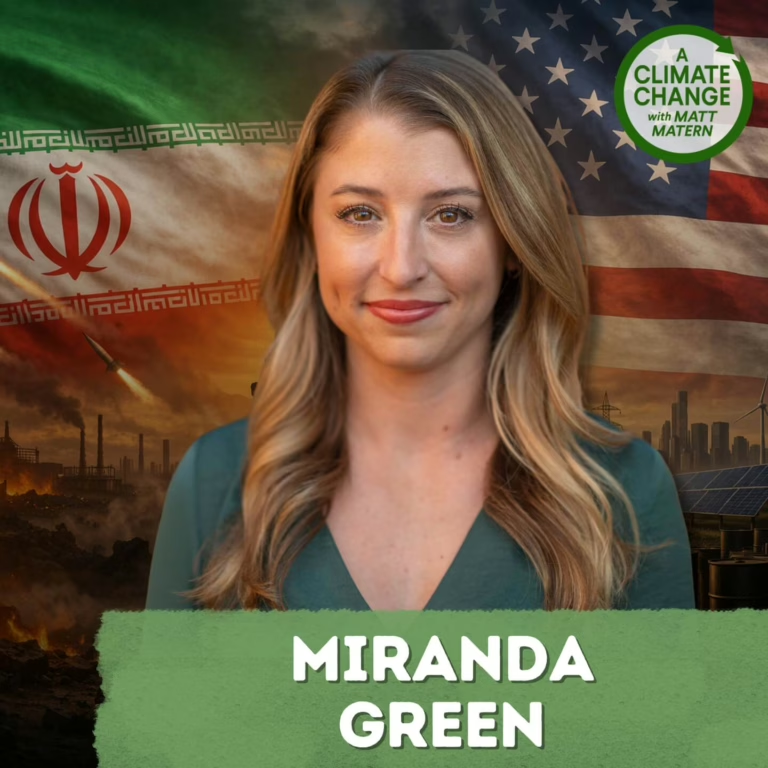
Matt speaks with award-winning investigative journalist Miranda Green about the fossil fuel dimensions of the U.S.-Iran conflict. Miranda – author of The Understory, Atmos Magazine’s weekly climate-culture newsletter – traces how the conflict has disrupted roughly 20% of the world’s liquid natural gas and oil flowing through the Strait of Hormuz, sent gas prices surging past $7 a gallon in parts of California, and exposed just how deeply the global economy remains dependent on fossil fuels.
They also dig into the Trump administration’s response: paying a French energy company to abandon offshore wind projects and invest in Texas LNG instead; keeping aging coal plants online under national security law; and Trump’s murky, shifting rationale for the conflict itself. Miranda connects the dots from dark money and fossil fuel donors to the policy decisions shaping the U.S. energy landscape — and asks whether the chaos of this moment might, paradoxically, accelerate the clean energy transition.
As we started seeing gas prices skyrocket, he tweeted, and he said, gas prices being high is good for America. Well, it’s not good for Americans. It’s not good for us, right? But it’s great for the oil and gas companies that are based here. It’s great for the fossil fuel industry. It’s great for his donors who helped get him into office. So yes, it is great for those businesses, because now we are relying on their oil and gas more to fill in the gap. They can charge higher prices. But it’s not great for you know, everyday Americans who are seeing this and thinking, are we heading into mini recession? Am I going to have to rethink my spring break travel because I can’t drive to see grandma and grandpa, or I’m gonna have to cancel the flights because I can’t afford $1,200 flights to the East Coast.
You’re listening to A Climate Change, this is Matt Matern, your host. I’ve got a great guest on the program, Miranda Green. Miranda has got a long and storied history as a writer, investigative journalist, author, and her most recent story that was published at Atmos, “The war with Iran, Is Already About Energy.” And, you know, that’s a very timely topic, and I’m looking forward to jumping in with Miranda and and hearing her take on this whole thing. Welcome to the program, Miranda, thanks for having me, Matt. So tell us a little bit about your background before we jump into Iran. Where? What? What drew you to the climate movement?
You know, I have been a reporter for my entire career. I used to cover politics and policy out of DC, where I transitioned into covering the EPA and the Department of Interior under Donald Trump. I was a congressional reporter chasing around members of Congress for two years, and then I decided that I wanted to move to California, which is where I live now, to kind of report on the impacts of some of those changing climate policies on the ground. And so for the last five ish years now, I’ve been covering kind of everything climate from what’s going on at the Trump administration in the White House, what’s going on on Capitol Hill, how is that impacting other local communities here in California or other places across the globe, and trying to make sense of what we’re hearing and what that’s actually meaning to the people like you and me.
Well, you know, what I’m struck by is how this war that Trump has jumped into May, ironically, have more environmental effects that in a positive way, then maybe what Biden had been doing in that it will get more people off of fossil fuels because of the prices being jacked up, and particularly countries that are poorer countries we’ve seen like Ethiopia. You know, before this war, they had banned the importation of combustion engine cars. So I think aren’t we going to see more of that going forward because of the price of oil just skyrocketing?
I mean, you could certainly hope that one of the positive impacts of this down the line will be a recognition that a reliance on fossil fuels is not a great energy strategy, and that it’s trickling down to everybody’s pocketbooks like you and I write. We are seeing the rise of gas prices daily. I think it’s up 30% in most states across the country right now. We are seeing, at least here in California, I’m driving around seeing gas prices at $7 a gallon some places, which is just insane. And I do think that that has made some people realize, why am I still driving, you know, gas guzzling cars.
Why am I still paying for gas heating when it could actually be cheaper for me to move to all electric but at the same time, that’s a hard transition to make for some people, because sometimes those you know, electric cars are still kind of pricey compared to some of the cheaper gas options. On the long term, there are a lot of studies that show that you make you know, you save 1000s of dollars on the back end, but it’s still a commitment to make on the front end. Do you have to hope that this is going to pay off? So I do think that there’s some positive notes to maybe come here the shake up, that we shouldn’t be relying on national and foreign countries. But at the same time, we’re seeing the Trump administration say, Oh, this isn’t proof that we should change to renewables. This is proof that we should be doing more drilling here in the US.
Yeah, well, I think the oil industry may be, you know, they didn’t really start massively drilling after Trump got elected, because the price of oil was such that it didn’t make sense for them to do massive new amount of drilling. So at least here in the US and so it’s kind of. Of, I don’t know, counterintuitive to his ideals, which are to promote the oil and gas industry, but when you jack up the prices to over 100 bucks a barrel, the incentives to change to renewables become just ever so much more obvious. Yeah.
I mean, I think that’s, that’s a logical way of looking at it. I don’t think that we necessarily deal with an administration that is on the same logic as as you and I are everyday people. You know, the Trump involved.
I’m not saying minute that he wants to happen. I’m just saying this is an unintended consequence of of the policy which he put together without thinking it through.
Yeah, of course. I mean, I think one of the things that I found so striking, not shocking, but striking, is that, you know, just in the last week or so, Trump, you know, tweeted after, you know, we’ve been in this war for about a month now, we don’t know how it’s going to end. And in some of the days, you know, as we started seeing gas prices skyrocket, you know, he tweeted and he said, you know, gas prices being high is good for America. Well, it’s not good for Americans. It’s not good for us, right?
But it’s great for the oil and gas companies that are based here. It’s great for the fossil fuel industry. It’s great for his donors who helped get him into office. So, yes, it is great for those businesses, because now we are relying on their oil and gas more to fill in the gap. They can charge higher prices. But it’s not great for, you know, everyday Americans who are seeing this and thinking, are we heading into a mini recession?
Am I going to have to rethink my spring break travel because I can’t drive to see grandma and grandpa, or I’m gonna have to cancel those flights because I can’t afford $1,200 flights to the East Coast. And I do think that that is maybe setting us up at a place where we are thinking holistically about changing, you know, pivoting away from fossil fuels. And maybe this will backfire, and maybe it’s backfiring in a lot of ways, but that might be one of them.
Yeah, I don’t. Obviously people don’t make decisions based upon one month of high gas prices. It’s going to take longer than that, and governments are less likely to make huge changes based upon one month of high gas or oil prices, but I would think actually the countries are maybe more inclined to make strategic decisions, like China has already been transitioning to solar and and wind and renewables for decades now, and have continued to jack up the speed of their replace replacing fossil fuels by the day, I would assume that this just has them put the, you know, the pedal to the metal, as far as pushing that forward, because they’re very dependent upon fossil fuels, and they would probably very much like not to be.
I actually think China’s a really interesting example that you chose there, because one of the largest importers of Iranian fuel is China. After us put put blockades on being able to import Iranian fuel because of the fact that we haven’t really had diplomatic relations with them for decades, China has actually been the largest importer. So not all this has dramatically impacted China, and I would, I would agree with you that this is making them think even more so about doubling down on clean energy.
China is at a complete 180 when it’s come to, you know, their fuel sources, they still have ton of coal deposits, similar to United States. But they are, you know, increasingly becoming the largest, you know, creator of electric vehicles, they are really doubling down in critical minerals, and, you know, they’re becoming the leader on the future of clean energy, which is something that, you know, I I’ve talked to quite a few experts who’ve said, essentially, what we’re going to start seeing is a battle of haves and have nots when it comes to energy. We are seeing countries realizing that clean energy is the right direction.
It has become economically viable. It’s cheaper. When we’re looking at politics like that, you cannot put a embargo on solar and wind, right? That’s not something that’s going to a military blockade is not going to stop the sun from shining, shining and wind from blowing. And then we have countries like the United States under Donald Trump that have decided that actually we’re gonna go the opposite direction. We’re gonna double down on this fuel that we have a plentiful amount of, and we’re gonna just or we’re going to go into countries that have it and take control, which is kind of what we saw in Venezuela, and some might argue, might have been some of the original thinking with Iran, but isn’t really working out that way?
Yeah, well, of course, with Iran, it’s it’s eminently more dangerous because it’s not just about their oil supply. It’s about all the oil supply coming out of the Gulf, which is very substantial. Percent of world production is all blocked up because. Of the Straits of Hormuz being blocked. And you know, what do you see kind of happening on that front? Have a crystal ball. Can you give us your insights where you think it’s going to go?
I mean, it doesn’t seem great. I think, I think that’s probably the best way to describe it. I mean, it’s, I’m seeing numbers that say 20% of all liquid natural gas and oil production flows through that strait of the of the global market, of that so 20% of the liquid natural gas and oil that we’re relying on right now is tied up in this strait. That’s a huge number of fuel that we’re not getting that is going to jack up prices. I think that the collectively as a globe, we’re realizing, wow, there’s we have so much reliance on this one specific area for everyday needs, because we use that, you know, across the board and everything that we do.
And when we have a country that is so about so much about energy security, it’s crazy that we are still so reliant on them for our everyday needs. And so I think it’s, I think that that is the kind of thing that makes people start thinking, Well, I don’t think it’s about us locking down energy, you know, more fossil fuels here in the United States. I think that’s more about locking down clean energy that we have here. But I will say the tea leaves are hard to read, right?
I think I would have agreed with you a couple of days ago about the direction of like, maybe the maybe we’ll finally move towards electric vehicles, but we just saw a couple hours ago, the Trump administration actually enforcing an incredible deal with a French company to stop an off to offshore wind projects off the coast of the United States, To get them to instead invest money into the oil and gas industry and LNG here in Texas.
So we have at one where the Trump administration just announced that it will give a billion dollars to total energy so that it would stop its construction of these winch these offshore wind projects, one of which was supposed to power hundreds of homes in New York City to instead have them invest in LNG in Texas going forward, because that is where the Trump administration wants the oil and gas industry, where it wants investment to be in even though you these are projects that are already ongoing, I think there’s gonna be a lot of lawsuits here, a lot of questions about the legality of this. Where this where this money is coming from. It’s definitely coming from taxpayers. But they are, you know, I don’t think that this war is stopping their lust for oil and gas.
Yeah, as you, as you said before, the oil and gas industry put 500 million or something into Trump’s campaign. So they are, they’re like United, a united front. The question is whether they can stop the inevitable, which is, as we talked about before, is that the renewables have come down in price such that they’re competitive or even beat fossil fuels. So, you know it he can’t, he kind of kind of can’t win that battle. Eventually we’re going to need those energy from those sources. And a lot of his advisors have told him that, particularly related to AI, and that we need, we need to roll out power more quickly, and solar is, is the fastest way to do that, as opposed to nuclear or even the natural gas. So I read some quotes that Trump had now said something positive about solar, which was kind of shocking that he seemed to do a 180 on that, which you know, he is prone to do 180s.
Well, I think I I would believe solar more than wind. Wind seems to really be his, his big and his big antagonist. He has not liked wind energy since he tried to get rid of wind projects in 2012 his Scotland golf course. And I think he will probably take that beef to the grave. But no, I think, you know, every year as a technology gets more viable, it gets cheaper. The odds are stacked against fossil fuels, right? We’re seeing that on an economic side. We’re seeing that obviously on a science side, we’re seeing that both on a health side and in a market side, that solar and wind is the future.
The critical minerals and metals that you need in order to make the batteries for those components are also really important to defense. So there’s, there’s multi pronged reason for us to be investing in clean tech in this way, which it’s not doing under this administration. But I think a lot of these conversations are, you know, as you just said, I don’t think Trump’s incentives to change his position on clean energy right now is are very small. You know, he’s got three, three more years in office, hopefully that. You know, if you if you trust. What the Constitution says. And, you know, he wants to do good by his supporters, which are by and large, the fossil fuel industry. And so, you know, while we are seeing this push for the need for energy, we are having a bit of an energy crisis before Iran was happening because of the building built out of data centers because of AI. And we are hearing over and over again that tech companies claim to be energy agnostic, that they’re happy getting that energy from wherever that is.
And we know that solar wind comes online the quickest. We are actually seeing the administration use that excuse to continue to keep coal power plants online. And so actually, I’m writing an article about that for the newsletter this week, which is about how we have now there are six coal fired power plants, actually five, and then one is a gas powered plant that were slated to retire last year, and the Department of Energy used national security kind of this, this law that they this supposed to be for wartime, needs to continue to keep them operating past the time they were supposed to close 90 days, past the time they’re supposed to close. But then they keep on, re upping them every 90 days. And what that’s doing is it’s these are largely inefficient plants that have been around for 60 years. That’s their life cycle. They’re no longer economically viable.
They’re dirty. And many of these states have, you know, desires to change them, either converting them to gas power plants, which is still fossil fuels, but cleaner than coal when it burns, or in Colorado, it’s trying to shut all six of its coal fire plants because it has clean energy goals that it wants to hit for its climate initiatives, and these plants don’t help them do that, but the Trump administration saying we need energy, we want to support AI, this is a perfect example, perfect reason for them to keep coal going, despite that, the these plant owners don’t want it, which is why we’re starting to See some lawsuits.
Yeah, well, I saw there was a similar situation in Washington state where they had come to agreements with the power companies to phase out coal, a coal plant there their last one, and you know, the Trump administration is trying to step in to keep that one going. And the power company is really like, Yeah, we don’t really want to do this, because it doesn’t really make sense. They’ve figured out a way to to shelve it. And, yeah, it’s unfortunate that, you know, he continues to fight for what he calls clean, beautiful coal, which we know is not not clean, more beautiful.
I kind of wanted to pivot back just briefly to the straits for moves and some kind of breaking news was he had said that he was going to blow up harani and electrical plants. I think, as of today. And then this morning he said, Oh, well, we’re not going to do that. You know, we had some talks with the Iranians, and, you know, they went reasonably well, and the Iranians are saying we had no talks. But who’s to be believed here? You know, I don’t know. It’s, bizarre. And I mean his, if nothing else, seeing the kind of crazy way that he’s operated in this wartime scenario, every news cycle, changing stories, changing plans, is the chaos is unbelievable. Yeah.
I mean, I think you just summed it up right there. It’s really hard to tell what the what the story is, because every, almost every hour, it changes a little bit. And I think it goes to this, the war in Iran, in general, we, no one is really able, still unable, to nab down why we did it, right? I mean, when, when it first happened, it happens to build the night it happened during negotiation talks? It was surprise attack. We woke up to the news. Trump, you know, gave a 10 Minute recorded speech. He didn’t take any questions for a couple days about, you know, the reasoning.
He both insinuated it for nuclear weapons because he thought that they were threat, which we have since heard nobody support as evidence, including his own National Security Council, in which, you know, one of the his top appointees resigned over this, and then he said it was for the Iranian people. He wants them to rise up and take back their country. But as you just mentioned, with the threat over, you know, potentially escalating this and attacking the power plants and the power grids in in Iran. I mean, that would be a direct attack on the people, right? People? That would mean that they would have no power. And who knows how long it would take to get any of those, you know, power plants back up, and the energy needs of the citizens back to what they need to survive. So there have been lots of conversation.
It was, what was I. A war crime to to knock out a civilian power source without a compelling national security need for it.
Yeah, I actually, you know, I think that the Red Cross, international, Red Cross, put out a statement that said, you know, war on essential infrastructure is a war on civilians and the Trump administration. I mean, I mean, I mean, I think the it to achieve what I imagine their some of their goals were, which is to have more control over this region than it did before. They need the support of the Iranian people.
And if they are increasingly looking at they are not coming in to help them and bring democracy, as they kind of insinuated, but they’re there to just for strategic means, which can mean making their lives worse. They’re going to be losing the will of the people, which I can’t imagine helps them in any sort of long term. And obviously, attacking this infrastructure doesn’t help them in any long term, you know, project either, especially if some of those hopes and dreams are maybe getting control of some of that oil that the US hasn’t been able to have in quite some time, right, right?
And, yeah, it’s unfortunate that he is turning millions and millions of people who were ready to have help from anybody, and then turn that around because of duplicitous behavior. Is, is really tragic. So, you know, I’m still hopeful, even though he has not given a whole lot of reason for hope that that they would actually get regime change based upon what they’re doing right now.
Yeah, I think again, it’s just, it’s, it’s like, it’s so hard to understand what their original goal was and what their goal is now. Because I think there was a very clear belief that this was going to be a lot simpler than it was. I think that there was a hope that it would be very similar to what happened to Venezuela. They came in, they grabbed the guy, they pulled out, the president. Now they’ve control the you know, Trump said at the State of the Union speech, oh, it’s been great. We just got 80,000 barrels of oil from them, and everyone’s happy, right? Whether that’s true or not. That, you know, leave that up to you to do some digging on that. But that’s not a message that he can give about Iran right now, Iran pushed back.
They one of the sun’s survived. He is now, you know, the sitting at Ayatollah, they are, they are fighting back. Israel has been the main source of the drone attacks on some of the oil infrastructure in Iran. But Iran has been, you know, retaliating by attacking its neighbors oil fields. So not only are we now, you know, just a couple days ago, some of the oil and gas issues that everyone was dealing with globally was because of the straighter Hormuz, the fact that no one can get their oil out, whether it was coming from Iran or not, but now we’re actually seeing Iran is retaliating by attacking some of these gas fields, these LNG facilities and its neighbors, which means that that infrastructure and that that is down as well.
So even if the strait cut opens, there’s no, you know, LNG to come onto boats through the Strait. And this just happens since, I think, Wednesday. So, I mean, everything is happening so quickly. I don’t think that anyone has really had a full grasp of what this means globally, but it’s, it’s impacting everybody unless, unless you don’t need fossil fuels at all, right?
Well, you know it’s, it’s hard to say, No, everybody’s affected by fossil fuels, because there’s delivery trucks and stuff like that that are delivering to most every business that we, that we all go to. But you bring up a good point is that the LNG facilities, I think it was Qatar, which they share facilities, actually, with the Iranians on that pars Peninsula were hit. And of course, the Iranians have been trying to hit other facilities across the Gulf, and have been successful on some occasions, if they were to knock out to more of the Saudi and Kuwait and UAE facilities, that’s going to jack up the prices of oil and LNG in the long term, for sure.
So who knows and and I think, you know, history is a little bit of an indicator of what might happen here, right? I mean, we people think about what happened in Kuwait. People think of what happened in Iraq. There was also attacks on oil and gas infrastructure. It took the Bush administration two years and $2 billion to repair the oil production that they had attacked during that war. So just to give you an idea of this is not a quick fix if some of these facilities are targeted and become kind of the the targets of war, right? We went from, I think, I think it felt, for me, like we went from this war could have been about oil, in a sense. Where the Trump administration was hoping that it would get access to it to now it’s becoming about energy security because of the ramifications of the SOAR.
Yeah, well, the Iranians now are saying, Hey, we control the Straits of Hormuz and we’re not going to let anything in or out without our permission, and and saying, Hey, we might want a toll of a few million dollars per ship that goes through, and so on and so forth. And so it’s it’s made our negotiating position even worse than it was before the start of the war, which has really backfired on Trump. And, you know Trump, I guess you know, he still has cards to play, but those cards are, you know, a lot of them are putting boots on the ground if he really wants to control the straights for moves.
It’s pretty interesting to see. It almost makes you feel how little this is thought about in the long term, because of the cards he’s had to play that are involving kind of asking for help from people that he has alienated, right? So he asked for the US allies and Europe and Canada to come in and help them clear the strait. They have largely rebuked him and said, You did this on your own. We had no idea this was coming. We’re not sending ships.
I think President Francis, President Macron, has been one of the largest out speaker speakers against this. He called it a reckless escalation, which is not a subtle thing to say. And then now we’re seeing the US asking Congress for millions of dollars to send to troops so they can continue this, when before, they said they didn’t need Congress that they could, you know, do this war on their own, but as we know, Congress controls the purse, so now he’s having to ask Congress to fall in line when he has a lot of enemies there. I wouldn’t say Congress has necessarily got the strongest backbone these days, but that’s not the easiest ask for him, and they’re not going to give it to him willingly very easily. So you know, he’s, he’s now kind of in a place where he has to, he where he’s had to turn to people that he’s essentially insulted in the past to ask for help as the situation escalates.
Yeah, that is kind of a fascinating turn of this. The irony of all this is that, yeah, I’m, you know, him saying, Hey, I’m the guy. I can do whatever I want, and now he’s got a kind of bag and, and, of course, calling our European allies cowards, you know, doesn’t have a particularly good look or so. Yeah, lots of stuff happening there, I guess, pivoting again to maybe the work that you’ve done, looking at donors and dark money and things that large companies do to subvert conversations and maybe distort information to their benefit.
Yeah, I’ve done a lot of reporting on how dark money is essentially fueling a lot of a lot of movements across the United States. I have focused largely on some of this dark money that comes from fossil fuel interests. Some of it has been from fossil fuel companies themselves. Some of it’s been from power companies. A lot of the reporting that I’ve done has been in the southeast, but even in California, we’ve seen that I wrote a story about how, you know, Chevron actually has been used running a local paper for a decade now in Richmond, California, which is right outside of San Francisco, and the paper that it runs doesn’t write critically about itself, but it is the only local paper that serves the entire area.
And this is the kind of, you know, misinformation that I am kind of seeing happening, almost as like a playbook that a lot of these groups are pulling from each other, where it’s dovetailing with organizations like the power companies or fossil fuel companies, or even people like Harold ham, he is one of the big oil and gas barons from Oklahoma. You know, they can donate almost unlimited sums these days because of Citizens United, and it’s really hard to trace where that money is going. Lot of them do it through their foundations, and you can spend a lot of time, as I have done, looking and kind of going through rabbit holes, figuring out, okay, this person paid this person, and this person paid this person, and this person paid this candidate, and okay, now I can kind of see how the sausage is made, how they got the donations.
And a lot of you know, the stories that I’ve covered talk about how they’re dovetailing with the lack of local news, and taking advantage of this kind of dearth of media in some of these small places where people are desperate for information, they don’t necessarily trust mainstream media. And so these kind of fake news organizations are being created to fill in the gap, and they tell them, you know, stories and messaging that are beneficial. To the companies that pay for them.
Yeah, it’s fascinating. I certainly have read a bit about some of these oil barons down in Texas and Oklahoma and fueling various campaigns there and and that they have. You know, they’ve made billions in the fracking business, and they’re, they’re spending it pretty liberally on controlling the state of Texas.
So, yeah, Timothy Dunn is a really good example of that. He is an oil and gas bearer and has made all of his money billionaire based in Texas down in the Permian Basin. He is a huge Trump donor, and he’s also extremely conservative. Really believes in family values. And so you see these really interesting dovetails between they, they are investing in organizations that are, you know, anti LGBTQ issues, or anti dei in schools, and then at the same time, pro oil and gas, because that’s how they made their money, and they are investing, and we’ve seen that.
Tim Dunn, for example, is the chairman of Texas scorecard, which is a pink slime partisan paid news company that writes positively about conservative issues in Texas, and then a tax issues like dei at schools, at Wim, and he’s also been an advisor at some other partisan media companies, like pipeline advisor, which is owned by a big network of these online news seeming organizations that I’ve covered quite a lot, called metric media. There are 1200 sites across the country that right partisan coverage, and then also, at the eve of key elections, they’ll, they’ll publish these papers that show up at people’s doors, specifically, you know, backing certain candidates. And they’ve been, you know, they’ve been tied to pay to play, where it’s very clear that they get paid to have this positive coverage.
Yeah, they’re getting more sophisticated in their messaging, so kind of pivoting back to the Trump coalition, and was based upon America first and kind of no forever wars, and they’ve kind of pivoted from that, particularly with this war in Iran. How do you how do you see that playing out? I mean, I’ve read some polls that it seems like the Maga folks are, are not. They haven’t broke ranks with Trump over this, though they may be upset about it.
I think it’s pretty fascinating. And I think that this must be the moment that is really testing Trump supporters, because Trump was a bit of a nationalist, especially during his first term, this idea that I want to strengthen the United States, but and I want to put tariffs on everyone, and I don’t really even need diplomacy, because it’s us, us, us, that is not really how you can win a war. And I can’t imagine if he ever ran on a platform saying he wanted to go to war with someone that he would have had the numbers that he had.
I do think we’re starting to see some, you know, some breaking ranks, like I said his national security advisor that he that was a Trump appointee, you know, he quit last week, basically saying, this isn’t the USS war. This isn’t a war for Israel. We should not be in this. Trump responded saying, I think tweeting something, or putting on truth social saying something along the lines of, you know, he was not the right man for the job, if he’s, you know, weak on war. But you know, we are seeing places like the Cato Institute come out with a study. They are backed by the Koch brothers, who are libertarian, libertarian organization which is against, kind of nationalist, against foreign wars.
But we’re, you know, have been big donors of some of these Trump initiatives, and they’re saying there’s no evidence that Iran had any sort of nuclear capabilities, right? So I think we’re starting to see the ranks breaking in in more subverse ways. They’re not necessarily coming out and saying, What the hell are you doing? This isn’t what we want. But we’re seeing people pull back and saying, This isn’t what we voted for, this isn’t what we asked for, and kind of knocking the logic here of why we’re why we’re in this, right?
And of course, if, if somehow it takes a twist where it all turns out well, and the US is in great shape, maybe some of these questions drop by the wayside. But right now, it doesn’t look particularly good, and he hasn’t managing the conflict particularly well, and the Iranians are fighting back. So he’s he better do a better job on this, or his constituents are going to be pretty unhappy with it.
I keep on thinking about what would it what would it be like if the State of the Union address had to happen like this week instead of a couple weeks ago, because. Is, you know, at that address, he talked about how he brought down egg prices. Remember, that was something we were worried about. Now we’re dealing with, you know, $7 gallon gas. There are just so, you know, we are. We just had job numbers come out and say that there’s been essentially no growth in the private sector under his administration whatsoever. And inflation. You know, the rates are not going down because we don’t have a steady economy. And now and now we’re dealing with this war and this increasing instability.
I mean, there’s so much for him to have to explain. I can’t imagine that. You know, if his administration stopped right now, he would say this is something he could look back on fondly. We will have to see how this all plays out. But right now, it’s not, you know, it’s not showing like he is giving people the campaign promises that he offered them, other than maybe helping the oil and gas industry make a ton of money. There you go.
Well, you know whether he we know where the bread is being buttered. And it’s, it’s always with the money people get Trump’s attention first, and then the little people get crumbs from the Trump table. That’s, that’s the way that I’ve seen it go down. So curious as to what your thinking is on Venezuela. Now, that’s something like a little bit in our rear view mirror, but it’s still there and and we still have kind of the remains of the Maduro dictatorship. Are still in power there, even though he may be gone.
Yeah, I think, I think that’s another one that we’re just we’re gonna have to watch as it goes. I mean, I think that country has less had less of a, you know, ground to stand on in terms of pushing back with the Trump administration. You know, when they came in, they very clearly came in strong. They took out their president. They have, you know, already been relinquishing some of the oil. I do think that some of their national interests align a little bit with the US as help too, right?
If we look at fossil fuels, for example, their oil fields, their fossil fuel infrastructure is extremely outdated and was not really pumping to capacity, even though it was one of their biggest money makers. So if the US comes in and helps rebuild and helps kind of modernize that that could financially benefit them in the long haul, depending on what you know, whether us gives back some of that money to its citizens or not, which we don’t really know what’s going to happen there right now. Also, you know, as a dictatorship, there were many people with are very happy to see Maduro go, and are hopeful that whatever they get going forward will be better than that.
So I don’t think we’re seeing as much pushback to the US coming in as we are seeing in Iran for various reasons. You know, obviously in Iran, we don’t know where this is going. Maybe, I think there were citizens that were hopeful that we would do something similar. That’s clearly not happening right now, and we’re hearing reports that if anything, Iran is getting stronger and doubling down, and it might go in the very opposite direction.
Well, certainly, the Venezuelans had voted in a democratically elected president which never got seated, and they would probably like to have their president seated. Yet Trump has kind of pushed that person to the side, saying, Oh, you’re not respected, which like, Well, I think they’re respected enough to get the votes from the people. That should be enough, right?
Well, I think that, if anything, that shows you a little bit of tea leaves of what could have or might still happen in Iran too, right? When Trump was, when Trump first, when we first attacked Iran, Trump had said, I want to work with the Iranian people to elect the right person. He didn’t say, I’m going to support whoever they elect, or whoever gets in power. So I think that that is kind of an indicator of what he of what he might do. You know, Cuba included, right?
We are now also saying that we want to, you know, take over Cuba. We want to help get rid of the sitting government, government. So there’s a lot of indicators, I think, that there’s a, there’s a, almost a playbook that is happening here, whether he can do it all, how it’s all going to end up for him, you know, is day by day, right?
It’s, well, it’s kind of come to American imperialism and just kind of saying, Hey, we’re going to go in and run the gamut on you, because we have more power than you. We can just get away with this, which, of course, may have been the way of the world for a long time, but it certainly was something we were trying to build a more stable world where this type of stuff didn’t happen. And Trump seems to be saying, Yeah, you know, Putin did it, you know? Why can’t I?
Yeah. I mean, it makes sense for a man who doesn’t like diplomacy, right? Openly shuns diplomacy and. And and I guess if you really want to get super esoteric about it, if you’re a true nationalist, but you want what the country next to you has, and then it becomes your country. Well, it’s still a national interest, right? So you’re not starting a war somewhere else. You are now taking over that territory for it to be yours. So, I mean, I think that this could be ultimately, kind of a to Donald Trump is at his deepest level. You know, he respects strong men. He kind of wants to emulate what some of these other countries have done. Colonialism is one example of that.
You know, it’s not something that we see happening these days, and when it does, you know, usually, you know, countries, especially NATO partners, denounce it, but Trump, you know, with Ukraine, didn’t. So I guess maybe it shouldn’t be so surprising that eventually he wanted to try something like this himself. But how it’s going to shake out, what is going to mean for post the Trump presidency is, is just, you know, really, really hard to quite understand right now.
Well, certainly, lots of variables out there. And Miranda, thank you for joining us and telling us about you know, your views on this and giving us a lot of new insights. Look forward to reading your reporting on this as we go forward and tell us a little bit about the places that you’re reporting for it.
Thanks. Yeah, you can follow most of my work. I write a weekly newsletter called “The Understory” for Atmos magazine. It comes out every week. Tries to thread the needle with some of the topics that we just talked about here, why what is happening right now is happening, and what it means for climate policy, and where did it come from, and what do I need to know about it going forward.
Well, appreciate your hard work in that area. Certainly, you know the fossil fuel companies, hopefully their days are numbered. We Trump is kind of working in the reverse on that front. But I guess we can all do our part to reduce our fossil fuel intake and vote for candidates that try to make those changes across the country.
Thank you so much for having me, Matt, it was great chatting with you.
To learn more about our work at A Climate Change and how you can help us reach our goal planting 30,000 trees in the Amazon this year. Visit aclimatechange.com – don’t forget to subscribe to our podcast on Apple, Spotify, YouTube, or wherever you get your podcasts. If you like this episode, please share it with a friend. See you next time.
(Note: this is an automatic transcription and may have errors in formatting and grammar.)