
Hear us on Apple Podcasts, iHeart, and Spotify Podcasts. Subscribe now!
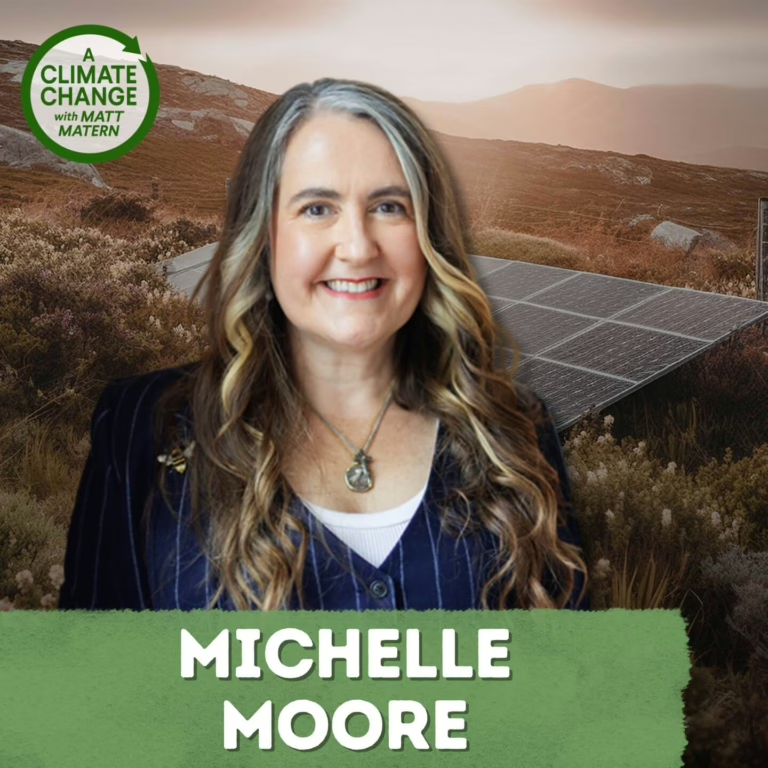
Matt checks back in with Michelle Moore, CEO of Groundswell and author of Rural Renaissance, nearly a year after the EPA canceled Groundswell’s $156 million Solar for All contract. Michelle shares how Groundswell is pressing forward anyway, building a new financing model around corporate off-takers and utility partnerships to keep 20MW of community solar alive. They also dig into the full-blown energy crisis hitting American families at the kitchen table – electricity bills up over 10%, AI data centers driving unprecedented demand, and a federal government that has largely stepped out of the affordability business. Michelle says the renaissance in rural America is still waiting to happen – you just have to switch streams.
Grandma doesn’t need to be paying for Elon Musk’s data centers. And until we understand more about how the Bring Your Own clean power program would work, or until we understand more about how to deploy energy efficiency to bring bills down, even if rates are going up, we just need to hit the pause button, because grandma’s bill doesn’t need to be going up. Your neighbor’s bill doesn’t need to be going up. Your bill doesn’t need to be going up. Until our system operators, until our electricity markets, our regional electricity markets, really figure out how they’re going to do this thing. We don’t need to be paying the tab.
You you’re listening to A Climate Change this is Matt Matern, your host, I’ve got a great guest on the program, Michelle Moore. Michelle was on the program before, and welcome back. It’s so great to have you. She is the CEO of Groundswell, and she does a lot of other stuff as well. So Michelle, great to have you back on the program.
Thank you so much, Matt. It’s great to be back with you today.
Yeah, I guess both a catch up and a recap for those who may not have heard your first episode. Tell us a little bit about Groundswell and what you guys are doing there.
Thanks, Matt. Groundswell is a nonprofit, and we have a very straightforward mission. We build community power, and we do it for affordability, and we do it for resilience, and we do it with community solar, community resiliency hubs, energy efficiency and home repairs and an AI data platform called gritava that helps us keep it all connected. And our aim is very straightforward. It’s to cut electricity bills in half for our neighbors who need it the most, and to strengthen local resilience.
And it hasn’t been very long, if you look at the calendar, since you and I last talked when my book rural Renaissance came out, the federal government passed the inflation Reduction Act, Groundswell was blessed to be one of the recipients of one of the solar for all awards from EPA and a second grant to build community resilience would have been $176 million investment. In the rural southeast that would have delivered more than $400 million in electricity bill savings. But then the one big, beautiful bill, Act passed repealing many major components of the IRA, all of those federal contracts and awards were terminated, so we’re still doing what we do.
We’re still helping people, and in fact, we’re helping people at increasing scale across the region, but we’re delivering on energy savings and resilience with utility partners, with local government partners, and with good corporate neighbors committed to partnership, the federal government is largely out of the affordability gang.
Well, yes, we certainly have heard that on the news that there’s been a huge change I saw recently that the current administration and the President had recently said, you know, he’s now behind solar, which was a bit shocking. I guess an encouraging move since he had kind of poo pooed it pretty heavily up to this point in time. I guess the reality is sinking in is that we do need solar, and particularly for this AI build out that is, you know, heading at every community, kind of fast and furious. And you know, from what I’m reading, electricity bills are rising because of the demands of AI. Are you seeing that in your the communities that you serve?
Absolutely Matt, something else that has fundamentally changed since the last time we talked is that we’re in a full blown energy crisis, and it’s an energy crisis that’s hitting people really hard at the kitchen table, rates are going up. Electricity bills are up by more than 10% across the country, and in some places, it’s even worse, and that is pinching family budgets that have already been hit with housing and grocery bill increases too, and that actually makes solar projects especially distribution scale projects. So smaller solar projects, you know, projects that might be on five acres or 25 acres versus 1000 acres, it makes distribution scale. Solar projects even more valuable, and here’s why, they can be deployed rapidly. And we need all the power we can get, and we need it local, and we need it a four if possible.
Oh, it’s, it’s kind of simple and straightforward, which I’ve talked to many people over the last five years about how the environmental movement wins. And a number of them said, Hey, we’ve we probably have to win on dollars and cents and and I think that finally, it’s come to the point where, clearly, solar beats gas, it beats coal, it beats nuclear on so many different fronts, and particularly cost and so at the end of the day, if people make decisions based upon cost, it’s going to be our winner.
Well, cost and common sense, one of the other dynamics that we’re seeing in the market now, particularly as we look at how might we bring enough power onto the grid fast enough to be able to meet demand, so the lights stay on, so that we continue to have a reliable energy system in this country, even if you aren’t focused on clean energy, even if you want any kind of electron you can get. The fact of the matter is that gas turbines have a supply chain that is five to seven years out.
So if you knew you needed power and you placed your order today, it would be past 2030 when you got the equipment that you needed to keep the power on. And solar projects, you know, particularly distribution scale, solar projects, are much more rapidly deployable, so you have affordability, you have more rapidly deployable, and you have projects that can fit into a local power system and be cited where people want them, that’s a big that’s a big issue that we’re seeing today. Too many larger scale projects, new types of generation, projects that cover 1000 acres or 2000 acres, raise a lot of concerns, especially with farmers on land use and distribution scale. Solar projects can be cited where people want to see them, and make much more sense in the context of a local community.
Well, you use the phrase phrase common sense, and I just am recently reading a book by Thomas, regarding Thomas Paine, who, famously, you know, had the pamphlet, common sense or book that made a big difference in the American, you know, Independence Movement. And maybe we need some kind of similar, you know, communication to people as to the common sense reasons why we should be going in environmental direction. Because I think we’ve been hitting people in the head, but with a lot of technical, you know, arguments, but hitting them in the heart may be more effective than the head strategy
and making sure it makes sense at the kitchen table. You know, I’ve been blessed to work in the energy and sustainability field for 35 years now, which blows my mind, and my very first mentor, Ray Anderson, who was the founder and founding chairman of a company called interface Inc, big global manufacturer of textiles and carpet headquartered right in my hometown. He used to call it doing well by doing good. It was about doing the right thing for the environment, because that’s about the future and future generations. It’s about caring for the places we live and as a person of faith, it is also our first job, you know, to care for the creation to be God’s partners in caring for creation to be his image bearers.
It’s about economic viability. If it’s not economically sustainable, you’re going to hit a brick wall at some point, right? So you got to take care of the economic requirements of the work too, and it’s about the people. It’s about the communities that you serve, people, planet profit. And you can do well, you can thrive, you can grow, and you can foster a local economy that’s able to provide jobs and sustain people. And you can do it in a way that’s not going to destroy the place you live and the place that you love, and you can do it in a way that supports thriving people too, and you just got to be able to walk and chew gum at the same time, which sometimes folks forget how to do.
Well, tell us, have you confronted the issue of data centers in your in the communities that you serve? And it’s no kind of, what what are, what is your organization doing to kind of make that viable?
Many of the communities that we serve, particularly across the rural south, have data centers moving in, and in some cases, lots of them, particularly if you look at Georgia, you. Look across Northern Alabama, even into Mississippi now as well, it’s prime location for large data centers. What we’re seeing is that data centers, just like any other corporate neighbor, can be a good neighbor, or they can be a not so considerate neighbor. And in Georgia, for example, we have a project in southwest Atlanta serving the historic neighborhoods that are close to the AUC where Atlanta’s HBCUs are located.
And Google, a leading data company, is one of the partners in that project and provided grant funding through Georgia Power, actually that’s helping to pay for home energy efficiency upgrades and enabling repairs. And that program overall includes a community resiliency hub. It includes energy job training, energy workforce preparedness, and it includes more than 55 homes getting significant upgrades, from an energy efficiency perspective, to cut their bills so data centers can be partners when they’re committed to the same goal, right, which is economic opportunity, but it’s affordable energy for everybody. But that’s not the playbook that every company is using.
That is unfortunate. So we’re seeing rates go up. What? What is happening in the communities that you serve? Are you able to help rates not rise through rolling out more community solar?
So two things. One, yes, there is tremendous upward pressure on rates and on bills, to quote a local mayor that we work with, it’s a simple matter of supply and demand. Demand has gone up. It has outstripped supply, therefore prices are going to go up, and that’s a hard trend to buck. It’s mass however. Comma, people pay bills, not rates. So it’s possible even an environment where there’s a lot of upward pressure on rates to keep bills down, or even to drive them lower, by investing in energy efficiency and also investing in local solar and energy storage projects, energy efficiency and community solar and energy storage can both be grid assets.
Energy efficiency gives you more capacity because you’re freeing up electricity that’s being wasted. You know through energy you’re freeing up electricity that’s being wasted through a lack of efficiency and with community solar and local energy storage, you’re adding capacity to the grid. So both of those are ways that tech companies and hyper scalers data center companies can invest in new generation in a way that’s also sharing affordability with local residents, particularly local residents who need those savings the most.
Well energy efficiency is something that I don’t think is talked enough about in the environmental movement or just in general, that it seems though that’s a an area that is a big win in in that if we all managed our electricity more effectively, we would not maybe need to build as many power plants if we turned off our lights, for example, or use less energy, and still had the conveniences of it, but just managed it more efficiently turning off your laptop when you’re on, using it, things like that.
Absolutely. Matt, not only is energy efficiency one of the least regarded, the least sexy aspect of the clean energy movement, if you will, it’s also one of the least understood where we work, particularly across the rural south, but this is true in rural communities across the country. The roots of energy burdens are really in the housing crisis, just for example.
Groundswell runs a program we call soul save on utilities long term, it delivers energy efficiency and enabling repairs like fixing roofs and fixing leaks so you can move forward with insulation and New Age bath equipment. In 53% of the homes that we enroll, we find repair needs that have to be handled before we can even undertake simple. Weatherization, and in about half of those homes, the repair needs are extensive. Just for example, many homes require new roofs, extensive wood rot repairs, remediation of mold before you can get in there and add insulation so to tackle energy efficiency and really bring down people’s bills for the long term. We’ve got to face the housing crisis in America too.
Is that something that you’re working on facing the housing crisis, and what are the things that your organization is doing to other than obviously what you were just saying,
Groundswell is definitely doing our part. Think understanding the relationship between high energy bills and the housing crisis is an important first step. For example, you know, there are a number of national reports and publications out there suggesting that we could get 100% of the energy that we need to fuel American AI competitiveness on a global scale, from energy efficiency, from making all homes in America, all of our businesses as energy efficient as they possibly could be, and that may be true at a high level, but the details matter, and anybody who’s ever tried to renovate their kitchen and bathroom knows how hard it is to make improvements to a house.
Right? Construction is challenging, and everything’s a little bit different once you get behind the walls. But you know, understanding that, yes, we can meet a lot of our demand by using less right through energy efficiency. But to do that, we also need to plan to fix the roof. We need to plan to update the electrical systems. So at a very practical, again, from a common sense perspective, we know, okay, well, you actually need to spend $3 not $1 to get a kilowatt hour back out of energy.
Efficiency is part of the solution, and it’s one of the issues that Groundswell is trying to illuminate. No pun intended through our work, you know, gathering that data, you know, understanding how you deliver energy efficiency and different geographies and a different housing stock. So we can really make a plan be practical, use common sense and make the best of what we already have, while we’re also continuing to deploy local community solar, local energy storage to strengthen our grid and to make sure that we’ve got local, affordable power available to our families and our communities as well.
Well, I heard that Groundswell is moving forward on 20 megawatts of projects, regardless of the federal resolution. How are you doing that and and what does that mean at the 20 megawatts is, how much? How much power is it? How many homes can that power?
The Federal Government may have terminated the solar for all program, but we need those projects, and we need that power more than ever. So yes, Groundswell is still moving those projects forward. Literally, the day that the termination letter came in from EPA, we had just received final bids on our first tranche of new community solar projects across Arkansas, Alabama, Georgia, North Carolina and Virginia, and those projects are too important to the communities that they serve to let them go.
So we have identified a different model to bring them forward, in partnership with local utilities and in partnership with the people they would serve, and that is to work with a leading corporate off taker, with a good corporate neighbor, you know, who comes in serves as an anchor off taker for that solar project, if you will, and then commits to share the resulting electricity with local residents so that The Corporate neighbor is getting the power that they need and is getting a fair deal, and so that local residents are getting affordability and savings.
Well, that’s pretty amazing, that you were able to make lemonade out of the lemons there.
So good work on that front.
Thank you, Matt. That’s what Grandma says to do, and that’s what Beyonce commends to us as well. So we’re gonna keep doing the good work and keep serving people well.
What what do you see in the path ahead? What are any continue doing? What you’re doing, changing it up a little bit. What? A What do you see the organization doing as you move forward?
Well, the market has shifted clearly, like Groundswell is a dynamic, entrepreneurial organization. We got a lot of grit and we got a lot of hustle, so we are pivoting to respond to the market that we’re in and keeping the people that we serve front and center, that they are our, why they are why we build community power. And you know, in that spirit, we are together with many fellows in this space as well. You know, until the IRA was passed, and until the IRA was largely repealed, energy affordability, the programs that enabled energy affordability, the programs that supported local community driven deployment were really driven by federal incentives and federal programs.
It was the federal government that was really making the market and historically, that’s the way that many new types of energy have been deployed. Just look at the moves that the federal government is taking now to support advanced nuclear or small modular reactors, many of the dollars that are needed to support deployment and to make it more affordable for the marketplace are being driven by the federal government, but the market has shifted, not only because of the Federal Government’s withdrawal from energy affordability programs, but because we need so much more power and we need so much more affordability at the local level.
So we’re going to continue to find what we call principled unity, you know, working with local utilities, local governments and corporate neighbors who share our commitment and share values around making electricity more affordable and continuing to keep it accessible to everyone, particularly to their their neighbors, their neighbors in rural America who are paying some of the highest electricity bills in the country already and use what we have, which is a lot of know how actual project locations, a spirit of partnership, a commitment to joyfully serve, and like I said, Matt, a whole lot of grit and hustle to get these projects built and to continue to find common sense, practical, straightforward, scalable solutions.
Ao that we’re not just building 20 megawatts of projects, we’re making way for 200 megawatts of local projects, so that we’re not just delivering energy efficiency and repairs on a few 100 homes or a couple of 1000 homes, but so that we’re building a mechanism for being able to bring energy efficiency and home repairs to 10s of 1000s of our neighbors, because the need is great. The time is now, and the value of these programs is also very much in alignment with the market demands.
So Groundswell filed a formal notice of disagreement with the, I guess, cancelation of their contracts to to roll out the solar where, where is it, in terms of the status of that, that process?
Well, not only did we file a formal notice of disagreement, notice of dispute, you know, through the administrative process for appealing the termination. But we also reached out to political officials at EPA and across the administration, and to colleagues on the Hill in both the House and the Senate. You know, from our perspective, particularly early on as EPA was sending out termination notices just didn’t make any common sense to us, right? President Trump had made a campaign promise to cut electricity bills in half for American families. Here’s this program that’s going to cut electricity bills in half for a million American households, but it’s being terminated.
Those two things did not jive. So we have continued, you know, in our efforts, both to dispute the termination administratively and at this point, we’re just waiting on final decisions to come back from EPA, and we’ve continued our outreach as well. You know, we believe in a moment where we’re in an energy crisis, it’s hitting the kitchen table. People need more affordable power. We need more power than we have on the grid that it really should be all solutions to the table and here, not just with Groundswells projects, but with all of the fantastic community solar and other projects that were on deck for the dozens, more than 60 solar for all awardees around the country that we have important solutions to offer in this moment, but the end of the story has yet to be written up until now.
The correspondence that we’ve received from EPA asserted that the one big, beautiful Bill act fully repealed the IRA and all of its programs. Plans. And you know, that was simply the the federal action that the administration and their correspondence pointed to for why they killed the solar for all program. Since, you know, we clearly, we don’t disagree with that, but we’ll see if they decide to change direction. But we’re moving forward and finding other ways to get these projects built, regardless.
Have appellate courts weighed in on this, or are you still waiting to litigate these issues? And where does it stand in that respect?
There are a handful of solar for all awardees. Who did move forward with litigation believe it was primarily some of the state awardees. There were a number of similar lawsuits that were filed, not necessarily about the solar for all program, but about other illegally terminated awards. And the direction coming from the district court says that the Court of Federal Claims lovingly known by cop. See, you know, all federal everything has to have an acronym, but that CofC was the right place to take those disputes. But I’m not aware of any of those moving forward or having determinations made at this time from Groundswells perspective. You know, we’ve been continuing with the administrative process and continuing without outreach to administration officials that we haven’t reached resolution along that path either.
Well, it certainly would be great if they changed course, though it doesn’t, it’s hard to be optimistic about that possibility. Let me ask you about support from states, cities, counties, other you know, forms of government that are in the communities that you serve. Have you gotten any help from any state agencies to move your solar projects forward?
We’ve gotten a lot of partnership to keep these projects moving from local governments, from our local utility partners, and also from some state agencies, from the perspective of pairing energy efficiency programs and some of the state energy efficiency rebates, for example, in with our solar program delivery so that we’re helping people save more money with energy efficiency too. But from a project development perspective, it’s pretty tough to replace $156 million in federal grant funding from any other single source. We are confident, however, with the importance of being able to bring new power onto the grid rapidly in a way that supports affordability, enabling this new model that we’ve developed to keep advancing these projects forward.
Like you, Matt, I don’t put a whole lot of stock in the possibility that the administration would turn around on its decision with regard to the solar for all program, Hope springs eternal, and it is new every morning. But we’re going to keep hustling and keep these projects moving with the partners that we have at the table now, who again have principled unity with us in delivering local claim power that is affordable and is that is sharing those bill savings with local residents.
Politically, it would seem to make sense that the current administration would support growing out power in states that he won in the 2024 election to to give them the benefit of of this federal money, which would support their development, to have more power on the ground. But that that would be common sense, and that doesn’t always play in the current administration, so I don’t know.
Well, there’s another shift that’s happening in federal policy when it comes to energy as well, and that is that the federal government has largely been withdrawing from the affordability business. It’s not just the solar for all program. It’s not just USDA doe, other EPA programs like community change grant that have been terminated, withdrawn or stalled. It’s also traditional programs like the Weatherization Assistance Program or LIHEAP that have been that have been gutted or that have been just significantly reduced in their effectiveness, right?
So many of the federal incentives are now going to big corporations like tech companies or new nuclear technology companies to support corporate interest, versus federal dollars going to households to support people’s kitchen table needs. So I think that what we’re saying. In terms of the federal government’s different posture is a move towards corporate subsidy versus kitchen table incentives.
So tell us about the West Side Resilience Corridor. It sounds like that a winter storm hit Atlanta, and those churches actually kept the lights on for the community. How did that happen?
Well, thank God the winter storm didn’t actually knock out the grid in that area, but the West Side resilience corridor churches were ready to go if it did. This project has a really cool origin story, but dates back to 2018 and the team at the National Lab, formerly known as the National Renewable Energy Laboratory, or NREL, and their solar energy innovation network. We partnered with a number of HBCUs, with Chandra Farley, who is now the director, the head of sustainability, Chief Sustainability Officer at the city of Atlanta. At the time, she was with an organization called partnership for southern equity to develop the vision for what resilience hub would look like serving Atlanta’s historic southwest neighborhoods and the AUC the Atlanta University complex.
And part of the vision that came from that project was a local resilience hub at a neighboring church that would serve the community. And the community members that we worked with local residents were like, hey, a project has to be at the Vickers community center of the Community Church Atlanta. And from that initial project, which we got built a couple of years ago, it’s actually one of the first projects to apply for direct pay
A larger vision grew from those seeds and Groundswell has been blessed to work with a number of partners, including Georgia Power, the Arthur and Blank Family Foundation, the city of Atlanta, and others, to develop additional hubs. We’re looking forward to getting started on construction. On the second one this year, and now to pair the Home Energy Efficiency and repair program I mentioned to you, which is delivered in alignment with the churches along the corridor too.
That is great. I wanted to know you know you wrote the book rural Renaissance. Is that still the word Renaissance for what you’re seeing in these communities right now, or has there been some degree of backsliding based upon what’s happened in the last year in the current administration’s cut off of water, federal dollars
and rural communities are resilient, so a renaissance is always there waiting to happen. It’s just a little bit harder than it might have been a couple of years ago, when you got to switch streams in terms of where the investment is coming from. Just last week, I was at an event in Washington, DC, that was sponsored by the Milken Institute and hundreds of people were there around the country, both big finance, right? Big investment makes out of New York, but also people representing local project developers and small communities around the country. And when you think about quality of life, you know, where do people want to live? Where do they want to raise their family?
The importance of land, you know, the importance of the ability to grow our own food, the values that we have around small businesses and being able to create not just a livelihood for ourselves, but also a livelihood that can support additional generations. Small towns in rural America are a beautiful place to do that in this very different environment where, instead of having energy investments that are moving forward in rural America, we have big data center sites that are rolling out across rural America, we just have to think differently about how we strike a fair deal. Because one of the things that I talk about in rural Renaissance, but that many others have talked about in many other places, is that rural America often gets the short end of the stick, right?
Rural America has the land, it has the resources, it has the labor, it has the water, it has the natural resources that go into producing the energy our country needs. But those resources don’t get valued fairly, right? You want cheap land in rural America to provide for some big ticket, you know, commodity that gets sold on the stock market, and that’s not a fair allocation of value when companies are coming in and siting in rural communities or small towns, whether it be tech company data centers, or whether it be a big new solar project or it be a small modular reactor, we need to be and by we, I mean state governments, advocates, local equity. Economic developers need to go in with a clear eyed vision of what is a fair deal. We don’t need to be giving away the farm with tax incentives and electricity bill discounts for data center companies whose balance sheets are larger than most countries in the entire world, right?
Like we need to make sure that we’re that we know how to drive a fair deal, and that rural communities are getting bears too, which, over time, may actually be a more sustainable stream of investment than even what a federal government grant would be able to provide. But we got to ask for it up front and make sure that we’re getting a good
deal well certainly being educated in a sophisticated consumer, essentially or negotiator, is so important. So I would imagine your skill set is particularly useful. If you could tell every listener who cares about energy affordability, one thing they can do right now, one action. What would that be
for everyone who cares about energy who’s listening right now, I’m going to cheat a little bit. I’m gonna give you a one A and A 1b for yourself to help keep your electricity bill more affordable. Find out what energy efficiency rebates or other incentives may be available where you live, and implement them now, some of those state dollars are actually funded by federal programs that do not have a certain future.
So let’s get all the energy efficiency that we possibly can today. And the same holds true for solar projects, particularly solar projects on local community centers, or for your local government, because those tax credits are going to run out too get as many deployed as possible. Now, my second action though, to help keep energy more affordable for everyone is support residential rate freezes. Support residential rate freezes right now, residential rates are going up all over the country, and they are poised to go up even more with rate increases that utilities have filed on public commission dockets around the US. But we need to freeze residential rates.
Grandma doesn’t need to be paying for Elon Musk’s data centers until we understand more about how the Bring Your Own clean power program would work, or until we understand more about how to deploy energy efficiency to bring bills down, even if rates are going up, we just Need to hit the pause button because grandma’s bill doesn’t need to be going up. Your neighbor’s bill doesn’t need to be going up. Your bill doesn’t need to be going up. Until our system operators, until our electricity markets, our regional electricity markets, really figure out how they’re going to do this thing. We don’t need to be paying the tab.
That seems like a very simple message, and one that makes sense that the consumers that are coming online, the new consumers, essentially these data centers, are very big, or should be paying the higher rates, rather than the people that are already baked into The system, which essentially had been promised a certain rate and based upon a certain level of investment. And you know, it’s only because new investments are being made into bigger energy centers producing centers, that the rates would have to rise so kind of basic economics, the the last person in should be paying the higher rate because they’re they’re the ones who are going to be driving the rates up.
So absolutely, and those and the tech companies and the hyperscalers who are driving demand are saying that they are willing and they want to pay their fill, that they are willing and that they want to pay their fair share. They even signed a pledge last week at the White House. But it’s not the hyperscalers that make decisions about rates, it’s public service commissions and other types of utility boards around the country.
So let’s hit the pause button freeze residential rates while everybody figures this thing out to make sure that we’ve got enough power, that we’ve got clean power that’s protecting the places that we live and love and that we’ve got power that’s affordable and accessible for all of us, you know, for Americans and also for local communities who depend on access to power for economic development.
Tell us, regarding heat pumps, for example, is that something that your organization has supported and encouraged consumers to get? Are they, are they driving change in a positive way to drive electric? Is electricity usage down or more efficient use of power?
Heat pumps are often part of the energy efficiency measures that we install at the homes that we serve with energy efficiency and repairs. So they can be a great solution for lowering bills, particularly if you’re going from a technology like strip heating, which is essentially like heating your home with a blow dryer to a high efficiency modern heat pump. Electricity is normally the source of heat in the area that we serve.
So it is an absolute win to switch people over to a more efficient heat pump in climates that are colder, you do have to attend to the type of technology that you’re using to make sure that you’re electrifying and that you’re also getting a more efficient device that’s going to continue to give you affordable power and an affordable technology, Even when it gets very, very cold.
You’ve said that your root, your work, is rooted in faith, and that the commandment to love your neighbor. How does that ground you when you’re spinning plates in a hurricane? As your team put it,
Well, I will, I will tell you, Matt, last year and absolutely, spinning plates, then the hurricane, all that pack of crackers. But my faith was my Touchstone throughout that entire year as well. Because for me personally, you know, I do this work because this is how I can love nine. This is how I can love my neighbor as myself, with the geeky stuff I know how to do and energy and sustainability. And at the end of the day, I do not do this work because of anyone sitting in the White House.
I do not do this work because anybody on Capitol Hill. I do this work for the praise and the glory of God, and I trust that God will make a way to be able to serve in alignment with the job that he gave all of humanity and whatever purpose he has in mind for me. So when you’re standing on that rock, as they say in the songs, you can stand firm. And that is exactly what I did all of last year. And I do give all the praise and glory to God for equipping me as an individual in that time and and also to equipping Groundswell to be able to continue doing the work that we do in service to our neighbors.
Well, kudos to you and your organization for all the work that you’ve done, Michelle, you’ve certainly had a storied career up to this point in time, having been a former Senate confirmed Tennessee Valley Authority Board member as well as a senior VP at the US Green Building Council and Former White House Federal Environmental Executive under President Obama. So you’ve had quite a quite a run up to this point in time. Where do you see yourself going over the next few years?
Well, Matt, I ain’t done yet. There is a whole lot more to be done. More more people to serve. Ways to serve better. You know, some of the, some of the challenges that I see on the horizon are making the resources that we have go further. You know, how can we confront what is the complexity tax on energy affordability and actually use AI for good? How can we use AI to make it easier to get resources from here to there to help people at the kitchen table. How do we build principled unity across a broader community of people and across more places? Just as you were saying, when you boil it down to common sense, it’s not too hard to get everybody nodding their head.
But yet, at the federal level, we’re essentially in a civil war of one party against the other, one set of electrons against the other set of electrons, and everyday people are hurting in the middle. You know, how do we bring more people together in principle, the unity to deliver what we all want, better quality of life, the ability to take care of our families and the ability to express care for the communities that we live in. And that is a lot of the work that I see ahead, principled unity and doing everything that we can to eliminate the complexity tax.
Well, that is a very good rallying cry, and principled unity. And I just saw a recent poll which showed there was just so there’s wide agreement on so many issues, where they’ll look at 75% of the electorate can can agree on lots of different kind of micro solutions to our problems. And. Uh, we need to to get to that point where we’re talking with each other as to how to solve these problems rather than fighting each other at every turn, which is just wasting our energy, literally.
And it’s exhausting, isn’t it? It’s just absolutely exhausting, you know, and this is something that I talked about in rural Renaissance as well. And in that spirit of principled unity and building principled Unity, we can agree on where we want to go, but we don’t always have to get there the same way. And America is a Federalist country. We have a 50 state energy market, and we have states that are blessed with very different sets of resources, and that face different challenges related to their grids and their built environment, their infrastructure and their natural resources.
So we could agree on a future where energy is affordable, where it’s abundantly available. It’s not a constraint, you know, to economic development or quality of life energy that is increasingly clean, so that its extraction or its production is not destroying, you know, places that we love, and then we can take different paths to get there, you know, based on the resources that we have available at a state or at a local level, and I believe, and I see, and I live every day in the places that we work, that people can come together around those goals.
Just look at the community working in the West Side resilience hub, or rather, just look at the folks working together in the West Side resilience corridor. Look at the folks that came together for our southeast world power program. So it can be done, but you have to approach the work with love and with care, instead of approaching the work looking for a fight.
Well, amen to that. So thank you, Michelle for joining us, and I love the work that you’re doing and the rallying cry of principled unity is one that should ring out throughout the land as we solve our problems together, because that’s, that’s the way that it’s going to get it done. So let’s, let’s work to that. And, you know, let everybody know where they can find your organization and and support you.
Thank you so much, Matt and y’all can find us online@Groundswell.org That’s G, r, o, u, n, d, S, w, e, l, l, dot o, r, g, and you can also come visit us in person. We’re thrilled to be hosting our annual rural Renaissance road show this year in November in Decatur, Alabama, and you can register online and come on down and join us in a conversation at the data center crossroads, which is the topic we’re taking on this year.
That sounds fantastic. So everybody should check out that and head to Georgia. Great to have you on the program, Michelle, and keep us posted on the work that you’re doing. And love to hear that you you know have have hurdled over roadblocks that have been thrown in your way, and just keep on going.
Thank you so much, Matt, it is a blessing to still be on the field, and we’re going to keep the good work moving you.
(Note: this is an automatic transcription and may have errors in formatting and grammar.)