
Hear us on Apple Podcasts, iHeart, and Spotify Podcasts. Subscribe now!
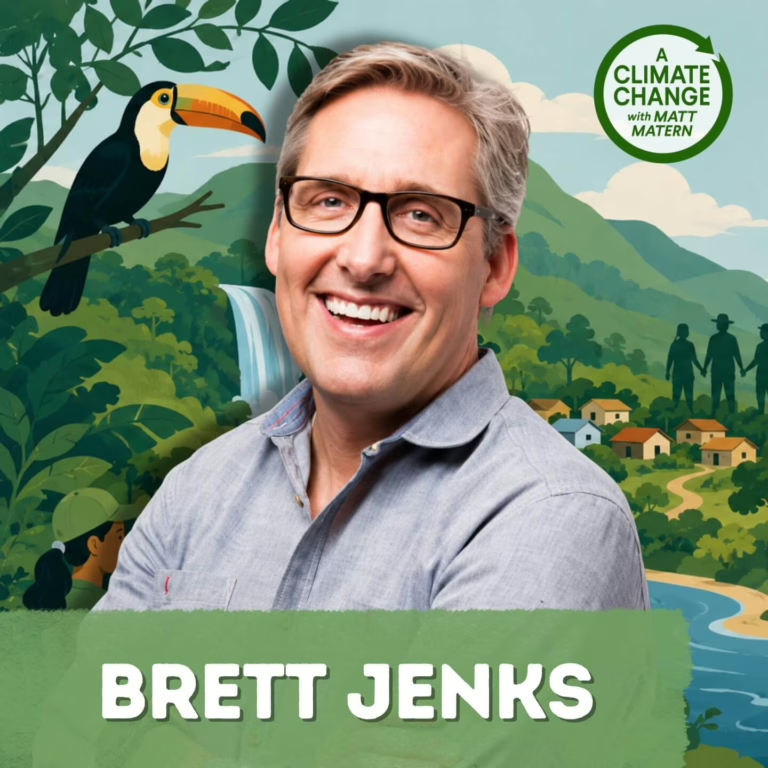
Matt is joined by Brett Jenks, CEO of Rare, a global conservation nonprofit that helps coastal fishing communities, smallholder farmers, and local leaders in 60+ countries build climate resilience through behavioral science and community-led solutions. Brett shares how Rare’s Fish Forever program grew from three pilot communities in the Philippines to more than 2,000 communities across Indonesia, Brazil, Mozambique, the Bahamas, and beyond – putting 4 million hectares of the world’s most biodiverse coastal ocean under sustainable management.
They discuss why climate adaptation has been underfunded for decades, why Bill Gates got it wrong in his recent climate memo, and why the real cost of inaction is a coming wave of climate migration that will dwarf anything we’ve seen. Brett also breaks down the three pillars of resilience Rare focuses on – financial, ecological, and social – and explains why helping a fisher get a bank account or a micro-insurance policy is as much a conservation tool as protecting the reef.
The United States has every single asset other than political will necessary to be the global leader in renewable energy and have energy independence and a climate safe future for all future generations. The thing we’re really working towards over the next 15 years is try to help as many millions of people as possible withstand the coming climate shocks. And it’s kind of a revolutionary idea.
You’re listening to A Climate Change this is mad Matern, and I’ve got a great guest on the program, Brett Jenks. Brett is the CEO of rare. He’s also done a ton of other stuff, founder of ever forest, member of the climate migration Council, which is now changed into another iteration. But Brett’s going to tell us all about this. Brett, welcome to the program.
Thanks for having me. Matt. Nice to be here.
So I always like to start with, how did you come to be a part of the environmental movement? What? What’s your story? And, you know, kind of journey.
I became a conservationist the day that someone told me what a conservationist was. I was living in Costa Rica at the time, and I was leading a little nonprofit that focused on rural education, bringing English as a second language to 100 rural schools as a pilot. And I met a guy named George Powell who, in his youth had created the Monteverde Cloud Forest with a number of his Quaker friends and family, and he told me what a what a conservationist did. And I think it was literally that moment when I realized that I wanted to, I wanted to do something similar when I grew up. Well,
I’ve been to Costa Rica once, and it is a magical place. So a great place to dream up new things. So that’s, I think I recall being in Monteverde. Sounds familiar there? There were so many cool places there.
Yeah, Monteverde is a Cloud Forest Reserve in the central plateau, basically, you would have, you would have probably remembered a really gnarly drive up a nasty dirt road, depending on when you went with the payoff being this incredible cloud forest. But along the way, you question whether or not you’re in the right place.
Okay, I might not have been there. I have to go back. I guess I was in some area where they had incredible volcanic action and, you know, as well as the forest and incredible wildlife. So just beautiful places all over that country.
It’s amazing. I lived there for four years, and I love it. I try to go back once a year. It’s an incredible place.
So then, after deciding that that’s the direction you wanted to go in, what kind of happened next on the path?
Well? So we I was working in Costa Rica, and as I mentioned, we were designing rural education programs. And this little nonprofit called Rare came to visit me in my office and said, Would would you? Would you help us teach English and whatever else is needed to rural adults living around these newly created national parks where we believe tourists are going to start coming in significant numbers.
And I realized that a number of my volunteers, we placed recently graduated volunteers from US universities in these rural schools, and my job was to sort of train them, get them ready, raise the money to feed them and house them for a year so they could be these first ever English as a second language teachers in the rural schools. And a number of them had been getting offers to quit the volunteer program, which was kind of like a mini Peace Corps, and go work for local tour operators, because they could speak English.
And they were already comfortable getting around rural Costa Rica and so I got a group of them together one week, and I said, Okay, guys, instead of you all becoming tour guides, what if we work together and design an academy so we can Train rural Costa Ricans to take these jobs and the rest is history. We trained about 300 local guides all over Central America and Costa Rica and South Africa, and really helped create a standard such that you can’t really operate local ecotourism projects without local guides.
But in the early days of ecotourism, you know, starting in the late 80s and early 90s, most of the guides were were Americans or Germans or Swiss, you know, biologists who could walk people around the forest and tell them what they were looking at. Now, it’s very much a, you know, a niche for local, local leaders. And we helped, we helped make that happen.
That’s That’s great. Yeah, certainly, I ran into some people who were guides, and they were all locals down in Costa Rica and and also in other places, in Peru and and, of course, the flavor that they are able to give a tourist is much, much different than somebody who’s who didn’t grow up in the area,
Exactly. It’s just a much richer experience. That was the idea.
Yeah, well, it worked. So then where did, where did, how did rare morph over the time period that you’ve been there then?
So when I when I joined rare was a really fantastic, teeny, tiny, little nonprofit. It had about a handful of staff, and had programs in a few countries, and the it was really clear that what we were doing, what my colleagues were doing, and folks who were here before I was was was really special, but really small. And so the goal became to take these community led Conservation Solutions and begin to figure out how to scale them.
And so what rare has done since then, you know, we, in many ways, we continue to be a very similar organization. We at our roots, we are wholly committed to the idea that conservation will be way more effective and lasting if it’s designed and led by local leaders, by inhabitants of the countries where the greatest biodiversity is, and so we continue to operate under that premise these many years later.
What’s different is, I would say, where we have become a decidedly entrepreneurial, a decidedly tech forward, a decidedly behavior centered organization, meaning we want to leverage the best business models, the best technology and the best behavioral science to be able to meet people where they are, and shift behaviors on mass To create the kinds of constituencies and the kinds of local leadership that’s needed to preserve nature and to help people thrive. And so what that looks like today is we have one of the largest coastal fishery recovery programs on Earth.
There are more than 2000 communities in countries like Indonesia and Brazil and Mozambique and and the Bahamas and Guatemala and many Pacific island nations now where the default way of managing local fisheries, and therefore local coral reefs and mangroves and sea grass beds is is a method called Fish forever that we’ve Developed with our local partners over the last 15 years, and that means that locals have exclusive access rights to their own local waters.
It means they set up their own protected areas so that the fish can repopulate the reefs and local habitats. They’re sort of deputized and licensed to survey their own waters and to enforce their own rules and regulations. And it’s kind of a revolutionary idea. When we first came up with it, people described it as, you know, since, since, many conservationists blamed fishers for, of course, overfishing without recognizing that there was no data and nobody knew they were overfishing. They just knew they were catching less fish after 40 or 50 years. It was sort of, it was equated with putting, you know, the fox in charge of the hen house.
And our response was, Well, what if the fox could learn how to propagate hens to the point that the fox could not only feed himself, but he could feed the whole community and repopulate, you know, the chicken kingdom in the process. And that’s essentially what what we built out and so that that’s a kind of a program where today we’re using innovative finance tools like impact bonds.
We’re using blended finance vehicles like impact investment funds to bring private capital and public capital, and then, of course, philanthropy and we’re mixing together multiple kinds of capital in. Multiple kinds of technology and policy change to scale up these outcomes for 1000s of communities all over the world, and so I think rare has become sort of a system shifter and a behavior change specialist, but still focused entirely on community led biodiversity conservation and climate resilience and adaptation.
That’s a pretty amazing story. I was reading somewhere on your bio that there are 4 million hectares that you’re currently kind of working on, and I don’t know how I didn’t know how big that was. And I googled it and said something like, as big as the state of Rhode Island. So it’s pretty good size of territory that you guys are working on.
It’s, we’re getting there. I mean, I would say what’s, what’s very it’s, you know, Rhode Island is a pretty small state, but this is the places that we’re talking about. Are the most biologically significant coastal areas in the world. So these are the coastal marine hot spots of the planet. And so pound for pound these, these are arguably the most important places for the ocean on Earth, and they’re now being conserved rightly by local inhabitants. So we’re really proud of it, but we have a long way to go.
Well, it’s a it’s a heck of a start, and so tell us how that road continues to expand it, and I don’t know. Are your plans to 10 exit, 100 exit, What? What? Or just kind of play it as it goes?
We have, we have a really ambitious plan for the next you know, we decided to five year strategies always seem too short to sort of articulate the kind of vision that you want to build your life around. And yet, 15 years seems ridiculous for a strategy. It’s just too long, so we decided to have a 15 year vision and a five year strategy. And so the vision is to enable a billion people all over the global South, living in the most biologically rich areas of the world, to be able to thrive economically and socially while preserving nature. And the strategy is to take all of our emerging work on regenerative agriculture and behavioral science, integrate that with our growing fisheries platform and be able to serve up to eventually, hundreds of millions of people solutions that improve their daily lives while making them more resilient to climate change while protecting nature.
So this means investing in the soils that grow the food that 40% of people eat around the world. Means eventually creating the tools and the systems and the solutions that benefit the billion or 650 million smallholder farmers that feed most of us every day. And these are some of the poorest farmers on Earth. They usually have less than 10 acres. They usually have one head of cattle, perhaps a four or five different products they’re growing to sell to the market, and a handful of foodstuffs that they’re growing for their own consumption. And they’re some of the most important people on earth. They happen to live in some of the richest habitats on the planet, and so they matter a lot.
This also means about 50 million coastal fishers who feed about a billion people every day, their number one supply of animal protein all these coastal countries all over the world, those 50 million fishers create about two 50 million jobs, and they fish in local waters that are less than 10 miles off their own coasts, and it’s in those little bands, you know, the kind of ocean that you’re looking at when you’re sipping a, you know, a cocktail with a little umbrella on vacation somewhere in a tropical place. It’s that little body of water you’re looking at when you’re staring at a sunset that harbors most of the biodiversity, most of the blue carbon, most of the coral reefs, most of the seagrass beds, you know, most of the mangroves. That’s where nature is in the ocean, and we’re enabling these folks to not only, not only protect it, just so.
That it’s protected, but to invest in it and to benefit from its recovery in order for them to be able to thrive there for generations to come. Because ultimately, Matt, the big this big question, and you mentioned earlier, the climate migration Council, the thing we’re really working towards over the next 15 years is try to help as many millions of people as possible withstand the coming climate shocks from drought, flooding, cyclones, sea level rise and all of the social uncertainty that comes with those climate shocks, and so we’ve decided that a lot of research supports this.
If we can help people save money, create bank accounts, get even small insurance policies, if we can help them begin to restore their lost fisheries populations that they depend on every day. And if we can help them invest in their own soil and in their own regenerative agriculture practices, then they have a fighting chance of thriving where they were born, which should be their right, rather than feeling like they’re just subject to some climate catastrophe that they had nothing to do with and didn’t cause, which is what’s going to face a couple 100 million people the next 50 years?
Well, I do think that the best solution is is preventative. What you’re doing essentially getting out ahead of the ball and saying, Hey, this is an area that is likely to experience some climate shocks. Let’s start building in the infrastructure and the investment to to mitigate those so that people millions, 10s of millions, hundreds of millions of people don’t have to move from those places because we actually anticipated that and did the hard work to deal with it.
I wanted to ask you in terms of, like, say, two different examples, maybe an example of a case that you’ve already done that work, and maybe a case that you’re looking at doing some of the work. And kind of, how does that play out in reality? Who do you go to and say, Hey, I like to save some Coast land in Indonesia or wherever it is. And, you know, to get that process rolling.
So generally speaking, we’ve operated for years under a sort of a basic practice, which says, let’s first identify a bright spot. Let’s go, let’s go find some reason for hope out there. So when we first were approached by a group of philanthropists and some practitioners who said, We really feel like there’s an opportunity for shifting fishing behavior in countries like Indonesia and the Philippines. Would you be interested in helping make that happen? Do you think you could help promote sustainable fishing among you know, these 50 million coastal fishers around the world. And so the first thing that we did was we looked all around the world, and we held a global competition.
We actually teamed up with National Geographic, because they have such a big brand, and we knew that if we if we did it with them, we’d get a lot more visibility. So natchio agreed to partner with us. We put up a, I forget, a 25 or a $50,000 prize for the best example of community led fishery recovery, and we found a litany of really interesting little examples. One was a Muslim cleric in Zanzibar had had convinced local fishers to establish no take zones.
And he was literally preaching to his Muslim Brotherhood about the need to protect the ocean. And everyone got on board and they did it, and they were actually able to measure fish recovery. We found an example by a university professor in Chile who had come up with a design of what he called a turf, which was a, you know, cool, a cool little acronym, territorial use rights for local fishers, so they would have their own turf.
So they were licensed to fish locally, and this is mostly for benthic species, you know, like critters that don’t move much. Let’s say, let’s say oysters that they were harvesting and so everyone was sort of have their little their area. And a community would then manage their own, you know, five or six or 10 hectares on the water and but they had figured out how to pass national level policy so that they had turfs along the coast of Chile.
So we visited the turfs. We visited these two ladies in Apple island in the Philippines who had just decided that they were only going to buy fish from these are two women who controlled most of the fish buying on this island, and they had the foresight to say, we’re only going to buy fish that are caught in a particular area, not in the marine protected areas. And that’s going to require you guys to work a little harder, but catch bigger, healthier, more valuable fish.
And that shifted behavior there so that people stopped fishing in the marine protected areas, and they too, saw their fish coming back. Long story tolerable. We collected these, these examples from around the world, we bundled the best practices, and then we went back to the Philippines and said, Let’s, let’s try to roll out all of these elements in three sites. And within a year of partnering with three communities who sort of raised their hands and said, Hey, look, our fisheries are trashed. If you want to come work with us, we’re in. We’ll be your partners. So we told them about Chile, we told them about Zanzibar, we told them about Apple Island, and all of a sudden we were off and running, and those three pilots were really successful.
First, the local fishers loved it and felt like they had a solution, even before they had any data, they felt empowered. They felt like they were doing better. And so that the three pilots led to, then an extension of 41 projects. And for those 41 projects, we collected about 2 million data points, spent a bunch of money on evaluation and learned that, in fact, we were seeing tangible, measurable evidence of fish recovery at a level that really made this an exciting program, like several 100% increase in biomass over five years. We took that data then to a group of philanthropists who started funding this work on mass. So that’s what good looks like in terms of new countries.
Generally speaking, it’s not hard to look around the world and say, well, there are 25 or 30 major marine biodiversity countries, some of them are highly dependent upon coastal fisheries. And when we have time and when we have the money available, we can ask you know their minister or a couple of local nonprofits or NGOs, or even a community leader in one place. Is this something you would like to embark on? And usually, we’ve now worked in 60 countries. Usually we’re told, you know, this isn’t China, this is going to be harder. This isn’t Indonesia. This is different. You know, this isn’t, this isn’t Brazil.
You know, by the time you’ve worked in 60 different countries, you say, Yeah, okay, fine. We know it’s different. We know it’s going to be very hard. But ultimately, we’re all humans. We’re literally all the same species. We’re just not that different. We have different languages, we have different customs, we have different cultures, but we’re still human beings, and we’re motivated by the same things. And that’s where this behavior change science comes into play, because what you start to recognize is people change when they see people around them changing, and people change when they think people around them expect them to change, and people will change really quickly.
If they think all of a sudden, the rate of change is dramatic, and they’re either missing out on something or, or, or they just see that it’s inevitable and they can stop having, you know, the internal logical debate about whether or not they should try it. And once you start to unpack and synthesize what we’ve learned from social psychology and behavioral economics and neuroscience, you know, there’s no unified theory of human behavior yet, but we’re humans, we tend to be motivated by the same things, and so we’ve been learning how to leverage what motivates change, to make each new project or each new country a little smoother, a little faster than the last.
Yeah, well, it’s pretty amazing process that you described in terms of creating the prize, to the pilots, to the 41 projects, to gathering the data, and all of those things together really are incredibly well designed. I mean, I’ve talked to lots of different nonprofits, and I would say that this is about as well designed as I’ve heard. So it’s kind of, I guess, no accident that you’ve been so successful at rolling it out to 60 different countries.
I guess you know, one of the things that I look at talking talking about Costa Rica, is that’s that country is kind of like amazing in how well designed they’ve been in terms of rolling out sustainable development such that they’re almost all fossil fuel free. They’re They’re almost all running on renewables and things like that. Like essentially, if we could replicate a model like that around the world, we’d be doing all right.
Well, I agree. I’m a no argument here. I’m a huge fan of Costa Rica. What’s interesting, though, Matt, is what, depending on when you went there. You may or may not know that what’s even more incredible about Costa Rica is that most of the country was deforested 3040, years ago. I mean, there was this huge effort to grow cattle all over the country, and so, you know, the whole Guanacaste region, you know, Northwest Costa Rica, became a cattle ranch, and it’s a terrible place for cattle ranching.
It doesn’t have the right soil, it doesn’t have the right grass, but all the trees were cut down, all the forests, lowland rainforests, lowland dry forests across the nation, was decimated in order to become a cattle ranching nation. That was an early vision of the country, and it took some real leadership, starting in the the 80s, really early 80s, late late 70s, early 80s, when a handful of Costa Rican leaders, many of whom had traveled and had seen, you know, sustainable stories in other countries when they realized what they could potentially have. And, you know, depending on, depending on, you know, you pick your hero and you pick the story that that describes the great success.
But from my vantage point, showing up 10 or 15 years after all that had begun, it seemed like it was a combination of sort of Michael Porter and the Harvard Business School, you know, saying the core competence, really, of Costa Rica could be educated people in a sustainable landscape with the first eco tourism nation, so that your sustainability is going to is going to be a greater source of revenue than cash crops like cocoa, like bananas and coffee, and then that educated populace will eventually be able to create a great service industry, and at some point you might even be a tech leader, and you Now have Intel, you know, in Costa Rica building chips.
And that was a that was a 30 year vision that a group of leaders had, and a vision that evolved over time. I wasn’t in the room, but I benefited from some of what those early leaders, I guess, the expectations that they created for being open minded, looking broadly for good solutions, and then figuring out how to focus enough on what we we in Costa Rica could develop in order To sort of win the, you know, win the game. I think getting rid of the military also saved them a lot of money along the way.
Right? It’s, it’s a story of complete genius. And, I mean, of course, they had some, some good stuff to work with. I mean, rivers for hydro, and plenty of sun, for solar, and probably some wind. But, I mean, they did incredible work with the resources they had. And you look at, well, there’s a lot of other Central American countries that have those same resources that did not develop them anywhere nearly as effectively as Costa Rica did.
Yeah, absolutely. I mean. They also, they’ve, they’ve been a great beneficiary of peace for quite a long time, and I think for for no other those other countries. I mean, look, I’m no expert, but I would say some of them have had a pretty raw deal in terms of whether what the either the geopolitics or what’s been done to them. And a number of them, you could also say, have not done themselves any favors by the people they’ve elected to to lead them. But there is a still a lot of potential for other countries in Central America to to they would never want to follow, you know, Costa Rica’s leadership. But they could, right? They could do it without calling it that.
It’s, it’s an incredible model, and I feel like it’s a model that can be used all over the world. I mean, every it’s not going to be the same formula, because everybody doesn’t have the same resources. But the the basic model towards going to a more sustainable economy is, is a winning model. And it sounds like what you’re doing with rare is, is somewhat, you know, parallel to that, that modeling.
Well, our belief is if, if people are resilient, they’re able to withstand shocks, and if they’re resilient, it means they’ve prepared, which means they have some foresight. And it’s not just luck. It takes planning and it takes looking ahead and understanding what’s coming. So you know, look at some of the decisions that have been made on energy in Europe over the last 10 or 15 years with this incredible vulnerability now around natural gas, not having nuclear power to rely on, not have, not having gone all the way through to the you know, the to construct.
I mean, the United States would be in a tough place right now, way worse than Europe, if we hadn’t figured out how to frack and we hadn’t created such energy independence. I mean, it’s on. It’s unfortunate for climate change that we’ve done that, but it certainly has strengthened our independence and resilience, although one could argue, at a huge cost to the planet, given the amount of fossil fuels we’re still burning. But I think, I think people, I think we’re going to, over the next 10 years, really learn the value of thinking about resilience again, because there’s a lot of uncertainty on the horizon.
Yeah, certainly, the chaos that is going on in Iran and around the Straits of Hormuz, you know, gives anybody who’s a leader pause and should be planning towards that maybe being the new future, or certainly that it could cycle through this again, and we could be looking at $200 a barrel oil. And if that’s the case, what? What have you got in place to protect against that eventuality?
Yeah, and as soon as you’re starting about, starting to talk about $200 a barrel. How can you not be thinking about energy independence with renewables? Because they are the most affordable way of powering just about anything these days. And so if you don’t, especially if you’re an emerging economy, it makes all the sense in the world to be thinking about growing your renewable energy base, because it’s going to be way more resilient and way more self reliant than fossil fuels.
Yeah. I mean, it’s it’s heartening to see countries like Ethiopia going to all electric vehicles. They will not import internal combustion engine cars, which is a smart move. And I mean, I’ve been saying for decades that the US should become energy independent because of the, you know, the dangers occurring in the Middle East, and of course, to the extent that we could get off of fossil fuels, we would not have to rely upon countries that are unreliable and are, quite frankly, our enemies,
and not not to mention We like to win, and we’re now losing on solar. We’re losing on wind, we’re losing on renewables. Writ large, you know, we’re getting creamed by our competitors, and we are on the ver we, I would say we’ve already lost the game on EVs as well. So, you know, drive, I was just in Costa Rica Re. Constantly. And the number of byds you see driving around Costa Rica is kind of amazing. The charging infrastructure is impressive. I mean, it’s, you’re talking about Costa Rica. It’s a country of 6 million people in Central America. Well, on its way, of course they have the hydro, and of course they have the solar.
But, you know, they’re gonna, they’re they’re now a market for a Chinese manufactured very, very nifty and very inexpensive. EV and well, if, if Costa Rica could build out a renewable infrastructure, certainly couldn’t. The most powerful nation in the world have figured this out like we were. We were ahead of them, probably by 2030, years. President Carter had solar on the White House. We knew about the technology we created. It. It’s, it’s just tragic that we have not we’ve done a worse job managing our economy than Costa Rica. That’s That’s it
fair to say. Now, some would argue with you, the stocks are doing great, blah, blah, blah. I think we all know the reality is that the gap, incoming, inequality gap is is growing tremendously. People are not happy, generally speaking with, you know, the affordability, the what? What the average, what it costs the average person to get through the day in the United States these days? And let’s, I mean, on each one of these fronts. Look, I’m not an economist, so I should even pretend to play one. I’ll just say there’s no doubt in my mind, the United States has every single asset other than political will necessary to be the global leader in renewable energy and have energy independence and a climate safe future for all future generations. But we’re missing today the political will.
So let’s kind of turn to another topic, taking on Bill Gates, he released his climate memo calling for de emphasis on mitigation. You push back publicly. What did he get wrong, and why does that framing matter for how we respond to climate migration?
You know, it’s so clear, if you simply look at the data, if you’re if you’re in this game at all, if you’re reading the newspaper day to day, it’s so clear that we need all hands on deck for both mitigation and adaptation. I mean, for the past 10 years, there’s been a real problem with us, philanthropy, admittedly by some, focusing almost entirely on mitigation, without thinking, without being willing to concede that we were going to hit 1.5 degrees Celsius, you know, above our pre industrial level levels, they were going to hit two degrees Celsius.
Now that we’re on track to hit perhaps three or higher, there’s no question that in addition to mitigation, we need to be working on adaptation. So, you know, my look, Bill Gates is a really, really bright, really successful guy. I would, I would only second guess him, you know, on a couple categories, and one of them would be he was very late to the game as a global philanthropist and tech leader to recognize the challenge of climate mitigation, to recognize the need to address the plight of billions of people who his philanthropy cares about and invests in all the time, not recognizing the climate shock that was going to be fall, all of those people.
And then, and then, I think we’ve also missed the boat on this adaptation question, that where there’s just, not, you know, there’s arguably a trillion dollar deficit annually, money that should be going into climate adaptation and resilience in the global south that would that would pass muster, in your words, as a preventive measure. Instead, we’re going to be spending way more than that for decades, if not a century, dealing with the geopolitical, economic, perhaps even military, fallout of the climate migration that’s going to result from us not addressing climate mitigation in the past 50 years and not addressing climate adaptation and resilience in the last 10 those that’s just the reality. That’s what we’re facing. And so anybody who has the means and the platform to invest in and to support those two verticals, who doesn’t, I think they’re making a big mistake.
So what do you see is ways that leaders like Bill Gates and other major philanthropists should be focusing their their dollars on?
I think we we need a Marshall Plan of sorts. This is a really hard thing to do. Like what I’m saying is, in some ways, incredibly naive, but we need to. We need to look ahead and see the disaster and start thinking about how much that disaster relief is going to cost us, and then act accordingly as responsible leaders on this planet. So if we know that there’s potentially 200 million, that’s conservative, 200 million climate migrants who because of droughts and floods and sea level rise and cyclones and then all the other stuff that comes along with those major disruptions, crime, gangs, militarization, political strife, leaning right towards totalitarianism from democracies.
I mean, this is what’s coming because of xenophobia, for all of the reasons you can imagine. Why wouldn’t we be talking about this global crisis as something that is avoidable, as something that we can address, and you know? So what would that look like? That would mean a sort of charter for personal resilience, you know what, what is Bill of Rights was what? 1512, maybe we need the 2032 you know, new citizens, global, planetary bill of rights that says, You know what, every human should be able to thrive where they’re born. Because the birth, your birth, is a, you know, is a lottery, and some of us are born to privilege.
Some of us are born to natural resources, and some of us are born in countries where you have the power to vote and the power to participate and the power to shape the planet. You know, we, we in the industrialized world, are a geological force. We are literally reshaping the entire planet and all of its ecosystems in a way that our fingerprints 1000 years from now will be all over this planet, the air that we’re breathing, the temperature of the planet, the contents of the soil, the way the mountains have changed and transformed, the way our geology reports itself, will all be different because of this 50 year period where we poured fossil fuel emissions into the atmosphere.
And so we are going to be blamed by future nameless generations for what we did. Only they’re going to be able to read the files and know we knew what was happening. You know, we are like you know, RJR Reynolds, 50 years ago, we knew the cigarettes caused cancer, and yet we’re still selling them every day. We now all the citizens of planet Earth who have a voice and can vote are complicit in this natural catastrophe that we each are creating every day. And so if you’re a leader, it’s your job recognize what’s coming and use your platform to help get ahead of this. Because it’s it’s not going to be pretty. We’re not going to be around to see it, but our legacy is and they’re going to suffer.
Yeah, it is truly horrifying. What could happen, I think I read, could be 400 million people in the Sahel in Africa that could be facing starvation if climate change continues to go at the rate that it is kind of predicted to go. And you know, it’s unimaginable what that looks like. 400 million people kind of on the march, you know, chaos of a magnitude that we’ve never experienced, and that’s just one piece of the puzzle that that’s not even talking about what could or was likely to be happening all over the planet.
So I. You know, these are gargantuan problems, and it is sickening to know that we know the answers to this. Big Oil predicted this back in the early 80s, that their modeling was, hey, you know, we’re going to get up to 430, parts per million, and all these bad things are going to start happening in in the climate, and they kept, kept smoking away. So I guess, you know, the big challenge is how to stop it, how to mitigate it. What are you what are your top ideas in terms of kind of, you know, things that you’re working on that you think will make the largest impact.
We’re really focused on doing what we’re best at, which is helping communities become more resilient shifting behaviors and patterns of land use and marine 10, marine tenure, marine use. And for my money, if you’re thinking about resilience in the Global South, and you spend time in the Global South, and you know people who operate 10 Acre Farms or who fish for a living, you know, in coastal Brazil or coastal Indonesia, what they need is pretty simple. Ideally, they need a savings account. They need to start being able to save money. They need to be able to enter the formal economy.
I mean, there’s a more than a billion people that don’t have a bank account around the world. And these are, these are the many of the folks that we work with. So learning to save money, learning to leverage a bank account, having something that we all have and just take for granted every day, but basic insurance, my house burns down, someone’s going to write me a check, and I’m going to be able to rebuild. Now. That costs me a little bit of money every month, but what an incredible source of resilience. You know, whether it’s my car or whether it’s my home, I have the privilege of having them insured. Well, for the most people in the world, they have no insurance. And if you have no insurance, and then you have no cash, even in a shoe box under your bed, where’s your financial resilience?
So now take financial resilience and move that to the side. What happens if you can’t count on being able to fish 10 years from now you’re a fisherman for 50 years, the catch per unit effort has been declining, growing population over exploitation of the reefs and the mangroves and the seagrass beds. So every day you go out a little further, a little longer, it’s a little more dangerous, and you’re catching a little less fish. And that’s been happening now for 40 or 50 years. So if you can’t count on the fishery, now imagine a farmer. So right up right upstream, you have a farmer. Maybe it’s the same person, Farmer Fisher.
There’s lots of those around the world as well. If the soil is has been denuded for the last 40 years because you moved away from natural processes and you’ve converted to spraying once a year to kill everything, and spraying a couple times a year to feed what you what you want to propagate. You’ve created a sort of a chemical catastrophe for your soil, such that the soil organic compounds, the life in the soil has has decreased precipitously. So the same way you’ve reduced the fish population on your reef, you’ve reduced the natural biota in your soil that makes your soil way more likely to cake over and dry up during a drought, it makes it way more likely to flood and wash out your crops.
And you know, we work with farmers in Colombia who in particular seasons will have a drought and a flood in the same year. It makes it makes farming virtually impossible. So if you can’t count on the natural resources around you as a source of resilience, and you can’t count on your your your financial resources as a source of resilience, then what’s left? Maybe social so if you if you’re not in a very cohesive social network of people that are going to help bail you out when times are tough, then you’re literally left with no with no recourse after a storm or during a flood or during a drought, which is why people who tend to have less money, who tend to be a little further away from centers of industry.
They tend to have stronger social networks, so at least there’s social resilience. But over time, those break down. And if all of your friends are farmers and you’re all in the same lot, or if all of your friends are fishers and the cyclone comes through and wipes out all your boats, and again, you have no insurance and you have no cash, what are you going to do? It might be six months before you’re back in business who’s feeding boom. Until that happens, that’s the future that is facing a billion people or more around the world.
So what we’re trying to do is simply propagate micro insurance. We’re a conservation organization. You can say, what? Why are you focused on insurance or why are you focused on savings clubs? Because of the reasons I just described, it also is a way of helping the people that use these resources, that rely on them, and therefore the ones most likely to restore them, to protect them, to steward these resources, which we all depend on globally. It shows them that we care not just about the reef, but we also care about the Fisher folk. And so it’s a it’s a holistic way of saying we value you. We value the nature that you inhabit, and together, we need to be resilient for what’s coming your way.
Yeah, a lot to unpack there. You know, just harkening back to my own life experience, I think my grandmother got me a bank account when I was, like, eight, nine years old. I mean, so it’s kind of like water to the fish for us, like, oh, that’s just everybody has that. Or the, you know, God knows how many insurance policies I have for various things that could go wrong. And as you said, that’s a incredible, you know, social safety net.
Hey, if anything goes wrong, there’s something out there that protects us from kind of disaster. I’m curious as to kind of the Brazilian coast, which I was in South America about a year ago, and like, I was struck by how ginormous that country is, that coastal areas just goes on forever. Are they doing anything similar to Chile in terms of kind of plotting out little pieces of of territory for their fishers?
Yeah, they have. They’ve built something really innovative, and they’re called resects, which is an acronym in Portuguese, but basically translates to extractive reserves for local people, meaning they’re managed responsibly, but they’re a source of fishing or a source of farming or a source of gathering products out of the forest or out of the mangroves. And so we work rare works with a number of these resects along, especially the northern coast of Brazil, in in, you know what the, what we call the coastal Amazon, and it’s the state of Para, where the these guys recently hosted the the climate cop, the most recent one.
And in this, in this particular area, you have a network of resects, a network of municipal bodies of water, and local stewards who are ideally fishing sustainably and harvesting sustainably, working out of those areas. And this is, this is this is new terrain. Most of the focus of conservation for the last 30 years has been on the Brazilian Amazon, very much the terrestrial Amazon.
But of course, the Amazon runs all the way out to the coast and and is a great source of nutrients for all of those coastal waters. And so as soon as you, soon as you expand your vision of the Amazon to include the coastal Amazon. It, which is starting to happen. They’re they’re increasingly more resources and more interest going to those people and to those kinds of projects out there.
Well, that’s incredible work. Really loved getting to chat with you, Brett. Everybody should check out rare and the website and donate and get involved. This is this is incredible work that you’re doing, and look forward to kind of touching base with you in the future to hear how it continues to roll out.
Well, I appreciate you, Matt, thanks for taking the time to learn a little bit more about us, and thanks for helping us get the word out.
To learn more about our work at A Climate Change visit aclimatechange.com. Don’t forget to subscribe to our podcast on Apple, Spotify, YouTube, or wherever you get your podcasts. If you like this episode, please share it with a friend. See you next time.
(Note: this is an automatic transcription and may have errors in formatting and grammar.)