
Hear us on Apple Podcasts, iHeart, and Spotify Podcasts. Subscribe now!
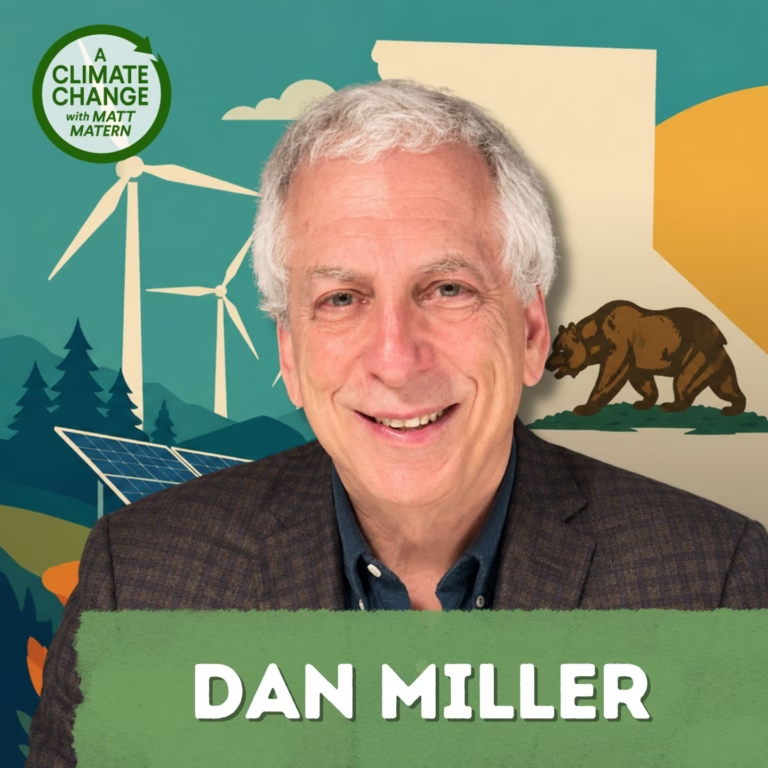
Matt is joined by Dan Miller – Managing Director of The Roda Group and host of Climate Chat on YouTube – for a wide-ranging conversation on the economics of the energy transition and the 2026 race for California Governor.
Dan explains why renewables are already cheaper than fossil fuels (a Harvard study attributes 8 million deaths a year to fossil fuel pollution), why EVs will replace gas cars the same way cars replaced horses, the $7 trillion governments still spend each year subsidizing fossil fuels, and why AI’s energy hunger is one of the biggest threats to climate progress.
Dan also makes the case for endorsing Tom Steyer for California Governor – drawing on Steyer’s book Cheaper, Faster, Better and his plan to take on the state’s utility monopolies.
Back in 1865 James Watt had invented a new steam engine that used 70% less energy for a given amount of work than the old style of steam engine, and everyone thought, “Oh, coal mining is going to drop because only 1/3 as much coal. It turned out that coal used soared, because when you say energy efficiency, just replace those words with lower cost, and things that are lower cost, people use more. Same is true with AI.
So, unfortunately, getting the long story short, improving energy efficiency won’t solve AI. The only thing that’s going to do it, in terms of environmental impact, is to have policies that get us to 100% renewable energy grid as quickly as possible, so that any growth in AI doesn’t extend the life of fossil fuels, and we can only do that with, again, political leaders willing to step up to try to make that happen.
You’re listening to A Climate Change. This is Matt Matern, your host. I’ve got Dan Miller on the program, Dan is a has a long background in the environmental movement, and currently is kind of backing the Tom Steyer campaign, so for governor here in California. So I wanted to have Dan on the program to kind of just talk about both his background in the environmental movement and why he thinks Tom Steyer is maybe the most environmental candidate running for governor in California. Welcome to the program, Dan.
Well, thanks. Thanks for having me here.
So, tell us a little bit about your background and what led you to the environmental movement.
Well, actually, started in the 90s, I read a magazine article by Bill McKibben, still today, you know, very well-known journalist and climate movement and activist, but this was all about how this Swedish Nobel Prize-winning scientist wrote a scientific article about global warming in 1896 that was Fonte Arrhenius, and how, and then he was talking about how we’re today, we are emitting so much greenhouse gasses that is going to change the climate, and this is again back in the 90s when people weren’t talking about this.
I just remember this tinge in my brain going, I can imagine this being true, and so I started studying more about it, talking to people I worked in Berkeley, so talked to climate scientists at Berkeley, and I got involved in the process, and then in 2005 I’m venture capital, which was something Tom Steyer was doing too back then, and well, actually he got started a little bit later than I did, actually, but we then switched the kind of investment we were doing in our venture capital firm to do climate change focus things in 2005 which is still pretty early on for this this area, and so I kept getting more involved, and actually I even have a podcast myself called Climate Chat, where we talk to climate scientists, so I’ve been all in on climate.
I’ve gone around the world giving talks on climate change again, starting around the mid 2000s and so I know the situation. It’s a very far more serious than the public generally understands, and one of the things that’s been lacking is leadership in the political sphere. That’s why I’m excited that Tom Steyer is somebody who is all in on climate and has been, by the way, for a long time. It’s not like something that just came up because he’s running for governor. He has been involved in investing in climate solutions or advocacy and these kinds of things for for a really long time.
Well, I ran for president back in 2020 challenging Trump, and I remember meeting one of Tom’s representatives out on the campaign trail, because he was campaigning, as I recall, in 2020.
Yeah, right.
So 2016, 16.
I think it was 2020 because you know it’s all in one.
Yeah.
Indelibly imprinted into my memory, so I do remember that. So, tell us a little bit about kind of your maybe scientific background that led you to kind of be pulled in that direction.
Well, my background is I studied engineering at Cornell and Stanford, and actually my first job was designing communication satellites, and one of my very first jobs there was actually working on the Landsat satellite that was taking pictures of the earth and different spectral bands, and therefore trying to understand the vegetation and things like that, so even in early days it was sort of environmental in a sense, but but it really wasn’t until I really started studying in the 90s and the 2000s about climate change and talking to scientists and really reading the scientific literature.
Sure, and things like that. I got to the point where I co-authored a paper on climate change, a peer-reviewed paper that was published in, I think, 2010 And if you read it today, we were spot on predicting what would the situation be today. So, while I’m not a climate scientist, I understand climate scientist, especially broadly, better than many people do, including many climate scientists who very often have a specialty, which you know they’re the world’s expert on, maybe cloud droplet formation or something like that, but I tried to take a broader view and understand all the different interactions, all the different major features of climate change, and how things interact, and that’s what we cover on my podcast, where we talk to climate scientists.
For example, I just was talking to someone today about this, a guy named George Saludis, who’s a NASA researcher, took a look at all the satellite data of cloud of the clouds on the earth for the last 25 years and noticed that clouds are decreasing over time, so one of the feedbacks to a warmer world is less clouds. Now that’s a problem, because clouds reflect the sun and keep the earth cool. So this is a climate feedback that not everyone’s aware of, that’s a very serious one, actually.
So that kind of thing is what we get into, and we talked very recently about getting rid of the RCP 8.5 emission scenario, and Trump tweeted about that this week, and actually mentioned RCP 8.5 which is kind of wild for such a detail of climate change to be tweeted about by the President, and of course was misinforming people about it, but anyway, that’s the kind of thing we do, and the kind of thing I do, and I try to, you know, stay up on what the latest issues are.
Okay. Well, it’s fascinating. And then kind of also looking at it from a venture capital lens, what types of ventures have you gotten into, and, and what, what do you think are some of the exciting technologies coming down the pike?
Well, yeah, that’s so I’ve been doing it for a long time, and that our firm was one of the first to invest in carbon capture, and this was back in like 2011 2012 when it wasn’t a thing yet, it wasn’t something that people were paying attention to, but we realized that, you know, we weren’t going to meet emissions goals or climate goals without having a way to capture co, so we invested in that early on, invested in battery technology and water technology.
Because natural resources are part of the equation, and how to, for example, one of our companies can eliminate PFAs, or those forever chemicals from industrial wastewater, and also, actually, more than just my firm, I’m also an advisor to other climate investment funds, and investing in all kinds of things, from things that stop cows from burping methane, which is pretty major climate impact, actually, to a whole bunch of other things, I’m making green hydrogen, for example, and those kinds of technologies.
Well, you know, we’ve, we’ve had a bunch of all those things on on our program over the years, and I own two hydrogen cars, so I’m kind of a proponent of..
Well, I’m sorry for you, I’m sorry for you there, a bit, a bit challenging. I hope you can, I hope you can fuel them reasonable price.
I switched back to electric this last vehicle after being carless for six months. I bit the bullet and went back to four wheels, but yeah, it’s you know, we had Terry Tamminen on the show a few times, talking about their his work with a governor back in Schwarzenegger, and helping roll out green hydrogen, which I guess will bring us full circle to Tom Steyer and value of having a a governor who believes in climate change and and takes really proactive steps as Schwarzenegger did to to start kind of down the the path of a hydrogen economy here in California unfortunately it’s been a bit stalled out as of late maybe you could, maybe you could comment upon that, and why you think it’s stalled out, and why the stations haven’t been built out as they were for hydrogen.
I mean, in particular. Yeah, well, look, I think green hydrogen is great, and there’s many applications for it. I don’t think actually that road transportation is one of them, and that’s because of physics. When you take a battery electric car, let’s say we start with wind and solar electricity, and we pump it into a battery, and then the battery turns the motor and pushes you down the road. That’s about 90% efficient, but when you take wind and solar and make green hydrogen, you lose a lot of energy there and.
And when you take that hydrogen and compress it, you lose some energy, and then when you put it in the car and turned it through a fuel cell, you lose energy. So, basically, about 30% of the energy you started with goes to turn the wheels, or in a battery car, it’s 90% Plus, it’s just more complicated and more expensive than battery electric vehicles, and it used to be the big advantage was battery cars took a long time to charge, and you could, you know, fuel a hydrogen car quickly if you could find a hydrogen fueling station, but now a battery, my EV charges in 20 minutes, and there’s some on the market that charge 80% in five minutes.
So the issue of the time to fill it is going away, and that was, as far as I could tell, really the only advantage that hydrogen had. So, more expensive, more complicated, more maintenance, and basically it’s a fancy, you know, hydrogen engine is essentially a fancy battery, right? You start with electricity, you end up with electricity, but it’s just more complicated in between.
So, battery technology is advancing so fast, and prices are dropping so quickly, that it’s just making it hard for hydrogen cars. Now, there’s lots of great applications for hydrogen and industrial applications, sort of long-term energy storage, where you have something that’s generating a lot of energy, excess energy for a while, you want to hold that for a long time. There’s a lot of good applications for hydrogen, but I don’t think in the long run cars are going to be one of them.
Well, I guess I thought batteries and the costs of creation of batteries, and also the environmental degradation that results from mining for the components that go into batteries is is part of the equation, right.
Well, do you take lithium, for example? Lithium, people thought lithium was this rare thing, it’s actually one of the most common elements on earth. And if you take a look at mining, for example, for every one ton of lithium we mine, we mine 50,000 tons of oil and 100,000 tons of coal, so it doesn’t even show up on the map in terms of environmental footprint for mining those things versus fossil fuels. Now it’s not comparing to hydrogen, but, but even hydrogen fuel cells take very rare metals very often to for the electrolysis and things like that, so everything we do has an environmental impact, like there’s really solar panels have environmental into a wind turbine, but some have far, far less environmental impact than other things, and when obviously fossil fuels versus renewable energy, there’s no contest at all.
Someone did an article showing that fossil fuel extraction is 500 times more than if we had 100% renewable, the extraction needed for a 100% renewable energy economy. So, basically, if you switch from fossil fuels to renewables, you’ll reduce extraction by over 99% is one way to look at it. Now, hydrogen versus batteries, that’s a whole other kind of thing. I think they both have impacts, but you know, we’re making sodium batteries now, it’s made out of salt, and those are starting to be in cars now, and 10 years from now, we’ll see, I mean, we’re basically phasing out cobalt in batteries already, and that was a major flash point for environmental impact. So, so we’re making progress there, and that’s by the way. So, Tom wrote this book called Cheaper, Faster, Better, which he talks all about this, that the future, you know, we think of, we don’t have to go into a cave and just get rid of all our worldly possessions to fight climate change.
If we’re smart, we learn how to phase out fossil fuels and these technologies like batteries and solar. So, solar, the price of solar panels has dropped about 99% in the last 30 years, batteries are on track to do the same thing. They, they dropped 90% from the time I got my first electric car, that was 2012 So, 10 years later, they had already dropped like 90% and that path is continuing. In fact, this year the price of battery for long-term energy storage like utility scale that’s dropped tremendously even this year.
So we’re on a path where energy, the clean kind, will be far cheaper than the dirty kind, but even so, from a political point of view, the people with the money are the fossil fuel industry and they control politicians, and that’s one reason. Getting back to your question, one reason we don’t have a lot of action on climate is because the political system is infused with money from the fossil fuel industry. We also just don’t have leaders that either fully understand or understand as much as they should. How climate change is not just a problem today, like most problems. Oh, it’s a problem. This fixed it. Okay, you fixed it, you’re done.
Climate change is not like that. CO2 lasts in the atmosphere for hundreds of 1000s of years, so once you stop emitting it, you still have the problem for hundreds of 1000s of years. So it’s something we have to be proactive about and do something about early. Tom understands that you can read his book, and he’s.. he doesn’t make it as catastrophic sounding about climate change. It’s a very optimistic book about what we can do, and I’m as optimistic as he is about what we can do.
What I’m not optimistic about is what we will do, and one of the reasons is because we don’t have political leadership that’s leading the way on this, that’s why I’m excited that someone who understands climate change as well as Tom does can be in a position of power. Now, be better if it was national power, but California leads the way on setting standards for the rest of the country. So, it is important to have a governor that truly gets climate,
I guess. The question is, and you’ve raised a lot of interesting questions. It’s like, you know, there’s all kinds of technology, and it’s evolving very quickly, and some might say that having the government involved in picking technology is probably the wrong partner in picking, because the government is notoriously bad at picking who should be the technology leaders.
So, what’s your, what’s your statement there in response to that, and why is Tom better than the other candidates on this, as opposed to say Xavier Becerra or something like that? Okay, well, let’s do the last part first. Is Xavier, for example, got the maximum donation from Chevron, and all of the Tom wants to sort of deregulate the electric utility, so that they don’t have monopoly power, and you can get local kind of energy providers like San Francisco can run their own energy system, that kind of thing, so all the energy guys are like giving money to everyone else except for Tom, so that tells you one thing.
If the fossil fuel industry supports Xavier, then maybe he’s not the climate candidate. Now, of course, way, way better than the Republican candidates. No question about that. But when it comes, if you are truly concerned about climate, as, as I am, and I think everybody should be, if they truly understood the situation we’re in, then you’d want the person who’s actually going to fight and do these, you know, do the hard things, and so tell us what the hard things are.
And back to your other, other, other part of your question was, what about the government, and I’m picking winners and losers. Fossil fuels are subsidized by governments around the world by about $7 trillion a year, so when you talk about getting the government involved, I mean they’re involved and they’re supporting fossil fuels, so governments support the thing that’s going to kill us, right? It’s not a, it’s not a good situation, so and also governments can play a role, they can fund early risky technologies, it’s very, very tiny amount of government budget, but then as they get rolling, then they can take their hands off the wheel and let those technologies move forward.
We actually have all the technologies we need, and renewable energy at my way is cheaper than fossil fuels right now, is why 90% of all new electricity generation today is renewables. It’s not fossil fuels, so it is cheaper today. But when you take into account the health impacts and the climate impacts of fossil fuels, if you factor those in, which you should, renewables are the bargain of the century, right, compared to fossil fuels. People don’t know this, but there’s a study from Harvard that shows that 8 million people a year die from breathing in fossil fuel pollution.
8 million, that’s one in five deaths in the world are due to fossil fuel pollution, not climate change, by the way, that’s just breathing in the pollution, including 100,000 or so, I forget the number, in the United States. So, it’s a leading cause of death, not talked about at all. So, bottom line, renewables are cheaper. The marketplace will decide. By the way, his book, Cheaper, Faster, Better, is all about that. It’s how to use the marketplace to to accelerate the energy transition.
So what do you see as a top five to 10 things that Steyer could do in the governor’s mansion to to make a change for the better regarding climate?
Well, I mean, there’s again, there’s like limits to what you can do in California, but one thing is there’s a lot you can promote renewables more by making a more fair playing field, allow access, so people don’t know this, but there’s tremendous amount of cheap electricity that wants to get on the grid and can’t. Now, this is a nationwide problem, but it applies everywhere.
So, just having the rules and regulations that allow that cheap energy to get on the and clean energy to get on the grid would be a huge step forward. What he wants to do with the electric utilities to allow municipal governments to run them or others like that, that will lower electricity prices a lot, and also allow some of them focus. For example, Alameda, a little town here, has their own electric utility, it’s 100% clean energy coming out of that.
So, there’s things like that. Gee, I’m trying to go through all of it. Obviously, our state, California, is a petro state, and we’re a big fossil fuel producer. We have to put in the right rules and regulations to phase that out over time, not shut it down overnight or anything like that, but to phase it out, not to stop subsidizing it, and those kinds of things. So that’s a little flavor of the kinds of things that a climate leader can do in California.
Well, there are certainly some limits that the federal government has put on California and other states that are acting towards having more pro-climate policies, and yet while the feds kind of abdicate the field or don’t want to do anything themselves, they don’t want anybody else to do anything positive in their stead. So, how do you see Steyer or any of the other gubernatorial candidates addressing that effectively?
Well, I mean, number one is to first of all fight it, because it’s ridiculous, it should be illegal. I mean, it’s criminal from many different aspects, but so number one, fight it. Number two, implement things that the federal government aren’t implementing, right? And lead the way by example. And by the way, what’s going on? The federal government is going to turn around in a couple of years, and if not, we’re, we have a lot bigger problems than we thought, but you know, this is a temporary blip, you know, you could argue that Trump’s the greenest president ever, right?
Emissions dropped, global emissions dropped into his first term due to Covid, but he didn’t do a great job fixing Covid, so we had our big emissions drop in his first administration, he’s doing a great job right now, promoting EVs and renewable energy around the world. I don’t think he’s intending to do that, but with the price of fossil fuels skyrocketing and the Strait of Hormuz closed, many countries are realizing that it’s strategically not in their interest to be fossil fuel based, and they’re switching away, and sales of EVs are soaring around the world because of what Trump is doing, so you know we could, we could look at different ways, but the point is to keep fighting even when you have people fighting against you, and Tom’s a fighter, so I like that.
Well, certainly, Trump, I’ve said this a few times on the program since the war started, that the unintended consequences of his war, that clearly pushing people in the direction of renewable, so absolutely.
You know, his, I think, of course, he’s a short-term thinker, so he’s thinking of immediate short-term profits for his oil buddy friends, is, you know something he likes, though he allegedly says that he wants cheaper gasoline for the rest of us, but action speaks.
Look at the pump, look at the price on the pump, louder than words. So, what do you think are some of the top innovations that the governor or the government in general in California or in other states could support that would really make a difference. You were talking about your, you’ve got your ear to the ground as far as technologies, and certainly there are examples of them, like California supported Tesla back in the day, and, and we’re gave the seed money to Tesla. Now, of course, Tesla is biting the hand that fed it, but that’s another story.
Well, the federal government gave a lot of money to Tesla as well. But well, first of all, there’s two things going on. First of all, there’s kind of things that I work on, which are the seed stage early technology, and these are things for the future. This is also something Tom did. I met him long ago, because he was a, and is a climate investor.
He has a group called Galvanize today, and he had another group called Radical before that was investing these early stage risky climate technologies, but right now we don’t have to. I mean, those are great, and they’re going to be developed over time, and we can talk about that, but right now we have wind, solar, and batteries. Batteries are dropping tremendously, so they’re displacing what’s called peaker plants. So it used to be, you know, you have a certain amount of electricity, but then sometimes you have a peak, and you’ve got to be ready for it.
So you needed a power plant that could turn on really quickly and get up to speed, and those were gas peaker plants, natural gas powered peaker plants, very expensive, not used very much, so the electricity that comes out of them, very expensive, but now they’re being replaced by batteries, because batteries just sit there and they hold energy when you need it, it comes out in an instant, so those are great, and they’re getting so cheap that now they’re used for that and many, many other things, and in California.
If you look at the amount of utility scale batteries, it’s really an amazing story over the last just two years of how that’s scaling up, so we need government policies that allow this energy transition based on current technologies that are again dropping dramatically over the price is dropping dramatically over time to scale up to basically get to 100% of replacement for electricity.
Now there’s a lot of other energy use besides electricity, heating your home and things, and heat pumps can do that using renewable energy. They’re 500% efficient, which sounds impossible, but it’s true. Because they don’t try to heat your house by generating heat, they heat well, or they heat your house by taking heat from outside and bringing it in.
So, the opposite of an air conditioner, and so there’s these existing technologies that government policy can make easier to get, easier to purchase, and you know, stop subsidizing the bad thing and allow the good thing to take over. So, and then we can talk about future technology. Carbon capture is something that works today, but no one’s willing to pay for it. We’re going to need it, because there’s already too much co in the air.
There’s other technologies to kind of turn to the carbon capture piece, because I have heard a number of environmentalists say that they think that that’s a boondoggle, and that the cost curve on it has not come down, and that it’s really the fossil fuel companies are selling us a bill of goods with that, and then that it’s, it’s just not where we should be investing our money.
Well, that’s okay. A number of things on that. First of all, it is true that the fossil fuel industry uses any excuse, including that one, and anything else you can throw at them to argue that they should continue going, so we can’t allow that, and that’s, I mean, we just can’t allow that. Means you’re not taking, if you’re going to allow the fossil fuel industry to do whatever they want just based on some excuses, you’re not taking climate action seriously. So we have to take it seriously. Now, the other question, can it scale?
Yes, it can. It works today, but it’s not scaling, because no one’s willing to pay for it. It’s currently free to pollute the atmosphere with co if you want to. So, why is someone going to pay not to pollute when you don’t, when there’s no reason to pay for it? If government put in policy, is that required you, under whatever condition, to use carbon capture, or if the government would pay for it, to, for example, remove it from the atmosphere, it would scale, and the prices would come down. But right now, it’s a very small industry, because, yeah, the technology works, but no one’s willing to invest in it to make it scale up. The other thing people should know is, when you hear these projections.
Oh, under current policy, we can stay at 2.7 degrees by the end of the century, which, by the way, is disastrous, but people think it’s a good number. That number already assumes an incredible amount of carbon capture, so the scientists could not keep the temperature down without it. So, what they did is when they put in the emission scenario, how much emissions will be in the future, they build in carbon capture, just as an assumption, they don’t have the technology, and they just, they say, well, we’re in the future, we’re going to figure out how to do this and scale it up tremendously, so if you are for not having an unsurvivable temperature by the end of the century or shortly thereafter, you already are a supporter of carbon capture.
So, in terms of, by the way, Tom, I should point out Tom is not Tom is with what you said on carbon capture. He, I have to have a discussion with him later about that, but he’s also against solar radiation management, which is the other thing that on my program we talk a lot about the need for.
Okay, well, let’s talk about solar radiation management, but at first I want to just talk about the carbon credit market and in California, and what would Steyer do to change it, and how do you see it working or not working in its current iteration, and how could it be improved?
Yeah, actually, that’s actually something I need to talk to Tom about, about the details of that. I mean, we do have a carbon market in California, it’s based on what’s called cap and trade, and for roughly speaking, they keep adjusting it. This is an area that I actually very strong about. I did a paper with climate scientist James Hansen on the best way to price carbon, and the best way to do that, and it’s not something Tom’s advocating for right now, until after we have a discussion on it, but it’s to put a price, rising price on carbon that goes up every year.
So it’s not based on an auction, just every year everybody knows what the future price is going to be, and it goes up steadily, and then you take 100% of the money collected and give it back to every citizen on an equal basis, and it turns out when you do that, since wealthy people use far more co than poor people do, that the bottom 70% of households make money on that deal, and so therefore they want the price to be high, and so you have a carbon price that people support, as opposed to there. If you just take the money into the government, then you just raise the price of everything, and people be very unhappy.
But when you give the money back to them, then you can get a support for it’s called fee and dividend, carbon fee and dividend, a lot of different names for it. They do something very similar in Alaska already, the Alaska.. what’s it called.. I can’t remember the name of it for the moment, but the oil companies pay into a fund that gives money to every Alaska citizen. They love it. It’s not done for climate reasons, but it’s exactly the same thing, really, when you look at it, and so it has support among conservatives when it’s rebranded a certain way, and anyway, that would be the way I would recommend it, but the point of what Tom, Tom is willing to fight against the fossil fuel industry, increase the kind of price on carbon, for example.
And these kinds of things to equalize that playing field we talked about earlier, and so he’s willing to do that. Very few people willing to even to talk about it, to be honest with you, or talk about climate at all. Right? I mean, that’s really a problem right now. Your program, it’s not mainstream that we’re talking about right now. You don’t hear climate talked about much on the news anymore, except for, you know, when a climate disaster happens, and they might mention that might be due to climate change, but this is pretty serious stuff we’re talking about. We don’t have a lot of time to address it, and again, I get back to the point that one of the big failures in climate action is the lack of political climate leaders. We need more of them.
So, tell us a little bit about what your thoughts are regarding the AI situation, and its incredible need for energy, and you know, California was has generated 100% of its electricity on some days from renewables. Are we going to be able to continue that if AI continues to be built out at a rapid pace, and crypto that uses a ton of electricity? Are there any types of regulations that you would envision that could deal with that more effectively?
It’s a very tricky problem, because even if you run your AI on 100% renewables, you’ve taken that renewable energy away from something else that’s probably going to continue on fossil fuel based energy for a long time. In fact, they talked about leaving coal plants running longer because of the surge in AI. So, AI is a big problem.
I went to a New York Climate Week session at Columbia University a couple years ago on AI and sustainability, and all the professors there, they had like four of them talked about how they were going to make computation computers more energy efficient in order to sort of solve this AI problem, and I’m going to ask you a question. What do you think the increase in energy efficiency in computers has been since the first electronic computers in the 1940s so just like what factor improvement in energy efficiency, this is like watt hours per operation, but you know, take a guess, a wild guess,
I don’t know if it is following Moore’s Law, if it did, then it would be incredibly effective, but you know, might be order of hundreds of 1000s of times more efficient, 10 trillion times more efficient.
Okay, 10 trillion times more efficient, and it gets, it gets so the energy required for a given amount of operations drops 90% every six years, but you say, okay, well, that should solve the AI problem. No, it actually creates the AI problem. AI requires efficient computing to expand, and what a guy named Stanley Jevons – I don’t know if you told this story in your thing, but back in 1865 James Watt had invented a new steam engine that used 70% less energy for a given amount of work than the old style of steam engine, and everyone thought, oh, coal mining is going to drop because you need only 1/3 as much coal.
It turned out that coal. Use sword, because when you say energy efficiency, just replace those words with lower cost, and things that are lower cost, people use more. Same is true with AI. So, unfortunately, getting the long story short, improving energy efficiency won’t solve AI. So, the only thing that’s going to do it in terms of environmental impact is to have policies that get us to 100% renewable energy grid as quickly as possible, so that any growth in AI doesn’t extend the life of fossil fuels, and we can only do that with again political leaders willing to step up to try to make that happen.
So in California, are we building out a lot of data centers, kind of commensurate with us being the AI leaders, or is that kind of being outsourced to others all over the country? I mean, the AI technology itself is being developed in California, for the most part. I mean, there’s a crazy boom in Silicon Valley again with AI, but the actual, I mean, there’s no reason to necessarily run it in California. We actually have high energy costs. People say, “Well, you have a lot of renewable energy, why your energy costs so much?
The reason that our energy costs are so much is because PGE has to pay for burning down cities, you know, but with the fire caused by their electric lines, and that’s also climate related, because the obviously the fires were helped on by climate change as well, and drying out of the forest, so the real cost is not really electricity cost, it’s these other liabilities and things like that.
I don’t take away the license of PG and E that admitted to, I think, it was killing like 88 people in paradise. Yeah, well, first of all, Tom wants to allow that to happen, and that’s why PG E is fighting against him, actually. So, there you go.
Yeah, yeah, I’d love to hear more thoughts about that, and why we should be getting, you know, de-linked from the current electrical grid providers and going with smaller providers, and, and how Tom would actually implement that.
Well, you know, I mean, San Francisco, I mean, just one, San Francisco wants to do it, and PG&E is offering them payment, you know, how much you can buy for it is really high, of course, and so if you have a state government that is friendly to that happening, it’s going to be a lot easier for them, so people want it to happen right, a long ongoing, and some Marin has successfully done it.
I mentioned Alameda, so there are some places around California, and they have reliable energy that’s cheaper than everywhere else, so everybody wants in on that, but but you have to have the state regulators and things like that to allow it. Some things the governor can do and some things they can’t, but obviously having a governor that supports that will make it a lot easier.
So, what’s the roadblock from San Francisco effectuating decoupling from PG & E?
Well, I don’t know all the details, but I know that one of them is that PG&E is offering it. Sure, sure, go ahead, but the price tag is like enormous, right? That way too high to be possible, so there has to be that has to be worked out, and things like that,
I guess, with the board that I’m trying to think of the name of it that regulates the California Energy Commission, is one, but I don’t.. there’s others, but yeah, there’s other, yeah, well, there’s public utilities, public utilities commission.
Right, yeah, yeah, so yeah, these are all areas that we could work on. So, how did, how do you see this playing out, and why, why is Tom really the candidate, if there’s anything else that we haven’t covered, please, please speak now or forever hold your peace.
Well, Tom, as everybody knows, Tom’s a billionaire, so people wonder, how can you? Oh, he also wants to tax billionaires, so people wonder, like, how can you trust a billionaire? But I can tell you, since I’ve known Tom a long time, and he was doing this before there were political ambitions, or at least on the table, that he’s been all in doing many things on climate, besides being an investor, like I am. He actually funded campaigns to stop oil company-sponsored initiatives in California to wipe out our climate regulations, and teamed up with George Shultz, of all people, to fight that, and was successful in that.
He, he started a bank. This is not directly climate-related, but with his wife, Kat Taylor, to just be a community-oriented bank that didn’t have the same incentives that a commercial bank has. They can actually do good things for the community. He has a regenerative ranch he runs to demonstrate regenerative practices in agriculture, so he’s not. He’s been doing all these things, and his book is all about how to get people to be encouraged to go all in on climate, or at least partially in on climate, but to engage with what this most important subject is, and one that does not get enough attention.
I’m really glad to see what you’re doing to sort of spread the word of provide information to people, because they’re not getting it through the normal channels, and so again, having someone who he’s, he’s, he’s progressive. He wants single payer health care in California. He has all of that kind of thing that you would expect from a progressive candidate, but he’s really the only one from my point of view that has the background understanding of climate change, has been involved in the industry for a long time, and is willing to, you know, go up against the fossil fuel industry, which, you know, Xavier is not really willing to do. He’s accepting, he’s accepting these payments from the electricity controlling people, and Chevron, and others like that. So, I think, you know, I think that’s the quick summary.
Okay, well, I want to ask you a question about electric vehicles before we sign off, and currently something around 25 26% of vehicles in California are renewable or electric vehicles. How do you see that improving, changing under Steyer, as opposed to just going, you know, the general trajectory that will happen regardless of whoever’s the governor of California.
Well, I don’t know, I mean, specifically, this is one thing that the federal government is trying to fight against, is our our laws on mileage in cars and things like that, that we’re, we have the most progressive in California, and then other states adopt him. Trump’s trying to fight against that, so there’s that issue alone. So, fighting against the federal government fight was a very important, I think, in general, the price of electric vehicles are is coming down, and they’re now about the same price, if not cheaper purchase price upfront, purchase price than the equivalent gas powered car.
There’s certainly much cheaper to operate over the lifetime of the car. Almost no maintenance. People don’t even know this. Tesla doesn’t have an annual maintenance. There’s nothing to do. You, you bring it in if you have a problem, but you don’t have to bring it in otherwise. And that’s, that’s great, by the way, and there’s no, you know, you don’t have any fuel filters to change, or all these kinds of things, so very little maintenance, and way cheaper to fuel it, of course, the electricity is much cheaper than gasoline, and on and on, so, and the price is continuing to come down, so my point is EVs are going to take over, no matter what.
They’re, you know, by five years from now, they’ll be so much cheaper, because battery prices are dropping so tremendously. They’ll be so much cheaper, you’d have to really just be an aficionado of gasoline power cars to want one. You know, people still ride horses, it’s not like horses went away, but it’s something you do because you really like horses, not because you want to get to the store to get groceries or something like that, depending where you live, maybe. But so I think that’s what’s happening in China.
The number one car market in the world is already over 50% of sales are EVs, and globally is in the US, we have, we suppress imports, right. We have 100% tariff on Chinese cars. In China, you can already get, like, a Model Tesla Model Three equivalent kind of car for half the price of what Tesla charges here. And I was in China recently, driving in these cars, and they’re great, by the way. The quality was really quite surprising, how good they were on the inside, too, the finishes and everything were really quite amazing. So it’s EVs are.. I’m not really worried about that, actually.
EVs are going to take over just purely on economics, and again, that’s Tom’s message. It’s cheaper, faster, and better. EVs are, you know, just right now getting.. well, they’re cheaper, and they have been for a long time in terms of lifetime ownership costs been cheaper for a long time, purchase price upfront getting cheaper right starting today, and they are faster, I can tell you that much, and they’re better in every single way. You don’t have to stop at the gas station if you’re able to charge at home, for example, you don’t have maintenance issues, and things like that.
So, all in all, and environmentally, by the way, people say, well, batteries are really bad for the environment. Batteries are being recycled today. There’s a company called Redwood Materials, started, by the way, by the CTO, a former CTO of Tesla, that can recycle batteries. Today, there’s not a lot of batteries to recycle, because EVs are a fairly new product, so that’s not going to be an issue. Batteries themselves, even after they’re no good in your car, they drop to, let’s say, 80% of what they used to be. That’s still an incredible amount of energy, and can be reused in a fixed application for a long time, and then eventually recycled. So, in terms of that, batteries in the long term are very recyclable technology.
Oh, it’s fascinating stuff. And appreciate you, Dan, coming on the program and talking with us about these issues and getting insight into the governor’s campaign, and what Tom Steyer is talking about, and also what Xavier Becerra is talking about. You know, everybody should check out Dan’s podcast, Climate Chat, and see what he’s up to there. And appreciate you again showing up and spreading the word.
Well, thanks for having me. Really enjoyed it.
To learn more about our work at A Climate Change, visit aclimatechange.com. Don’t forget to subscribe to our podcast on Apple, Spotify, YouTube, or wherever you get your podcasts. If you like this episode, please share it with a friend. See you next time.
(Note: this is an automatic transcription and may have errors in formatting and grammar.)