
Hear us on Apple Podcasts, iHeart, and Spotify Podcasts. Subscribe now!
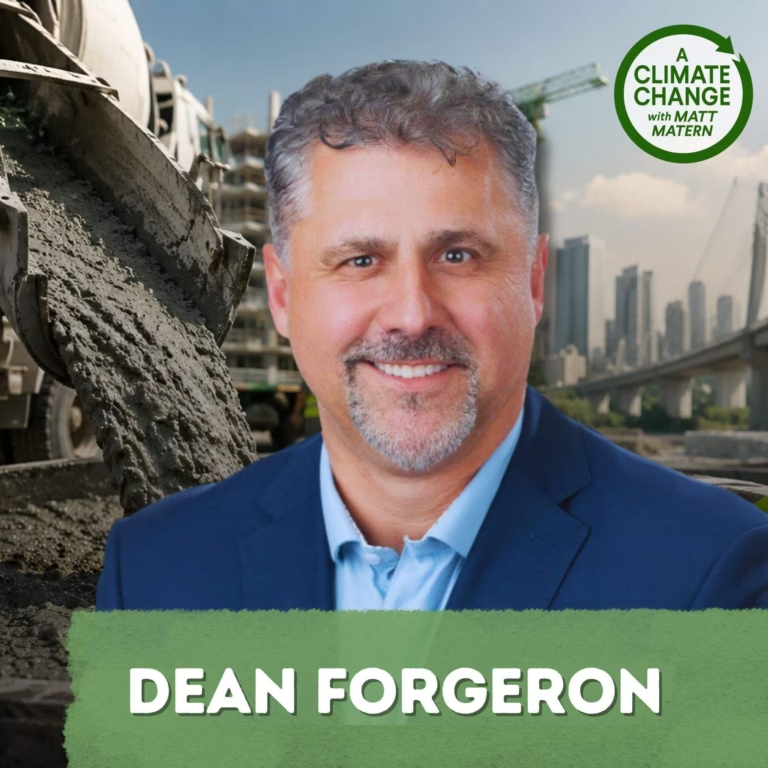
Matt speaks with Dean Forgeron, Chief Technology Officer at CarbonCure Technologies, about the Halifax-based clean tech company decarbonizing one of the world’s most polluting industries. Dean explains the chemistry behind injecting CO2 into concrete – where it permanently mineralizes into calcium carbonate, the same material as limestone, while reducing cement use by roughly 4.5% on average. They discuss CarbonCure’s recent milestone of 11 million truckloads of low-carbon concrete produced (~768,000 metric tons of CO2 stored), the company’s 2026 CleanTech Breakthrough Award, and how the industry is shifting from offsetting to insetting – modifying supply chains to actually reduce emissions at the source.
We developed a technology to take waste co that is basically captured from emitters and using concrete. Concrete is actually made up of cement and aggregates that are put together, and the cement is what is the carbon-intensive portion of concrete. It’s the binder, it’s the glue that glues all this together. And when you make cement, you need to take limestone and heat it up really high temperatures that requires energy, which contributes to some of the co footprint.
So, what we’re doing is introducing co back into the concrete production, creating some small amounts of limestone, thereby beneficiating the concrete, allowing a producer, concrete company, to reduce the amount of cement they use to produce the same quality concrete, thereby reducing the footprint of that concrete.
You’re listening to A Climate Change. This is Matt Matern, your host, and I’ve got a great guest on the program, Dean Fogeron. Dean is the Chief Technology Office Officer at Carbon Cure Technologies, the Halifax-based clean tech company that figured out how to lock co permanently into concrete. He’s a professional engineer and fellow at the American Concrete Institute. Dean leads Carbon Cures energy and product development, and a background spanning fiber reinforced self consolidating green concrete technologies, that’s a mouthful. Dean, welcome to the program.
Thanks. Thanks. Nice to be here.
Well, as anybody who’s following the climate crisis knows, one of the big challenges that the world faces is is having green technologies to make some of the things that we have previously been very carbon intensive, and and concrete is one of them. So, tell us what your firm has done to kind of change that.
Yes, so like Carbon Cure, starting quite a few years ago now, we developed a technology to take waste co that is basically captured from emitters and using concrete, and perhaps I’ll give a bit of background. Right, so concrete is actually made up of cement and aggregates that are put together, and the cement is what is the carbon-intensive portion of concrete. It’s the binder, it’s the glue that glues all this together.
And when you make cement, you need to take limestone and heat it up really high temperatures, that requires energy, which contributes to some of the co footprint, and then just a chemical reaction that converts limestone to cement that we know and we use globally, that chemical process emits co as well. So, what we’re doing is introducing co back into the concrete production, creating some small amounts of limestone, thereby beneficiating the concrete, allowing a producer, a concrete company, to reduce the amount of cement they use to produce the same quality concrete, thereby reducing the footprint of that concrete.
Yeah, I saw the video of some of the technology that I online, and it showed the co being pumped into what looked like kind of churning vat of concrete, so is how do you get the co? What, who’s your supplier of the co?
We normally, because we’re distributed around the world, approaching 2025 30 countries, we have to get co from local sources that are available, so there are gas companies that capture and clean the co from multiple applications, for example, in the cola or the beer you drank, that’s co that has been pulled from emitters, cleaned up and used, and we use that supply chain for our concrete producers, and that’s where the co comes from.
Okay, so I saw that you guys have done 10 million truckloads of low-carbon concrete produced and 750,000 metric tons of co permanently stored, which earned the company a 2026 clean tech breakthrough award for Climate Tech Company of the Year. Congratulations on that. What, what are the goals going forward as far as rolling this out on a wider basis?
Yeah, so maybe I’ll, because we won those awards, and those numbers you have, were actually a little bit old. We actually just passed 11 million truckloads of low-carbon concrete, so that’s in our industry. We supply concrete by the cubic yard, so that’s 19 million cubic yards. So, what does that mean? What’s the context here? Let’s say 20. 5000 Olympic swimming pools filled with concrete, or maybe paving a road that is in the order of 55 to 60,000 miles long, four inches thick of concrete.
That’s what our producers around the world have injected concrete co into, so that’s basically real production at scale, and we are now at 768,000 metric tons. So really, I’m looking forward to this 1 million metric tons of co averted. Yeah, so that is what our outlook is. Carbon Cure, we’re looking to partner with ready mix producers around the world to leverage this technology and basically continue to accelerate the both the cement savings and the environmental impact.
So, do you guys need more funding? What’s what’s the current challenge or challenge set of challenges that you face to roll it out on a wider basis.
Yeah, so what I would say is, over the last 10 or 1012, years that we’ve been doing this, we’ve been able to validate and move into large scale production things like performance-based specifications, and that, that is, instead of being prescriptive on what concrete should have in it, allowing performance to dictate that will help carbon cure. Buy clean programs will help carbon cure, and the reason for that is concrete producers have to adopt this.
There’s work involved in adopting a new technology, so the combination of those things and carbon credits are actually a very important part of this transition, so our technology doesn’t have any upfront costs to the concrete producer, no real major operational reinventions, introductions, but sharing carbon credits with our customers helps overcome some of the hesitations of trying something new, and actually support some of the work needed as a concrete producer. They have to manage quality, which means if we ask them to change the mix design to take advantage of the co, there’s work involved there. So, the carbon credit program we have, and the sharing of those credits with our customer, it’s actually an important part of both getting new customers and getting existing customers to use it more and more concrete to accelerate this forward.
Where are you seeing the greatest growth and adoption of your technology?
It’s quite broad, because we are North American based. Our largest footprint is in, in North America, but over the last few years we’ve expanded, and other markets in Asia Pacific, Europe, even Latin America have started to adopt this technology. We’re just at a slightly earlier stage. We haven’t seen one area go faster than the other. It just, it just takes time to adopt through the process once again, having credits to help to augment this movement and to accelerate it is actually an important part of our plans.
I saw this program just a few days ago, and they were talking about how China, in something like three recent years, had produced more concrete than the United States in the 20th century, and kind of mind blowing. So, are firms in China adopting some of this technology?
What we’ve done is we started in North America, we’ve expanded to certain years, we haven’t gone into China quite yet. I think that’s a very, very large market that we will get to in due time, as we expand. We’re a small company trying to expand and provide value to our customers, making sure they provide value, and this takes a little bit of time. So, not yet, but we’re working on it, right? So, in 2026 you not only got that clean tech breakthrough award, you also did, you also get the carbon X Prize for clean tech as well.
That was in 2021 where we won the Carbon X Prize, and that was actually an important part. We were quite young at that moment. We’re starting to accelerate, and winning the X Prize proved to us, and then also allowed us to gather funding. Basically, employees were coming, so that really did help us quite a bit.
Yeah, it’s a pretty, pretty impressive award, because I know lots of companies are competing for that, and to win that is, is pretty impressive. So, in terms of your, you’re involved in the, in the technology side of it, what, what was kind of the technology breakthrough, and do you see a. Further breakthroughs in the technology side of the business to do this even more effectively.
Yeah, so if I look back, we have been leveraging a mechanism that we understand quite well, and we’ve been able to prove it to hundreds of producers in hundreds of different types of cement, so we’re quite happy with that, but we were always missing a small part of this reaction that via the methods we were studying it with, we couldn’t see recently. We actually worked with MIT to help us understand what was happening at that early stage, and their specialized equipment really shed light on what was happening between the times we were checking it before, and actually helps us shape how this reaction occurs in our minds.
Getting us this understanding actually will help us help our customers, not only explain to them what’s happening, but tweak this process for maximum benefit of the producers once again, though we’re not standing still. Ultimately, we continue to do research on this. Everybody at Carbon Care really feels the urgency of climate change, and so we’re really trying to help our customers by creating as much value as we can for them, knowing that that will basically incentivize them to expand the use in other plants in their fleets, in other mixes in their portfolios, and then have people in the region, competitors, also pull it on board, so that we can basically push down the carbon footprint of concrete, one concrete producer, one mix at a time.
So for somebody who’s not a technical person like myself, I’m not to kind of walk us through this, and I guess I’m kind of looking and thinking it seems kind of simple, you just pump the co and the cement and presto change, oh, it works, but obviously you won the X Prize for it, so it seems like it must be a little bit more complicated than that. What, what do you do? Is it an airtight vacuum sealed situation where you’re pumping it into a into something that is sealed, so that it adheres to the concrete and the cement molecules and all that? What, what makes it, what’s the secret sauce here? Without obviously rights.
Yeah, no, so I think the important part is like sealed vessels, etc. That’s lab scale, and many people can do that. The hard part is transitioning to real life full scale production, and knowing that concrete producers cannot sustain any slowdown in production, and it has to be a low lift, easy install, and reliable. And for Caribbean Cure, we understood the reaction. A lot of the work that I ended up doing in my team was to create the equipment that actually integrates into the production process, and we couldn’t seal vessels. You can’t seal a truck, so you need equipment that can add the co into that productive facility, and can be commanded by the manufacturing equipment. So we have two boxes.
If you go on a website, you’ll see one communicates with the manufacturer, batching equipment, the stuff that makes that signals all the materials to be added to the mixer and one that controls the co from the co tank and the key here is the timing of the injection and the the amount of time we actually have in that concrete production because as I said before we can’t slow down the process so the secret sauce is that understanding and then just our lots of experience over the last 10 years of understanding how different cements react with co and how to properly dose to have the maximum impact while we have the minimum cost.
Couple questions regarding that one is, How do you measure how much co actually adheres to the to the cement, and well, let’s start off with that one.
Yeah, so we have many different pieces of equipment that allows us to figure out the amount of co that’s uptake. The key is our equipment actually can dose the accuracy of the dosing equipment is the important part, because in production we, we don’t know specifically the mix until we’re called by the vast computer to inject the co, so you have to be quite accurate there, and for it to be repeatable, and that’s I would say that’s our secret sauce, that’s where all of our IP and our patents revolve around is the specialized equipment that can do this within the industrial setting without any issues, and we’ve done this injection I just talked about accurately 11 million times to date, and scaling, that’s a lot of times. Okay, yeah, you have patented technology. Has anybody kind of licensed or used your patents to do. The same thing, or you, the only company out there doing this.
We’re the only company doing it in this way. I don’t know many others that are doing, or even attempting to inject into the concrete facility the way we are. It is quite a difficult environment, and you have to do it right to create the calcium carbonate particles in the right form, etc. in order to initiate the cement efficiency, allowing the customers to take out cement. That entire process is not only equipment.
There’s a team that makes sure the equipment is installed and maintained. There’s a team that communicates with the QC people at each plant to make sure they understand they do all the required testing, meet all the requirements, but they can do that with less cement, and we have people helping those customers talk to their customers in order to move this technology, so the tech is one part, it’s an entire, if you will, ecosystem we’ve built around helping our customers create as much value as possible from this this reaction that we study in the laboratory using and for example at MIT as well.
So did I catch this correctly, that the co actually reduces the amount of cement that has to be created because the co molecules have some degree of mass that?
It’s slightly different, maybe I can get a little bit, a little bit technical here. So, when you inject co, just like in your cola, the co will absorb into water, that’s what your cola effectively is, co with a water absorbed when cement touches water, there’s up there’s some dissolution of things, and what ends up happening is there’s calcium comes out of the cement and there’s co from the water and they bond to create calcium carbonate, so we have this very fine material, and because we’re injecting while we’re mixing, it’s quite uniformly distributed, but we’re grabbing a bit of calcium during this very complicated chemical reaction, and that induces some changes that effectively make that cement more efficient.
What we mean by that is it can achieve similar strengths as before carbon cure with less cement, and cement is the most, most expensive ingredient, and it’s the most carbon-intensive ingredient in concrete, so if you can achieve the same properties, the same end result with less cement, this is where you get this reduction in carbon footprint, and that is what this technology has proven. In I just checked this morning, 350 different cements from around the world, in fact, we’ve injected concrete into 21,000 different recipes from producers all over the world with different materials, and so this reaction is quite robust.
And what it’s doing is making that cement slightly better at producing strength, allowing the producer to take out a bit of cement, and right now we’re at about four and a half, 4.7% cement reduction, and because the concrete interest is so big, four and a half doesn’t sound like a lot, but with the amount of concrete that’s produced around the world, if we apply this, we’re talking millions and millions and millions of tons of co reduced.
That’s that’s really impressive, and I guess fascinating that they’re 21,000 or more different types of cement, you know, you kind of, you know, a for a lay person, don’t even think about that, like, hey, then cement, like, and so the kind of sophisticated, you know, you’re talking about a very sophisticated reaction occurring, where kind of my simplistic mind is it’s this seems like about as simple of a reaction as possible. You’re mixing these two compounds together, it’s like ideal, and, and you know, thanks for unpacking that for us, that there’s a lot more to it.
Well, if you think about it, like the concrete that goes into your sidewalk, that goes into your curb, that’s in your basement, in your foundation, in the column of a short building to the columns of the tallest buildings. And we just did a 70 some story building in the in Atlanta, I think, 68 story. They’re all different, they have different ingredients, because they all have different properties that the engineer who built it need, and so these producers that are driving around with trucks, it seems simple, because it all looks great. It’s actually quite a complicated recipe that they’re managing this cement, and in many cases co, and a whole bunch of ingredients and a whole bunch of requirements from the end user.
So since concrete accounts for seven to 8% of global co emissions, and there’s 100,000 concrete plants worldwide, what’s what’s kind of the plan. And what, what is the curve look like in terms of implementation to 100,000 concrete plants worldwide?
Yeah, so that’s an interesting one, because you know, as a company is trying to grow, you always have this line that you’re trying to match. I think the key is we have a foothold in North America, we would like to continue to expand using that concrete into as much different types of applications as possible, and we’ll support our customers in all the testing required to get there. Then, most recently, it’s been going to other regions, finding those early adopters, getting concrete production going, and showing that market, what we’ve shown in North America to date, and so it’s this, this ramp up of regional production, then influence of the associated concrete companies, and basically expansion.
Now every area has different requirements, so as we go to another country, it sounds like just put co in concrete. Well, they have a different set of rules required that we need to get into. So every country we have to not only introduce technology but possibly do some testing for regulatory boards to get approval and get our customers in a position where they can actually produce that concrete, so you do that at scale, and that’s the balance that we have. We want to go faster, but there’s also timing to get a lot of these approvals, etc. And so that’s how that’s our hurdle at this point.
Well, how big is your company currently in terms of just employee count?
I think we’re at 70. 70 something. I’d have to check.
Oh Okay, so yeah, there’s a lot of room for growth, for sure. Well, it’s.. it’s something that it’s great to hear that there are these that technologies being rolled out and they work, and they can.. they can cut the curve in terms of admissions, and that’s really what we need to be doing, and, and that they actually make sense, they make the concrete stronger, and you have to use less cement, like, to me, I think that’s where the environmentalist movement has to win, is at delivering a product that, that is more efficient and less expensive than the more polluting product.
Yeah, and for companies like ours, we have to create value. This industry, although it does have an environmental impact, it’s creating some of the most important structures that we have around the world, and that industry is actually looking for things like carbon care and other ways they have to manage these complicated supply chains, they have to manage competition and all of that in very thin margins. So it’s our responsibility to have a tech that provides them enough value to move, and so that’s what we’ve attempted to do is balance creating sufficient value, so they make this a no-brainer, and they move with us as fast as we can get them to move, and I think that’s the important part, is that aspect of it.
Well, my dad was a chemist, and my brother, chemical engineer, so for the nerds out there, maybe we’ll go back to the MIT piece, and maybe walk us through a little bit about what they did there to measure some of the effects of what you’re doing and and take it to the next level.
Sure, yeah, so before this we were studying the reaction and we were effectively stopping the reaction, studying certain aspects, but when every time you do that, you miss something with MIT, they have some very unique equipment that we found a year and a half ago after speaking with Edmure Masek at his lab, and what they’re doing is they’re observing the reaction in real time, but not stopping it, letting it go, and watching the changes, watching what happens at the early stages to this reaction, and so what we found is not only does the calcium, the co grab calcium, as I mentioned, create a stone calcium carbonate, but that plucking of co from the reaction changes a little bit how that cement evolves, and that’s what we have been leveraging for the last 10 years, we didn’t quite understand it.
We just knew it happened, and we could leverage it, and our customers from around the world tested it, and they could leverage it. But the MIT work showed us this interesting initial reaction that we are leveraging, and so that’s been the important part of their work. And I could get even more technical, but I think for this perspective they have special equipment that allows us to look at the changes and how the, if you will, the cement hardening process evolves with all the various compounds I mentioned, but watching that in real time and not stopping it to measure anything, just watching it and measuring it in real time. We actually have a paper that we’re about. To publish by the time this is done, that’ll likely be published. So, for those who are very technical and really want to get into it, it’ll likely be on our website, and you can, you can click on it and get as deep as you want to get into the reaction.
Learn more about co and concrete than you know, advanced degree, PhD level.
Yes.
So walk me through a real scenario. City is building a new infrastructure project. How does a low-carbon concrete get, get on the bid sheet?
Yeah, so like ultimately the path that seems to be occurring is the people who are trying to get the building built or the structure built are asking for low carbon concrete, and there’s several ways of getting there, and we work with our producers and their mixes in order for us to basically help them achieve those goals. Today we put targets of total GWP, is typically the total amount of co in the concrete they want, and then there’s a bidding process from various producers to achieve both cost structure, or put a cost in, but really achieve the strength and other, if you will, characteristics of that concrete, and then they have to report the amount of co in that concrete, and we usually do it via an EPD. It’s typically how think of an EPD like the label on your on your food, like what’s in it, right?
An EPD effectively is a third-party verified, if you will, weighing of all the co associated with that concrete, so that’s normally the, you know, requirement. And then somebody in the bid process, let’s say our producer has to provide the bid for that. So, what’s happening now is the industry is starting to push the requirements of both cost strengths, and then co. If you want the co to be down, you have to kind of say you want the co down, otherwise everybody reverts back to the normal process, which would be I’ll get your performance characteristics, and I’ll bid on price. If you want that environmental layer, you have to add one more criteria, and the industry has the tools to give you the data you need to make that decision. The end result, the person specifying the concrete needs to weigh that property.
Are there any national, state, or local regulations that support your business in terms of saying, hey, we want reduced amounts of co in concrete, and we want to capture some co in the process.
There are a few that that allow mineralization as one of the ingredients. Typically, any ingredient into concrete needs to go through pre-approval, and I mentioned that about other countries as well. So, even in states in the US, certain states, let’s say you want to go to a Department of Transportation project, which could be on any, any of the OT-related infrastructure, you need to first have your product approved, and then you need to effectively, that effectively gets you permission to use the product, and then the rest of the bidding process can go as normal, and if there’s a co requirement, then the bidders need to take whatever tools they want, that Carbon Care is one of those tools to achieve the total environmental input, but there’s very few that mandate co mineralization. I think there’s, there’s a few areas that are trying to push it, but it’s not widespread at this point.
Were there any changes in the IRA that helped you, and have any of those changes been wiped out in the last year and a half, by the current administration,
I’d have to check on that one. I’m the technical guy, so ultimately I’d have to check with the commercial folks on that one. I haven’t – we haven’t seen increased barriers for our producers. Our producers are asking us to help them with more and more complicated concrete, the OT I mentioned earlier, because it can top the mind, because we’re working with several of our producers that are ready to do even more complicated concrete. I don’t think the barrier is regulatory at this point, especially in the US. It’s just we just need to do the process to get these concrete producers into more and more concrete, and educate the market, you know, my, my history with product development and commercialization. You need to do the education, you need to build the trust of the people who are going to adopt your technology, and so that’s what we’re doing today.
And so, are you working with some of the biggest concrete producers? I’m not sure exactly who they are. I think it’s seen Cemex trucks and stuff like that, but I don’t know who’s who’s at the top of the chain.
Yeah, we’re working with a lot of large producers. Some of our producers have 70 or 80 plants with Carbon Cure. You can go on our website and there’s lots of names. Of different companies that are using it. The typical process for a company with multiple plants would be investigating, doing some lab research on one or two plants, and once they understand the full value, they start to figure out how do I leverage this value at scale. And typically, you need to do more than one plant in the city, so that you can deliver concrete from anywhere in the city, and then you start thinking about why don’t I replicate this, because there’s the material savings, there’s the benefits, why don’t I replicate this in every, in every city? So that’s typical expansion process. It takes a bit of time, but that’s a typical expansion process.
You talk about kind of educating an entire ecosystem of people involved in building, how have you been effective in working with, say, architects and city engineers and procurement officers, and the like, that all are part of this chain about building buildings and things like this actually help where we can actually disseminate the information, but in our early stages we did quite an extensive education with architects, engineers, etc.
Now what we’re doing is focusing on our customers and then asking them where do, where do we want to go next, and many of them are telling us a D O T, or can you speak to this architect, but in general, as long as you meet the performance requirements, the industry, and we’ve been, we’ve been doing this for a while in North America, there’s plenty of projects that they can go see in their city that have it in there, so there’s, it’s over time, the projects our education on platforms like this, regular marketing, or our customer faces, facing teams, you know, basically pointing to other customers that are using the tech in projects that are in their neighborhood, that is what creates a snowball, right?
And I guess eventually, hopefully, there would be some regulation that says, hey, we should do more of this because it is environmentally friendly, and therefore even more interest requirement, essentially. Hey, we need better, higher quality cement that has a lower carbon footprint.
Yeah, I think it’s moving in that direction. Things slow it down, speed it up, but ultimately we still hear a lot of people asking, How can Carbon Cure contribute to lowering my footprint, so that I can bid on a project or bid on a job, and that to us implies the people on the at the end are still asking for it, so we will, we will continue to support our customers to provide them the lowest quality or lowest co concrete we can.
What about in Europe? Are you seeing faster levels of uptake of your technology because of they’re certainly seen as probably environmental leaders is as well as like California,
yeah. So, what I would say is we focused on North America. We’ve started to go into Europe, but part of getting into Europe is there’s requirements for product, it’s called an EPA, but ultimately there’s you need to do a series of tests with with the European regulatory body to get approval in Europe, so we’re going through that process now. We have some early adopting companies that are helping us, they, they’ve, you know, partnered with us, they have production, and we’re working to create all of the testing required to get into Europe.
Once that happens, we can see that that pull will likely go faster, but they do have more regulatory hurdle barriers, or if you will, hurdles to go over to ensure what goes into Europe is as high quality as possible. So we’re early, early-ish into that process. So it’s hard to answer your question, because we’re not quite far enough to be able to, to put the pedal on the metal, if you will, we need to get approvals.
No, you could kind of understand that it’s important that there are regulatory hurdles, and that we’re talking about 70 story buildings and roads and bridges. So, we want, we want the concrete to work, so..
Exactly.
So, I’m glad there’s somebody checking to make sure that that it does work, and, and I’m glad to hear that your, your stuff is working, and maybe even exceeding the current type of cement that is being used.
Yeah, like, if I can go back in time, I would have started, we would have started Europe and other countries, but at that moment in time, we were smaller, and we were focused on our North American, America, so there’s always a, you know, it’s a catch 22 You need to focus on an area, get all your ducks in a row before you go to a new area. When you go to the new area, you tend to have to go over some hurdles regulatory wise, and then we’ll expand.
So, how do Carbon Cure’s carbon removal credits actually work mechanically. Who buys them, and what does the money actually do for the business?
Yeah, so the credit buyers, and you can actually search this on our website, ultimately purchase the credits or various names. What we do is actually we share the net revenue from those credits with our customers as an incentive to continue to move through the process of adopting and scaling, and the important part is the scaling part. We just, because you get co and you get comfortable with one mixed design getting co, that’s not enough to make it make sense. You need to put it into as much production as possible, so the credits are actually forcing the motivating, if you will, the use of co in more and more concrete, so it’s an important part of our scaling scaling plans is to share these credits with the customers to make it incentivize them for the work they’re doing, because they’re literally changing the way they make concrete as a result of co and that takes time and money for them to do it as well.
How many types of concrete it’s a small manufacturer, an average manufacturer making? I mean, it kind of, you know, you look at, see them at the side of the road, and you think that looks like a pretty simplistic stone age type of operation.
I’ve seen I’ve seen some that have decided to focus on 10 or 20 standard mixes, but I’ve seen some batch computers with hundreds of mixes that have been tweaked for one client or another. A person who’s finishing that road you just mentioned, maybe he’s finishing the sidewalk, he might need something a little bit different than the guy finishing it on the other side of the street. So, there are lots of different recipes, just for scale, right? We have about, call it 500 and some plants, but we have injection into 21,000 different mix designs, so if you just divide those two, that gives you a sense of what is what could be the average, if you will, of a curb and care customer, but I’ve seen a wide range, it depends on their customers and their customers’ needs, that is, it’s pretty incredible that there’s so much variance in that product that seems like about as simple as…
Yeah, well, remember, like it’s a set of ingredients, but you can almost have plus or minus a few pounds of one ingredient, or ingredient, or another, or an additive that makes it behave the way the producer or the construction person wants it to behave, and so it’s, yeah, it’s an interesting combo.
Yeah, well, I guess you know an analogy might be chocolate chip cookies, that every chocolate chip cookie is a little bit different than the next one, and some are fantastic, and some not so fantastic.
And if you look at the ingredients, if you didn’t know that the end result was different cookies, you’d be like this would produce almost all the same thing, and in the bowl they probably all look the same, they just don’t all perform the same, right?
Right. So there’s a lot of skepticism about carbon credits right now, greenwashing concerns, quality concerns. How does carbon cures credit hold up compared to say a forestry offset.
Yeah, I think we’re talking different, different leagues here. So we actually work with Vera and other third parties to create a methodology that basically confirms the net savings I’m describing, this four and a half percent cement reduction, for example, and the methodology is very detailed in how you calculate that net savings. Curbing Cure cannot get any credit if it produces lower quality concrete. It needs to be same quality, lower footprint, and you only get the credit from the lower footprint. There is a methodology with lots of steps and lots of testing and checking, and so we built a back end, the data backend.
That’s why I know there’s 21,000 mix designs, because I can ask our backend team to go look through all of the data, and what it is, is we’re comparing before Caribbean cure, after Caribbean cure, every truck, so there’s 11 million, we have 11 million net comparisons, and we provide all of that to this credit body. They provide all of this data to the third party, they audit all of that net savings, and then we make, they make a decision on how many credits that, that work, if you will, results in, and then it’s minted, so Carbon Cure just provides the data, they go through all the calculations, and we get, we get the credit, so that process is an important part of it.
Number two, like the co that’s put in, we know it’s mineralized, we measure that, and then the cement savings, that’s the other portion of the credit we had weights. For every batch of concrete ever made with carbon cure that we have credits for, we know the exact weight, because the producer has to do that. Producer has to weigh all the material and have a log of it. So, if you think of it like every one of those 11 million, there is what we call the batch ticket, that’s the, that’s the batch actuals of what was produced in that mix design before carbon care, we know, so the net difference is what we calculate, and we only do it, we do it truck by truck every time, and that’s what’s emitted. It’s quite a bit different than forestry, because of the nature of it,
no pun there, nature of it. Yeah, well, I, that is fairly scientifically, you know, it’s very accurate way of measuring, and of course, when you’re planting trees, you don’t know how they’re going to grow and mature, and whether they survive, even or some grow a long time, or some don’t, and some fall over, and you just don’t know, but it’s a permanence question that you know, it’s like this is mineralized, and unless you heat that thing back up to 1000s of degrees, that’s locked in, and then the cement you put in, you measure it, and you say that concrete in that sidewalk has less cement with carbon cure than if it didn’t have carbon cure. So that’s the difference, and it won’t change from that point forward, so that’s the important part, I think, for the difference of permanence.
So, if voluntary carbon markets dried up tomorrow, if Microsoft and Shopify stop buying credits, would Carpenter’s business model still be viable?
Yeah, I think there’s a move in the industry to go from offsetting to effectively, if you will, modifying your supply chain to have a reduction, so it’s effectively in setting, and luckily current here produces the material that most of these, a lot of these companies are trying to clean up, if you will, by buying voluntary, so I think we’re at part of the supply chain that this reduction can be, if you will, monetized, if you will, by the end producer. So it’s a transition. We knew it was coming, and I think we’re positioned well for it. We just need to get a bit more scale. We just need to continue to accelerate.
So in terms of, I guess, boiling it down to, is it economically viable to use carbon cures technology, such that it reduces, say, the amount of cement that has to be used? Is that sufficient to offset the cost of putting the technology in the, in the system.
Yes, that’s literally our initial in with all these producers, is they have to see a net equal or benefit to compensate for their time spent and the changes that they have. So our business model is to provide a ROI that is positive for the customer, right? And then we work to make sure they have the using enough concrete in order for that ROI to occur, so the producer, this should be a net positive for them. They do have to do more work, though, that do have to do a little bit of work to help us make those changes.
So, if you could change one policy, federal, state, local, international, that would do the most to accelerate green concrete adoption. What would it be?
Speaker 1 43:30
If I think about the, if I think about North America, I think we’re running in that direction now with low, basically low carbon concrete, ACI is working on some framework to basically measure and dictate what low carbon concrete is, and it’s really about people who are then buying it to start pushing for that, that would accelerate, if you will, everybody looking at things like Carbon Cure to help reduce your GWP, so for Carbon Cure help, but I think for the environment it would also help as well.
Give us the acronyms of ACI and GWP, what are..
American Concrete Institute?
How does that, how does that play into this whole process,
so they actually create codes, if you will, for the concrete industry, and one of the things they’re doing is creating a low carbon concrete, if you will, code or document that helps define it, and this is typically this group is in academics, but industrials, etc. that are working to look at the local materials we have, and what does what should the industry do to push that global, the co footprint, GWP glowing warming potential down as fast as we can, and how close is the ACI American Concrete Institute to instituting a new code to taking?
I think it was recently published. So, what that does, it provides a framework, so that people who specify concrete can then refer to that and say, I would like this. This, you know, basically you need to create a definition such that specifiers can pick that word and that definition put it in their specifications, so it creates that.
So, what does success look like for for your company in 10 years? And what version of this story? Where are the milestones along that path?
yeah, in 10 years we want to be in 1000s of concrete plants around the world, and most importantly, in most of their production, most of their concrete around the world, helping them leverage basically co that would have went in the atmosphere, leverage that in concrete production, allowing them to reduce the cement content and helping them to win local projects, etc. And then, if I was to put a number, maybe I’d like to see 50 million tons of co versus just clicking on to 1 million, hopefully in the next year or so. So, like, you know, that little bit of that turn, that’s what I, what I’d like to see.
For someone who’s listening, who works in construction or designs buildings, owns properties. What’s the one thing you’d want them to do differently after this conversation?
I’d like for them to consider carbon cure, or to learn a little bit more about what we’re doing, and so when a local producer says, “Hey, I have this carbon cure mix design, will you accept it? they would be a bit more educated in advance. So we have lots of information on our website in order to go and learn about it, but I would hope that they’re open to looking at the data that our customers show them on the performance of the concrete and measuring carbon cure against, if you will, the control and being open to including co as an ingredient in the concrete production, just like the hundreds of producers have, and the approaching 90 million cubic meters of concrete that have produced today’s to date has leveraged.
Okay, you’ve heard it here. Go check out, you know, talk to your concrete producers and say, “Hey, are you using carbon cure? And if you’re not, why not? And maybe find one in the area that that is using carbon cure technology, so you can have a cleaner, greener cement. Tell us a little bit about the investment opportunities in carbon cure technologies. Are there currently investment opportunities for people who want to invest in this company?
I don’t think we currently have, but you can give us a call if you want. We have nothing open, so I don’t think we need investment at this moment. We’re, we’re, we’re in a good position, but okay.
Well, we’ll look forward to, you know, seeing this, your company roll out to the next level, and and expanding this technology to 1000s of cement producers around the country, around the world to reduce our carbon footprint. Well, thank you, Dean. Great talking to you, and appreciate the work that you’re doing out there.
Thank you, Matt, and thanks everybody for listening in. And go to our website if you’d like, or you can contact me. I’m on LinkedIn, and on the website, if you have any questions.
Sounds good to learn more about our work at A Climate Change. Visit aclimatechange.com. Don’t forget to subscribe to our podcast on Apple, Spotify, YouTube, or wherever you get your podcasts. If you like this episode, please share it with a friend. See you next time.
(Note: this is an automatic transcription and may have errors in formatting and grammar.)