
Hear us on Apple Podcasts, iHeart, and Spotify Podcasts. Subscribe now!
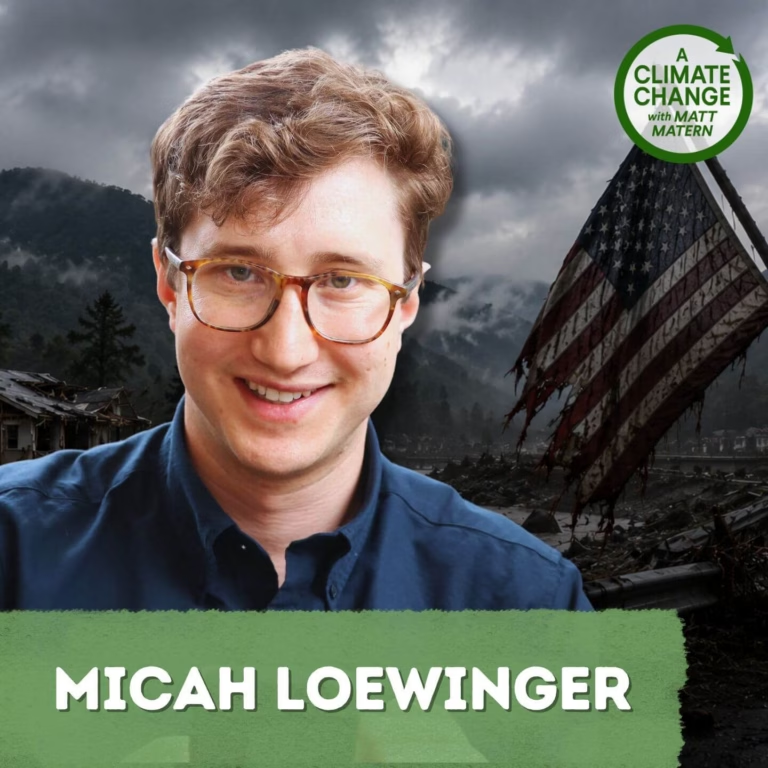
Matt speaks with Micah Loewinger, co-host of WNYC’s On the Media and the reporter behind the new four-part series American Emergency: The Movement to Kill FEMA, about how the agency built to respond to America’s worst disasters became one of its least trusted institutions. Micah explains how he came to FEMA through years of covering far-right militias, why the “FEMA camps” conspiracy theory traces back to the Cold War, and how it disturbingly echoes in today’s migrant detention programs.
They dig into the contrast between Hurricane Katrina – a genuine failure that defined FEMA’s reputation – and Hurricane Helene, where the agency performed well but was buried under an unprecedented wave of misinformation. They also cover the political fight over the agency’s future, the strange story of Cameron Hamilton (fired from FEMA, then nominated to lead it), and what it means to head into disaster season with the agency hollowed out.
The fact of the matter is, if FEMA, you know, just vanished tomorrow, then every state would have to respond to extreme weather events completely on their own, and the sense I get is that, like, state budgets are not just going to absorb that cost altogether, even though FEMA is quite unpopular, even though FEMA is blamed for mismanagement and dysfunction after Trump threatened to get rid of FEMA altogether. I think he saw the bulk of Congress sort of stand up and say, like, we’re not going to go along with this.
You’re listening to A Climate Change. This is Matt Matern, your host. I’ve got a great guest on the program, Micah Loewinger, co-host of On the Media. It’s carried by 400 public radio stations nationwide. Micah’s beat is political extremism, internet culture, and the evolution of this new industry. He’s also a host and reporter on American Emergency: The Movement to Kill FEMA. He’s an award-winning investigator. He’s investigated far-right militias, and he’s been featured on 60 minutes, as well as a host of other platforms like The Washington Post, The Guardian, NPR. And so, without further ado, Michael, welcome to the program.
Thanks for having me.
Well, I always like to start with what was your trajectory to kind of go in this area of the environment. What, what drew you that in that direction?
Sure, well, you know, as you mentioned in the intro, I don’t climate the environment, it’s really not my beat. I came to writing about learning about FEMA by way of the stuff I usually cover, like media and internet culture and political extremism. So I kind of walked into this topic crab-wise, really from my years of covering the far right militia movement, I tracked a lot of far right groups leading up to january 6, and during that time I noticed a pattern that I didn’t feel like was like really adequately talked about or reported on or studied, which was that paramilitary groups in the United States would often show up to extreme weather events like hurricanes and big floods and wildfires.
And they would come ostensibly as like volunteers raising money for survivors, helping collect supplies, helping hand out food, the kind of thing that volunteers do after big disasters, but what I noticed, and what I kind of gleaned through my reporting, is that there was sort of a cynical effort to some of this work that that natural disasters offered militia groups an opportunity to fundraise for whatever they wanted, it offered an opportunity for them to recruit, and it offered them an opportunity to look good in the public eye through media coverage, and if you fast forward to January 6, something that fascinated me is that a number of the high-profile defendants either joined a militia after a natural disaster or started their own militia after a natural disaster, so I really came to thinking about FEMA and extreme weather through this kind of nexus of political extremism in the climate.
Well, that is a fascinating thing, and I don’t think I’ve heard anybody do any reporting on this. So, please do tell us more.
Well, so when militia groups would show up to natural disasters, when I sort of tracked these groups, I would listen in on their conversations, I would track them on social media, they would use this walkie talkie app called Zello, and I did a whole bunch of reporting on it, and I would often hear these kind of strange stories about FEMA. The militia groups seem to have a lot of lore about FEMA. They would often mirror some of the negative stories that, non, you know, not political, political extremists, everyday people will say, you know, they’ll voice their frustration with FEMA. They don’t really understand what the agency does or is supposed to do.
They don’t understand why it often feels like FEMA is absent in the immediate aftermath of, like, a big hurricane, and so sometimes they would speak ill of FEMA, but it was really their way of kind of expressing a larger distrust of the federal government, but occasionally I would encounter these much, much deeper and darker conspiracy theories about FEMA, that FEMA is running secretly running concentration camps, and that FEMA is going to use disasters like. Stream weather events as an excuse to like round up political dissidents, put them in these so-called FEMA camps, take away their weapons, stifle political dissent.
All of this, so I had heard this story through my militia reporting, and I wanted to understand the history of this conspiracy theory, because it’s just so wild and it seems so untethered from reality, and so what you hear, actually, in the first episode of our series, American Emergency: The Movement to Kill FEMA, is the backstory to that conspiracy theory, which really takes us to the Cold War, when FEMA wasn’t even called FEMA yet, and FEMA was much, much more fixated on civil defense and responding to the threat of nuclear warfare much more so than extreme weather and, and, and disasters that we associate it with today.
That is fascinating, but you know, as a kid growing up in the Cold War, I don’t recall there being kind of much reporting. Now, of course, there was this – was when mainstream media was like three television channels, and so this, you know, it just – this might be whispered about in really the darkest places of political discourse on the far end of the spectrum, but, like, you know, practically nobody is hearing this.
So the FEMA camps conspiracy theory really comes from some news that comes out in the 80s, and it kind of picks up in the 90s. FEMA is not created until the late 70s, that’s when we see the collection of consortium of different agencies, kind of brought together under this new name, the Federal Emergency Management Agency, I call it a Federal Frankenstein, because the agency is given this dual mandate of civil defense and natural disasters, but in the 80s under Ronald Reagan, a lot of the paranoia and planning and doomsday planning around the Cold War really begins to pick up, and Reagan is acting on these, these fears, these, you could call them fantasies of what would happen if the United States were hit by a nuke, and there were some experts at the time who believed that, like, maybe worst-case scenario, a third of the American public would survive, two thirds would die, and so a large part of the government starts to try to answer this question of, like, what would we do, like how would we continue, how would America continue, how would the government continue, and so FEMA is put in charge of helping prepare and game out these scenarios.
They do all kinds of wild things during the Cold War. They build a whole underground complex in Northern Virginia, called Mount Weather, which still exists today. It’s actually being renovated right now. It’s still operated by FEMA. It’s, it’s an underground city where the White House and 1000s of federal workers would run our country underground in the, in the aftermath of a nuke or some other big disaster. They do other things that they, they do other things that kind of inspire distrust of FEMA. For instance, Reagan signs this executive order to create a program called Project Nine Not Eight.
Which just sounds like some kind of like Kurt Vonnegut-like subplot, but basically Project Nine Not Eight was trying to help set up refugee camps around the country where people from from big cities like New York and Los Angeles would could evacuate to, and so the FBI actually ends up getting working with FEMA and the National Security Council under Reagan to scope out places for these refugee camps, they go to casinos and car dealerships and Walmarts and warehouses, and they’re not even telling people who run these businesses what they’re being scoped out for. This is all happening quite covertly, and actually a journalist and historian wrote a wonderful book about this, called Raven Rock, Garrett Graff.
So, if you want to learn more about this sort of bizarre Cold War history, I would look there. But this is really where the FEMA camps conspiracy theory comes from, and it comes out in the late 80s that Reagan has asked his National Security Council and FEMA to draw up plans for declaring martial law, and in the so that if a nuke did drop on the US, or more than one, that the federal government could, could basically retain power, and very quickly, you know, get the country back on track. That’s a very. Charitable way of putting it, this comes out in the Iran-Contra hearings in the late 80s, and so, legitimately or not, these conspiracy theories about FEMA as this vehicle for, you know, interning large numbers of Americans and taking control of the government.
Sort of running a shadow government, start to spread, of course, the FEMA camps never happen, the refugee camps never happen, the martial law plans never happen, but the fact that, like, there’s a paper trail for this stuff, there’s documentation that they were talking about it and thinking about it and investing resources, of course, that’s going to end up inspiring, you know, distrust of the federal government and paranoia around FEMA, and the sad thing is that this storyline of the FEMA camps continues to haunt the agency even to this day. You can find conspiracy theory videos on YouTube and TikTok. Alex Jones made multiple documentaries about the FEMA camps. Glenn Beck devoted multiple segments to it. It’s just this story that will never die, and it gets in the way of a lot of the legitimate work that FEMA tries to do.
Well, I guess some are concerned on the left that say Trump might declare some form of martial law, some kind of emergency, and try to grab power at some point in time, so it’s, I guess, there are concerns on both sides of the political spectrum that for misuse.
Absolutely, absolutely, and you know, I spoke to one FEMA employee from the seven who worked at the agency from the 70s through the early 2000s his name’s Leo Bosnar, and he’s a real kind of steward of emergency management in the agency. He told me that the first time he heard about the FEMA camps conspiracy theory was actually from a reporter in Washington, DC, who believed that FEMA was going to round up liberal dissidents. Later on, it came to be adopted by militia groups, white supremacists, and, you know, fringe or groups that really were animated by these fears that civil liberties would be stripped away, and that a tyrannical government could, you know, wreak havoc on our country, and I think it’s important to point out that these concerns are not unique to any political ideology or political movement, and it’s certainly one of the sad ironies of the FEMA camps conspiracy theory is that we have now a mass deportation program that, of course, has been built out and expanded by the Trump administration.
And last year FEMA actually announced a program where they were offering $608 million to states as an incentive for building and operating their own state migrant detention centers. To my knowledge the only state that ended up actually trying to get this money was Florida, and just in the past month or so, Florida has been reimbursed, I think, over $50 million for the construction of Alligator Alcatraz, the notorious detention center in the Everglades, and so you know this is a site that has been like a massive boondoggle, it’s been under constant public scrutiny, it’s been, it’s been accused of, you know, a laundry list of human rights violations, but in some ways it’s the most real FEMA camp that was ever built, because FEMA did actually give money to build this to get to build this prison, and so I was just fascinated working on this story about thinking about this, this fear of a tyrannical government, and how animating and how powerful it is for political movements, and then to see, you know, after all of this history of this conspiracy theory, that it, you know, in a very, very, very small, very twisted way, it comes true.
Well, it does kind of shock the conscience that FEMA, which is what we normally think is a disaster management organization, is creating migrant detention centers, or certainly funding them in any way, shape, or form. It’s kind of perversion of its stated purpose, or has it done things like that ever in the past? Why, and why would they use money from FEMA when they, you know, had already put, like, whatever, $150 billion into other parts of the federal bureaucracy to fund their immigration campaigns.
It’s a good question. I mean, I’m not an expert on the. Um, on sort of the deportation system, my understanding is that for the Trump administration to reach its stated goal of deporting millions of people, there are some choke points, among them beds, you know, like facilities to put people in the court system is in the immigration court system is insufficiently set up to process the number of people that they would need to legally deport these people, they need busses and plane tickets to remove people from the country, so my sense is that they were trying to incentivize states to help to help build out the capacity for removing people from the country, but to your question about, like, why is FEMA doing this, it’s a really good question, and it was one of the most fascinating parts of my reporting for this series, is learning that in many ways FEMA is like this mirror for what our leaders fear most at any given time. We talked a little bit about during the Cold War, it was nuclear warfare.
We could jump ahead to the post to the Hurricane Katrina era, just after 911 the Department of Homeland Security is created. FEMA is kind of brought into DHS, and so we see FEMA’s priorities scrambled once again to focus on helping states and cities prepare for potential terrorist attacks. And then, as we’ve been discussing now, if you zoom ahead, you could see how the Department of Homeland Security under Christie Nome is has really been, and even to this day, after her ouster, has really been fixated on immigration, and so you see throughout the history of FEMA this, this tension, this question of like what threatens America most, and depending on who’s in charge and you know what the political context is, sometimes the answer to that question is national security priorities. I would argue, and I argue through our reporting, that what was often given short shrift, too often throughout FEMA’s history, was the threat of extreme weather. There was a constant drumbeat of hurricanes and earthquakes and wildfires and devastating events that took many, many more lives in the United States than, say, nuclear wars ever did.
I kind of wanted to jump in right to that, and you know, I’m fascinated by Katrina, but I feel like Hurricane Helene was a little bit more close in time to to all of us, yeah, and I know that there was a lot of stuff that went down with Hurricane Katrina, but that kind of was a different kettle of fish in terms of people’s distrust of it, more like from an incompetence standpoint, feeling like FEMA just kind of couldn’t get their stuff together, and then just bollocksed part of the process, so it’s kind of like a natural feedback that people distrust the federal government to do something right, is kind of naturally screwed up, throw a lot of money at it, and just don’t do it particularly well. So that’s kind of like in the range of normal stuff that we’ve had go on, and in the US for quite a long time. So, but the hurricane Helene stuff to me is a different problem, and that the federal government people go out to the sites to help people, and they’re greeted with outright hostility, and to me that’s dramatically different.
Yeah, I mean, Hurricane Helene was in some ways, in some ways just really different from past hurricanes. The biggest difference really was the level of mis and disinformation around the agency, the storm, and the government’s response to the storm. Hurricane Helene was a an unprecedented storm in as a storm itself, it dumped a huge, huge amount of water across many states, but it was most severely felt in Western North Carolina, where there was this historic flooding, basically in the mountains. Many people who had never experienced flooding before found themselves without drinkable water, without power. Many people’s homes were destroyed, no cell service, no internet. Roads are, you know, covered in debris, and FEMA, you know, I spoke with a number of. Experts, emergency managers, people who study FEMA, including people who are very critical of the agency, and I asked them, I was like, the story is that FEMA screwed this up.
Did they, did they, you know, did they do a decent job, and what I heard over and over was like, yeah, they actually did a pretty good job, they pre-staged a huge amount of people, federal workers, search and rescue teams, water, food, cots. They, in many ways, learned the lessons of Hurricane Katrina and were much, much more proactive, much better trained, competent leadership, and so then the question is, well, why was the story that FEMA screwed up and FEMA dropped the ball, and that they failed the people of North Carolina? And a big way to answer, there are a number of ways to answer that question, because it’s quite complicated and nuanced, but we have to look at the fact that this was in the middle of a very, very toxic presidential election, and then candidate Donald Trump spread a number of lies about FEMA and the federal response to the storm. He said at the time that FEMA didn’t want to help his supporters in North Carolina. He said that FEMA didn’t have any money to help Helene survivors, because they had spent all that money housing migrants, undocumented migrants, and so this fueled a lot of conspiracy theories and misinformation on social media that actually led to a considerable number of violent threats against FEMA’s leadership.
Some of FEMA’s leaders were doxed, in at least one case they were swatted, meaning there were, you know, hoax phone calls made to police in the effort that, so that police would show up at basically with a SWAT team and break down their door, you know, which is very, very dangerous and has led to deaths in the past, and so we had this strange dynamic where FEMA workers were increasingly fearful of some of the people they were supposed to serve, and some FEMA and some Helene survivors were fearful, fearful of FEMA, not really knowing what their real purpose was, what, whether they were doing a good job. There was a conspiracy theory going around that FEMA was using this storm as an excuse to steal people’s land, which has this is a theory and a storyline that has spread around for a while, and it really is a confusion of FEMA’s buyback program, where basically they offer to buy homes from private citizen, you know, property at mark at pre-storm market rate.
The idea being that if you’re living in a flood-prone area, you might survive one flood, and then you may encounter another, and another, and another, and it actually, like, would save the federal government resources to not have to respond to the same flooded area over and over, and yet, because of there’s been so much distrust and disdain for FEMA over the decades, this has kind of morphed into yet another narrative about how FEMA isn’t there to help you, it’s there to take something from you, it’s there to take away your rights or your belongings, and so it’s really sad to see that misinformation gets in the way of one of FEMA’s main responsibilities, which is to offer assistance to people after big storms, individual assistance, and also local governments, states and counties, and towns, but you know, putting the politics of everything aside, applying for money from FEMA is extremely frustrating.
And when I traveled to North Carolina to speak with Hurricane Helene survivors, that’s what I heard from people, you know, they’re terrible at communicating in some cases what kind of money people are entitled to apply for the paperwork, and the bureaucracy is head spinning and frustrating, and if you’ve lost absolutely everything, and you’re looking for somewhere to stay, or you’re trying to figure out if you’re going to get some help from the federal government to rebuild your home and restart your life, having to fill out reams and reams of paperwork and provide tons of documentation is often just like not feasible to people, and so that was something that really came out to me in my reporting, which is regardless of which you know side of the aisle you’re on, or where you get your news, or what corners of the internet you hang out in, um. Um, FEMA, if it, if it wants to improve its image in the public eye and better serve the people it’s chartered to serve, it needs to figure out how to streamline its, its assistance programs, or it will continue to pull as one of the least popular agencies in the federal government.
Well, you know, thanks for clarifying a lot of that for us. I certainly am struck by the toxicity of Donald Trump in this whole thing, that his interest was in benefiting himself politically, obviously more than helping any survivors navigate a disastrous situation, and given that North Carolina was a state that was kind of in play, I think it, I think it was,
they were, they were basically neck and neck at when, when Hurricane Helene hit, it was just like four or five weeks out from the from the November election,
right? So it was, it was a very close battleground state, and, and Trump, you know, I mean, he’s a dirty fighter, he’d be willing to do just about anything to win, so of course he’s gonna, he’s gonna lie, cheat, and steal in any way he can to gain advantage, and it’s unfortunate, but that’s who we’re dealing with, and and of course people who are listening to him tend to believe some of the things he says, no matter how outrageous and stupid they may be, but that is the political moment that we find ourselves in.
One thing that’s really important is that after all of the misinformation that then candidate President then can’t then candidate Donald Trump was spreading about FEMA after Helene hit North Carolina and other states, Hurricane Milton just a couple weeks later ended up hitting Florida, and FEMA again deployed to Florida to do what it always does, which is go around and canvas, telling knocking on doors and telling survivors what kind of assistance they may be entitled to, and so in one unfortunate case, a FEMA manager named Marnie Washington actually told her staff that they could skip homes that had Trump campaign signage to avoid further harassment, because this was a moment where many FEMA employees were, were nervous to interact with, with some, with some survivors, because of all of the harassment and threats that had been sent against the agency and its workforce.
And so this was leaked to the right-wing media, and it was a, it was a huge scandal for FEMA, and the sad part is that it seemed to kind of confirm what Trump had been saying for weeks, which is that FEMA didn’t want to help his supporters in a weird, I thought of it as kind of like a disinformation boomerang, he spread this initial completely unsubstantiated claim, which led to chaos and fear among FEMA’s workforce, and then in turn created the scenario for this woman, Marnie Washington, to effectively break the law by not helping some, some Trump supporters, and that became the proof that he and his supporters need, needed to show that, yeah, FEMA is broken, is broken, it’s biased against Trump supporters, and then when Trump came to power last year, he actually ended up referring to that episode in an executive order at a time when he was threatening to get rid of the agency altogether, and so you really to understand why FEMA has been picked apart and gone through so much turmoil over the last year and change, you have to really understand the political situation in in late 2024
I’m curious, and that wondering if the Florida folks responded to FEMA maybe more reasonably because they’ve been through so many hurricanes and they kind of know the drill, whereas in Western North Carolina, as you said, they had less kind of contact with FEMA and would be maybe more ripe for disinformation and problems.
That’s a good question. I honestly don’t know the answer to it, but I one thing I learned from from speaking with reporters and speaking with people on the ground in North Carolina, speaking with experts and FEMA, current and current and former FEMA workers, is that there are some parts of the country that are just a little bit more isolated that are not as used to dealing with federal workers a. And Western North Carolina was one of those places. There was a huge amount of misinformation online during Hurricane Helene, but there’s like a real question about how much of it was seen by people who experienced the hurricane, because a lot of them didn’t have access to the internet.
So there may have been rumors that were spreading, maybe some people had power, they were more likely to be in Facebook groups, and you know, chat, and you know, watching, in sort of absorbing misinformation on X, or whatever, but I think just as likely, there’s just in many parts of the country, there’s just a more of a culture around people helping themselves and helping their neighbors and approaching federal assistance with, with suspicion, and maybe not entirely from a conspiratorial mindset, but more of just a cultural mindset.
I heard over and over that, you know, in Appalachia, people just just help themselves, you know? If there’s a road down in the street, you’re going to cut it up with a chainsaw, or your neighbor is going to come over and do that for you, and you’re not going to wait for FEMA to come and help clear it, or for FEMA to help, you know, pay a construction crew to, to, you know, fix the road, or whatever. So it’s really complicated. I try in the series, I tried not to make it seem like everyone was just losing their mind because of social media, because so often that’s how we kind of talk about politics, but I think that for some subset of the American public, these, this misinformation, these conspiracy theories are really animating and really visceral, and for, and for others, you know, their distrust of the federal government may come from other places, so in Florida, I’m not sure, but yeah, to your point, they deal a lot with, with, with FEMA, and they’re, they’re very used to the kind of the hurricane protocol, so maybe, maybe there were, there was less of penetration with conspiracy theories. I really don’t know.
Well, we’ll have to leave that for another report, but let me, let me turn back to the extremist groups and say I haven’t seen a lot on news media regarding, say, the Proud Boys or the Three Percenters, or some of the other groups that maybe were most, you know, active around January 6, so is it fair to say they’re not, as you know, not growing in, and as problematic as they were a few years ago, or is it just that the media isn’t covering it, or some, some other iteration?
It’s probably all of the above, I think you know on the question of coverage after january 6, and in the lead up to january 6, there were, you know, probably more journalists on the beat, you know, there were just more reporters covering this stuff, there was also more of kind of like a public and political appetite for monitoring far-right extremism. There were a number of think tanks and foundations that were kind of helping fund the work of researching and tracking this stuff, and what we have seen over the past few years is a real kind of breakdown of that of of the just the work of tracking this stuff. There are some think tanks that have have stopped putting money towards it. There used to be these sort of disinformation initiatives.
A lot of that stuff has become quite politically taboo under the second Trump administration, some journalists who covered this stuff for a long time are out of work, or their news outlets closed down, and so there is, to your point, just less, less reporting overall. Are the groups less active? It sure feels that way, militia groups over the past couple decades have largely operated in as reactionaries, a lot of times their activity, their membership, their recruitment surges under Democratic presidents and then wanes under Republicans. Donald Trump’s first term kind of broke that pattern. He had a way of making it seem like there were shadowy forces out to get him, undermining his administration at every term. You know, this was the deep state, and so even though he was in the, he was in power, the narrative was that his agenda was was being stopped and being blocked and undermined. I do think you know, after january 6, I think, although there’s been a considerable effort to rewrite that history, I do think it had had a chilling effect on a lot of these groups. It was at the time, you know, the largest criminal invest, criminal investigation in American history.
A lot of people, even if you weren’t necessarily arrested and sort of sucked into the, the, the, the sprawling investigation of january 6, many people got a knock at the door, you know, many people got a phone call, many people were questioned, and I do think that it kind of raised the public price for participating in some of these groups. Now I’m sure many of them have been kind of more quietly operating. I read an interesting piece in The Atlantic recently about how you know immigration has been an animating force for a lot of these militia groups for many years, and now we have ICE. Now we have a giant official enforcement mechanism that is in many ways fulfilling the wishes of militia groups that you know 510 years ago would have themselves gone down to the border and sort of tried to counter immigration in a sort of vigilante manner, so it’s a very complicated question, but I do know from tracking these groups that if even if their activity is in a law, or seems that way, they will emerge again one day,
kind of an interesting, maybe tough question to answer, and that’s why I’m going to throw it at you. Is the Southern Poverty Law Center got into some trouble with their kind of investigations into these groups? Maybe you can comment upon that.
Yes, I mean it’s been a minute since I was reading the coverage about the allegations against the Southern Poverty Law Center, but my understanding is that they’ve been accused of basically paying informants, and so, assuming those allegations are true, I don’t know. That would certainly, that’s certainly reason to raise eyebrows about the work that SPLC has done, that allegation was sort of contorted into this like much larger claim that I don’t believe is true at all, which is that the Southern Poverty Law Center is secretly behind this political extremism that it has been documenting, which there has been, you know, a real public campaign to fight the narrative that there are neo-Nazi groups and that there are far-right militia groups that they are like kind of an authentic phenomenon in American society
After January 6, there were conspiracy theories about, or I should say, unfounded claims about how basically there were feds at on the Capitol on January 6, and that they, that the federal government was responsible for staging a false flag, and you know, inciting well-meaning patriots and tricking them into storming the Capitol, and I have seen no evidence to back that up. It does, it is likely the case that the FBI has has had and protected informants in some of these groups.
It’s not not surprising to me that the Southern Poverty Law Center has has informants in some of these groups. The ethics of paying those people, I think, is quite murky, and I’d like to know more about who they paid and why, and how the SPL sees line if I remember correctly, is really that you know they are, that you know the information that they get from these informants is stuff they pass on to law enforcement, and their their claim would be that you know the public benefits from the information that they’re able to extract from these groups, and it helps lead to public safety, and perhaps hedge off, you know, real-world violence. So, it’s, it’s a very complicated story, and I’d love to learn more about what what SPLC really has been doing.
Well, of course, I mean the FBI had informants in the KKK and the Communist Party, and whatever organizations they were investigating for from the beginning of time. Now, whether or not that’s kosher is something to be questioned. I assume in some respects. It is like, hey, if you’re investigating, or in the best way to investigate is be on the inside, you know, from a news for Southern Southern Poverty Law Center, you know, their ethics are different than, you know, a federal agency. Yeah, I guess. What are you paying for, and are you paying for people to engage in extremist behavior that be off the reservation, if you’re just paying for intel, that’s it, that’s a different story, but you know, I guess there, there’s that’s a rabbit hole that could take us far and away from where we started, so I’m gonna see if we can walk back to FEMA here, and as fascinating as it might be, you know, Cameron Hamilton was fired from FEMA, is now nominated to run it. How did we get here?
Yeah, Cameron Hamilton is a fascinating character. He joined FEMA at the very beginning of the second Trump administration, and he was like a real head scratcher pick to be acting administrator at the time, because he didn’t have the kind of emergency management experience that most of the recent FEMA administrators that have had even if you go back to Trump’s last term, Pete Gaynor, one of Trump’s picks to run FEMA, had done like 10 years of state level emergency management work in Rhode Island, and we’ve seen similar resumes from other people who’ve run the agency. Cameron Hamilton, on the other hand, he did. He had an emergency management role in the State Department, but he was brand new to FEMA, and so the fact that this, this guy was now running the agency, even in a temporary capacity, upset a lot of FEMA workers.
They saw things that he had said on social media. He had been spreading, you know, false claims about FEMA’s work during Helene on X. He had had said he had talked about how the federal.. there’s a bureaucratic sickness in Washington, and that the administrative state would have to be scaled back, he said this when he was running for a congressional seat in Virginia in 2024 so he comes to FEMA and everyone’s kind of wondering, like, what’s he going to do, how’s he going to run the place, and then just three days into Trump’s second term, he says that he’s thinking about massive overhauls at FEMA, or maybe just getting rid of FEMA altogether, and so now all of a sudden you have this like 20 25,000 person agency like freaking out because they don’t know whether this agency is going to exist in a month or two or three.
And the guy who’s reading that, leading them through this crisis is kind of like this MAGA warrior, you know, with no, with insufficient emergency management experience, and he does something I think that catches a lot of people off guard, which is he kind of he tries to stand up to Christy Noem, who is really acting on Trump’s threats to kill FEMA, and a lot of people at the agency, and in the emergency management world, will point to things they failures from Cameron Hamilton preparedness programs, he tried to cut strange things that he said about the agency while he was running it, he but I do think he deserves credit for seeing the value of FEMA, and, and not going along with the agencies, excuse me, the administration’s plan to get rid of it all together.
And after quite a bit of, like, kind of stand, you know, kind of back and forths and arguments with Christy Noam and Corey Lewandowski, they end up basically indicating to him that he’s going to be fired, and he, in May of last year, testified in front of a House committee and said that he didn’t think that FEMA should be abolished altogether, and he was publicly fired. I think either that day or the next day, so it’s wild that after all this drama, you know, he would be invited back to run the agency, and later this week he will sit for a confirmation hearing, and we’ll see what happens.
That is very bizarre. You know, I was kind of thinking, well, maybe he was standing up for FEMA, because in part it’s self-interest. Hey, who wants to run an agency that has no employees? That’s kind of not very exciting for one’s career, but it seems as though, hey, if Trump wanted to ax it. He doesn’t have to stop because Cameron Hamilton tells him to. He just, he could roll over Hamilton and put somebody else in there who, who he could pull the plug on. I mean, he, he, Trump is at least somewhat cognizant of public opinion, and I assume he’s, he didn’t pull the plug on it, because it just wouldn’t fly in in the public opinion polls.
Yeah, it’s, it’s, it’s fascinating to me, because you know, FEMA is one of the least popular agencies in the federal government, and that’s saying something. This is a time of deep resentment towards the work of our federal government in Washington, but there is no real political constituency that really wants to get rid of FEMA altogether. You know, I think that there are a lot of different philosophies about what FEMA should look like, how it could be reformed or broken up or rearranged, some of it more mainstream, some of it more fringe, when it comes to these, you know, reimaginings of FEMA, but the fact is, like Republicans and Democrats like FEMA in Congress, because FEMA gives their states a lot of money, and the fact of the matter is, if FEMA, you know, just vanish tomorrow, then every state would have to respond to extreme weather events completely on their own.
And the sense I get is that, like, state budgets are not just going to absorb that cost altogether, so what I’ve gotten from my reporting is that even though FEMA is quite unpopular, even though FEMA is blamed for mis, for mismanagement and dysfunction, fairly or unfairly, here and there, after Trump threatened to get rid of FEMA altogether, I think he saw, you know, the bulk of Congress sort of stand up and say, like, we’re not going to go along with this. In particular,
you look at his base, Texas, Florida, Alabama, Mississippi, Louisiana, South Carolina, now all those states are, you know, getting hit by hurricanes all the time, so like they are probably the biggest beneficiaries of FEMA, so like you know it would only be shooting themselves in the foot to take it away.
Yes, Republican counties are disproportionate recipients of FEMA funding, and that’s not to say that you know Texas and Florida aren’t interested in seeing FEMA’s workforce scaled back. There is, like, a conversation right now about how to change the agency, although the Trump administration stopped short of abolishing FEMA, he did put together a FEMA review council that, over the last year, has been working to think about what changes could be made to FEMA in the future to make it run better, and they released a report in May with a whole bunch of changes, and they suggested they’d like to see FEMA, FEMA’s workforce reduced, and that they want FEMA to respond to fewer natural disasters going forward, and that that they also recommended that states may end up paying more for disaster recovery than they currently do.
Now we don’t really have details on any of that stuff, but I do think it speaks to this, this just very uncertain moment for FEMA’s future. Like, how is it going to change, and what would it mean functionally for states to respond to more of these disasters than the federal government, or excuse me, What would it, what would it mean for states to pay more for for response to natural disasters, and it’s, it’s certainly just a very uncomfortable and uncertain moment for for many state leaders who who work on this stuff.
Tell us about Alt FEMA and the anonymous employees trying to keep the agency alive from the inside.
Yeah, I spoke to a FEMA worker, an anonymous FEMA worker who started this anonymous newsletter called Alt FEMA, and it was just fascinating to hear about, you know, a government employee’s experience of Doge, and what it’s like for rank and file workers to see their agency. Kind of picked apart by its own leaders by the by by the White House and by the leaders that the White House installed at FEMA, Alt FEMA came out of this moment where there were many anonymous whistleblowers across many different agencies who were starting to post from, you know, unofficial counts like Alt CDC or Alt NASA or Alt Coast Guard, this kind of thing, and Alt FEMA is a new is a sub stack where readers can learn about some of the some of the drama at the agency from the perspective of the people who work there with a bit more I think kind of specificity and kind of attention to policy than you would get in normal coverage from say like Reuters or the AP, which still do some good reporting on FEMA, but are really more for, you know, a kind of a normal lay audience. And what I think is interesting about Alt FEMA is that many of the leaders – sorry, many of the readers are people who work at FEMA. I mean, it’s a big agency, and it’s not always good at communicating with itself. Other readers are emergency managers at the state and local level across the country who rely on FEMA contracts and grants and various programs, and over the course of the Trump administration, haven’t always gotten up to date clear information about the direction of the agency, so it was fascinating to me to speak with this person and learn about the risks that they took to get the information out.
Oh, it’s, it’s a public service for all of us to learn more about these things, and I mean, our, our bureaucracy and of the federal government is so enormous, it’s really beyond any human’s capacity to understand, certainly all of it, and even small portions of it, like just FEMA, which is not small at all. I mean, as you said, 25,000 employees is hard for, like, a human, one human person, to get their arms around that big of an agency, but that being said, I wanted to kind of, kind of close with your interview of Cameron Hamilton, and what your takeaways are from it, and what we should be kind of expecting going forward, and of course, a teaser for your series, American Emergency, this forward investigation that you launched on may 1, 2026
Yeah, I’m.. I had a fascinating interview with Cameron Hamilton, where I felt he was, he was quite candid about his experience running the agency. He talked to me about being polygraphed by Corey Lewandowski and Christy Noam, who accused him of leaking information to the public, which he denies that he did. That just an extraordinary amount of conflict and antagonism that the temporary leader of FEMA faced in his meetings and interactions with the leaders of the Department of Homeland Security.
I just, we’ve experienced such a, such a tumultuous governing style under Donald Trump that maybe you know, you know, the thought of a leader of an agency being forced to take a lie detector test isn’t shocking anymore, but it just, I honestly was, was speaking with him, gave me a much clearer image into the chaos and dysfunction at FEMA under this administration, and what’s at stake for our country now that so much damage has been done to the agency, he notably called me shortly before the release of our last episode, and asked me to not air that final episode and not let people hear my interview with him until his confirmation hearing had passed, because he told me he was worried that the things that he told me might bring him negative attention when he answers questions from lawmakers later this week.
And I told him that wasn’t an appropriate request, and that, as a journalist, you know, I believe that when somebody is trying out for a really big job, the public should have access to as much information as possible. That said, my sources believe that Cameron Hamilton will still likely be confirmed as the next leader of FEMA, and he comes into this job at a. Really important and uncertain moment for FEMA. We’ve just begun disaster season, you know. This is the time when we can expect an increased risk of hurricanes, floods, wildfires on the East Coast and the West Coast, and FEMA is not in great shape right now, of course, it survived the attack, the attempt to get rid of it altogether, but a considerable number of people at the agency have been fired or have elected to retire early or to, or to quit and moved to the private sector leaders who had responded to hundreds of natural disasters left, and FEMA.
FEMA’s own employees have said that the agency is not in its best form as we head into this, this crucial time when we typically rely on FEMA to help states prepare and respond to extreme weather events. Last year, whistleblowers at FEMA likened the current situation to what the agency looked like in the lead up to Hurricane Katrina, when there was another mass exodus, a much larger but similar mass exodus of FEMA employees that left the agency unprepared to respond to Hurricane Katrina, and there’s fear that another big disaster could once again overwhelm the agency, and you know the public will pay the price.
So, backing up the chain a bit, or going up the chain a bit, we’ve got a new Secretary of Homeland Security, Mark Wayne Mullen. Has he stated on the record his position towards FEMA? And, and what are your thoughts as to what he would likely do to FEMA going forward.
Mark Wayne Mullin has attempted to present a much, much different sort of attitude towards FEMA publicly. Christy Noem was openly antagonistic to FEMA workers. She accused them of being members of the deep state, and she instituted this absurd policy where she personally had to sign off on FEMA expenditures over $100,000 Everything in the world of emergency management costs more than $100,000 and so she oversaw an enormous backlog of contracts and grants that brought FEMA’s work, you know, in some ways to a standstill.
When she was ousted in March, and Mark Wayne Mullen came in, he began the process of lifting this very stupid policy, and the agency has not completely, but it has started to move through this, the these grants and contracts that that states and local governments rely on to to prepare for and respond to these types of disasters, so that’s one big step in the right direction. He has indicated that he takes seriously responding, preparing for disaster season, hurricane season, so he’s saying a lot of the right things, but there continue to be big vacancies at the agency, in you know, important positions. There are also just unqualified people in big positions.
There’s this guy named Greg Phillips, who’s the director of the Department of Response and Recovery. He’s a, you know, MAGA ally who spread a bunch of unfounded claims about election fraud. He gave a strange interview that’s been widely reported about how he teleported to a Waffle House, and here’s a guy who’s in like a significant position at FEMA. He’s like third or fourth at the very top of the agency, and I wonder how the agency can can stabilize going forward when it’s lacking the experience it’s long relied on, and while it still has people who don’t have sufficient experience running the show, so it’s, it really is there. There’s a lot of questions about how FEMA will respond if and when you know the next big hurricane hits.
Well, Mike, I really appreciate all the great reporting that you’ve done on this, and you know it doesn’t make me too safe and secure feeling like.
Our senior officials at FEMA are teleporting to Waffle House, but you know, hey, you know, you get what you can, and so just before we let you go, wanted to tell us about any future stories that you’re working on, and, and how people can you know stay abreast of the work that you’re doing. Yeah, we don’t often get to do these, these sprawling investigations like the one that we just finished into FEMA. You know, it’s a four-part series, American Emergency, the movement to kill FEMA.
It’s a really nice listen, that the sound design and the storytelling is awesome, and we’re super proud of it, but you know, at On the Media, we make a weekly show, we’re a media criticism show, and we cover current events from a sort of meta perspective, where we look at how the media and and public officials are shaping how we understand what’s happening in the world, and we’re one of the oldest media criticism programs in the country, and I think we do, you know, really, really great work at this moment where the press is under attack, and the way all of us get news is rapidly changing. So, check out on the media, subscribe to the show, and if you like American Emergency, we do these types of deep dives, you know, every year or so. So, I’m sure whatever we cook up next will be great too.
Okay. Well, thank you very much, Micah. Everybody, check out on the media, and we’ll look forward to having you on the show next time you cook up a great new investigation. Micah, thank you.
Thank you, Matt. Really appreciate it.
To learn more about our work at a climate change, visit aclimatechange.com. Don’t forget to subscribe to our podcast on Apple, Spotify, YouTube, or wherever you get your podcasts. If you liked this episode, please share it with a friend. See you next time.
(Note: this is an automatic transcription and may have errors in formatting and grammar.)