
Hear us on Apple Podcasts, iHeart, and Spotify Podcasts. Subscribe now!
Today, no guest – just Matt, telling one of the strangest and most hopeful stories in American politics. It’s the story of the first Earth Day, when 20 million Americans – about one in ten of the entire country – took to the streets on a single day in April 1970, and changed the course of the nation in just two years.
Matt traces how that one day produced the EPA, the Clean Air Act, and the Clean Water Act – and uncovers the part most people have forgotten: nearly all of it happened with overwhelming support from both parties, under a Republican president. He tells the story of the conservation-minded Republican who co-chaired the first Earth Day, the 374-to-1 House vote for clean air, and the day Congress overrode a presidential veto to protect clean water. Then he asks the question at the heart of it all: how did environmental protection go from a shared American value to a partisan football – and what would it take to get that common ground back?
This episode is part of our “250 for 250” series – solo episodes marking America’s 250th anniversary by revisiting the moments in our environmental history when ordinary people changed everything.
I want you to picture something for me. It’s Wednesday, april 22 1970 and from coast to coast, New York, Denver, Philadelphia, little towns you never heard of, people are pouring into the streets, not hundreds, not 1000s, 20 million Americans, one out of every 10 people in the country, all on the same day, for the same reason, the air was making them sick, the rivers were catching fire, and they had finally collectively had enough.
It was the largest demonstration in American history up to that point, and here’s the part that’s going to mess with you a little, everything those people were marching for, they got it within two years, this country had a brand new federal agency to protect the environment, the strongest clean air law on the planet, and clean water law that still governs every lake river you’ve ever swum in and the fastest a political protest has ever turned into law in the history of American environmentalism. Now, quick question, Who do you think made that happen? A wave of progressive Democrats, a liberal president riding the moment, not exactly. The president who built the EPA was a Republican.
The Congress that passed these laws was united with both Republicans and Democrats voting almost unanimously, and the single most dramatic moment in this whole story, the one that almost nobody remembers, is the day the same Republican president tried to kill one of these laws, and his own party walked onto the floor of Congress and overruled him, overriding his veto. But I’m getting ahead of myself. Let me back up.
Welcome to a climate change. I’m your host Matt Matern. Before we get into today’s episode, I want to tell you what we’re up to over the next few weeks, because it’s a little different, and there’s a reason behind it. This year, America turns to 52 and a half centuries since the Declaration of Independence, and by happy accident of timing, right about that same moment, this show is hitting a milestone, its own 250th episode.
o we decided to put these two things together, and we’re calling it 250 for 252 50 episodes marking 250 years of this country, and to do it, we’ll be publishing a few extra episodes like this one, where it’s just going to be me, no guests, telling American stories, specifically the ones most of us were never taught, the moments in this country’s environmental history, the fights we won, the laws we built, the times Americans of every stripe looked at a poisoned river or vanishing species, and said not on our watch.
Because here’s what I believe: protecting this place, the air, the water, the land isn’t separate from the American story, it is the American story, it belongs right alongside the marches and the movements we already celebrate, and in a moment when all of this can feel so divided and so exhausting, I think it’s worth remembering it didn’t start that way, and it doesn’t have to stay that way. So that’s what these episodes are, a look back, so we can figure out how to move forward, and as always on this show, How you can do something today. So today, no guest, just me and you, and one of the strangest, most hopeful stories in American politics. How protecting the planet used to be something both parties fought for, and what it would take us to get back to that.
So let’s get back to where this starts, and it doesn’t start with a march. It starts with one furious senator and an oil spill. January 1969 off the coast of Santa Barbara, California, an oil well blows out. As much as 100,000 barrels of crude pour into the channel, miles of beach go black, birds dolphins, sea lions coated, dying, washed up on the sand, and a senator from Wisconsin named Gaylord Nelson flies out to see it with his own eyes.
Now Gaylord had been trying to get Washington to care about the environment for years, years. Nobody would bite, but flying home from California, he’s reading a magazine, and he comes across a story about the anti-war teach-ins happening at college campuses, these grassroots, bottom-up gatherings where students would just show up and learn and organize, and something clicks. What if you did that?
But for the planet one day the whole country a teach-in for the earth, and here’s what I love about this: Nelson doesn’t try to control it, he basically lights a match and steps back. He hires a 25 year old kid named Dennis Hayes, who literally drops out of Harvard grad school to take the job, and Hayes builds a scrappy team of about 85 organizers out of a cramped office, and they push the idea out into the world and let people run with it, but Nelson does one more thing, one very deliberate thing, he does not want this to look like a left wing event, because he knows that the second this becomes a Democrat thing, it’s dead.
So he reaches across the aisle and picks a Republican congressman to co-chair the whole thing alongside him, a guy named Pete McCluskey, and McCluskey is a character, a decorated Korean War veteran and a trial lawyer, and what he called himself was a Teddy Roosevelt Republican, because conservation was in that party’s DNA, going all the way back to the president who protected more than 200 million acres of American wilderness. Teddy Roosevelt, McCluskey said yes, and just like that, the first Earth Day had a Democrat and a Republican standing at the front of it on purpose, so April 20-second, 1970 arrives, and it’s enormous.
100,000 people flood Fifth Avenue on New York, crowds in Detroit, Philadelphia, and cities and small towns in every corner of the country, 20 million people, and almost overnight, opinion flips by the middle of the year. Something like eight in 10 Americans are calling themselves environmentalists. So, hold that image: 20 million people in the streets, because the real question is, did it actually do anything?
This is where the story gets good.
Well, most protests, even huge ones, fade. Everyone goes home, the cameras leave, nothing changes. That’s the normal ending. That’s not what happened here. Watch the clock on this Earth Day is April 1970 By July, just three months later, President Nixon sends Congress a plan to create an entirely new agency whose only job is protecting the environment.
December 2, 1970 that agency opens its doors, the Environmental Protection Agency, the EPA, seven months after the march, but it’s not done on December 30-first, 1970 New Year’s Eve, Nixon signs the Clean Air Act into law, and you need to hear how this thing passed, because the numbers like this just don’t exist anymore in the United States Senate.
The vote was unanimous, not one senator against it in the House of Representatives, 374 to one to one one no vote in the entire House. Sit with that. Take any issue in America right now and try to imagine 374 to one. You can’t, it’s science fiction, but in 1970 cleaning up the air was that obvious to that many people.
Now you’ve got the EPA and the Clean Air Act, both inside of eight months of the march, and both signed by a Republican president, which, okay, we have to talk about Nixon, because Nixon is a twist running underneath the whole story in private, Nixon didn’t really care about the environment. By most accounts, he found environmentalists annoying and thought it was a passing fad. One of the Earth Day organizers, McCluskey, later said Nixon was suspicious enough that on that first Earth Day he had the FBI keeping an eye on the college students involved. Let that sink in.
The same president who built the EPA also had agents watching the marchers. So, why did the president build the EPA and sign these laws? Because 20 million people made it the smart political move, because the public wanted it so badly that opposing it would have been career suicide. Nixon read the room, and the room was the entire country. That’s the lesson hiding here. And we’ll come back to it. Public pressure doesn’t need a politician to believe it. It just has to make doing the right thing the only option that keeps them in office, EPA done, Clean Air Act done, two for two, which brings us to the third law, and the single best story in this whole episode, the Clean Water Act.
In the early 1970s America’s water was a horror show, the. Cuyahoga River in Ohio was so soaked in oil and industrial sludge that it caught fire, an actual river on fire.
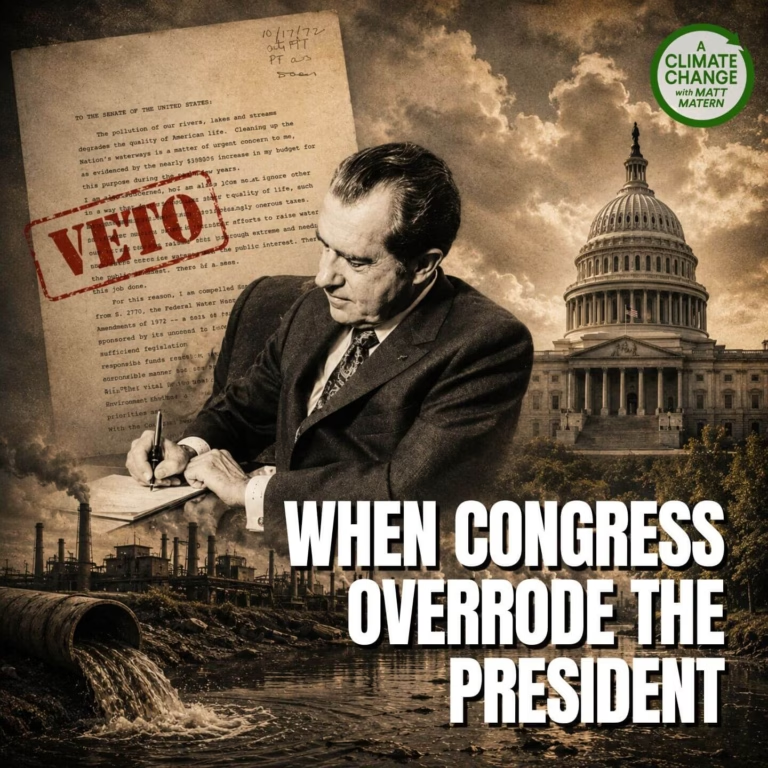
Lake Erie was now being called dead, a dead lake, raw sewage in the water people fished in. So Congress writes a sweeping law to fix it, forces polluters to stop the dumping sets real standards, puts federal muscle behind the clean water for the first time ever, and just like that, the Clean Air Act sails through, the Senate passes it 74 to nothing, the House 366 to 11, overwhelmingly bipartisan deal done, except it lands on Nixon’s desk, October 1972 and a Nixon box. The price tag is big, $24 billion and for Nixon, who’s running for re-election as a fiscal conservative, decides this is where he draws the line. So, on October 17, 1972 he vetoes it, he sends it back to Congress, and this is the part that gets me.
He basically dares them in his veto message. He says out loud that he’s counting on at least a third of the chamber to be responsible enough to back him up and sustain that veto. He’s telling Congress to their faces, I bet you don’t have the votes to override me. Now, picture that night in the Senate, it’s late.
The President of United States, the leader of the Republican Party, has just thrown down a challenge. The safe, smart, loyal move for every Republican in that room is to fall in line behind their President. Well, they don’t2. hours, two hours after the veto, the Senate overrides it, 52 to 12, and out of those 52 votes to overrule the Republican president, 17 of them are Republicans. The next day, the House does the same thing, 247 to 2396 House Republicans crossed their own president to do it. Added up more than 100 Republican members of Congress looked at their own party’s leader and said, not on this, not on clean water.
The Clean Water Act became law on October 18, 1972 over the veto of a president who usually gets the credit for it. I want to sit in this for a second, because it’s so far from where we are now. It almost sounds made up. The president drew a partisan line, and his party, his own party, refused to follow him, not because they were rebels, but because clean water wasn’t a partisan thing, it was just the right thing, so the obvious question is, How on earth did we get from there to here?
First, I want to convince you that 1972 wasn’t a fluke, some one-time accident of timing, because the street kept going. One year later, in 1973 the Endangered Species act that law saved the bald eagle, literally our national symbol, which had been hunted and poisoned down to a few 100 breeding pairs. That law now passed the Senate 92 to nothing, and the House 355 to four. And Nixon signed it just after Christmas 1973 And remember Pete McCluskey, the Republican Earth Day co-chair, he helped write it.
So this is a pattern: Clean Air Act, clean water, endangered species, all in about four years, all with enormous support from both parties. The question is, why? Why was this the one thing Washington could all agree on a few reasons. One, the problem was undeniable. You could see it. The river was on fire. The smog was choking cities. You didn’t need a scientist to tell you the air was bad. You could taste it. Two, it hit everybody. Pollution doesn’t check your voter registration. Republican kids and Democrat kids were breathing the same poison air, and three. This is the one we’ve lost. Conservation has deep roots in both parties.
The president, who put more than 200 million acres of this country under protection and created five national parks, was a Republican, Teddy Roosevelt. For a century, protecting the land was something the right and the left could both proudly claim. So, in 1970 environmental protection wasn’t a side, it was a shared inheritance, something Americans of every political stripe could look and say, yeah, obviously we shouldn’t poison our own children. That was the consensus. That was normal. And then it wasn’t.
So, what changed? The short version, over the following decades, environmental protection slowly got pulled into one side of the field, fights over regulation and costs.
The rise of newer issues like climate change that got coded as partisan industries with a lot of money on the line, and a politics that increasingly sorted every single issue into my team or your team. I’m not here to hand you a villain. The honest answer is, it was a slow drift with a lot of hands on it over a long period of time, but the result is stark. A cause that united 20 million Americans in 1970 is now one of the most divided issues in the country. And here’s why. This isn’t just a history lesson. Those exact laws, the ones born from that bipartisan moment are being fought over right now.
The EPA authority, the reach of Clean Air Act, which waters the Clean Water Act actually protects, whether the government can even regulate the pollution driving climate change, all of it is live in the courts and in the agencies as we speak, but I don’t want to leave you in doom, because the whole point of this story is the opposite of doom. 20 million ordinary people, students, parents, nurses, mechanics, nobody famous showed up on a single day, and they bent the entire federal government to their will in two years.
They didn’t have social media, they didn’t even have a president who agreed with them, he was having them watched, they just refused to be ignored, and there were too many of them from too many places to wave away, that’s the inheritance, not just the laws, the playbook. So, do something today. Here’s what this looks like. First, refuse the frame. The next time someone tells you clean air or clean water belongs in one political team, you now know that’s not history, that’s amnesia.
These were all our laws. Second, it’s 2026 America’s 250th year, and the most American thing in this entire story is people showing up and being heard. So, show up, vote on it, call the office of whoever represents you, and tell them clean air and clean water are not negotiable. And third, maybe the hardest one, have the conversation across the aisle, find the person who disagrees with you on everything, and start with the one thing 374 to one of us agreed on.
Nobody on any side wants to poison our own kids, that’s the common ground. It’s still there, it’s just buried. 20 million people found it. Once we can find it again.
That’s the story of the first Earth Day in the bipartisan era that kicked it off, part of our 250 for 250 series, counting down to America’s 250th birthday and our 200 and 50th episode. And if this one moved, you’d do me a favor, send it to somebody you never normally talk about these things with. That’s the whole idea. Spread the ideas far and wide. I’m Matt Matern. Subscribe on Apple, Spotify, or wherever you get your podcasts, and we’ll see you next time. Do something today.
(Note: this is an automatic transcription and may have errors in formatting and grammar.)