
Hear us on Apple Podcasts, iHeart, and Spotify Podcasts. Subscribe now!
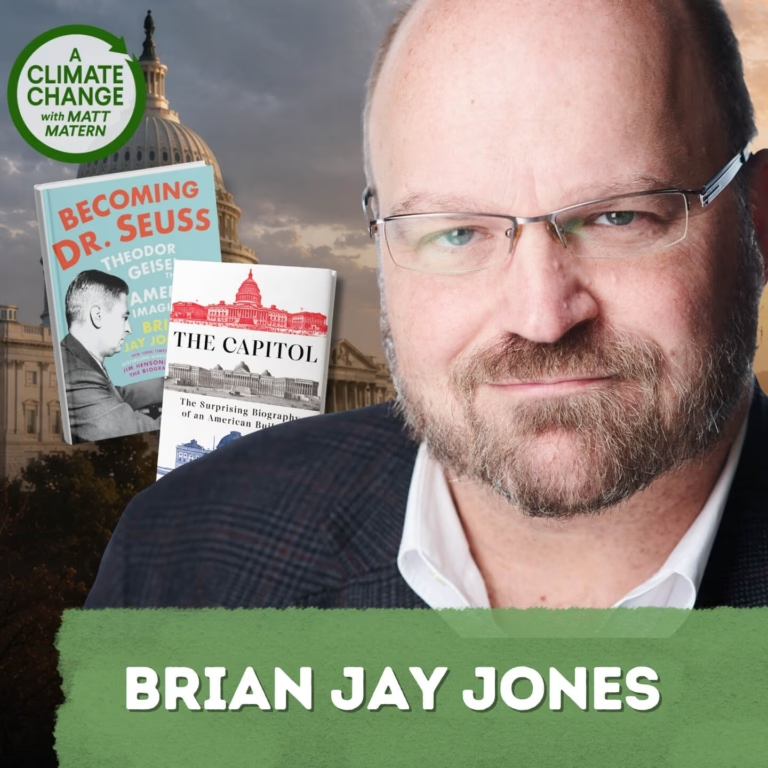
Matt speaks with New York Times bestselling biographer Brian Jay Jones, author of Becoming Dr. Seuss and the new book The Capitol: The Surprising Biography of an American Building. Brian traces Theodor Geisel’s unlikely path – from advertising man to the most beloved children’s author in America. They dig into the making of The Lorax: the cookie-cutter condos eating up La Jolla’s coastline that made Seuss furious, the nine months of writer’s block, and the Kenya trip where he drafted the whole story in 90 minutes on the back of a notepad. Brian also shares the story behind his new biography of the U.S. Capitol, and how he was inspired to write it after January 6, 2021.
This episode is part of our “250 for 250” series, marking America’s 250th anniversary by revisiting the figures and stories in our history when ordinary people changed everything – from Dr. Seuss and the little orange creature who speaks for the trees, to the enslaved craftsman who cast the Statue of Freedom atop the Capitol.
But he did come out and say, “Look, I live in a house that’s made from wood, and I write books that are printed on paper. I’m not saying never cut down a tree, but darn it, use your resources responsibly. And there was a development going on, as he called it cookie-cutter condos, where every building sort of looked the same, and just encroaching on his hillside. And he said, “Everything God took years to put there, they are tearing down in a week and a half. That was sort of what inspired him. His own personal response was to watching progress encroach on what had been his pristine bit of nature there in San Diego.
You’re listening to A Climate Change. This is Matt Matern, your host. I’ve got a great guest coming on the program today, Brian J. Jones. Brian’s background is a biographer and historian, author of Becoming Dr. Seuss, Theodor Geisel and the Making of an American Imagination, and a new book, The Capital: The Surprising Biography of an American Building. So, welcome to the show, Brian.
Hi, thanks for having me. This is great.
So, tell us a little bit, you know, we were kind of doing a little theme on the Lorax, because you know, he’s an environmental hero out there, and, and you’ve studied, you know, Dr. Seuss. So, tell us a little bit about your study, and, and what, what brought you to Theodore Geisel, aka Dr. Seuss?
Sure, so I have joked that between Jim Henson, Dr. Seuss, and George Lucas, I pretty much own everyone’s childhood now. If you were born anywhere in the 20th century, I’ve got you. You know, Seuss was.. I wrote about Jim Henson first, and Jim worked very closely with George Lucas on Labyrinth, and so I moved into Lucas because of that. I had a photo of the two of them together, and I thought, “Oh God, that’d be a neat subject to do next. Went back to writing Jim Hens, but when I got done, I went to Lucas. Finished up with Lucas, and I was just having a conversation with my agent and my editor about what’s kind of the next good fit? What’s the, what’s the trifecta?
People wanted me to do David Bowie because of the labyrinth trifecta, but, but what’s the trifecta, and sort of the American imagination of creative geniuses, and Seuss was, was the one we had, we had really talked about, and the one that really excited me. We talked about one of the reasons Seuss really excited me was because I was not really a Dr. Seuss kid, I was a Muppet kid, I was a Star Wars kid, but I didn’t learn how to read reading Dr. Seuss, Dr. Seuss to me was the dentist office book, you know, I learned how to read, you know, my mother handed us Mad magazine reprints and Penis reprints, and that was kind of whether appropriate or not, that was how I learned to read.
So Seuss was one of these characters I didn’t know a lot about, and when I started writing about him, I could have named his greatest hits, I could have maybe pulled six to eight, I don’t think I could have even named 10 books and didn’t realize he’d written, you know, more than 60, so it was a real, it was a really fun book for me to write, because I was learning about him as I wrote it, if that makes sense, where you know, but the earlier subject could have given you sort of posts, I could have told you what sort of the greatest hits were, as I went along, and sort of known that narrative is familiar somewhat with the baseline. Seuss, I didn’t really know anything, so he was a really, really fun subject to write about and to learn about, and how important he is to children’s literature, and to, and then to, you know, literature in general.
Yeah, he has a fascinating story. Tell us a little bit about, you know, his backstory. He was a cartoonist, right? And then kind of dipped his toe into children’s books.
Yeah, he had his first career was, he was a really successful, he actually made a living, you know, submitting cartoons of, you know, The New Yorker and things like that, in the tame, in an era when you could make a living doing that, but they’d done a lot of cartoons, wrote, you know, cartoons for humor magazines, and then moved into advertising almost by accident. He had, he was, you created an ad campaign called Quick Henry the Flit for Bug Killer.
Back in the day, that became, you know, where’s the beef of its time, this gigantic ad campaign that everybody knew what it was, and got into advertising, was advertising for a long time, and was making a lot of money, but got into children’s books, not because at that time he felt a compelling need to tell stories for children, or that children deserve their own books, that all sort of came later, that’s how he becomes Dr. Seuss, but kind of because there was money on the table, you know, he had an exec, an exclusive contract with the firm he was doing the ad work for, that prohibited him from doing a lot of outside work, but one of the things he could do was children’s books.
And so he writes into Think That I Son of Mulberry Street, almost just because he can, but then turns out to be really good at it, but can’t make a living at it for a long time, Seuss’s books come out intermittently, for you know, maybe the first 20 years of him doing them, until he strikes, gets really lightning in a bottle when he releases Cat in the Hat and the Grinch in the same year. I mean, before that, he was still kind of an ad man, doing children’s books on the side, but though Cat in the Hat is actually the game changer for him, and the reason is. Because it’s a book with a pedagogy behind it. Cat in the hat is written using an educator-approved reading list.
And because of that, that book could be used in the classroom, and it became a reading primer for parents. Liked it because it was a fun book to read. Kids loved reading it, and teachers signed off on it, because it had an educator-approved reading list. And Seuss then created a reading imprint, beginner books that used that reading list, so that was what made his book so important, was not only were they really fun to read, again parents signed off on them, teachers loved them, kids adored them, but they had that pedagogy behind them, that was something I did not know when I took that subject on, was why that was so important, so that’s the real game changer for him, and for reading for children in general.
Kind of explain how it is that he got this stamp of approval by educators for, you know, the cat in the hat versus not getting it for maybe prior books. What changed?
So, in the mid 50s, I think it’s Time or Life magazine has a big article doing what we sort of do as adults, maybe every 20 years, we wring our hands and wonder why kids aren’t reading, and you know whether we want to blame video games or or movies or comic books, as they did at one point in the 40s, in the 50s they decided that one of the reasons kids didn’t read, and this is probably fair, is because children’s books, especially reading primers, were terrible.
It was Dick and Jane leading these lives of quiet desperation, and no kid wants to read that book. And you know, and it’s a lot of pointless repetition to try to drive words into kids’ vocabulary, and the writer of the book, the writer of the article, John Hersey, who wrote Hiroshima, he said, you know, it would really be great if they could get somebody like Dr. Seuss or Walt Disney or somebody to like write and draw a kid’s book, kids would love that, and it just happened that somebody who knew Dr. Seuss took that article to him and said, would you like to do a kid’s book, and Sue said, okay, but the catch was he had to use that educator-approved reading list.
So it took Seuss a long time to come up with it, but he essentially was asked by publishers or children’s books, you know, somebody thinks it would be a great idea if you would write a kid’s book, you should write a kid’s book, and Sue, for about 10 years prior to that, he had done a really important class he taught at the University of Utah on writing children’s books, where he basically says sort of the same thing that the Time magazine article said, which is children’s literature is terrible, but what Seuss was trying to drive into these aspiring writers at that time was, you know, don’t talk down to a kid, it wasn’t so much about the vocabulary, it was, you know, your primary competition is the comic book.
Kids like fast-paced, they like things to be fun, they don’t need to be lectured to. Stop trying to make them adults, you know, their children. We’re not trying to breed, we’re trying to make, you know, very proper young men and women let them be kids. So, Seuss has this sort of epiphany, even in the late 40s, about the importance of kids’ books, and when you finally couple it with that, that marching order to do one that has an educator-approved list, that’s when it sort of all clicks for Seuss at that point.
So, what, what were his books before the grant? I mean, before the Grinch, and before the Cat in the Hat, that you know, maybe we might know of now, but weren’t kind of educator-approved.
Sure, so all I mean, you know, probably almost every book that he wrote before Cat in the Hat. It’s sort of a greatest hits. It’s then to think that I saw it on Mulberry Street. It’s Horton Hatches the Egg. It’s Horton Hears a Who, you know. It’s, I think, Scrambled Egg Super is in there, and Happy Birthday to me. And it’s just, you know, it’s a lot of books, you know, and they’re great. They’re great Dr. Seuss books, even after I need to make clear, even after he starts doing the educator-approved word list, he still does books he calls the big books that aren’t beholden to that word list.
The Grinch is one of those, for example, the Grinch does not use the educator-approved word list, happens to come out the same year, but that’s what Seuss would later call the big books, because they were actually published in a larger size than my Cat in the Hat was, so you probably know everything that he wrote prior to the Cat in the Hat, but once Cat in the Hat catches fire, his entire back catalog just explodes. At that point, that’s when he can finally start doing it full time. He was still, you know, it’s hard to believe, but even at age 53 he was still doing ad work. He couldn’t write children’s books full time.
Yeah, it’s fascinating that he had such a long run up to a catching fire, and then catching fire for kind of an odd reason that you know all of a sudden he uses some different words that are educator approved, and then wallah all the doors open, and yeah.
And you know, and he called it a literary, or compared it to a literary straight jacket, and if you see his word list, and he would, when he would get his aspiring authors, like, you know, like the Berenstains, who did the Berenstain Bears, and a lot of their books were using those educator-proof lists, but it would say things like, you know, you can’t make it a plural unless you’re just adding an s, if it has to be an es, you can’t make it a plural, you can’t use a contraction, you know, you can’t add “ing” to make a word of verb, or an ad, you know, it’s like there were a lot of really restrictive conditions put down on that, and Seuss talked about when he was first, you know, challenged with this, it took him a long time because he couldn’t.
He couldn’t come up with a subject and the verb that would work, and you know, with Seuss, a lot of things are kind of apocryphal, but he does tell the story about how he was, he’d been staring at the list for a year, and finally said, “I’m just gonna look down this reading list, and the first two words I see that rhyme, I’m gonna go with it. And says that cat and hat were the first two rhyming words you saw on the list, and that’s when it started to fall together. He said initially he wanted to write about, you know, a queen zebra, neither of those words is on the list, and he wanted to talk about climbing a mountain, and mountains not on the list, so you know it was really, it was a very restrictive, you know, funnel that he was trying to pour himself down.
Well, it’s kind of like, you know, haiku or the sonnets that Shakespeare wrote. There’s a straight jacket of, you know, format.
Yeah, yeah, and you know, and Seuss was, was notoriously a perfectionist, and I think that’s one of the reasons his books are so good, because he worked really hard. I think I think Seuss would sort of be beside himself nowadays, you know, with celebrities writing children’s books and trying to make it look so easy, and just one of those things that people crank out, because he worked really hard on his and thought they were really important and really needed to be, you know, really digested, and he would even, when his books, when he would have them in rough form, and he would have the words on the page, he would pin them to a cork board in his office, and stand back and look at them, and make sure that he even looked good on the page.
If there was one line, for example, even if the rhyme scanned perfectly, if it was just way longer than any other line on the page, it was going to go out because he didn’t even like the way it looked on the page, so he had these really high standards for himself on not just the way that the rhyme sounded, but the way it looked, and that’s one of the things about Seuss with rhyme, is you never have to pronounce a word funny to make it fit the rhyme scheme, and I noticed that a little bit when, as I was reading the Lorax last night, again, there’s places in there where he’s got, he’s got a real mouthful in some places in there, but the rhyme scheme still works. You don’t ever have to say, if I would pause in the right before I hit that word, it would work, right? Seuss was really particular about that.
Well, you know, an amazing writer, and I guess that’s why his work stands the test of time and has been made in the movies, and we’re still talking about it, you know, years after he’s passed, and decades, decades after, and it was just graduation season, which meant that all of the places you’ll go hit the top of the bestseller list again, you know, 40 years after his death. So..
Yeah, it’s amazing. So, tell us a little bit about the long road to the Lorax, and who was Geisel before 1971.
So the Lorax is first of all, it’s one of the big books, so it’s not adhering to a word list, but, but this one comes out, you know, 15 years after Cat in the Hat is hit, so Seuss is now really Dr. Seuss, he’s like the most beloved and well-respected children’s writer there is, the writer they all kind of look to your every year, you’re looking for the new Seuss book to come out, and Seuss himself acknowledges that The Lorax is a book that was written in anger, that it was one of the, as he said, it was one of the few things I ever set out to do that was straight propaganda, then it’s a direct quote of his.
There were books Seuss had done before that people saw as message books, whether they were deliberate or not. Some people said Seuss was never, was never messagey. That’s why his work resonates, because he was never preachy. That is not true. Something like Yertle the Turtle, for example, was deliberately a message. Yertle the turtle is Adolf Hitler, that is, that is Seuss doing Hitler, because it’s the turtle climbing to the top on the backs of the people, and finally gets toppled when the turtle on the bottom burps, and using the word burp in that book was actually very controversial, but tumbles Yertle into the mud. That was Seuss deliberately doing a parable about Hitler, a book like The Sneetches.
I don’t see how anybody could argue that the Sneetches with the star-bellied sneeches, and you know, judging people based on whether you have a star on your stomach, and how many stars, that’s a deliberate message in that book about racism and differences. So, and even something like The Grinch, Seuss made a lot of money and had a first career as an advertising man, and in the Grinch, he’s telling you that Christmas doesn’t come from a store, and Sue spent a lot of his career telling you Christmas could possibly come from a store, having done advertising work, so that’s Sue’s sort of, sort of, sort of wrestling with the issue of consumerism in the Grinch, even something that he, as a personally, had had to wrestle with.
So there’s always been messages in Seuss, but this is one that he actually saw later was him deliberately writing straight propaganda, and it came about because he was standing in his home studio, which is at the very top of a mountain in San Diego, looking down at the ocean, really beautiful, and and there was a development going on at the base of it that was just as he called a cookie cutter condos going in, where every building sort of looked the same, and just in. Encroaching on his hillside, and he said everything God took years to put there, they are tearing down in a week and a half. So that was sort of what inspired him, what his own personal response was to watching progress encroach on what had been his pristine bit of nature there in San Diego.
Yeah, I mean, it’s if anybody’s been down there, La Jolla is an incredibly beautiful place, and I’m sure 5060 years ago it was even more beautiful before they developed it as much as they have, but so then he decides to write the Lorax and tell us a little bit about that journey and how it, how it took off.
Yeah, so so the idea for this comes along again at sort of the perfect time. I mean, it’s around 1969 1970 He’s thinking about this, which is at that time you’ve got an oil well off the coast of Santa Barbara blows out and kills dolphins and sea lions in the area, and it’s all over the newspapers. And 1970s when you get Earth Day, and Seuss is sort of reading about this in the paper as well, so he thought it was probably time to say something about the environment, and this is a pretty good, pretty good environment to release a book like that into, but he kept saying, getting back to sort of the earlier conversation we just had, that he didn’t want it to turn into what he called a preachment, he didn’t want to write an overly preachy book, he said the ecology books that I had read were very dull, and I couldn’t get started on the Lorax.
He said it took him about nine months to even get started on it, and again, it’s part of the part of it is just Seuss. Seuss had this really incredible work ethic. He would always sit down at his desk in his office every single morning at the same time and try to work eight hours a day at the desk and leave at 5o’clock for happy hour, whether anything happened or not. It was a really good work ethic, and there was a lot of days with the Lorax that nothing would happen. He had a really bad case of writer’s block with it, so he finally went on safari with his wife.
He went to Kenya in 1970 and and his idea of safari was mostly hanging out at the hotel, and at the pool, but he, he talked about how he had been still trying to figure out what his plot was, what is the storyline, he doesn’t even have a name for it, really, yet, and he says, I hadn’t really thought of the Lorax for weeks, and then when he was in Kenya, something about watching elephants walking across a hill together opened him up. He says, “To this day, I don’t know why that released me, but he said that was something about that spark, and all of a sudden he started scribbling down the storyline, at least of the Lorax.
A lot of notes on a small notepad, and that gave him the basics for the story was about, you know, it was signs of a laundry, it was a laundry pad, which is about, you know, about this big, it’s not eight and a half by 11, it’s a little, a little tiny notepad, but something about watching those elephants really knocked that open, and he said, I looked at elephants ever since, but it’s never happened again, but that was enough that when he got back to La Jolla, he could finally get it started.
And one of the first things he had to do was figure out what his main character looked like, and this is one of the really fun things about Seuss, because you know it’s really hard when people try to write like Seuss, or if people try to write a poem like Jabberwocky by Lewis Carroll, we end up making these very convoluted, odd words, and it doesn’t like the thing about Jabberwock is, it reads so naturally, even though most of these words are made up, and Seuss makes up a word like Grinch, and of course, that’s of course, that’s a Grinch, I mean, it makes there’s something about it, makes perfect sense.
And with the Lorax, he said, you know, you initially started off drawing him to look like a gopher, and then he made him made him look like a robot, and then he would change his colors, and then he made him big, and then he made him small, and then he said, finally he got to this little orange figure with sort of a brush mustache, and said, I looked at him, and he looked like a Lorax, and that’s it. I mean, there’s that’s the magic behind Seuss. There’s no magic, it was just the hard work, but immediately he says, he looks like a Lorax. Where did the name come from? He doesn’t know, it just looked like a Lorax to him.
It is pretty incredible, the genius there, but of course, a lot of hard work goes into that. You know, I had heard of kind of a backstory that the Lorax sits at the LBJ Library rather than at the Seuss library.
Yes.
Which is kind of fascinating that a book sits, a book like that sits in the Presidential library.
Well, the reason behind that is that you know when, when the book came out, it was a Seuss was a little nervous about it, because again it was messaging and it did get him in trouble in some logging communities across the nation, but the President, former President Johnson, was a big fan of it, and because he thought it aligned with a lot of things he and he and Lady Bird had done when he was president, like the Highway Beautification Project, and things like that, that he had done.
He just said, “You know, this really resonates with kind of what we were trying to do. Would you consider giving us the original manuscript? And so Seuss gives him the manuscript, so it’s when, and he went there for opening day of the LBJ Library, and Johnson says later, “He’s like, you do know you were the most. Famous person there, but that’s why that book is, that’s why that particular Seuss manuscript is in the LBJ library.
It’s a fascinating story, you know. You wonder, is there.. you know, you talk about trying to copy Seuss, and obviously there must have been hundreds, if not more, of people, authors who would have loved to, you know, copy his genre because he, he’s so, so well loved. Has anybody come even close to kind of hitting that, that bar?
Somebody who writes and draws at the same time, is there’s not a lot like that. There’s a really charming series of kids’ books that, like the novelist Brad Meltzer writes, that then the artist Chris Elianopolis, I believe that I’m saying that correct, illustrates, and they are absolutely charming, and they’re like, you know, I am Teddy Roosevelt, and I am, you know, Harriet Tubman, they’re really adorable books, that one’s close, but as far as somebody who’s like the full threat, like the right, the writer and the artist, I, I can’t think of one off the top of my head.
Well, it almost, you know, that creates a certain genius of the connection, like there’s no difference between writer and draw, like, like you said, he created the character, he has it both as the writer and as the illustrator, and so it’s, it’s one this.
Yeah, there’s no need to try to distill your message for someone else’s imagination. I mean, you, you do get in, you know, in the history of comic books, you get great partnerships, you know, you get, you know, you get Simon and Kirby, and you know Simon Siegel and Schuster, and you get really great partnerships, but you know, you, you get a, you get a few every once while, like Frank Miller’s, for example, who write and draw. There’s no need to translate what’s in your head to somebody else, you know.
If you read, you read these really great scripts by Alan Moore, who’s a favorite writer of mine, and they’re phone books of scripts with him describing every single panel, and these artists, people like Dave Gibbons, grab a hold of that, and have a lot of fun translating it, but you know, there’s still, there’s still, there’s still a distillation, there’s still a translation between what Moore’s got in his head, even as detailed as it is on the page, and what somebody like Gibbons is going to put on the page, so there is, there is something to be said for being the writer artist behind whether it’s comics or children’s books or something, like, you don’t, you don’t have to run it through any kind of filter to get what’s in your head down on the page.
What about from an environmental standpoint, are there a lot of great environmental kids books out there, and anything close to kind of Lorax quality? You know, I air, but you know,
I can’t answer that, actually, because I’m not sure. I’m not as well versed in, especially new kids’ books, as I, as I am about Seuss. You know, at the time, there wasn’t anything like the Lorax, and I would think even today there’s not anything as iconic as the Lorax. You might be having people writing books that do a similar take on a similar message and do it very well, but you’re going to have very few. You may have some, you’re going to have very few that rise to the top to the point where you and I can say Lorax, and people know somehow what that is, or they’ve heard of it. It’s one of those words that sort of entered their vernacular. People know a Lorax like they know a Grinch.
Yeah. Well, I mean, in part he had the field, it was a little bit more of a wide open field at point in time, so not to diss any of our current writers who are writing into a field that’s probably exploded in terms of volume as compared to where it was in, in the 40s, 50s, and early 70s, right. So, why don’t we switch gears to your new book, The Capital, came out june 2 from Dutton. Tell us about about the book and what brought you to it.
So, I have made my career as a biographer, writing about iconic American figures, and I think this is probably the most iconic American figure that I’ve written about, and I’ve called it a biography, a surprising biography of a building, because it is, in a way, a living thing. It has grown and evolved with us as a country. It continues to represent us and represent who we are and what we aspire to be to this day. So it was one of those books that even though I had to go back and read documents that were 200 years old, it’s still alive, you know. There’s there’s not a lot of people who, you know, somebody passes and you’ve got just a just a finite amount of information to deal with.
This one is the story continues. So I actually was inspired to write it by january 6, because I am a former staffer from the United States Senate. I worked there about 10 years, and seeing what happened on january 6 in real time, especially as people were on the floor of the Senate, really hit me hard and really made. He’s angry, you know. When I worked for a senator, we would – the senator’s executive assistant, for example – would say we’d still be in the office on, you know, a Wednesday night at 7o’clock and she would come in and say, “Senator, he lived three blocks from the from the Capitol.
So she’d say, “Senator is going to walk home, they’re over on the floor right now, but he’s going to walk home when they’re done with this bill. Can somebody take him his briefcase and his coat, and we would fall over ourselves to be the person that got to walk over to that building, go in, take the elevator up, go into the cloak room, and walk onto the floor, and hand our boss his suitcase and his jacket, and then walk off the floor. That was it. Just going onto that floor was special. There’s a region they call it floor privileges. To get on the floor, it’s not a right. Even as a staffer, you have to have floor privileges beyond there. There’s just something really special about that.
I’ve never forgot that it’s always mattered to me. And that building, again, I lived six blocks from that building the whole time I lived and worked there, and it was pre 911 It was a little bit of a different time with your congressional ID. It was your, your, your key to anywhere you could walk, any almost anywhere in that building. So I used to spend a lot of time just walking through that building and exploring that building and trying to imagine what it was like in the old Senate chamber when Daniel Webster was there, and things like that. So it was a really, really important building to me. And after january 6, it was one of those things I kind of, what this is, this was my way of trying to give back to the building after what had happened there.
Well, it’s kind of interesting that you, you know, you know, tag the book to January 6, because the first episode of our podcast was on, was recorded on january 6, so…
Wow, was it really?
Yeah, so I, I was driving into the radio station at the time we were doing the show on the radio, and I see, I hear all this stuff going on, I just turned on the radio and heard this, and it’s like, holy crap, and as fate would have it, I was interviewing Paul Manafort’s writing at Van Rick Gates, who pled guilty to some, some crimes. So I was interviewing about his book, and so it kind of goes full circle, as to, you know, we’re close to our 250th episode, and and the beginning of it was on january 6, so…
For the 250th anniversary, even.
Yes, for the 200 yeah, 150th on the 250th So right, so I have a connection there. What are some of the inspiring stories that you know, kind of give us a little teaser, as the book.
Sure, I mean, what I love about that building is, is how much it reflects who we are, in the sense that, sort of like the American experiment, the building itself is the result of imagination, compromise, violence, hard work, enslaved people, ingenuity, finding the best materials, symbolism. It’s all sort of wrapped up in the capital, you know. There’s what.. there’s a reason. For example, I love the fact that there was a deliberate effort to make sure, as they continued to build and add on the building, that it was built out of durable materials that they would stop making things out of wood because they understood that the building needed to last because symbolically the nation needed to last with the capital as the reflection of that should be a really permanent structure.
So I love the thought that goes into that and I love the fact that when we were when George Washington was initially after they chose the site for the Capitol, and when they want to design the Capitol building, they actually open it up to the public. Now, this is not unheard of. Ancient Rome used to do this, and ancient Greece used to do this. They would have public competitions for public buildings, but this is the United States in 1790 There’s not a lot of people here yet, including really not that many professional architects, and they say we were designing the nation’s capital. Submit your plans, and people you know who can’t draw are sending in just these charming drawings of what they think the US Capitol should look like.
You’ve got one drawing where it’s got a giant, maybe it’s a sculpture, maybe it’s a weather vane, whatever it is, it’s a gigantic bird that’s almost as big as the building beneath it, and people’s exteriors don’t fit their interiors, but you know there’s something so, so charming and something so inspiring about the fact that Washington was saying, you know, Americans design your American iconography, this building that belongs to you, tell us what you think it should look like, and what finally happens is Washington himself starts going through some of these designs, and early on says, “Man, do I want a dome? Man, do I like these dome designs.””
And once people sort of knew that Washington liked that dome design, more and more designs start coming with domes on, including the winning design by a non-architect, a physician named William Fort Matern, who draws this really beautiful sort of low building with a sort of a push button dome on top of it, but, but Washington loves it, because it’s the other contender was had a higher dome, but the building was a little more European looking, they called it, they sort of called it the fancy piece behind the back of the architect who submitted it, and Thornton’s design went up because it’s sort of simple, it’s I overuse the word elegant. I’m listening to my own book on tape right now, which is a little ghost, but man, is the word elegant in there a lot. But that really is the best word to use a lot of times.
It’s very elegant, very simple American design, and it prevails. And that’s the design that still defines the look of the Capitol. In fact, that design is still part of the Capitol. It’s like that very central portion is still part of it, and the wings that were the house and the senate are still there today, pieces of them, but that was the general footprint that we still follow, central section with the rotunda and the dome in the middle, house and senate on either side.
As the building expanded through the years, they sort of held to that basic template, but I love that, you know, even in 1790 we turned to the American people, and said, define your iconography. There’s something really wonderful in that. Well, Washington was such an incredible leader. It’s, you know, kind of hard to replicate somebody as profoundly, you know, gifted in that domain. Yeah, you know, when you say elegance, I think of Lincoln’s use of language, and how elegant it is. It’s like it doesn’t require as many words. He says it so beautifully, so simply. Yeah, that you can’t imagine that anyone could have said it any other way, and yet no one else ever did.
And in Lincoln Stein, in fact, that’s when the Capitol was under expansion again, to sort of look like it does today, but again, even at that time, this is Americans ad libbing, and we’re approaching the Civil War during this time, so we’ve, we’ve got a lot of strife going on inside the building. It serves as a military hospital at one point, they’re baking bread in the basement of it, I mean, it’s a multi-use building until finally somebody says we really need to be the, you know, there’s, there’s, there’s pigs running through the halls of the Capitol building. Here we need to really clear this out, but at that time they were expanding and adding the wings where the House and the Senate were on it.
And the architect at that time, a guy named Thomas Walter, nobody had asked him to, but he, as he was putting together his drawings for the new wings, he thought that dome that’s on the center of this right now looks way too small for this building, so without anyone asking to, on this piece of paper about seven feet long, he draws this beautiful drawing of the Capitol with its new extensions with a very tall dome on it that looks a lot like what’s on there today, and had it just hanging in his office in the Capitol, and members of commerce would walk by and sort of do a double take and would say can we have that and they said sure absolutely you can have that.
How much does it cost? A million dollars. How long will it take a year? None of that was right. It took a long time. It was much more expensive than that, but it was just it was an ad lib when anything else. It was someone, it was Walter saying, wouldn’t this look great like this, and Congress saying absolutely, that would look great. Nobody asked for it, and yet it is the iconic part that silhouette. You see it on anything, it defines the look of Washington DC. I mean, everybody knows that that silhouette, it was just, it was just a matter of happy accident, almost a great American story.
So you focus on restoring the stories of enslaved people who built the Capitol, most prominently Philip Breed, who cast the Statue of Freedom. Why did that have to be at the center?
Because it’s at the center of who we are, actually, as a country, and it’s a really hard conversation for us to have, and you know, you see so many of these monuments, and we imagine and know all the great things that happen in them, but don’t always understand or appreciate who it was that built them, and there were pretty good records kept of who was who was working at the Capitol for about the first 40 years or 30 or 40 years that they’re working on it.
So they know that there were over 300 almost 400 enslaved people who are working on it in the early days, and that continued on into into the 1850s until in 1860 until Lincoln finally emancipated and started off even emancipating in the district, but the story of Philip Reed is he was an enslaved craftsman in Maryland and DC, working at the foundry, Mills foundry, just outside of Washington, and he, he was, he was so talented that he had actually helped cast the big statue of Andrew Jackson, the one that you can see down in Jackson Square in New Orleans, is based off of it, and when they, he did not sculpt the sketch, the statue of freedom, that’s on top of the Capitol.
That was done by a gentleman named Thomas Crawford, who was an American and working in Europe, working in Rome, and when he had sculpted this in plaster, he sent it to the United States in five pieces that would then be assembled and like sort of screwed together, and when they got to the United States, another. Craftsmen screwed it together and said, this is the way it will look, and they said, okay, great, take it apart, so we can ship it out to Maryland and cast it in bronze, and the guy said, well, you need to pay me now to take that apart, and at that time, the American government was not inclined to pay him to do that, so Philip Reed, who was going to be working at the foundry where they would cast this, came in and said, you know, she’s got a, she’s got a screw in her helmet. Why don’t we just hang her from that and let the statues wait, start to reveal where the seams are, and just again a solution hidden in plain sight. But he’s the one that thought of that, and they said that’s great.
So then Reed was able to take it apart and bring it to the foundry, and then Reed was the one tasked with casting it in bronze, and working on it day in, day out, and it’s, I mean, it’s, it’s really tough, detailed craftsmanship, and tough work, and he’s the one that, that once he had a cast, put it back together, had it shipped up to the Capitol, and by the time they put it up on the top of the dome in 1863 he was a free man, and you know, continued to live and work in Washington, D.C. and raise a family on his own in DC, but just, you know, the, just, the, there’s something very moving in the fact that the building itself, that sort of embodies American democracy, and the statue on top, that is the personification of liberty and freedom, are put together by those who had none of that.
Yeah, that’s an incredible piece of our story. And thank you for telling it. It’s something that we need to be reminded of, because sometimes it seems as though that kind of stuff gets brushed under the rug, and the current administration is seems to be doing a job of trying to brush, you know, that erase, yeah, yeah, erase part of the American story that you know, saying like, oh, slavery, it wasn’t that bad, type of…
Right, and you know, and a lot of enslaved individuals were were in charge of coring the marble that was then shipped down river to be to be to be used in the construction of, you know, columns and walls in the Capitol, and at the Capitol Visitor Center, there’s actually still a piece of that quarried stone on display that still has chisel marks in it that would have been put in there by the enslaved craftsmen out there, and likely out in Montgomery County, Maryland.
Well, everybody should go out and check out your new book, and, and some of your other books that have been published along a while ago, Becoming Dr. Seuss, Theodor Geisel, Making of the American Imagination, and George Lucas, A Life, Jim Henson, The Biography, Washington Irving, an American original, and you know it’s a lot of great work that you’ve done out there. Just to kind of wrap it up, if a parent or teacher in the audience has read the Lorax to a kid 100 times, what’s something they probably don’t know about the book that would make the 100 and first reading a little different?
I think part of the is to understand Seuss’s own point of view on that. Seuss was an incredibly, he was incredibly progressive, especially for the 50s and 60s when he was coming out, and you know, the book is seen as an anti-logging book, and it gets banned in logging communities to this day, still. And Seuss himself was very careful to say, “Make sure you’re reading this closely, because I don’t say we should not be logging, that we should not be cutting down trees.
What I am saying is we need to use our resources wisely, because that’s the real tragedy behind it, and he points out that, as you know, one of the things Seuss does really well in there is points out that the entire ecosystem is related, you know, if you don’t have the trees, you don’t have the barbalute bears, because the fruit’s gone, and then when the water’s polluted, the fish have to leave, and when the skies are smoggy, the birds have to leave, like he’s he’s really stressing the importance of an ecosystem, but he did come out and say, look, I live in a house that’s made from wood, and I write books that are printed on paper. I’m not saying never cut down a tree, but darn it, use your resources responsibly. I think that comes through in the book for sure, but you know it’s one of those.. I think Seuss would be very careful to just say, you know, under understand that this is about using using the Garden of Eden. We’ve been given very wisely.
That’s a great message. What’s the most useful thing a biographer can teach a climate audience about lasting change actually happens? How lasting change actually happens?
We teach, I mean, part of what we do is make sure that we help you understand, explain, and contextualize the past, because, as the saying goes, if you don’t learn the lessons from the past, you’re doomed to repeat the errors of them, or something to that extent, so you know, we try to view it as our job is to. Is to contextualize that and make clear who these people are, what they’re doing, and why they were doing it, and if, if in sometimes it’s, sometimes it’s hard, because you, you know, Seuss, for example, has some work in the during even prior to World War Two, but during World War Two has some work that is incredibly hard to read now.
It’s incredibly racist, especially with its portrayal of the Japanese, because he was creating American propaganda at the behest of the United States government. But really hard to, really hard stuff to read. So, part of, part of what you have to do as a biographer, is make sure you understand what that is and what the context of it is, and not excuse it, but make sure people understand what’s going on there, so I think I think part of our job is to, is to responsibly, you know, convey the lessons of the of the time and let you take it from there, you know. Let me just lean in a little bit to my subject.
Jim Henson was very much about about the environment, and and a show like Fraggle Rock, for example, is his statement on species living together in harmony, even if they don’t always realize they’re doing it. Jim often said, “I want to do a show that will stop war, and people would say, “Only you could get away with saying that, but Fraggle Rock is his response to that. So, you know, when I was writing that book, a lot of people came out of there and said, “I didn’t even realize there was a deliberate message behind something like Fraggle Rock, so I hope when you’re reading Seuss, you understand that this is a deliberate message on Seuss’s part. As I said, his quote is, ‘This is the first time I deliberately wrote propaganda. He knows exactly what he’s doing in this book, so that’s what I’m hoping we, as biographers, can convey to you is intent when these things happen.
Well, appreciate your great work on the subject, and I’m some thing of a consumer of biographies. I used to almost practically just read them because I felt like they were so important to understanding history and understanding how stories kind of come together, and that there’s even even the greatest of whatever presidents or leaders have have so many other people that are part of their story.
Yeah.
And so many little twists and turns that that you know happen that seem like small things, but then they become very, very big things.
Yeah, I mean, we used to always say working in, in on Capitol Hill, that you know, people are policy and policy are people, and it’s the same way with history. History is not something that happens, it is something that people do, and so that’s one of the things that, that I think, especially as biographers, that we really love is almost any, any big event you can distill down to individual stories, and that’s one of the great things about writing about the Capitol.
For example, is every chapter, since that’s what made it so much fun, every chapter seems to have two people going at it, and it’s usually an architect in one hand and the superintendent in charge with bringing that sort of talking, as we were talking about Seuss with the writer and the artist, you’ve got the architect who designed the building and the superintendent in charge of building it going at it constantly, so every chapter was kind of fun in that regard, because you’ve got an inherent conflict because people are involved, people with their imperfections and their egos and their agendas are really driving that narrative and a lot of the story, and you know that’s that’s history. History is people doing things, it’s not something that happens to people, it’s something that people make.
Yeah, it’s, it was always fascinating to me to read a good biography. And so, looking forward to picking up your biography on the Capitol. Thank you, Brian J. Jones, for joining us. And you know, I had one last question for you, which senator did you work for while you were in Washington?
So, I grew up in New Mexico, and my senator for my entire time I was growing up was Pete Domenici.
Okay.
Who, you know, with the University of New Mexico, I was sort of the hometown boy, and the New Mexico delegation is not very big, it’s only five members total, two senators, three house members to this day, still only five. And it was a very tight delegation, you know. It was, it was a really.. I mean, it was an interesting time. It’s a time that you can’t go back to, and I don’t want to be dewy-eyed about it, but it was the 90s, and it’s like things are so different now than they are, than they are now, than they were then.
But it was a very.. you know, it was a very tight delegation across, across party and across the hill, and even to this day, you know, all of those former staffers, we were all, you know, people in our 20s, we didn’t have any money, and none of us had any cars, but we were all working together, you know, early in the morning, late into the evenings, and just loving what we did, because we were, you know, working for our home state, which made it really special, and and learning the process and learning the congressional, learning parliamentary procedure, learning the budget process and appropriations, and just how government works.
It’s just a really fascinating, fun time, and we often joke that it was sort of our Vietnam, because now 40 years later we’re scattered, you know, politically we’re scattered geographically, but you get us all together and everybody starts telling their. Stories again about what was going on, and then what they were doing at that time. It’s just, it was a real, it was a real time and place, but that was why I dedicated the book, even to to that old gang that I had worked with, because it was a really, a really tight-knit group. And we actually, there was, we had the same staff for about six years, which doesn’t always happen. They were turnover was was very light in that office for quite, for quite a while.
Well, it’s a fascinating experience, and I’m sure you know, as you just said, you richly treasure something that, that like that. So not too many people have that opportunity to to work in the Senate for 10 years and and be a part of making policy and assisting in that process, it’s an incredible opportunity.
Yeah, and it’s something that I even, when I was there, I never took for granted. Like I said, it was, you know, we would follow ourselves just to bring the senator his coat. Once you had a bill on the floor, that was, I mean, that was that was it. You’d go over and you carry your accordion folder under your arm, and very first time I ever had to staff my senator, I went down. You know, you have to walk very quietly, and you’re not allowed to approach the well, like where the, where the parliamentarian sits, and the presiding officer said, you can’t go down there unless you’re backing down there. And so it’s very, there’s very much a protocol down there.
And the very first time I got called, you know, to go staff my senator, I just sat down in another senator’s seat, thinking that was where I sat, and he turned around and he said, “You can’t sit there, and I went, “Oh. So I got up and I sat in his chair, and he says, “No, you still can’t sit there. And he makes a motion to one of the pages, who then brings you this very uncomfortable upright wooden chair that you then sit in to staff your senator, and you just sit there with your accordion folder, and you don’t look at the cameras overhead, you try to make yourself, you know, indispensable and invisible, and you know when he, if they turn around, you hand them a piece of paper, you shake your head no if they ask a question, but, but like that was the moment you live for, when you could go down there and just sit behind your member and staff your member on the floor, that was, that was, that was what it was all about.
Oh, exciting stuff. Well, thank you, Brian J. Jones, for sharing that with us. And you know, look forward to checking back with you in the future about any new books you might be cooking up.
Well, I don’t have any ideas cooking yet, but we’ll see where I am in a year from now.
Okay. Well, it sounds good. Well, thank you very much.
To learn more about our work at A Climate Change, visit aclimatechange.com. Don’t forget to subscribe to our podcast on Apple, Spotify, YouTube, or wherever you get your podcasts. If you like this episode, please share it with a friend. See you next time.
(Note: this is an automatic transcription and may have errors in formatting and grammar.)