
Hear us on Apple Podcasts, iHeart, and Spotify Podcasts. Subscribe now!
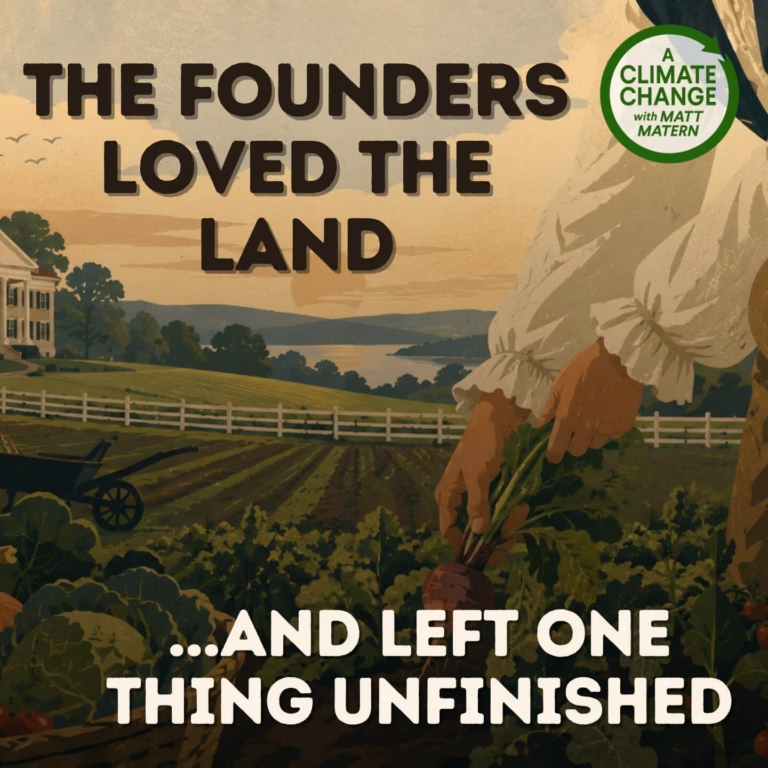
In this milestone 250th episode, Matt goes solo for the final installment of our “250 for 250” series – tracing what the people who founded the country actually believed about land, soil, and stewardship. From Thomas Jefferson’s near-daily weather diary and George Washington’s soil-saving crop rotations, to the myth of endless abundance baked into the American character, Matt lays out what the founders left us: a genuine love of the land, and a dangerous belief that it could never run out.
This episode is part of our “250 for 250” series, marking America’s 250th anniversary by revisiting the figures and stories in our environmental history when ordinary people changed everything.
Picture Philadelphia in the summer of 1776. There’s a 33 year old delegate from Virginia holed up in a rented room, putting the finishing touches on the most famous sentence in the English language, that we’re all entitled to life, liberty, and the pursuit of happiness. And that very same week, he walks into a shop and buys a thermometer on july 4, 1776 the day the Continental Congress adopts the Declaration of Independence.
Thomas Jefferson opens a little notebook and records the weather in Philadelphia, cloudy, 76 degrees. Think about that, the man drafting America’s birth certificate was on that exact day logging the temperature, and he never stopped for nearly 50 years, right up until six days before he died on the fourth of July 1826 Jefferson kept a weather diary twice a day, dawn and afternoon today he’s known as the father of the American weather observers, and here’s the thing, we tend to forget about the founders, we remember them as arguing about taxes and tyranny and representation, but they were also every bit as obsessed with something more, the land, the soil, the weather, what grew, and where, and why?
So today, on our 250 episode, marking 250 years of this country, I want to ask a founding question we almost never ask, not what did they believe about government, what did they believe about nature, about land and soil and stewardship, and the harder one. What on earth would they make of the land now? Welcome to a climate change. I’m Matt Matern, your host.
Today, we’re closing out our 250 for 250 series, where we’ve been marking America’s birthday and our own 250th episode with the environmental stories that built this country, and like a few others in this run today, there’s no guest, it’s just me, you, and the story of what people who founded this country believed about the ground beneath their feet. Let’s start with Jefferson, because nobody thought harder about this. Jefferson democracy couldn’t grow in just any soil, and I mean that almost literally. He believed a free republic had to be a republic of independent farmers.
A man who owned his own land and fed his own family answered to no one, no king, no landlord, no boss. That independence he thought was the root system of freedom itself. In his notes on the state of Virginia, Jefferson writes, those who labor in the earth are the chosen people of God. If he ever had a chosen people, he basically gave farmers a sacred status, that was Jefferson’s view, and the flip side scared him. He distrusted what he called the mobs of great cities, people who depended on a paycheck to survive.
In Jefferson’s mind, the farmer was free and the wage earner was vulnerable, and a republic full of vulnerable people wouldn’t stay a republic for very long. Land equals independence and equals the only soil a democracy could grow in. Independent farmer was the backbone of the entire American experience. Now, flash forward, at the founding, roughly nine out of 10 Americans worked the land.
Today, it’s under 2% Almost none of us have a daily relationship with the soil that feeds us. We have a relationship with a grocery app. We kept Jefferson’s idea of freedom, and we quietly let go of the ground it was supposed to grow out of, which leaves a question worth sitting with. If American identity was once rooted in the land, what exactly is it rooted in now?
Here’s the missing thing, though. The founders didn’t just admire the land, they farmed it, and they thought hard about doing it right. Start with Washington, who called himself a farmer first, a general, and a president second, and he meant it. He inherited Mount Vernon as a tobacco plantation, and out 2100 acres, and tobacco, he came to believe was destructive.
It stripped the soil bare, and in a few seasons it pained him to the British merchants who set the prices, so by 1767 Washington did something most of his neighbors wouldn’t do. He abandoned tobacco entirely. He switched to wheat, and then he started experimenting like a scientist. He built a box with 10 compartments, each filled with a different mix of. Oil and compost, cow manure, horse manure, river mud, and planted the same seeds in every one, just to see what the land actually wanted.
In 1786 he had reorganized his whole estate, five farms, nearly 8000 acres, around a seven year crop rotation, wheat to sell, corn to eat, legumes planted for one reason only, to pull life back into the soil. Take a second with that. That’s regenerative agriculture in the 1780s and he loved it. Writing an English farmer in 1788 Washington said the more he learned about agriculture, the more it pleased him. And then this line, how much more delightful it is, he said, to make improvements on the earth than all the vainglory which can be acquired from ravaging it.
Let me read that again. How much more delightful it is, he said, to make improvements on the land than all the vain glory that can be acquired from ravaging it. Let’s think about that vis-a-vis the oil industry and the mining industries. The most powerful man in America saying he’d rather build up a soil than conquer the world after two terms as president. What did he want? To go home once more, seated under my own vine and fig tree. Now, Jefferson had the same instinct, just pointed at a variety instead of rotation. He kept a garden book, daily entries that grew to more than 300 kinds of vegetables and 170 types of fruit trees across 5000 acres. He treated farming as a science and kind of a moral calling.
He traded seeds with neighbors and correspondents all over the world. He once stuffed an Italian rice into his coat pockets and smuggled it out of Lombardi, risking arrest because he thought it might give the American South a better, healthier crop. His line: the greatest service which can be rendered any country is to add a useful plant to its culture, and my favorite detail, Jefferson failed constantly. Italian rice didn’t take, the olives died. His neighbors called him the worst farmer in Virginia, but he wrote every failure down to him. That was the point. Strip away the powdered wigs, and the idea underneath it is strikingly modern, that the land isn’t just yours to use up, it’s something you answer to wreck the soil or rebuild it. The choice says something about who you are.
That’s the same instinct behind every farmer today who’s trying to leave the ground healthier than they found it. The founders were doing it by candlelight, but the founders handed us something far more dangerous, and to see it, you only have to look at one word Jefferson used in that same book, describing the new country. He wrote that America had an immensity of land courting the industry of the husband, the immensity that word did a lot of work, because when you believe that their land is endless, you build an entire worldview on top of that belief. You exhaust a field, move west, there’s always more. Limitlessness got baked into the American character, and it’s the whole idea of the frontier, and here’s the uncomfortable part.
For a long time, it worked. The abundance was real enough, and the myth paid off for two full centuries. We got rich treating the land as bottomless, and the bill never seemed to come. This is the hardest idea we’ve ever had to unlearn. A stable atmosphere is not immense, groundwater is not limitless. A living soil, a fishery, a forest, none of it is bottomless. The founders handed down a great gift of confidence, a sense that the future was wide open, but that confidence came wrapped around a dangerous error, that the planet would never send the bill in 2026 The bill is coming due.
So, if the founders loved this land as much as they did, if Washington thought tearing up the earth was kind of a vanity, if Jefferson ranked introducing a new plant right alongside the Declaration of Independence. Here’s a question that should nag at us: Why is the document that they left us, the one that actually governs this country, completely silent about it? Go read the US Constitution. It protects speech, religion, property, due process. It says nothing about clean air, clean water, or a livable environment. The founders wrote their reverence for the land into letters and their farms, they never wrote it into law, and here’s what makes that strange. Almost everyone else eventually did. Today, roughly three quarters the world’s national constitutions include some form of environmental protection, more than 100 of them guarantee citizens and.
Right to a healthy environment on this one, the country that more or less invented the national park is an outlier. Our federal constitution still says nothing at all. But here’s the hopeful part: it’s starting to happen here from the ground up. A few states now have what are called green amendments, environmental rights written directly into their bill of rights, sitting on the same footing as free speech? Pennsylvania did it back in 1971 Montana followed one year later, in 1972 and New York just joined them recently in 2021 A handful of others, Hawaii, Illinois, Massachusetts, have some environmental language in their constitution, but it tends to get treated as aspirational, a nice sentiment, not an enforceable right. Now, you might think that a single line in a state constitution is mostly symbolic.
Well, let me tell you, it can actually do something. In Montana, 16 young people, some of them teenagers, sued their own state. Their argument was simple: Montana’s constitution promises them quote a clean, healthful environment, and the state had passed a law forbidding its own agencies from even considering climate change when they approved fossil fuel projects. The case, called Held versus Montana in 2023 became the first constitutional climate case in American history to go to trial, and the kids won. The state appealed, and in December of 2024 the Montana Supreme Court upheld it, ruling that a clean and healthful environment necessarily includes a stable climate, and the state does not get to simply look away from it.
The court’s language was blunt. Montana doesn’t get quote a free pass to pollute the Montana environment just because the rest of the world insisted on doing so. 16 kids and one sentence written into a state constitution 1972 and they moved the law of the land, that’s what these amendments can do. And now there’s a national movement to spread them, to write a healthy environment into more state constitutions, and eventually push for it at the federal level too. They call it the green amendment movement, and right now more than a dozen states are weighing in. So look at what the movement actually is. The founders’ unfinished business, they gave us liberty on paper and reverence for the land in practice, but they never connected the two.
They never made clean air and clean water a constitutional right. And now, two and a half centuries later, a 16 year old in Montana and a movement of lawyers and ordinary citizens are trying to finish the sentence the founders started to take the old American instinct that how we treat the earth is a test of who we are, and finally give it the full force of constitutional law. This isn’t rejecting the founding, it’s completing it. 250 years ago, nobody knew that we could pollute enough to change the climate, that was beyond conception that humans were capable of that. Now it’s scientifically proven.
So, here we are, 250 years on, from Jefferson’s thermometer to satellites and supercomputers measuring the climate today, it’s a one unbroken line, one long American argument about a single word: limitless. The founders handed us two things. First is a gift, a real durable love for the land, and an instinct of how we treat the soil, that is a test of who we are. The second is a trap, the myth that the land could never run out in 250 years. It’s come down to this: keep the first, outgrow the second. Hold on to the reverence, let go of the illusion of endlessness, of limitlessness.
So, with 250 episodes of this show, 250 years of this country, and across the whole 250 for 250 series, the stories rhyme. The first Earth Day, the national parks, the agencies we lean on when disasters hit, the national figures who urge us to protect our land before it’s too late, and now the very ground the country was built on. None of it ever protected itself. The soil Washington rebuilt the parks, we set aside the climate. Jefferson started measuring on a cloudy day in July. Every bit of it stays ours only if every generation decides it’s worth keeping, which is where you come in. The founders measured, experimented, planted, and wrote it all down.
They paid attention to the land, so pay attention to our land, learn where your water comes from, put something in the soil this year, buy from a farmer who’s rebuilding the ground instead of mining it, find out whether your state is one of the few that’s written a healthy environment into its constitution, and if it isn’t one of those states. Know there’s a movement working to change that, and you could help, you could join in. So, jump in, and when somebody tells you a natural thing is simply too big to ever run out, remember that’s the one idea the founders got wrong – it’s the one we can’t afford to inherit.
So, that’s our 250th episode, and the close of our 250 for 250 series marking America’s 250th birthday and our own. Thank you for being here for all of it. If this one moved you, do me a favor, this year take someone you love out to a piece of this country, a park, farm, trail, a patch of dirt, and pay attention to it together. That’s the whole idea. These places only stay ours if we use them and defend them.
I’m Matt Matern. Subscribe now to Apple, Spotify, or wherever you get your podcasts, and we’ll see you for episode 251. Go do something today to learn more about our work at A Climate Change. Visit aclimatechange.com If you liked this episode, please share it with a friend. See you next time.
(Note: this is an automatic transcription and may have errors in formatting and grammar.)