
Hear us on Apple Podcasts, iHeart, and Spotify Podcasts. Subscribe now!
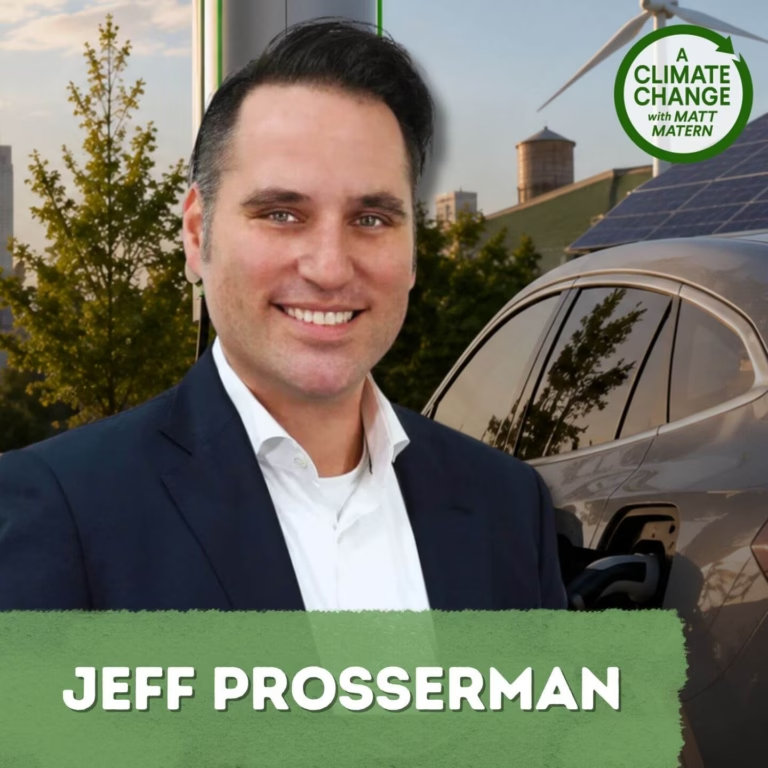
Matt speaks with Jeffrey Prosserman, CEO and co-founder of Voltpost, about a simple idea with big potential: turning the lampposts and utility poles cities already have into electric vehicle chargers. Jeffrey shares his path from leading product development at Samsung to founding Voltpost, and explains why more than 40% of Americans, those without a private garage or driveway, still can’t conveniently charge an EV at home.
Over 40% of Americans live in homes without private garages and lack access to convenient and affordable charging access. There’s somewhere between 35 to 55 million lamp posts and over 180 million utility poles across the US. If we could transform them into EV chargers, we unlock a lot of value for drivers, but also for cities, and being able to generate revenue from something that otherwise historically has just provided a light. If we really want to get everybody to go from gas to electric, we need to create that bridge.
You’re listening to A Climate Change. This is Matt Matern, your host. I’ve got Jeffrey Prosserman, who’s co-founder and CEO of Voltpost, a venture-backed company based out of New York and San Francisco, that’s on a mission to decarbonize mobility for democratizing charging access. Voltpost retrofits ordinary lampposts and utility poles into electric vehicle charging platforms, turning infrastructure cities already have into convenient, affordable places to plug in. Before Voltpost, Jeffrey was director of innovation at Samsung, and spent more than 20 years working at the forefront of technology, and in 2022 graduated from Columbia University’s sustainability management program to focus full time on building climate technology solutions. Welcome to the program, Jeff.
Yeah, thanks for having us set for the conversation today.
Yeah, so you know, I kind of gave a bit of an intro of what you guys are up to. Tell us a little bit about your personal journey of kind of coming to the environmental movement, what, what were the impetuses for that path?
Sure thing. So, as you mentioned, I’ve been working in technology in New York for over 20 years at this point, and after leading new product development at Samsung for a number of years came to a point in my personal and professional life where stopped asking what I want to do next and really started to focus on why, and this was around the pandemic, and just prior there were the climate strikes happening all over the world.
And around the same time my son was taking his first steps and ultimately that sparked my personal journey, where started to think through what future would leave behind for my son and obviously the next generation of humanity, and recognized that there was a lot of important work to be done in decarbonization and building climate technology solutions, so that led me, in the midst of a pandemic, to go to Columbia University, get a master’s in sustainability management, which is like a green MBA, really understand the climate science, and then fast forward about five years, and here we are.
So, how long is Voltpost been up and running?
So, we started Volpos in Q 2021 and this actually came out of a research paper that I wrote in the Columbia Masters program, really thinking through if we could retrofit the existing street lights and utility poles that lived in the fabric of our communities, obviously curbside and in parking lots, and transform them into EV chargers. This came out of a personal struggle as well, recognizing that there really was just a lack of convenient and affordable public charging in New York City, and we quickly realized this wasn’t just a New York City problem, but a problem across the country.
Currently, what? What’s the status of the company? How many of these have you rolled out, and what’s your kind of goal for the next, say, one year, two years, five years?
Sure thing. So, Full Post is a venture-backed company. We’ve been on this journey about five years now, very much mission-driven, as you mentioned, to decarbonize mobility by democratizing charging access. Our vision is really that we can make charging as ubiquitous as the common street light that is curbside in your community today, and so over the last few years, we’ve taken it from concept to commercialization, where we now have lamp posts and utility pole chargers deployed across the country. We have projects in New York, Michigan, Illinois, Massachusetts, Connecticut, California, and DC, and have proven out that this is a way to deploy chargers that is significantly lower cost, significantly faster, can be installed in just a few hours, and obviously taking no new curb space, no new real estate by leveraging the infrastructure that’s already there, so.
You, how do you, how do you split the revenues with the companies that, or you, I guess possibly municipalities that you’re linking into their, their electricity?
So we really look at full posts as a service for the public good, and ultimately we’re powered through our partnerships with cities, with utilities, and the private sector. We’re actively deploying our turnkey solution across all three, depending on who owns the poles in the built environment, depending on the project, and so we have won a number of RFPs, a number of projects across the country that have been put forth where there’s that lack of proper charging infrastructure, and ultimately that’s enabled us to fund the project development, identifying the sites, getting the chargers turned on the grid, and then managing it through the software. Each project has different parameters, ultimately of the rev share and the cost breakdown, but generally speaking, we can show that it’s a significantly more cost-effective way to deploy charging, because we don’t have that construction trenching up front,
yeah, I would imagine that it would be challenging to create a charging center. I have a second, my second EV, the first one I bought in 2015 and there were really a lot fewer charging stations back then. Now it seems it’s not quite as crazy trying to find a charging space, but it’s not always as easy as I might like, and this is in Southern California. I would imagine other cities probably have less charging stations per square mile. What, what’s the current density of charging stations that we have in the United States, and what, what kind of level do we need to get to?
Yeah, I mean, we’re really going from the early adopters into the mainstream of both EV adoption as well as EV charging infrastructure rollout across this country. I mean, different reports will give you different numbers of where we ultimately have to get to, but it’s certainly north of over a million ports on the level two side that are needed to support EV charging in a convenient and frictionless way, the same way people would be driving a gas vehicle today, and another component of that is really thinking about the broader charging ecosystem. It’s not a one size fits all solution, obviously. We fit into that ecosystem by being able to provide convenient curbside and parking lot charging, which is that medium level, level two charging, not the DC fast charging that is typically available on highway corridors, and when you’re going from one city to the next.
That makes a lot of sense, but when you’re thinking about cars being parked for over 90% of the time, driving less than 30 miles on average in a densely populated city, really, we just need more plugs turned on where people are parking today, so we think about it more not just in the charging speed, but also the convenience. How much time we can cut out of people’s lives in order to be able to have that opportunity-based charging. So, a lot of ways to look at the numbers of how many ports are ultimately needed, but at this point we’re just in that early tipping point as we go into the mainstream.
So one of the things that is driving this is that we’ve got more EVs on the road, and we’ve got, say, in California and some other states, approximately 25% of all new cars are EVs. What, what percentage do you think that’s going to get up to in the next five years, and, and what, what’s the rate of the rollout that your company is looking to do in terms of new installations?
Sure, so I mean, certainly in the midst of some policy headwinds in the moment, we look at that more of a speed bump in the road to electrification, and would say that obviously California, New York, historically have been ambitious in their climate targets to align with the Paris Agreement to get to 100% electrification on the road by 2035 I mean, certainly not exactly on the track to hit those numbers. She can just see beyond just the headwinds in front of us, but we are making progress in spite of the recent slowdowns of what have occurred. Over the last year and a half or so, I mean, ultimately on our side we are looking to deploy quite quickly through this deployment method that really cuts that construction entrenching out over the next five years, getting into the 10s of 1000s of units that we would have deployed across the country at this point, we do see that path unlocking, where last year things did slow down a bit because of the federal funding freezes, but at this point the dust has settled and are on a path to rapidly scaling again.
So in terms of your artfully and diplomatically saying policy headwinds, you know, I think that means for the average listener the IRA was certainly, you know, cut from what it was originally intended to do to what maybe it’s, it’s doing now. Maybe you could describe how those changes in the IRA have affected your firm.
Sure, yeah. So ultimately, there were two buckets of federal funding for EV charging, the Nevy funding, which was 5 billion, which last January had an executive order that froze the funding that was primarily for fast charging, but then there was a component of that which enabled each state and ultimately to determine when they were fully built out to reallocate funds for level two charging community-based charging, which is effectively what we’re rolling out.
The second component of federal funding, the 2.5 billion through the CFI program, also was frozen last January through the same executive order. At this point, we’ve seen quite a roller coaster, to say the least, but that first bucket through Nevi has been unfrozen in that there was a lawsuit with Earth Justice and the Sierra Club that provided leadership to go alongside 16 states in DC to release the funds that had reached a court order to release the funds.
And the CFI lawsuit is following the same path with the same playbook, with the same attorneys, with the expectation that in the coming months this year to reach the same conclusion, Vol Po specifically was awarded three federal contracts through the CFI program that were frozen last January. That certainly created a lot of uncertainty for us, and frankly, everybody in the EV and EV charging sector last year, however however, we are seeing that unfreeze at this point and seeing a path to deploy in spite of those challenges, and obviously not all of our contracts were tied up with the federal money that was a component of our pipeline.
Okay, so what has happened in a lot of court cases? The current administration has lost it to maybe the trial court level, but then they’ve appealed those decisions regarding the Nevi funding. Have they appealed that, or have they kind of gone with unlocking the funds and just letting it happen?
At this point it is progressing with the funds on the state level with Nevi, and we have seen certain states begin to reallocate funds from fast charging to level two. Obviously, it’s unpredictable time, so don’t know what’s going to happen by the time this podcast gets released, or where we are going to be in a couple months, but it’s a point in time. There’s also the Build by America compliance, which full post is compliant, meaning that we make our chargers in America and manufacture them here as well.
There had been a proposal that was looking to increase that from the current threshold up to 100% without any lead in period, which effectively is another component to try to block both the Nevi and CFI funding that was in a proposal phase that has not progressed beyond proposal yet, so we’ll see where things are heading more than midterms, but when you take a step back from a driver experience, people want EVs, they’re safer and. Frankly, better cars, if you’ve ever driven one on it, I hear you have, obviously, on your second EV, and so there’s a consumer shift that’s happening, no matter what happens on the federal level, and we’ll see where we are in six months.
Right? Well, I would imagine maybe quietly the current administration may be seeing a putting policy hurdles in front of rolling the EV industry is not helping the economy, and given the challenges the economy is facing through the war and Iran and other factors putting putting other barriers into economic growth is probably not a wise thing, so they may be reconsidering their, their initial actions. Is there any, any sign that that’s actually true, or…
I mean, I mean, I would say that if you talk about American energy independence, certainly the war and gas prices and challenges of the current moment not made the previous policy decisions of blocking the EV charging money, one that is really for the people or representative of bringing down the cost of living, and so obviously from a perspective of a leader in the EV charging sector, we’re seeing that the consumer sentiment is there and people want to be driving EVs, and they want access to convenience and affordable charging, and so we have spent some time in DC meeting with policymakers over the last two years of uncertainty.
And we’re seeing pockets of people begin to speak up on this, obviously more so behind closed doors than what’s happening in the headlines. There’s been the broader automaker pullback at the end of last year. By the end of the day, when you’re looking at this from a global perspective, if fees are here to stay, so it’s a slowdown in the acceleration to get there to net zero emissions, but it’s not going to stop. It’s going to move in the other direction, the same way we moved in this direction from the broader policy piece.
Well, obviously China’s producing EVs at an exponentially faster rate than we are, and my understanding is they have 100 different car companies that are making EVs, and some of them are dropping to price points low, as low as around $10,000 so if at some point in time somebody is going to open up the doors to those vehicles coming in the US, and if not the US, everywhere else, and, and that will be the new, the new standard.
100% I mean, ultimately, it’s just pulled America back in the global automotive industry in what’s happened in the last year and a half, and certainly unfortunate in the impact that it’s had for the automakers, and obviously the slowdown in growth for companies like Full Post, but in the end of the day we’re charging forward and delivering on the infrastructure that this country needs in spite of the headwinds.
So I guess the question from a strategy point of view, say the national government just stops any or most all of the funding sources for the type of work that you do, is there enough state money, municipality money, or just private money that has this concept make sense.
Yeah, I mean we’re certainly seeing states step up over the last few years, in spite of the federal headwinds like California and New York, Massachusetts, Michigan, Illinois, and others, ultimately it becomes more challenging, but it’s not the full road block of this progressing. I mean, in the end of the day, there’s a lot of utility-related programs we work with utilities across the country, the utilities see this coming head first, and really, by retrofitting existing infrastructure into chargers, it’s not just a charger.
We really look at this as an intelligent infrastructure platform, where charging is the entry point, and what we mean by that is once we go through the regulatory maze to get the rights. To attach chargers to poles and interconnect them to the grid. We’ve already done the heavy lifting of working with cities, working with utilities to make all that happen, and then there’s an opportunity to add additional technology over time, grid services, and other types of sensors as it makes sense to support the various needs use cases of different parking scenarios.
Well, one thing that comes to mind is feeding power back into the grid, and that all of these vehicles have substantial batteries that could feed power back into the grid in cases of emergency or heat waves or those types of things, power outages. What is your company, you know, looking at that as a possibility, and what, what is it doing to address that scenario?
Yeah, 100% I mean, there’s certainly an opportunity to provide broader grid services through EV charging that are publicly deployed, both curbside and parking lots, and we’re very much working with utilities across the country as they define their plans in that way. I mean, like any technology, you have certain tipping points, and I think where we are in the current moment, obviously EV charging is matured and has standards set around it.
When we talk about vehicle to grid bidirectional energy going from the cars back to the grid, certainly it’s an exciting opportunity as part of the future. Question is, how quickly is that going to come at scale, and some of the elements that we need to overcome as a country. One is, obviously, we don’t have a lot of cars on the road today that can facilitate that bi-directional energy transfer, and there’ll be more that come online over the next few years.
Second, with the utilities, they need to establish programs, regulatory frameworks, both for companies like us to participate in that energy management, as well as for the public, for drivers to be able to access that interconnection process that provides the power in the other direction, however, these things are very much rapidly developing and certain, certainly part of the grid of the future, and it’s a very exciting time in having this distributed energy network that we’re building out, where we can turn on these additional services in that we have a modular and upgradable platform-based approach, which means that as these technologies mature, we can then be ready to integrate them.
So, Jeff, in terms of the utilities, you know, some one of my concerns is that they tend to be sometimes opposing things that would be good for the public, but not necessarily good for them, and maybe a tricky question for you to answer, since you have to deal with them, but what do you see are the reasons that they want to cooperate with what you’re doing, as opposed to oppose it, and if they are opposing it, you know, what are your arguments to work with it or get around it?
Sure, so utilities are obviously risk off and sometimes have questions around anything driven by innovation, however, when you look at what we’re doing, retrofitting existing street lights and utility poles into chargers, we’re able to quickly show them the business case where we’re significantly reducing the cost to deploy chargers, saving 10s of 1000s of dollars per site, sometimes north of 70 plus percent compared to traditional charger by leveraging what’s already there. The way we do that, we’re either pulling the power through the existing conduit to provide the interconnection or dropping the power down from above to connect to the grid.
And so, yes, there’s questions around how does the metering work, and is it a digital meter, or is it our previous larger scale meter that we need to attach to the poles, and we just try to provide as much flexibility as we can, given that the utilities are going to constantly have outmoded regulatory challenges that we support them in building that bridge toward deploying this in a meaningful scale. We have two of the largest energy companies in the world as investors in the company, one of them being Exelon, where we’re deploying across their territories in Chicago, in Washington, DC, and.
Other projects that have yet to be announced also have RWE, one of the largest European energy companies, their New York-based energy transition investment team that is supporting our growth across the company, across the country, and so at this point we’re pretty tightly integrated with both the opportunities and challenges that come with working with the utilities, they’re certainly slow-moving machines, but in the end of the day, we are bringing something that has been very well received across the board. It’s just a question of how do we connect the dots between stakeholders to get these projects off the ground.
Well, it’s kind of fascinating when you like just look at the history, and that 100 plus years ago things move very quickly in terms of electrification. It was just kind of like, hey, we need to modernize, get it going, blah blah blah, and now we’ve kind of entered this stasis mode of like, hey, this is the way that is, you have to kind of operate in this very structured environment. Change is hard to come by, and we, you know, we don’t want.. we want to be safe in all of our decisions, which, of course, being safe is nice, but it also means it makes it hard to improve. How do you deal with that kind of static mindset?
I mean something we deal with every single day, that if you look back in history, 400 years ago, there were electric cars and there was a grid that was forming across the country and innovation that was occurring to pull this together, it was a call to action moment, and I think we’re in a similar moment of electrification, obviously with different technology and a lot that has been historically ingrained into how we get there. I think what’s fascinating about what we’re doing right now in working with utilities and cities across the country and state agencies is that we’re effectively supporting them in gathering the operating data to duck and weave and determine how can we adjust some of that outdated policy to unlock things like this from scaling from 50 to 100 units in a given market to truly the 1000s or 10s of 1000s.
And what’s exciting in the work that we do is in talking to say Con Ed in New York City, and then PG and the West Coast, or anyone in between, it could be from the morning to the afternoon, that we’re gaining an insight on how to do what we’re doing more effectively in one utility region, and then sharing that with the utility halfway across the country, and so in many ways we’re writing the playbook to enable this from a regulatory perspective to scale.
So in terms of investment, how much has has your company gotten in terms of investment, if that’s publicly something you can disclose, and what are your kind of targets going forward?
So, Full Post has raised approximately $9.5 million across three financing rounds. The company is actively raising series A round this year, and certainly are grateful to have the support of our current investor pool, as well as established relationships with infrastructure clean energy investors across the country, so if you’re listening to this and potentially in that window where you just want to reach out and see if there’s an opportunity, maybe that’s my plug here, but in the end of the day we really see that in spite of the macro uncertainty from last year.
Which made it more challenging, frankly, for anybody in the renewable energy sector to raise financing with projects getting paused and canceled and reconfigured. At this point, the dust is truly settled, and we’re winning a number of new projects again since the start of the year. We’re excited to announce some of the partnerships that we have coming up, and so there’s been a lot of noise, but we’re charging ahead in spite of the challenges.
Well, charging ahead, pardon the pun, but yeah, what new partnerships are you working on? And can you announce to the public? Now,
Sure, this So I mean, what I can share beyond Exxon being an incredible partner as an investor in deploying across their territories, we have our manufacturing partner, EBSC LLC, which enables us to truly scale for. Family owned manufacturer for 50 plus years, making far more than just EV chargers. We have AT&T that provides our IoT connectivity as our preferred partner. You see a great opportunity the same way we were talking about it being an intelligent infrastructure platform for grid services to co-locate connectivity solutions like g alongside charging on poles in the built environment, because obviously the carriers are already deploying next generation connectivity technology on poles.
\So this is a way to do it faster and cheaper for both the carriers for us and for the utilities, so that’s really exciting opportunity of creating a connected charging platform, and then we have other partners on the installation and maintenance side, maybe names you hadn’t heard before, but those which really become part of the Vol Post developer network, which are the boots on the ground local electricians, developers who actually make these projects happen on a day to day basis, but yeah, that’s just to name a few.
Okay, and how much are you seeking to raise with your series A round?
I mean, we’ll see how the round comes together, but targeting a $10 million round on the equity side.
Well, certainly, good luck to you on that front. And is it limited to sophisticated investors, or is it more open to the general public?
Yeah, we are effectively raising from accredited investors, and so cannot just take money from anyone, and certainly respect those who’ve part of the Voltpos community signing up to a newsletter, and just following the journey, found a lot of people from all over the world reach out, saying they want this on this point six of the seven continents, but at this point we are a US-based company, we’re scaling for the infrastructure needed in this country, can look at and entertain some of these international opportunities, or those who just think what we’re doing is incredibly exciting, but need to maintain focus.
That brings up a good question. Do you see other entities doing this in Europe, or in Asia, or other places?
Yep, so really one of the first signals of should we do this at all was seeing that in the UK company Lupatricity, which got acquired by Shell, ended up deploying a few 1000 street light chargers in London and really different areas of Europe. We’re excited to have the person who led the UK Office of Ubatricity, James Everly, as the person who’s leading business development at Full Post now. He’s since migrated across the pond and is supporting doing this on a second continent.
So really he’s got a book in him himself of just doing this in the UK and bringing the same knowledge over to the US. Obviously, there’s other companies focus on curbside charging and innovative charging solutions, and we really look at this as a broader partnership play that it’s not a one size fits all solution, and that all these players need to come together to really provide the solution that the public needs.
So, have there been studies done as to EV adoption rates for people who don’t say have a home charging solution versus other people, and how this, how your product might shift the goalpost and getting more of them to to get EVs if they had options like what you’re what you’re bringing to bear.
Sure, yeah, I mean, over 40% of Americans live in homes without private garages and lack access to convenience and affordable charging access by that measure, and so if we really want to get everybody to go from gas to electric, we need to create that bridge, which is why we founded Full Post, beyond just thinking about the percentage of people who live in apartments and rental units, etc. I mean, we have 10s of millions of polls.
The estimate would be, and it’s a data set, there’s a company in this, in and of itself, but there’s somewhere between 35 to 55 million. And lampposts and over 180 million utility poles across the US, and so if we could obviously take a small fraction of that in hundreds of 1000s and transform them into EV chargers, making them revenue generating assets, then ultimately we unlock a lot of value for drivers, but also for cities, and being able to generate revenue from something that otherwise historically has just provided a light.
Right, well, I appreciate you coming and sharing this on the program. What do you see is the biggest challenges you have in going forward and rolling this out to Main Street USA.
I mean, it’s a great question. I would say that people typically are inspired with what we’re building, however, given the macro headwinds, it has distorted in a way, the view of what we’re really doing, and that’s just in the current moment. I mean, when you get beyond the headlines and you’re really looking at the medium to long term view of this, I would say that everybody reckon most people recognize that electrification is here to stay
It’s a question of how quickly we can reach that full transition, and so the challenge has been that, because of what happened last year on the federal level, it creates uncertainty, and that uncertainty, frankly, just breaks investor confidence in the US clean energy sector, and that’s not a Volpos explicit problem, that’s a problem for this country and the financial markets holistically. So, at this point, though, we’re seeing everyone turn the corner and recognize that at a certain point we have to get back to business and start building again, and so we’re doing that effectively at Voltpos, and as that sentiment shifts, proving at the unit economics charger by charger on polls, starting to see others wake up to that reality too.
Well, I think at the end of the day, money will make the best argument for or against the EV world, and what, what is the cost savings that say your company provides that that can beat gas in, you know, head to head competition.
I mean, if you look at the price at the pump today versus the price to charge a car, we’re talking about multiples of difference. I mean, obviously not going to give you numbers based off of how big your gas tank is or how big your battery is, but we’re talking two to five times more money at times to fill up a gas tank versus fill up a battery, so the economics are there, but certainly the fact that oil prices have jumped up due to the recent war has probably done as much or more to get people headed in the direction of their EV car dealer than than almost the incentives that were coming out of the IRA. What do you think? Have you are you seeing that on the ground in terms of more demand post war in Iran.
Yeah, 100% I mean, it’s a great question. I think everything moves in cycles, and at this point, because of the war, I mean, we talk about American energy independence, and the reality is EVs provide a path to that, and so when you take out the political component, which unfortunately this has become more political than it truly should be. This just provides a faster, cheaper, safer, and frankly more entertaining way to get from point A to point B.
So, yeah, I mean, you could pick what side of the aisle you want to be in and go through deliberate if this makes sense for you, but in the end of the day, I mean, the billions have already been invested globally. This is already passed tipping points from our market acceptance perspective, and so the US is now just lagging behind, unfortunately, but that’s not to say that in certain aspects, like EV charging, it’s not going to continue to catch up on the vehicles themselves side, obviously competing China and some of the other players, it certainly will become more difficult in this turbulent moment, but I still believe. That we’ll get there, and I’m optimistic on the path to net zero.
Well, I’m glad to hear that, and you know all of us have some duty in pushing that forward, whether it’s buying an EV or voting in a way that supports policies that help us decarbonize our economy, so everybody should take take action that they can, and you know, I think the good news is that EVs are at roughly the same price point as gas-powered cars, so it really isn’t as big of a deal to make that shift towards towards an EV vehicle.
Yeah. And honestly, it’s the first moment, like, as we go from early adopters into the mainstream, there’s a lot of used EVs now that are frankly, because of this policy challenge, now in a spot that they can be much more affordable, getting a much higher power quality vehicle for a fraction of the price of what it would have been just a few years ago, so we’re kind of at the end of the first act for my telling of this story of the EV transition.
And we’re just starting that second act, and in this moment there’s certainly, unfortunately, some companies that didn’t survive that first act, but those who have and continue to grow, who remained resilient, like Voltpost, are seeing that we’ve turned a corner now. Everybody still wants their charging. All these cities that had their funds frozen, they’re hungry to get this going and get these projects off the ground again, so we’re just really grateful to have such great partners.
Well, that’s that’s good to hear, and certainly the fact that it is cheaper to charge a vehicle on the orders of magnitude of two to five times, plus the fact that there’s so much less maintenance for an EV vehicle, I had my, my EV vehicle, I did not have to take in for maintenance for three years, not one time, so, like, you know, it just, so much easier, and, of course, that’s not even throwing in the fact that the cars are so fast and fun to drive, so that, you know, drive ability aspect is very high, so you know.
Thank you so much, Jeff, for being on the program and sharing with us the story of Voltpost, and how you guys are, you know, rolling out charging to people who don’t have access as easily, which is a very important part of the decarbonization process, and if for those of you out there, they’re accredited investors, go check out Vold Posts and see if you’re interested in getting on the ground floor there, and if you’re not, follow them online. Jeff, I assume you guys have the standard social media things out there.
Yeah, now feel free to follow the story, whether it be LinkedIn or whatever platform you may use. We got a path, and if you want to bring convenient and affordable charging to your community, given that there’s just a lack thereof in this country, certainly do feel free to reach out, as we’re very much not just looking at this from the top down, but also from the bottom up to support drivers in their communities today.
Yeah, for all of those, if the listeners out there and viewers out there that have connections to political folks in your community, or just you’re connected yourself, it’s a good thing to raise to your elected officials that this is something that the communities need and should have for every driver.
Exactly. Well, Matt, I really appreciate you spotlighting full post here today, and certainly welcome you or anybody from your community to find us and reach out if there’s a relevant.
To learn more about our work at A Climate Change. Visit aclimatechange.com Don’t forget to subscribe to our podcast on Apple, Spotify, YouTube, or wherever you get your podcasts. If you like this episode, please share it with a friend. See you next time.
(Note: this is an automatic transcription and may have errors in formatting and grammar.)