
Hear us on Apple Podcasts, iHeart, and Spotify Podcasts. Subscribe now!
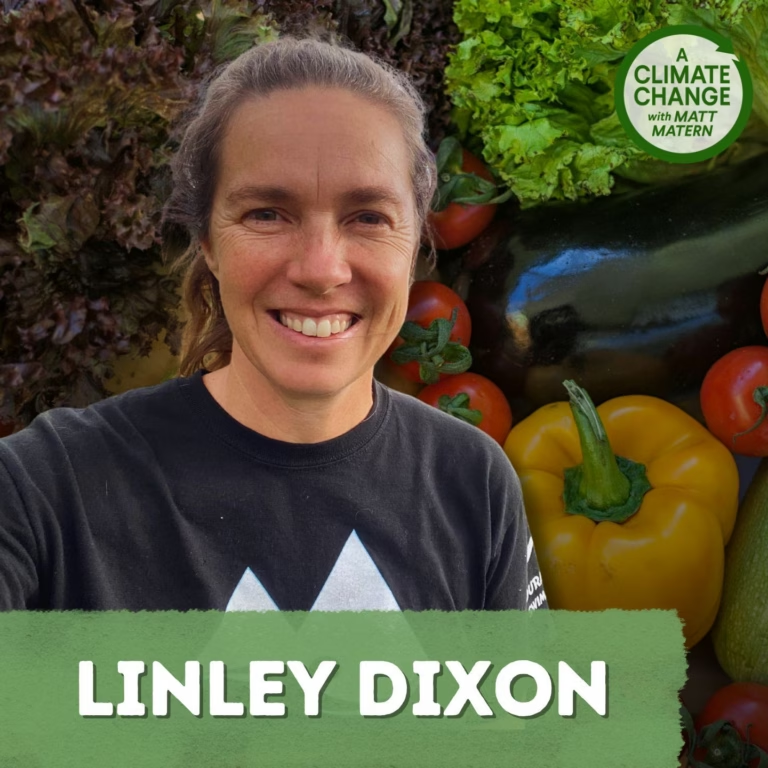
Matt speaks with Dr. Linley Dixon, Co-Director of the Real Organic Project and cohost of the Real Organic Podcast, about why how we grow food may be the climate lever we’re ignoring. Linley explains that synthesizing nitrogen fertilizer alone accounts for 1-2% of the global carbon footprint. They also dig into what’s gone wrong with the label people trust. Only about 1% of US farmland is certified organic while roughly 80% of our organic blueberries are imported, fraudulent “organic” grain shipments undercut American farmers, and the USDA allows soil-less hydroponics to carry the same seal as a soil farmer.
These are forever chemicals that are produced, and they end up in sewage sludge that then gets applied as fertilizer. They figured out this loophole of putting these little porches on the sides of the barns and calling that outdoor access. Our food system shouldn’t be regulated state by state, and there are only two states right now that prevent it. We all eat food from other states. It is kind of a game of whack-a-mole, the people who are making so much money off of this just figure out a different way to do it.
You’re listening to A Climate Change. This is Matt Matern, your host. I’ve got a great guest on the program, Dr. Linley Dixon. Dr. Linley is a co-director of Real Organic Project and co-host of the Real Organic Podcast. Welcome to the program.
Thanks so much for having me, Matt. Happy to be here.
Well, you know, just give me a little background on what you brought. What brought you to the environmental movement? I always love to get a little backstory.
Well, I feel like I have a farmer gene. I was just kind of born wanting to do this. I was the kid that like collected the kitchen scraps from all my neighbors and buried it, and then would like look to see if I, you know, could create this beautiful black gold, which is soil, you know. And I gardened and just always knew someday I was going to start a farm. I worked on a bunch of organic farms growing up, and it was the age of the CSA movement. You know, just getting started. So I worked up in Maine and just kind of fell in love with the lifestyle. And really, for me, it was all about working in the land and just the dirty fingernails, like feeling the day.
And I ended up going to graduate school for a really long time because I was studying biology, and I we didn’t have land in our family, and you know, land access is is probably the biggest barrier for new farmers getting into organic farming who you know don’t have family in farming, and so I just could never figure out how to get started or where I even wanted to do it. So I just I kept in graduate school, study biology, actually got into molecular genetics and evolution, and so kind of overlapped with the study of deep time, which really gave me a sense of understanding how rapidly we’re changing our climate now, and it it all started to kind of come together that this thing that I love to do was also the solution to so many of our problems current day. You know, not only a solution to climate change, but how we treat each other in our communities. You know, and how we live more closely, understanding the way nature works. You know, I think we’re so out of touch with that now. So it just felt right.
Well, you know, a lot of people will say that our farming practices maybe are the core problem of the environmental problem, and that if we solved our farming problem issues and our food growing issues, that a lot of our environmental problems would be resolved. What What are your thoughts on that?
Well, just the synthesis of nitrogen fertilizers alone account to over one to 2% of the carbon footprint. Just that one thing. Never mind. That’s just synthesizing it. Never mind. Once you apply it, most of it is lost off the land. The plants take up less than a third of what we’re applying. Most of it gets run off. It causes those dead zones in the Gulf of Mexico that we hear about. So algal blooms, and then you know oxygen depletion in the waterways and severe marine die off. But little less known is nitrous oxide is produced, and that is a greenhouse gas that is 300 times more potent than carbon dioxide.
So we’re not talking about this enough. It it cycles out of the atmosphere faster than carbon dioxide does. So carbon dioxide will last you 100 years before it can you know maybe come get cycled back out? So I feel like, of course, carbon dioxide is is the main problem in our burning of fossil fuels, and but fertilizers also connect to the nitrogen cycle in addition to the carbon cycle. So we have a lot of work to do. Organic farmers know what they’re doing, and we’re really good at it. And we have had pretty much $0 going into studying how to do organic farming. Most of the money for agriculture goes into you know input development.
So you know, just understanding how to fight pests with chemicals, and really organic farming has evolved by just farmers talking to each other in the exchange, and our yields are so much better now than they were beforehand. So you know, feeling really good that we know how to do this. I think right now we live in a marketplace that isn’t supporting it, and under a farm bill that is so heavily subsidizing the other system. The chemical farming that we just can’t compete.
So you know, in terms of dollars and cents, and and why organic could beat the chemical process in in the marketplace. I mean, that’s or or kind of like for the mega farms that are 1000s of acres and stuff. They, I mean, is it just that it’s more kind of? I was going to say idiot proof that you can farm large swaths of land with chemicals without as much thought and without as much human input, or or could you farm 1000s of acres of land organically with current, you know, current technology.
I think it’s scale limiting. So, and the good news is that there’s a lot of people that want to get back into farming. They don’t necessarily want to sit on a tractor and spray chemicals, but they are interested in you know the long rotations and the different crops that organic farming offers. It’s a it’s a more interesting lifestyle than just sitting on a tractor and you know putting it in auto mode and you know in your air conditioned container.
So anyway, I think a lot of new farmers, a lot of kids going back to their farms, are interested in exploring this. But like I said, we’re stuck at about 1% but the market is over 6% overall, and so the difference there is made up in how much we’re importing organic from around the world, and with that is coming a lot of fraud and unknown, especially when it comes to grain. There’s a lot of documented grain fraud, and it seems absolutely ridiculous that we’d be importing so much organic corn and soy when that is what our country produces. But you know, this is just the system that we have set up where we so heavily subsidize the chemical corn and soy production. The organic farmers are kind of on their own and they’re competing with these really cheap, often fraudulent imports. So it’s really something we need to fix, and these are the issues that the Real Organic Project was founded on.
Well, I have to say there is some family connection, and that my family-I don’t not personally-owns a farm or some farmland in Illinois, and I assume they’re growing corn and soybeans and stuff like that, but I assume it’s also being grown kind of the the old you know the chemical method, and you know what what is a way that somebody who’s in that situation can kind of get off get off the chemicals and you know do grain farming without without the chemicals.
Yeah. There’s some new things that have been happening with no-till, and you know, people call this kind of farming tweener, like it’s you know a little bit between just the conventional chemical farming and looking towards organic. But I mean, there’s a big difference. So no-till is done mostly with herbicides, and so the way you’re able to achieve no-till is to use an herbicide to kind of get the field ready, and then you can drill in the next crop, and that is has been encouraged for a while, and under our farm bill, especially with some of Biden’s climate money, he put a lot of money into climate smart agriculture, and it was close to 3 billion.
Actually, it was it was quite a bit, and a lot of that encouraged this no-till with with herbicides. But the problem is, we were surface supplying the fertilizers, and that. was causing even more runoff. So you have these drainage tiles that kind of help when there’s heavy rains get the soil aerated again. And a lot of the surface applied fertilizers were running off the surface down into the drainage tiles, and we’re seeing more of that eutrophication of our waterways than ever before with no-till, so really the best solution we’ve been finding is to grow cover crops, massive amounts of cover crops, and actually incorporate that organic matter into the soil.
So we’re increasing the organic matter over time, and it was thought that no-till would increase organic matter, but it’s not really showing over time for that to be the case. So this these are traditional practices of organic farmers. Lots of cover crops, lots of biomass and tillage, and then those cover crops end up becoming the fertility source as they slowly break down by the life in the soil. They become the fertility for the next season’s crop, and so these are age-old organic farming practices that we’re finding are the best for the climate.
And what types of cover crops are you talking about?
Oh gosh, there are so many, and it really depends on your geography and your timing and the crop. And now there’s mixes of cover crops. So usually you’ll get something like a hairy vetchen, which is going to fix nitrogen. So you’re thinking. Your legumes, and those are going to break down fastest, so they will provide early season nutrients for the crop. But if you want your cover crop that’s incorporated to provide slow release fertility, the things that break down later in the season are going to provide fertility, you know, for you after the nitrogen legumes have broken down, so those are things like grasses. So really sophisticated organic farmers.
That’s why I was talking about like figuring this all out. It’s tricky, and so really sophisticated organic farmers have these longer rotations. They have different cover crops. They might use something like sun hemp, which is a very fast kind of tropical. It loves the heat of the summer, and it will grow 1015, feet tall, and then you’ll have to flail mow that, and you’ve got so much organic matter that you can incorporate.
But then you could, if it’s the fall, you could put in a cover crop that might survive the winter, or that’s you know a number of the species will maybe get going in the fall, and then they die off, and then the vetch comes through, survives the winter, and provides some biomass for the spring. And so it’s very place dependent, depending on when you get your rains, how cold it gets, and organic farmers have been figuring this out and sharing information over the years. And it’s it’s really affirming to see that the carbon now that we started to measure soil carbon, that these are the systems, even with heavy tillage, that have the highest soil organic matter over time.
So, are these cover crops like one of them? You said the hemp, kind of tropical. Is that a indigenous to to the U.S. or is that a plant that comes from somewhere else.
Yeah, most of them aren’t native here because we are, and that is something that other organic farmers are excited about. I talked with a Oklahoma farmer, Emily Oakley, is working on coming up with native mixes. You know, again, she’s got to figure this out herself. You know, the it would be great if the agricultural departments and the universities were studying these things, but even still, you know, any organic research is a is a huge minority of the research that gets funded. So, you know, we’re we’re trying to figure this out ourselves, but you know, mostly we’re looking for lots of biomass to get that carbon back into the soil.
So, tell us about your real organic podcast and how it started, and and what’s kind of the focus of of the show.
We actually, as a group, formed a real organic project in 2018, and I don’t think the podcast started until COVID hit because we were getting together and sharing practices as organic farmers. We had a conference at Dartmouth every year, and we were going to have one like the beginning week of April. And if you remember, that’s when COVID hit. So we were among the first to kind of adapt to online conferences, and we interviewed people that whole summer of 2020 remotely, like this. You know, we didn’t even have a Zoom description subscription at the time. It was crazy, you know, things that we just take for granted now. We were all just trying to figure out. So, we took all those podcasts and we made it.
Ended up being 10 hours total of a production, just talking about organic farming and the movement, the connection to soil health, nutritional health, and climate change. And every Sunday, we released it in January. So every Sunday, we released two hours over five weeks. And then we took, we realized, oh my gosh, we’ve got a podcast here. So we took all those old interviews that we pulled clips from, and then started to release them as a podcast. And we had really great people. I mean, we had Michael Pollan at the beginning, and Al Gore has a farm that’s certified with the Real Organic Project, and Vanda Nishiva, some really big names. Dan Barber’s a chef in New York, and some really big names. I don’t know if you know. Alice Waters is also a chef out in California, and so anyway, it it launched us, and it’s it’s been pretty successful and fun, and continued every week to this day.
Well, that’s great. Yeah, I mean, I I love going to restaurants that list on the back of the menu or somewhere on the menu that all the different organic farms that they get their produce from, because you know, makes you feel like okay, you know, you’re being well taken care of by by the restaurant, and and I assume that helps grow kind of the ecosystem of organic farmers to to to show, hey, this is this is really great produce, and it tastes great.
Yeah, that’s one for your listeners. One thing that you can do is every restaurant you go to, ask them what do they have that they source locally, and ask them to tell you what the farm is. And so, what what do they have right now that the farm is producing? And that really puts them on the spot because there’s. Farms. I mean, there’s restaurants that really go all in and source a lot of their stuff, and there’s other restaurants that just kind of token buy. So when you ask them, you know, which farm and what are they producing right now, it holds them accountable. And oftentimes, you can talk to that farmer at farmers market, or you know them in their community in your community, and just say, hey, is this you know restaurant really sourcing from you. There’s a lot of greenwashing going on, but we love our restaurants that are faithful to us, local farmers.
Yeah, I think that’s that’s a great idea to where everybody can get involved, and and we all go to restaurants, or most of us go to restaurants. I I do frequently, so it’s a it’s a good question to ask, and and and a great kind of like has a bigger impact than one might think. It’s like, hey, if you can turn a whole restaurant towards you know buying organic, that’s a lot of food that that would be purchased in in a good way. So. tell us about this the situation of the fraud and that we’re using we’re only manufacturing or producing 1% of organic food in the U.S. and 6% outside the U.S. I mean why can’t a the U.S. produce more than you know the full 6% in the market or more, given that you know we we certainly have the land to do
it. Yeah, it’s just crazy. We’re subsidizing chemical agriculture so much that it’s really you have to kind of go rogue when you’re organic and figure out your own sourcing, and the the price point might be there for you, and then these huge ships come in from you know who knows where it used to be Turkey, but we the USDA kind of figured out that that’s where a lot of the fraud was coming from, and the ports just kind of changed. So we’re we’re kind of playing whack a mole, trying to figure out. I mean, this is this is big money to be able to turn a shipment of grain into organic overnight. And the Washington Post covered this story of of how they were doing it.
You know, he caught the fraud. Peter Warski was the journalist who did it, and so you can still look up how. And they’re still doing it. That was a 2017 Washington Post article, and still going on. So there’s just so much money to be made, and and you know there’s a lot of folks that are wanting us to kind of switch this idea of regenerative farming over organic, and I think that real organic actually is regenerative. And so if we would just you know put money into protecting the organic farming from fraud, it would create the marketplace opportunities for organic farmers to thrive, and it would prevent a lot of the greenwashing that’s happening in a regenerative space that doesn’t have a definition for what that can include.
So, what what steps is the current administration, the USDA, taking to to stamp out this fraud, if any?
Oh gosh, they’ve defunded the National Organic Program by-I mean, they’ve fired two thirds of the staff. So it’s getting worse under this administration, much worse.
So, is there any kind of policing done of this grain that is being fraudulently marketed as organic?
No. Other than the farmers are basically saying, you know, I had a market. Here’s what the price of corn was, and then you know this shipment came in, and now the price is way down here. It’s just, it’s really hard too for farmers who are farming organically and they know it works, and they’re able to get these chemicals out of their lives and their communities, they’re not going to go back, and so many of them are either they’re just retiring the farm if they’re not able to make it work, or they are you know barely scraping by, and it’s just preventing more farms from transitioning. So I truly believe that if we could just get on top of this fraud, and that’s going to take a real investment in our government actually enforcing the organic laws, and that’s not happening right now. But I truly believe that we’re capable of doing this. That you know, farmers want to.
Well, I guess you know, as a lawyer, I’m just kind of wondering where the case is in terms of like maybe there’s some case to sue these people who are fraudulently marketing their product as organic, who are pulling it, putting it through the system.
Yeah, one of the we have a lawyer that’s a farmer as well, and you know he’s been working with. He has these beautiful soil grown blueberries, and he was on the shelves and imports. I mean, we are importing so many organic blueberries right now, it’s it’s around 80% But all of our fruits and vegetables are over 60% now that we’re importing both conventional and organic. And so he was kind of kicked out of the marketplace, and he started online direct sales. And you know, because he’s a lawyer, he he looked at the organic law a lot of this. Production as organic as hydroponic, and he’s like, “How is this even possible? Because there’s soil all over this law. It’s a very regenerative law, if you will.
And he was saying the problem is that the fines too for getting caught for being fraudulent. He’s done some of his own personal testing just because his business has been put on the line by all these imports, and you know, finding fraudulent organic, you know, pesticide residues so high that it can’t be from any sort of cross contamination or drift. It absolutely has to be from direct spraying. So he’s found this fraud, and he’s just saying that right now the laws are such that if you get caught, the fines are so minimal, and you can just open up a different business name or work with a different certifier. It’s so easy to get around. There’s so many loopholes.
So, like I said, it is kind of a game of whack-a-mole that the the people who are making so much money off of this just figure out a different way to do it. Even even when they get caught, the severity isn’t in line, you know, with the how much money they’re making.
That that is really sad. I guess then maybe just the law of the marketplace of of exposing the companies that are that are marketing things as organic that aren’t would would help. And I don’t know, is any of that being done?
Well, it’s a pickle. So, the Real Organic Project would like to do it. We we’ve done a little bit of our on our own, so we know it’s a huge problem. Where are eaters going to turn once we expose the fact that organic has so much of this fraud? And you know, I’m not well loved by members of my own organic community because I’m talking about problems within the system, and I think for a long time the organic movement was trying to reform the USDA and the National Organic Program, and they still are, and they want to do this quietly so that organic farming can succeed. I mean, they fought so long to get this law in place, and they need it enforced. And talking about the problems will only harm organic and drive customers away.
And they’ll say, “Why do I pay more for this if it’s all fraud? Now, it’s not all fraud. Obviously, there’s some fraud out there. The system isn’t perfect. It’s like saying let’s just get rid of all stoplights because some people run them. You know, so we do have to fix the system and we do have to talk about it because working quietly behind the scenes really was not working for the organic movement. There’s another problem that we’ve had, which is a lot of confinement of meat production. So these huge poultry barns are like 200,000 up to 2 million birds in a facility, and this is a very you know conventional way of producing chickens. And they figured out the the organic law requires outdoor access. So they figured out this loophole of putting these little porches on the sides of the barns and calling that outdoor access. And even when the organic community fought to get that loophole gone, the facilities were grandfathered in until 2030.
So all of the real organic poultry production has just disappeared in the meantime because it took so long to get these things fixed behind the scenes, the Washington Post also uncovered this story at the same time, and it uncovered the story about organic grain fraud, and it also uncovered some fraud with dairy because dairy cows actually have to go out and graze, and that this same reporter, you know, did an expose on the fact that the the cows were outside, but they weren’t going out to pasture, which is what the law requires, and it’s because these facilities are getting so big. Remember, I was saying at the beginning that I think organic farming is scale limiting, and that’s because the cows need to go out and get new pasture.
And so, if they’re eating the pasture on the barn every day, they got to walk a little further to actually find their pasture, so it was just cheaper for these massive facilities to keep the the cows close to the dairy barn. He caught the fraud, and you know nothing changed. They the National Organic Program did an investigation. They scheduled their visit, so that day the cows were out grazing, and you know everything resumed as normal, so we’re just having a really hard time. We need the USDA was kind of a funny match to to house this organic world because they are so heavily influenced by the chemical industry, and nobody really wanted it at the USDA. But this law was enacted, and yeah, it’s just been a battle ever since to get them to enforce it, and it’s because there’s so much money from all of these chemical inputs that really don’t want organic to succeed, and that has definitely infiltrated the USDA.
Well, certainly, I would think that all of us. Calling our representatives to hold the bureaucrats to account to to put some pressure on them. I mean, it may not be the ultimate game changer, but of course, voting for candidates that support real organic farming, and then maybe on the micro level, as you said, talking to the restaurants and the farmers’ markets, and making sure that the produce that we are actually getting is really organic, and and making an effort to to make sure that the the places we’re buying it from they’re meeting that standard.
Yeah, we need a lot of organic champions right now. We we did have John Tester in Montana was an organic farmer as a senator. He did not get reelected, but you know Shelley Pingree up in Maine is an organic farmer. Sometimes we get organic farmers that are actually in the House and Senate, and that’s why it’s exciting. And they really fight for these issues. There is a bill right now called OIVA, the Organic Imports Verification act that would test exactly what we’ve done and know that there’s fraud. It would test imports, specifically grain imports.
But you know, we had some Europeans over here where organic is just working. You know, it’s like 30% or more of the organic purchases. A lot of it’s local. They have all the infrastructure set up, and they just laugh at us. They’re like, “I can’t believe the organic community had to lobby for 30 years to get a bill, you know, that may or may not make it to the farm bill right now about whether or not we test. That’s just something that they do routinely. It’s it’s absolutely insane.
Yeah. Well, I guess what can we copy from the Europeans to clean up our our agriculture here? That may be.
Yeah, that they did actually that really worked was when they passed their European organic laws that were very similar to the National Organic Program. They kept, you know, organic was kind of regionally enforced by farmers by different groups, and they kept those regional groups alive as add-on seals, so that there was always farmer oversight and that the farmers could continue to improve the laws. And it used to be, I mean, we have our organizations that are still enforcing the USDA National Organic Program rules, but they have to follow what the National Organic Program says, and they can’t go beyond that for organic. And so that’s why when the farmers came together and said, “Hey, we’re losing this, and they formed the Real Organic Project, we were copying what was working in Europe, which is a farmer-led add-on label so that there’s an extra layer of farmer oversight. So that’s what that’s what we’ve done. We feel like we did it 20 years too late. We should have done it from the beginning, like they did in Europe. But hey, we’re here now.
Well, has there been any support from the administration? You hear some noise from Robert F. Kennedy Jr. that he’s for Maha and and Make America Healthy again has has he moved the needle at all regarding food and organics?
I’ll say the one good thing that he’s done is bring this issue of chemicals in our food system to light to so many people that weren’t hearing about it, so I’m very grateful for that. The latest, there are a lot of failures that have happened since the Trump administration came in and RFK too. I don’t know if you’ve talked about PFAS at all. These are forever chemicals that are produced and they end up in in sewage sludge that then gets applied onto land as fertilizer, and that was something that we were gaining ground under the Biden administration to prevent on a federal level because our food system it shouldn’t be you know regulated state by state, and there are only two states right now that prevent it, so this was something that we needed to pass federally, just because we all eat food from other states, and you know we were making a lot of progress, and that’s just gone away under the Trump administration.
It’s you know it’s a funny thing where you’ve got a health secretary that’s saying you know we need to regulate the chemical industry, and you’ve got a president that’s saying, you know, we don’t want any more regulations. So it’s kind of a funny mismatch where I don’t see how this is working out well. And you know, it was kind of how is this going to work at the beginning, and then we’ve seen it play out that it just really doesn’t. The other big thing that’s happened is is around glyphosate. So glyphosate is the most widely used herbicide, and it’s used a lot now, a lot more for this no-till agriculture. And you know, under this is like a climate smart practice. And Maha folks do not like glyphosate. There, there are a lot of studies that it.
Causes non-Hodgkin’s lymphoma, and there have been huge lawsuits over it. I mean, these companies are Bayer Monsanto is is the company, and it’s losing billions of dollars over this. But it it also affects your gut microbiome. So because it was originally patented as an antibiotic before it wasn’t used as an herbicide, so they’re right about all of this science. And what they’ve done is they’ve decided to domestically produce glyphosate, and that has caused a lot of chaos in the Maha movement because RFK has said that he understands that this is a national security issue, so he hasn’t opposed it at all.
So there have been a lot of times when the MAHA movement has wanted RFK to speak up and oppose things that are happening. The there’s another thing that has been introduced into the farm bill where you cannot sue these companies like Monsanto and Bayers have lost so much money and they’re asking you know for something to be put in just like permanently protects them from any of these cancer lawsuits, and that has made its way into the farm bill. So, the Maha movement’s in a bit of turmoil right now because they’re not getting the support that they had hoped for.
Yeah, I mean, to me, they they brought Kennedy on just to like window dressing to you know, to say, hey, we’re trying to do things to make things healthier, but you know, the reality is they’re not going to do anything, or they’ll you know they’ll make you know little little moves that aren’t really that valuable. Whereas the yeah, like getting rid of red dye was like the big thing that they did, like some of these artificial dyes. But the companies were like, “Yeah, no big deal. We have replacements. You know what I mean? Things that they could hop on board for. They’ve made little changes like that, right?
Right. I mean, it’s just incredible the PFAS stuff and sewage sludge put on our fields that we’re growing our food in. It’s like, can we poison ourselves in in in a more efficient way. I mean, it’s incredible.
Well, and not only. I mean, it bioaccumulates. So we’re putting it on pasture, and then the animals are eating the pasture, and it bioaccumulates in their meat and milk. So these things are more. We’re like concentrating it up the food chain, these are man-made chemicals that have these really tight bonds. So it’s a fluorine and carbon bond that are triple bonded together. They just don’t exist in nature. Nature doesn’t know how to break them down, and then they bioaccumulate. And so when the animal eats the grass that has taken up these forever chemicals, the PFAS, it bioaccumulates in the meat and milk, and so then it bioaccumulates in us too. So no, no level is safe of PFAS in our blood, but we all have PFAS in our blood. So these are just things that need regulations.
Well, that that hearkens back to Rachel Carson, the marine biologist and conservationist, whose 1962 book *Silent Spring* revolutionized the environmental movement, where she talked about the health dangers of indiscriminate chemical pesticide use, and in particular DDT, which you know I guess we ban DDT, but then you know we go on and and are allowing all kinds of other chemicals to be used in our food chain.
Yeah, DDT is the one that made those shells of all of our bald eagles. Right, we lost our bald eagles for a long time because they were so weak, and bioaccumulation was the problem back then. So it’s it’s like we haven’t learned these lessons. We’re repeating them.
Yeah, it’s it’s well. That’s so sad. Is that we do have the science that shows that these things are incredibly damaging, and and yet we’re continuing to go down a path that just killing ourselves. It’s it’s kind of suicidal. That’s the scary part. And from what you’re saying, we can grow, you know, organically, and and it wouldn’t. We could avoid these problems. So give us give us a path of hope of how we are going to change this around.
I mean, the hope is that there’s so many people that want to farm this way, we just don’t have a marketplace to support us. So, I yeah, I see the next generation. There’s a lot more women who are farming now, and and so and we want to do it organically more so than men. So it’s kind of exciting to me this this kind of young next generation, first generation. Many of them are first generation farmers, or there was a time where it was like send the kids away. You know the farm isn’t making it, but the kids that are coming back to the farm are are asking to you know take a portion of it organic, and they’re you know convincing their parents that this can work.
And like I said, I it. Does work biologically. It’s just we’re living in an economic system that really is subsidizing chemical agriculture so heavily, and in ways that you you don’t even realize. I mean, crop insurance, for example, you can’t even get crop insurance unless you apply the chemicals, right? They give you crop insurance if you’ve taken care of them in a certain way, and the crop insurance should be there in case you know a hailstorm comes and wipes it out. But really, what it is, it’s a whole government subsidy, so that if you’re given a low price for your product, you end up getting a check in the mail. So you basically are producing, you know, under the cost of production, and you you get a price point that’s just so low, and then the the USDA subsidizes it with another check.
You know, speaking of more recent things that have happened under the Trump administration, at the same time that he got rid of, there were these wonderful local food programs that were getting food into schools and into food banks and hospitals, and this was, you know, part of the Biden’s Inflation Reduction Act. So for the first time, there was actually a little bit of money in there for local food programs, and they got the Trump administration got rid of these programs. It was devastating. A lot of our organic farms, us included, you know, we had grown our farms to meet the demand. But most of the farmers I talked to was like at least by a third, and so our farms can expand to grow if if there’s demand for our product.
It just shows how marketplace limited our movement is, and in the same week that they got rid of these programs, they announced a $10 billion another one. I mean, there’s constantly $10 billion packages of relief for commodity, you know, conventional commodity production. So there’s just so much money in so many different secret ways, like this crop insurance thing that I’m talking about, where the other system is just subsidized, and the organic farmers don’t have those same programs. To yeah, we just can’t compete, and it makes a farmer not be willing to transition because the crop insurance check doesn’t come if they transition to organic, and so just the whole system is set up to support the commodity chemical way of doing things.
Well, it’s just maddening to to hear our government dollars being you know wasted and and actually used in a way that’s damaging to us. So it’s not it’s not just that it’s being wasted; it’s actually hurting us and poisoning us with more chemicals. It’s it’s unbelievably you know destructive.
Yeah, I really don’t blame the farmers in this. I mean, they were encouraged to do this from USDA policies, so they they could just as easily be encouraged to grow organically with USDA policies. It’s not revolutionary to support a way of farming. We’re already doing it.
Right? And and Europe seems to be able to do it. So it isn’t it isn’t beyond our capacity as is farming communities. And like I’ve I’ve read that what is it? Is it Belgium or the the Netherlands produces an incredible amount of the the food in in the EU with with the the system that they have. I’m trying to think of the gardening system that it is, but it’s like such a small country just being productive. Like we could do the same thing here
It’s so much a part of their culture to celebrate their local food and what produces well in their region. So the whole tourist industry and and their way of life celebrates food, and we could easily do that. We have so many different ecosystems here. Instead, you just go to a sea of you know corn and soy production when you cross our country. But it really could be something so different that really, you know, we’ve seen a draining of all those communities as the consolidation has happened too, and we could see a return to, you know, life on Main Street and all these communities if we looked at maybe ecotourism and other ways, you know, actually growing food. The USDA calls anything that humans eat as a specialty crop, like it’s so so rare to grow things that humans eat instead of for ethanol or you know confined confined animals. So if we could get a lot more pasture, you know, animals back on pasture and produce a lot more human food, I I think it you know would really be a revival of our communities.
That that’s a great point. Is that there’s been a drain from those communities for 125 years, in part because of the you know the big ag movement that has occurred, and and it’s probably hurt the country in so many ways.
Yeah. And it would be great for the climate too. There’s something called stacking enterprises. So if the goal is to keep put animals back on pasture, get rid of ethanol production-that we know is a climate disaster. I’m assuming you’ve interviewed someone on that one, but so I don’t need to go into it. But so if we get rid of like a third of all of that, our corn production goes to ethanol. Put that back into pasture, and then get rid of all the confined animals. You could do something called stacking enterprises. So you’ve got all this perennial, you know, living prairie, which is what this land was meant to be. It’s what it used to be. So you you have these perennial grasses, and then you can also have sort of a dotting tree landscape, which is you know the prairie that it used to be, and with that you can rotate lots of different animals. You can produce you know the trees themselves could produce hazelnuts or other kinds of nut trees, depending on where you are.
You’d have to kind of look at your regionality and you know what could you have the trees produce. You could produce honey and bees, and there’s just so many different ways that you could have a very diverse agricultural landscape that is also very climate friendly, and you know there’s there’s a movement out there that talks about rewilding and how we actually need all of these chemicals in order to be highly productive in a smaller amount of space, so that we can rewild and put all this land back to nature, and that is the big debate that we’re going to have at our conference in the fall. We’re going to bring in Michael Grunwald, who wrote a book called “We Are Eating the Earth, and he’s going to had him on our…
Yeah yeah.
So he’s going to make the argument that we need chemicals and we need to minimize, you know, our the amount of land that agriculture takes on, and he’s going to debate Tim Bowles, who’s from UC Berkeley, who’s an agroecologist, and he’s you know more in line with Real Organic Project in that we see that farming can actually produce a lot of food on land in ways that mimic ecosystem. In this idea that you know we’re actually sharing our land with wildlife, and it’s like the human touch and knowledge of place that can actually encourage biodiversity on our farms and at the same time produce food.
So this is the big debate that we’re going to have at the conference, and it’s a great way to just kind of hear from these different point of views and see if we can unpack and understand better what our future, what is best for the climate. And you know, you’ve got two very intelligent people, Michael Grunwald, that really believes in Tim Searchinger. If you read his book, he’s the mathematician who has talked about this that he’s really backing? So these are very intelligent people, and we we just need to know what the best path is. So it’s really important to kind of have these debates in a very respectful way. Really looking forward to seeing how they kind of unpackage these really complex ecological questions that we have facing us.
Well, you know, I must say that I was not particularly in love with Michael’s, you know, arguments. It seemed a bit dystopian to have a lot of animals on feedlots, and that that somehow was better than having them out on grasslands and stuff like that. And you know, I guess the alternative argument is just like eating less meat would be, you know, certainly which he does, right? He’s a vegan.
Right?
But you know, I guess I, you know, a thought came to mind as you were describing this idyllic scenario of all these small farms. Like, where do you stand on having solar as a part of that mix?
Oh, totally, and it’s very similar in that both wind and solar, when they get really big, you know, they they cause a lot of the similar problems. We have a farmer in Oklahoma whose water has been like all of her groundwater was disturbed when they put in these big, huge, massive windmills, and it’s so much less destructive to have these kind of smaller, localized, community-owned power, both for solar and wind. It just it just goes to show once things get too big, it’s usually pretty ugly the environmental footprint, and so I see them very similarly.
There’s a lot of farms that have been able to put solar panels up. We have solar panels on our farm, but and integrate livestock. But if we you know if we convert too much in in one place, I feel like it gets harder to do a lot of the care that would require of that land to produce food on it as well. So I guess I’m a proponent of a very democratic, you know, more community-owned production low. Depending on you know what your region is like, we’ve got a lot of sun in Southwest Colorado here. What we’re what you’re good at, so but I do I don’t believe in these kind of larger, more monopolized grids that you know end up inevitably, the the systems become so large that they end up doing a lot of environmental harm.
So, are you originally from Colorado, or no?
I actually grew up in Baltimore, Maryland. So, I escaped the East Coast to to come to the mountains.
My uncle was a writer and and taught at Boulder, and he said if he had 12 lifetimes to live, he would live them all in Colorado. So he was a big.
I get it. I do love it here. Duran is beautiful.
It is a beautiful state. Yeah. So yeah, it’s been a minute since I visited, but certainly one of those places would love to go back to. So, yeah, we’ve covered a lot of ground. You know, maybe you could leave us with for someone standing in the produce aisle who wants to make a climate smart choice. What’s the most powerful thing they can do today?
Oh, it’s very challenging. Ask your store if they source from local farmers, and if they don’t, you know they might. It’s funny. It’s like it’s not local if it’s like citrus from Florida, and you’re shopping in Florida. So it has to be, you know, ask them if they source from any smaller, more regional farms that you know. You know, go to your farmers market, figure out what the farmers are, and then shop at the stores that are still independent enough that they can make the decisions and source from their local farmers. And you know, often you’ll have a choice. They still get, you know, all of the stuff that comes off the truck, the big industrial organic, and you know, sometimes the stores won’t even offer the local organic, and I guess my point is find the stores that are still willing to work with the local farmers and shop there.
Okay, that sounds like a plan. That’s one one good thing we can all focus on. The real organic project has grown to over 1000 1100 farms in seven years. What’s what’s working, and where do you see it growing over the next seven years?
Well, it’s funny we have this concept of dying in beauty sometimes because we have very strict standards. So you can’t have a split farm. You you have to move your poultry around on pasture. And every time we talk to the eaters, they’re like, “Don’t you know keep your strictness. Everything eventually gets greenwashed. You know, and the farmers joke like, “When are we going to need a real, real organic project? You know, like, “What is this one going to get greenwashed? There’s just this constant pressure to grow and to succeed. You know, this like mindset that you you have to be big in order to succeed, and it’s better to grow more slowly with integrity, and that’s what we’re doing right now.
So we’ve sort of, kind of come to a place where we’ve flatlined around 1000 farms because we have we have pretty strict standards. The other thing that’s happening is a lot of the small farms are leaving USDA organic certification because the Trump administration got rid of cost share, so it’s very expensive to get certified as organic. So a lot of the small farms are still doing their organic practices, but have dropped it. So I guess my point is, you know, even if you don’t see that USDA organic seal, talk to your farmers, get to know your local farmers. Many of them are still producing organically, and we are we are fighting within the USDA to keep standards strong, so we are doing it with integrity, which might mean that it it is more difficult to see the label in the stores. But but for the most part, everybody agrees with us that that’s the right route to take.
What’s the partnership with Nature Land, and what what does going global mean for the movement?
Well, that’s where we’re having all of these difficult discussions. Naturalland is also a farmer-led add-on standard to the European movement, and so or to the European organic, and so we wanted to align with them because they too have a whole farm standard, so you can’t just certify this portion of your farm is organic. The whole farm has to be organic. So we thought, okay, this is a really strict standard. It’s it’s hard to make this work in the U.S.
Let’s let’s partner up with an organization that has made this work, you know, for over 40 years around the world. But that’s where we’re having these really difficult discussions of like, should we do something called mass balance, which is this really kind of consumers are completely unaware of it, but because it’s so hard to separate another pile, right? You’ve got your at a mill, for example, you’ve got your conventional grain and you’ve got your organic grain, and we’re saying make a separate pile for your real organic grain. Well, what they tend to do is something called mass balance to get around having to segregate it, where they would put it in the same pile and then take out the same amount. But it means that you’re not always getting that same real organic grain.
And real organic project said we’re not going to go there. You know, we don’t like that idea. We want to eat. We we believe there’s nutritional integrity, actually higher nutrition, you know, that comes from these real organic farms. So we want to make sure the identity is preserved all the way to the store shelves, and it just means slower growth. You know, you’ve got to get the whole food, you know, everything through distribution to agree to segregate and label separately, and that’s that’s quite a challenge. So that partnership is exciting because it aligns us with you know all of our same values around the world, but getting things like that started you know take a long time because it does require you know all throughout the supply chain segregation of the product.
Well, I’m I’m glad that you’re out there doing the good work, and I appreciate all your hard work to making our food supply, you know, healthier. And so, what gives you hope that the real organic wins this this challenge?
I think our integrity. I, you know, I think I think we’ll succeed over time because, you know, people will trust the farmer-led aspect and the integrity of the organic farmers making the decisions behind the seal. So, yeah, I believe that at least we’re here now. I wish we had started 40 years ago; we’d be as big as natural and is. But the U.S. is a very different landscape, so I’m excited to see farmers actively involved in the organic movement again.
I do see people kind of waking up. I know that just the food scene in LA has changed dramatically in the last 20 years, particularly the last 10 or so, where a lot of restaurants are featuring organic food and and wanting and putting it on their menus and stuff, which was unheard of 20 years ago, maybe mostly unheard of even 10 years ago. So, like, I do think there is a gaining there. It’s gaining momentum in popular culture. Like, people want to have that type of food and are willing to pay for it. So, I do think that eventually we’re moving in that direction, and yeah, it’s a delicious revolution.
It’s like once you try the food, it’s so tasty you won’t go back.
Where’s that tipping point? You know, it’s like we need to hit tipping point where, yeah, you know, the cult there’s a culture shift.
You know, it’s so oil intensive. The chemical agriculture that is, you know, as prices go up, it’s actually a good thing for organic because it just it just makes it so that our pricing is more similar, and that even with all their subsidies, that when the price of oil goes up, the the cost of you know you see that the costs kind of wash out so I actually love it when all prices are high I think that’s more representative of you know it actually you know it’s paying for the cost of what what we’re doing to the environment we need to stop subsidizing it so much that people think twice about you know how many flights they’re taking, or maybe it’ll encourage them to get that electric car because it’s just so much cheaper in the end. So I’m a big fan of high oil prices.
Yeah, I kind of was rooting for $200 oil too. You know, it may be painful to a lot of neighbors, but my electric car it doesn’t hurt, so
I know you feel like, ha ha! I knew this would happen, right? I’m on top of it when you’re driving around in it, right?
Well, you know, not that I want anybody else to suffer pain, but I think it is like you said to pay the true price of the cost of that product, which the cost of that product is environmental, you know, damage to to all of us. And yeah, as you said, hey, that nitrous oxide that comes off the soil from using all these chemicals, 300 times more powerful than CO two, which you know is just incredibly bad. So that’s a real win that we could chalk up very quickly to get off of that that stuff. Like that’s would make an incredible difference.
Yeah, if you look up Haber Bosch, that’s the process that makes these nitrogen fertilizers, and it is very energy intensive. So that plus the nitrous oxide, it’s just a climate disaster to be producing food with fertilizers.
Well, thank you, Dr. Linley Dixon, for joining us on the program. It’s been delightful talking with you, and keep up the good work. And. Love to check back with you and see how things are going. If there’s things we can do to help, let us know.
Enjoy the conversation, Matt. Thank you.
To learn more about our work at A Climate Change, visit aclimatechange.com. Don’t forget to subscribe to our podcast on Apple, Spotify, YouTube, or wherever you get your podcasts. If you like this episode, please share it with a friend. See you next time.
(Note: this is an automatic transcription and may have errors in formatting and grammar.)