
Hear us on Apple Podcasts, iHeart, and Spotify Podcasts. Subscribe now!
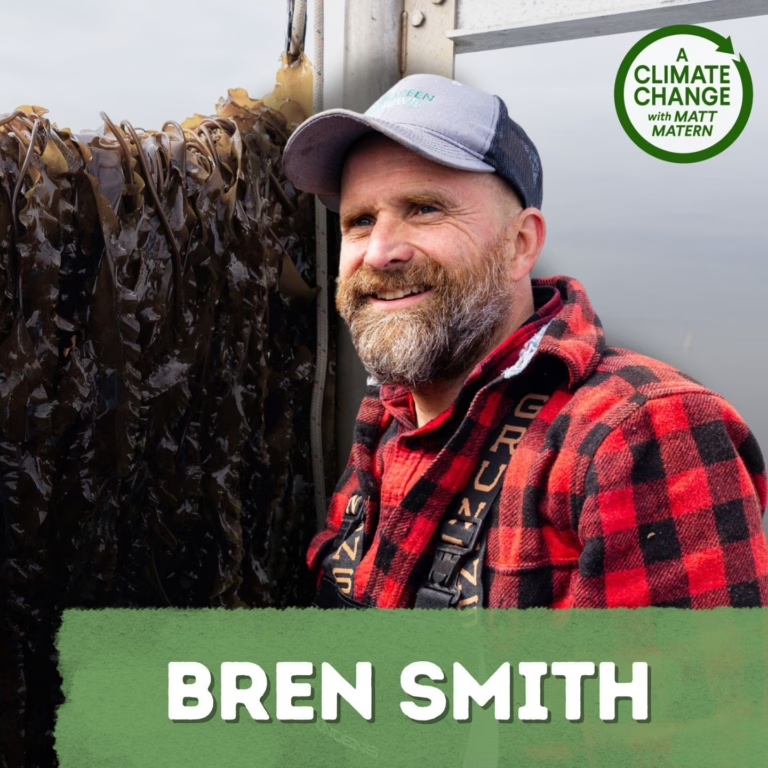
Former commercial fisherman and GreenWave co-founder Bren Smith joins Matt Matern to explain how regenerative ocean farming can rebuild marine ecosystems, strengthen coastal economies, and create resilient blue-collar jobs. From kelp and shellfish farms that require no freshwater, fertilizer, or feed to seaweed biostimulants that can help crops use less water and fertilizer, Smith shares why kelp could become a powerful tool for climate adaptation, food systems, and domestic supply chains.
You’re listening to A Climate Change. This is Matt Matern, and I’m your host. Got a great program coming up. We’ve got Bren Smith on the show. Bren’s the co-founder and co-executive director of Green Wave. And Green Wave’s kind of near and dear to my heart. Is that I’m a Tulane alumni, so our icon is the Green Wave. So we’ve got a connection right from the start, Bren. Thanks for being on the show.
Right, right up. Yeah, it’s an honor to be here. You guys do you it’s such good coverage. So I’m happy to be here.
So tell us a bit about your story and how you went from you know, commercial fishermen to regenerative ocean farming.
Yeah, yeah. Yeah, I this was not the plan. I never thought I’d be growing vegetables underwater, right? That definitely wasn’t my my vision, you know. I grew up in in Newfoundland, Canada, you know, a fishing village in the easternmost point of of all of North America and it was sort of what you imagine an idyllic, sort of perfect fishery is in many ways. It was you know, fishermen’s co op next door, kids selling cod tongues door to door.
Everybody sort of you know owning their own boats, collaborative, working together, really protecting the ocean, not destroying it. And you know, all I ever wanted to be a fit was a fisherman. And as I look back on that and sort of ask me why didn’t I want to be, I don’t know, president or an astronaut or something like that. But it’s like you’d wake up and you’d wake up and you’d see those fishermen head out over the horizon. They own their own boats, they had these self-directed lives.
And just this pride of feeding their community. And like they were jobs which still to this day people sing, you know, write and sing songs about. Right. And there are certain jobs like this. There’s coal mining, there’s steel workers, there’s you know, farming, there’s fishing. Like, we don’t hear many songs about you know hedge fund managers, but we well, great ones, right? But we hear there are like literally thousands around these cultural occupations. And I think as
Those of us that are trying to sort rebuild the American economy for these coming years, we have to remember that this is as much about culture as it is about sort of addressing the environment or the economy. We this is really we need to capture people’s sort of have these soul-filling jobs so it taps into that blue-collar innovation and we re redirect all that latent capacity towards addressing the climate crisis.
So anyway, so yeah, all I ever wanted to be was was a fisherman. So I dropped out of high school when I was 14 and headed out to sea. Fished all over the place, fished so many different things, lobster, tuna, herring, ended up in Alaska fishing cod and crab. And again, some, you know, I still missed those days. They were thrilling, thrilling times in my life. My body’s pretty beat up, but and most of the fish I was catching was going to McDonald’s. And so everybody else sort of, you know, I I
I spent a lot of time in them food movement in New York later when I did oysters and o and you know, McDonald’s was the was the sort of like the lowest class of of food. And to me it’s like still I go get a fish sandwich and it’s my safe space in the parking lot where I sort of I eat one and then I’m sort of imagin those days. But you know, we know this now, but I didn’t we didn’t fully understand it then. but we were just tearing up the the oceans, you know, pulling up entire ecosystems with our trawls. We got a sense
That the ocean couldn’t provide this for forever. And and I wouldn’t blame the fishermen, you know, the captains of industry. Yes. But as, you know, as fishermen, we just did what humans do. We got too good at what we did. Right? We just like we just drove innovated and innovated, got more and more efficient until we moved beyond what the ocean was able to to capture. But when I was out in Alaska, the cod stocks crashed back in Newfoundland and my home.
know where it was raised, and 30,000 people thrown out of work. And I think that was the most pivotal moment of my life where I had thought environmentalism was about birds and bees and seals, that it would that it was something very remote. And then I saw 30,000 people thrown out of work, fishermen walking the streets like hungry dos ghosts. I saw an economy that built up over 200 years destroyed, and sort of the emptiness that filled the
the communities here is absolutely heartbreaking. And that’s that was that moment where it’s like, there aren’t going to be any jobs on a dead planet. If we lose our oceans to ecological collapse, this is a kitchen table issue. This is not an environmental issue. And that sort of set me on this trajectory. I didn’t have any language for it. the words like sustainability, climate wasn’t a thing. This was like, you know, early 90s. So
I left there and I went on this sort of search. I ended up on the salmon farms, and that was supposed to be the answer, right? So we’re gonna protect the fisheries and we’re gonna grow salmon. That was good. We’re gonna feed the planet, new blue jobs. But that was exactly what solutions shouldn’t be, where they just took everything on land, industrial models on land, like industrial pig farming on land essentially, and moved it out to the ocean. Monoculture using antibiotics, pesticide polluted polluting local waterways, just like growing what the ocean wasn’t able to handle, couldn’t provide.
And I think what that taught me was was like we have to look at the ocean as a unique agricultural space. Like we’re going to be moving out to sea, right? You know, the what freshwater crisis, soil degradation, population rise, our food system’s going to be pushed out to the ocean. Our wild fishery cannot handle that. So the question is, so we’re going to be farming in the ocean. The question is what is it going to look like?
And what we shouldn’t do is farm around markets, right? So everybody what aquaculture did was everybody wants to eat salmon, tuna, so we grow salmon and tuna, but that’s a wild palate, that’s a wild taste. Instead, we need to look at the ocean, ask it, what does it make sense to grow? And then build an agricultural system a r around that. So that was this is a salmon farms I left the left there and then ended up eventually.
in Long Island Sound in Connecticut, an odd place for for a Newfoundlander to end up, sort of the suburbs of New York. but there was a long tradition of oystering. So I started oystering there, really not knowing what I was doing. I I I s you know, leased a f leased some water, bought some cages, got a boat, and just killed millions of oysters. Like I was running a death camp out there because it’s so different than fishing. it’s about cultivation, not chasing.
but eventually got pretty good at it. built a successful business for seven years, selling into New York at the beginning of that sort of boutique, sort of food, the local food movement coming out of out of New York and you know, the code different coastal places. And but then I was hit by Hurricane Irene and Sandy two years in a row, which wiped out my farm twice.
And that was a very, very hard time because it was this second moment I was in an ecological collapse. Like clim climate change was not discussed as much. It was sort of a big debate about whether it exists. And it is stunning to see that it’s still a debate. But there, it was seen again as an environmental issue. But my farm destroyed twice by hurricanes.
It was clear those of us on the water with like lobsters disappearing, like things were just changing so fast that this was the new normal and we were canaries in a coal mine. And on for me, it wasn’t about, it was it was about how do we, how did I, how was I gonna adapt, create a resilient farm? How was I gonna ensure that I was gonna be able to die in my boat one day, s you know, spend my life on the water, hand it down to my my daughter. So that was the that second moment.
So it’s a a remarkable journey and I I love the canaries in a coal mine you know analogy or whatever. It’s I think it’s it’s apt and it’s it’s something that the canaries are are definitely chirping or not chirping and and we need to listen and and so you pivoted and created a non profit Green Wave. tell us about about that pivot and and what Green Wave is doing.
Yeah. So I mean I learned from my oysters at that moment. Like when I started to rebuild and adapt my farm, I didn’t invent anything. I mean, I just like talked everybody, learned from everybody, borrowed ideas, stole ideas, and I think what I did was synthesized it into a into a model. And what we did was oysters are these incredible creatures, like techno Mother Nature’s technologies designed.
Yeah.
To breathe life back into the ocean. You know, they take nutrients, nitrogen, and other things, soak it in and then spit, I mean, filter it in and then spit out oxygen, you know, do 50 gallons of water a day. So here are these crops that require no water, no fertilizer, no feed, and breathe life back into the ocean. So the question for me was what else is like that? And so you have
you know, shellfish like clams, mussels, scallops, oysters, there are hundreds of kind of shellfish, and as well plants underwater, so vegetables, you know, sorry, seaweeds underwater, which grow just by using sunlight and excess nutrients in the water. so that was the beginning of, you know, the regenerative ocean farm. And that I built that up and that became successful. And I started training, you know, the lobsters disappeared on Long Island Sound.
you know, $18 million business just, you know, decimated as lobsters moved north. And so I started working with some of my friends up there who were in the lobster industry to to start farming. so I set up Green Wave with my co-founder Emily Stengel, just a little little nonprofit, really just you know family and friends. And then as we were doing that, the idea began to really gain steam. And
6,000 people signed up for the farmer training program. I there was just this explosion and then requests in a hundred countries. So that’s when we got very serious. And instead of founding a company, what I decided to do was create this nonprofit with Emily, which was meant to create create this sort of collaborative knowledge network. Because it’s hard to grow food underwater, right? It’s like a dumb place to grow food. It’s like Mars and underwater are like really tough.
environments, right? But we’re gonna have to. But the way we’re gonna do it is by crowdsourcing and working together and and and not building walls, but actually creating knowledge networks. So we’ve created Green Wave and Green Wave’s evolved over time. And now what it is is we’ve got a a regenerative ocean farming hub which is open source. We can learn to build hatcheries and farms and the right processing equipment. it has a community of 8,000 people sort of learning
learning side by side. And then we’ve got a couple high touch supportive programs for s for farmers that are are up and operational. We have the Kelp Climate Fund, which is a subsidy program that pays farmers per pound an addition like an add an additional subsidy per pound for everything they grow because of the positive externalities, right? Like Kelp, it soaks up carbon, nitrogen, rebuilds reefs. That should be priced in.
caustic help. So the nonprofit does that. We have something called the Mike Help app, which is an app which farmers are entering all their data. So we’re able to track yields and and what’s happening on farms all around the country. we have a we have a really intensive hands-on farmer training program that includes both hard skills but also soft skills so we support farmers to create co-ops and new finance mechanisms
things like that. And then we have an innovation center in New Haven where we’ve got a farm, a processing center, a seed bank, and a and a nursery where we’re we’re sort of figuring out what what are the best practices and then trying to disseminate them.
That’s that’s great stuff. you know, you you mentioned positive externalities and I was thinking that probably out on the boats in Newfoundland they weren’t talking about positive externalities too often. But that’s that’s
No. No. No. We were talking about getting ashore with with with cash in our pocket and how much trouble we could get in. You know, that was the yeah, yeah.
Well positive externalities is a is a great phrase from economics, which I studied in in undergrad down at Tulane. And you know, it’s it’s you know, it’s the kinds of things you’re talking about that Kelp does and and all the positive benefits that we get from growing it. Maybe you could kind of riff on that a little bit because I I think it’s it’s so important that we all talk about it, we learn about it, we invest in it.
Yeah. Yeah, absolutely. So, I mean, it we really agriculture’s one of these spaces where we can move beyond sustainability. I mean, sustainability is about, you know, taking a a bad thing and making it better. So your clothing, reducing its impact, right? so like Patagonia’s journey on reducing the impact of of of their supply chains around textiles would be an example.
And and of course, you know, seaweed and shellfish are extremely sustainable in that they require no fresh water, no fertilizer, no, you know, and no ag inputs, no feed like aquaculture, so no wild fish feed, and no land, which is you know, farmable, arable land. We we grow of course coarse in the ocean.
And so that makes it mo s the most sustainable crop on the planet, but we have to move beyond that where we can, and and shellfish and seaweed is where we can do that is is where it’s actually regenerative and restorative, breathing life back in the ocean. So shellfish and seaweeds, they soak up nitrogen, carbon, phosphorus produce oxygen. They they function as reef ecosystem, foundational reefs, which attract all these different species. You know, some of the best fishing in the area around is around my farm because there’s just so much going on.
There’s so so many different species are attract to it attracted to it and all the birds are there. There’s just a lot of activity and we should be proud of that as as regenerative ocean farmers that we’re we’re working to rebuild ocean ecosystems. you know what’s interesting in this journey, you know, so we know that we c we grow these species and we they do good things, but markets don’t, you know, value them.
And so the answer to that was supposed to be carbon credits, and that was the the big push. And that’s been an interesting journey for us because we were very excited about ecosystem credits and carbon credits. but what happened was that what we found was that you know, as we’re increasing supply and there were more and more farmers coming on board, the the science was too slow. So that sort of getting the science to to the to pro provide the rigor in order to have the confidence that carbon that the amounts of carbon being sequestered.
The policy was too slow. So it was just moving so slow through government agencies and then you know to set a price on carbon. And then when that when that was going to come out, the price was going to be too low. Like what’s the goal of of carbon credits is to incentivize farmers to plant
More good things, right? You know, to to adopt these good practices. But so we decided because it was too slow and the price was going to be too low, we needed to use our nonprofit to to create the subsidy program as an alternative to blue carbon credits, right? And that’s the Kelp Climate Fund. and we would hope to eliminate that over time. But one of the you know, one of the the the the really unfortunate things we’ve seen across agriculture in general is just the challenges around
valuing those ecosystem benefits. and so that was a real lesson in our our journey to of like like how do we not only harvest crops, but how do we harvest the ecosystem credits? it seems like you know at least the US, you know, our country isn’t there yet. Yeah.
Yeah, I guess the question is how do we get it to the point where it is sustainable in an economic sense, that there’s enough economic benefit that it’s it’s self sustaining. now, of course, some degree of subsidy seems reasonable in a you know, an early industry and we’re trying to get it off the ground and it has, as you said, so many positive externalities it’s worth paying for. And the problem with our economy is it doesn’t measure.
Exactly.
Hose positive externalities, it it it basically says you get no benefit for all this positive contribution that you’re making to the wider community. And that’s that’s challenging. But how far are you away? How far are farmers away from kind of having kelp be a economically kind of sustainable, viable crop kind of on its own.
That’s right.
Yeah. Yeah. Yeah. Absolutely. So, you know, we just did this kelp this industry report, the state of the the kelp industry. we released it this year. because it’s been ten years we’ve been at this. and and so we it in order to step back and really assess where the industry was and what’s and sort of figure out what the strategy is going forward.
And because the the on the profitability what we were seeing was those doing polyculture like like w which which which is the model I was raised in, so you have a crop of all for all seasons, you’re not just just doing kelp, that that’s profitable, right? Because you have multiple markets, multiple options, and then if one crop fails or the market is lumpy, then yeah you have other other options.
So we find that shellfish farmers that are also doing seaweed they’re very resilient and doing well the farmers that are kelp only it’s been really boom or bust so you so we’ve had startups you know companies begin on on both coasts they grow fast these are value added you know companies they start buying a a lot of kelp farmers are doing well then and those those companies which are which are venture funded run out of money and then they disappear.
And it’s interesting, we’ve seen over the last decade in the food and agriculture space, a lot of the venture funding that went into agriculture and f and foods really wasn’t a resilient enough to solve the complex problems of agriculture. Like it’s not apps, right?
These aren’t is it is it these are infrastructure heavy food logistics, agricultural logistics is really, really low margin, things like that. They were just a very di a different set of set of problems. So when we did this report, what we learned was first of all, the good news was that we have enough permits know, there are s close to six thousand permits throughout North America, which is stunning.
There were none when we when when we started ten years ago. there are enough farms, there are enough nurseries to grow between like ten to thirty million pounds. So we proved this like when we started, we were told that small and medium sized farms would never be able to scale up to commodity levels, right? And we proved that that’s not the case. And there’s a whole bunch of reasons for that we won’t go into, but that was that’s a huge success.
And so our report, which was based on a whole bunch of data points, you know, data sources that if we take our existing permits or experienced farmers or nurseries and mobilize and optimize what’s there, we’re gonna actually produce at scale. So the supply issue is there. The problem has been the market, and I think there were two mistakes that were made. One is a huge amount of money.
We were talking like, you know, probably half a half a billion dollars went into very, very speculative moonshot efforts around kelp. So you had the Department of Energy coming in around biofuel, you had companies like Running Tide and Kelp Blue coming in around blue carbon credits and actually like selling blue carbon credits before kelp you know farms were were up up and running. And you know the trouble was they picked these two
markets of of you know biofuel, which is the most technically advanced, like the fossil fuels the most technically advanced, sophisticated, politically powerful industry on the on the globe. And the the idea that seaweed was that should be the first market we we should push on, I think was a real mistake. And blue carbon, like I said, the science was not there and the policy wasn’t there at all. So huge amount of money in the that can be okay sometimes if it leaves a lot of
You know, it l it in its wake, it leaves a lot of infrastructure there and and and a lot a lot of benefits. The trouble was it went into such speculative activities and we saw basically at the other end no hatcheries, no farms, no, you know, processing facilities, nothing. So all that money just went up in smoke, right? Which is really unfortunate. So we lived through this bubble. Then this other route that we took, and I think it was a mistake.
Which was specialty foods because that’s what I come out of. You know, I created a a CSF, you know, com community supported fisheries. I was selling into restaurants and Whole Foods, sort of really that specialty food mystery. The trouble was was that specialty food just couldn’t scale. Right? You know, the the noodles and the pickles and the the you know the the the beef alternatives, things like that, they just weren’t scalable.
It was good in that it it moved probably a million pounds or so through the system, right? Every year, got things going, got the got farms going, but it wasn’t able to to scale. So now we’re in a situation where we have this robust supply, really experienced farmers with the permits, all this sort of stuff.
And now we have to think we’ve got to start mobilizing the market. A little the speculators have all left. They’ve moved on to other things like AI. And now we need to rebuild this around actionable sort of, you know, robust markets. And the good thing is kelp is just a powerful crop.
It you know, it it has so many uses in not only food ingredients as a replacement for, you know, synthetic stabilizers and texture and stuff like and and proteins, but also as a biomaterial and you know plastic alternative coatings and then also in agro agricultural inputs, you know, things like biostimulants. So there’s so much work to do. It’s just while we were working on supply, we thought the folks on the market side with that much cash were gonna be successful and they that that just didn’t happen.
Well it it is fascinating trying to find the the best uses for it. I I don’t I’m curious as to how like how big is the Japanese market for kelp, ’cause I assume their market is is much more robust or larger than the US market as i it’s such a intricate integral part of of their diet.
Yeah.
Well, here’s the crazy thing. So yes, there was this if you look back and and I I write about some of this, but I I I didn’t know it at that point when I wrote Eat Like a Fish, where I go into the sort of his some of the history of kelf. But there was this moment where where kelp and seaweed was really heavily used in the US.
So in the in the early of early 20th century, like in San Diego, for example, there were 1,500 workers on the docks of San Diego producing dozens of different products out of kelp, including fertilizer alternatives that was going to nearly a thousand farms in the Midwest to rebuild soils, right?
This was something, and what happened was that they this was all based on wild kelp forest and the wild kelp forests in in in around San Diego were completely destroyed and decimated. So they ran out. And then there was no nowhere to go. So that was one that was one piece where it is part of our our history the but in in of course in Asian cultures it’s really, really heavily used and it’s used in cuisine all the time.
I mean I think what what we believe is the kelp as an ingredient, as a biomaterial, as a biostimulant. we don’t have to shift tastes. I mean, we worked on that. We all tried to like in the climate movement, we’re trying to create climate cuisine and try to take these things that are, you know, not delicious and make them delicious. And all the chefs were working on it and stuff like that. The trouble is shifting tastes is extremely slow, right? And the climate emergency is fast, right? So if we had a hundred years, yeah, we could probably do it.
But there so that’s why we really need to not try to ro you know convince everybody to eat kelp, but rather weave it into all these in existing industries. And that’s what we’ve seen recently, which is fascinating, is that like the world’s just changed so much since we launched GreenWave and f since I was first started farming. Where like sustainability, we had lots of big companies come to us and wanting to use seaweed, right?
And and it was all around sustainability, lower lowering their impact. And sustainability, climate impact was actually, at the end of the day, a finger on the scale. It didn’t change really the product streams and the decisions that what larger food companies were were were making. But what’s happened is that they’re facing serious problems. And so, you know, whether it was first COVID, then you the world works in threes, like COVID.
Then the Ukraine war and then and and and and now the breakdown in geopolitics, people are the companies are very, very worried about their supply chains and where are they gonna get their ingredients of the future. Right. And so just like everyone’s on a hunt for, you know, precious metals, they have to figure out where they’re gonna get their stabilizers, their proteins, all the different ingredients. And so we’re seeing larger companies now. We just created a program with Unilever.
Called Kelp Colab, which is you know, companies have these problems that they need to solve, and kelp is actually one of the ingredients that they can use that it can be domestically produced. I mean, anybody that can produce a raw commodity at massive scale domestically, I think is really well positioned in the future. And that’s what’s changed, right? We were a climate crop before, now we’re a domestic crop with that we can grow it at at at real scale that has all sorts of good things in it, right?
That that companies need. And so the the the the country’s changed in that way. We see it with like we’re seeing this in textiles and forestry. We’re seeing in the soldier fly industry this huge push now for domestic production and we’ve we’ve sort of become part of that. So I’m I the market side what’s become headwinds I think is shifted into into tailwinds.
It’s great to be able to shift on a dime and and kind of do a jujitsu move and whichever you know, way the wind blows, you figure out a way to tack into it in in a in a healthy way. Talk let’s talk about this biostimulant from kelp poise to help farmers grow crops. that sounds like a a potential huge win for both agriculture and for the environment in in growing kelp.
Yeah. So I mean, you know, when we think of kelp, we think of that holy strategy. So, you know, we c we can use it for for ingredients in in the food sector, and we can use it as biomaterials, as alternative plastics and coatings and things like that. But this third piece of using it as an agricultural input, we’ve learned over you know, we step back a couple things, a couple dynamics. One is
Our oceans are filled with nutrients that come from land-based agriculture, right? That nitrogen, the phosphorus, all this stuff runs through the waterways and ends up in the ocean, and that’s killing our oceans, right? Excess nitrogen and things like that are creating dead zones.
And so what we need to do is create this nutrient loop, right? A bridge between land and sea where the nutrients c come down from land, we collect it with our seaweeds in the in in the oceans and then bring bring those nutrients back to where they belong in the soils.
Right. And so b build a bridge between land and sea. So that’s like one principle. And these sort of nutrient sheds are are piece. The other piece here is that if you look back in history, whenever the soil has been in trouble, everywhere in the globe, in coastal regions, people have gone to the sea to rebuild the soil.
Right? It happened in New England, happened in California, happened in Ireland, happened in Chile. You know, it’s like it this is really what people do. So this is one of those times our soil and land-based agriculture is real in trouble really in trouble when we need to go to the ocean to help rebuild it. So by so seaweed has all these nutrients in in it in there that that
That soil and plants need. And so it’s not a we turn it not into a fertilizer. Fertilizer is like, you know, nitrogen, phosphorus, it’s NPK, you know, potassium. This is a biostimulant. And what it does, it boosts the health and the efficiency of the plants and soil. So for example, wineries in Napo Valley have used seaweed biostem for a long, long time. They call it the sunscreen every farmer needs. All right, so they spray it before heat, high heat events and it helps protect the plant.
And what really what happens is that the the the nutrients that are in there increase the efficiency of the soil and build it up in the plant to where it’s n naturally should be. So it needs less fertilizer and less water. So it’s about a 20 to 30 percent reduction in f fertilizer need if you’re using seaweed biostimulant.
It’s about, I forget the number, is 7,000 gallons less water per hectare is needed. So it just creates a more efficient system and get those plants up to where they need to be. And about, you know, I think point five percent of the planet of farmers use seaweed biostimulant now. We need to get that up significantly. And Green Wave has a program to try to get that into a million acres here in the US. And I think we’re heading towards this place where.
You know, where we we’re where where the aim is nutrient independence. I mean, fertilizer prices doubled in twenty twenty four for land-based farmers, right? And they’re facing incredible pressures on drought. Wha here’s the thing where we can grow our biostimulants, our agricultural inputs in our local waters and bring them back to land to to to help provide crop protection in this in this era of climate change.
And so because we’re solving problem again, problems like it like we’ve moved from kelp being a hero climate ingredient to kelp being a working class problem solver for existing industries. Well agriculture is in trouble because of fertilizer costs and drought. Kelp can play a a role to help address those challenges.
Yeah, I mean that’s that seems like an incredible opportunity. And I guess the question is how is that working out kind of on a as we talked about earlier, just a dollars and cents metric for for farmers and and I mean from what you’re saying, it seems like it should make sense if they reduce fertilizer costs and decrease the amount of water usage.
Yeah.
Mm. That that seems like a an obvious win. I guess the question is, are there manufacturers out there converting enough kelp into this biostimulant?
Absolutely. I mean, one of the challenges I mean, land based farmers, like any farmer or fisherman, just like they have the economics down to a penny, right? And a land-based farmer knows exactly how much they can pay and should pay for agricultural inputs in proportion to their yield. Very, very price sensitive.
So that means a real challenge as you’re bringing something like a biostimulant to market because farmers, you know, their str land-based farmers are struggling as it is. Good thing is it’s it’s it’s already heavily used in certain industries, in specialty crops and berries and wineries. it’s used heavily, it’s used used in the dairy dairy sector. So and what we’re able to do, all of that seaweeds that are used for biostimulant now are all wild harvest around the globe.
Right. So that it’s actually clear-cutting our oceans when we use seaweed biostim in in land-based farms. But the prices of of of seaweed bi biostim from wild harvest is going up. So when we compare, Green Wave actually has a processing facility for biostimulant, and we’re able to come in at 10% lower than existing biostim prices because we’re able to grow, we’re able to access seaweed locally. And as far as scale this is one of the benefits of the last ten years.
Like there are now five large-scale seaweed biostimulant operations in north in North America, right? And all based on farmed seaweed. And you’re able to they’re able to produce it really high volume. So that’s not enough, of course. We need more of them, but it’s it the the key is that through fermentation systems with the biostimulant, it’s just not an extremely complex complex or expensive proposition.
What you’re trying to do is break open those kelp cells so land based plants can access those nutrients. And we’re able to do that with some unit economics that just really work on our on our side.
Well, that seems like it has a tremendous potential not only here in the US. of course, I’m familiar with California and the farming here and and the fact that we’ve had lots of drought and lots of farms are having to cut back because they just don’t have enough water. and I believe that’s happening across the western US and and in other parts of the US as well. So it’s
We we we have including in California this year we’re we’ve got trials in twenty six states with thirty-two crops on I think close to two thousand acres, different plots all around the country with so it’s gonna be a big surge of data coming in of showing seaweed biostem versus just using traditional fertil you know, fossil fuel fertilizers. So it’ll be an interesting moment. The data that’s been coming in has been real been been strong.
In fact, see the biostimulants work best on crops that are under stress. It’s interesting. Like if you have crops that are doing fine, they have a great year, they get the great right amount of water that ye, you know, good rains, and their nutrient profile looks fine. You don’t see much of an effect of seaweed biostim. If the plant is in trouble, if you’re facing drought stuff like that, you see an incredible difference as the seaweed activates that you know, the hormones and the the other things in the plants.
So I wish, like I really wish we hadn’t gone into biofuel and into blue carbon, but instead right from the start had been in the in the gone into the ingredient space and in the biostimulant space, right? And I think we’d be but you know of course we I’ve just we’re just a small nonprofit and we can’t direct where the where the captains of industry to go and you know where Silicon Valley heads.
Well, sometimes you need to crash and fall down before you find your way. So hey, at least the path is is fairly clear and it’s opening up. where do you see this going in the next three years, five years, ten years?
Yeah, I you know, I I think you know, it’s a reflective time for all of us, you know, what w with the world the way it is. And the we were so part of that climate moment in the twenty twenty tens. And there was this incredible emergency, and we needed our solutions to go really fast. So it was all about like how do you scale, how do you scale quickly, and how do you how do you build these solutions?
And I don’t think you can build solutions that way. They’re too fragile, right? Is and I think we’re an an example of that. and that instead you need it this is gonna be a multi-generational issue to rebuild the product you know, capacity, production capacity in North America to address climate change, to do a mix of adaptation and carbon reduction.
This is gonna take a a a long time. I mean what, you know, you look at solar, nineteen seventies, it was in the, you know, Carter comes out and look how long it’s taken. It takes a while to solve these problems. So those of us in the climate movement there were in such a rush.
I think the risk is you create fragile, fragile systems. So we’re we really need to build for the long haul something, things that are durable, an industry that can weather the coming crisis and storms. We need to build things that we own. So you know, through co-ops, through shared finance, things like that, things that are that communities own and that can’t be taken for us.
And we need to build like I think a huge amount of the the elite sphere is building in the clouds now. I think we want to build a real things for real people and really stay focused, focused there. and I think there’s two directions of sort of where we could where where we will take the country. And I want to be on the rebuilding side. And we see it, it’s like incredible organizations like Industrial Commons, which are rebuilding domestic fiber supply chains.
There’s Northern Forest, which is doing it, doing it around the forestry industry. There’s actually, you know, I’d put this oddly enough in the same space. There are folks that are rebuilding the internet and social networks from front you know from scratch in a way that are that are actually pro-people and I’d put kelp in this same spot of how do we take these legacy industries, rebuild them and rebuild them for people, make them circular and make sure there’s horizontal benefit and the benefits aren’t just going to a few folks at the top.
So I really my hope is that what we have is at the end of the day really resilient, grounded reefs where you have 20 to 50 farms in an area, processing hub, seed banks, and then rings of entrepreneurs creating value added products and then we replicate those reefs up and down the coast and and we see hundreds, if not thousands, of them around the world. I think that’s the hope. Where I don’t want to go is into a space where seed is privatized.
So farmers have to pay large corporations for their seed where where we don’t own our infrastructure, we need to own that supply those supply chains, and that we we have access to lease waters that that you know there that there isn’t a mass privatization of the seas. It’s interesting. Like the fun thing about this space, it’s rare do you get to build an industry from the bottom up, right?
And and like look and plan and be like, okay, let’s figure out how to create farmer owned seed libraries. Let’s make sure leases are all you have to live in the home state in order to lease land. Like we’re able to look at this and build a system from the the bottom up and that’s been really that’s been the fun and exciting part.
We just have to make sure that it continues and that as we have more success, that that success isn’t taken from us.
Well there’s there’s a lot of questions that come to mind with what you just said. one of them is which countries are maybe on the cutting edge, maybe further advanced than the US in this area. And you know, you mentioned, hey, you’re growing in the water in the waters, which nobody owns except for I guess the leasing rights through the government, and the challenges associated with that.
And because I had heard from I believe a kelp farmer that was trying to do something here in California saying, hey, it was taking, you know, sixteen, seventeen different agencies had to sign off on stuff before, you know, they could do anything. And then they eventually went to the Philippines and did it, you know, in you know, quite a bit faster with a lot less red tape. So maybe you could talk to some of that.
Yeah, yeah.
Yeah, absolutely. I mean, California is its own culture, right? And like there’s a reason, you know, Ezra Klein wrote abundance and he’s from California, which is like and like the the the the how hard it is to move through coastal c commissions in order to build things, how hard it is to do affordable housing and stuff like that. I mean, California is like a is unique because many other places, whether it’s Alaska, whether it’s Maine, whether it’s New York, Connecticut, throughout Atlanta, Canada, BC, just leases were actually surprisingly easy to get.
And they and there were there were structures. And because there was a shift in like and the actually the head of the coastal commission years ago in California said, Listen, I’d love to approve these because we know that kelp farming and seaweed farming is really good. But my mandate as a coastal commissioner is to protect, right? Not to build, not to reimagine not to right.
And so he he was actually asking for a change of of direction of mission from from above, right? So so it’s so we see certain regions really surging forward with with Burbank, but California unfortunately has been the the hardest one to do. Actually what we’re hoping is as biostimulants become successful in California, there’s such demand for California’s probably ground zero for folks that want biostimulant and have seaweed biostimulant and have used it in the past.
There’s a long tradition in California that if we build that up, then then the the the the policy will follow. That why are we taking why are we having to bring seaweed from Alaska and New England, right, to California when it can be grown domestically.
So I think that’s gonna be at the end of the day, that’s the gonna be the equation there as far as expertise, it’s interesting. So long tradition in Japan, South Korea, the Philippines, China. what’s interesting is there’s been a a whole bunch of cross pollinization because what what’s happened to their industry, I spent a l I did did a bunch of trips and spent a long time with farmers in these different regions.
And what they haven’t done is updated their system. Their labor costs were low enough that like Japanese farmers for Nori plant, I’m not kidding, a million bamboo stakes by hand, right? and now they they’re short, I think 20,000 workers. They can’t like they need 20,000 new workers in the industry because folks are aging out and no one wants to do it. So there’s a really interesting collaboration between now South Korea, Japan and the US.
In order to do some technology swapping because we’ve gotten quite good at growing sort of high volumes in small areas with with with very different farming designs. And then you take somewhere like Philippines, the challenge they’re having is warming waters. They’ve always grown in very shallow waters and their head their production level is going down quite fast.
And so again we’ve seen folks in the Philippines reaching out being like, Okay, how do we change the farming system? Because we have to go out to deeper waters now where it’s cooler. So I I I’d say the centers of innovation is Asia. There’s incredible work being done in Norway, Canada, the US is incredible work in Mexico, Chile. The issue is the oceans are changing so fast, and globalization is so disrupted.
And winding down, or we don’t know what it’s gonna look like, right? That what we’re finding is that the only way we’re gonna get through that is by s swapping strategies and collaboration. So we’re finding that each of us have a piece of the puzzle, and the only way we’re gonna do it if we’re is is if we’re sort of working together and and take a collaborative, like a pre competitive stance right now as far as technology transfer.
One of the things I had a guy on the program recently and he was using AI and drones to to plant forests and things like this and curious as to whether or not that kind of technology is being used in the planting of of kelp.
Yeah.
Yeah. So this is such interesting. So there have been a lot of huge amount of efforts. And the Greenway Farm is used as one of the main test sites for all sorts of drone technology and sensor technologies. We’ve worked for we’ve worked with like, you know, Google X and all the universities and stuff like that.
It’s been a place because we’re very open and welcome to innovation. And what’s interesting, the ocean is brutal, right? Is like like for it like the sensor technology and the drone technology is just cannot handle the biofouling, all the things that grow in and gum up the works, right?
And so they’ve tried to create chemical coatings that that are able to protect all the working parts from the ocean. And the ocean just always wins. And I I mean I would say we’ve seen an incredible history of failure in ocean farming because of the lack of humility. And I don’t mean that lightly like I’ve done it. So when I started my farm, like when I redesigned the farm I had these big buoys and I was gonna like, okay, I’m gonna take on the hurricanes by just making sure that everything sort of can weather these massive storms.
And the the the storms just picked up my farm, moved it like, you know, three quarters of a mile away, just like that, right? and then I learned, no, I need to be a willow, not an oak. So I actually reduced the size of all my buoy buoyancy, said buoyancy so that the farm just bends in the storms underwater and then pops back up. And that’s so there’s a certain design.
Like you need a certain des set of design principles and and stance when you’re working with the ocean. I bet it’s the same on Mars, actually. Like you just can’t fight, right? What’s going on what’s going on here? It’s just always gonna win. And drone technology and automation is one of the examples that ocean’s really tough. I will say another thing too, which is like I started with this being like, I want to die in my boat. These are soul fulfilling jobs.
The climate movement, the effort to rebuild a move the America needs to be filled with blue collar innovation and and like tapping into all that ability. I don’t want a world I like I I’m I’m not gonna I don’t wanna I don’t wanna be part of a regenerative ocean farming system which is run by robots. It’s just not interesting to me, right? So like it I f it I think it’s boring, right? What’s interesting is it n a a use of technology
That’s that’s sort of appropriately applied to human later labor and human innovation. And then we do it just like I’m working with the ocean in concert with the ocean in order to build these farm in my farm together with the ocean. We need to do that same collaborative thing with technology. This idea that technology is going to come and replace, you can just see how that’s working aro around the country. and you know, I’ll de I’ll defend it with my shotgun, my farm from the robots, right?
Well, I I think that sometimes it’s a bit overhyped, so the tech solution. So, you know, I I think some a little of it goes per probably a long way. You know, before we wrap it up, I’d like to talk about your book, Eat Like a Fish, which you got the James Beard Award winner prize and how did how did that come into being?
Yeah. Yeah. Yeah, yeah, yeah.
Yeah, I’d, I never want to write a book again. It was a brutal brutal thing. I I so I was just actually this was I was working with a bunch of chefs and we were gonna do a a small cookbook, right? A little bit about my story and then, you know, a bunch of recipes in there from famous chefs. And that’s what it started as and then as it got shopped to publishers, the publishers asked instead for a more of my story.
So that’s that’s how that’s how it it began. it’s funny I would love you know I joke around about not I never want to do another book. I think I would love to rewrite that book or overlay something and all the lessons learned, right? We’ve learned so much through the way. Like I know my story, but then as more people have come into the industries and all the incredible all the incredible folks that have come in
And the mistakes we’ve made and the things that have gone well. th that one I’d like I’d like to tell. I think there are some some lessons in there. But it was a it got a pretty it got a decent reception and it was I got to tell the story of falling falling in love with my wife. So that’s that that’s a good thing.
That’s a beautiful story. Well, everybody should go out and check out the book, Eat Like a Fish and and also, you know, check out the Green Wave and the site that you know, I the website and volunteer and and do all the things to support the work that Brenn is you you are doing out there in the world, which is is great work.
Yeah.
Thanks so thanks so much. It was an honor to be here. This exciting time, like the world’s in crisis, but this is a real chance to like rebuild our communities and build them in a way where where you know we o we own them and that we we’re sort of central from the productions. We’ve had enough sort of solutions from above that have that have that are being forced on us. And this is a time instead that that they can they can come from below. So so join us. You know, it’s all like all hands on deck.
Well, I I love the message and I’m I’m right there with you. So let’s just do it kind of one day at a time, you know, with just what we can do today. So you and everybody check out greenwave dot org, right?
That’s right. That’s right. Good. All right.
Yep, greenwave.org and join our online community. There’s the you’ll find people arguing about everything from from anchor size to blue carbon.
Love it. You know, it it’s we learn a lot through arguing. I I know that.
Yeah, exactly. Exactly.
So well thank you for being on the show and we’ll love to have you back sometime to follow up on everything we’ve been talking about.
Yeah, I would love to. It was an honor. Thanks so much.
(Note: this is an automatic transcription and may have errors in formatting and grammar.)