
Hear us on Apple Podcasts, iHeart, and Spotify Podcasts. Subscribe now!
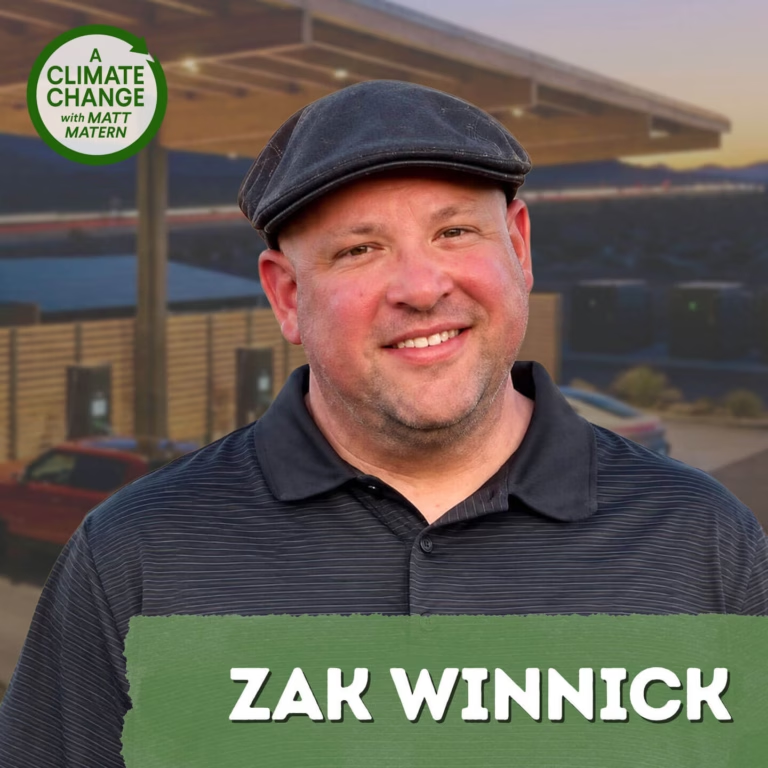
Matt Matern speaks with Zak Winnick, founder and CEO of Rangeway Energy, about reimagining EV charging for the next generation of drivers. Zak shares his vision for hospitality-focused charging stations with reliable fast charging, comfortable amenities, solar power, battery storage, and other clean energy solutions. They explore the challenges of building EV infrastructure, the future of ultra-fast charging, and Rangeway’s goal to transform the road trip experience.
You’re listening to A Climate Change. This is Matt Matern, your host. I’ve got a great guest on the program, Zak Winnick. Zak is the founder and CEO of Rangeway Energy. Welcome to the program, Zak.
Hey, thanks for having me on, Matt. Great to be here.
So tell us a little bit, mean, I know you have a background in hospitality and you have a company that you built that is called America’s First Hospitality Forward EV Charging Network. So how did that come about?
Yeah. Was kind of a really long story. I’ll do my best to summarize it. I’ve been an EV owner for about 15 years. And, during that time I’ve worked most of my career in the hospitality industry, working everything from being a phone operator all the way up to being like a front office manager running operations in a hotel. and then also on the flip side, I was also, an IT director for a couple of hotel companies and properties as well.
So when I lost my job last January, January 2025, I’m trying to figure out something to do. My position was eliminated. I was the IT director for a healthcare AI startup. And I was like the joke that my job was one of the first ones to ever be eliminated by AI, because it was right at the start of that trend, if you will.
So I was trying to think about something in some way to do something while I tried to find another job either in the space or something else that, you know, maybe make a slight pivot. So I was sitting there one day and had one of those wonderful light bulb moments where I was just like, well, hey, I’m an EV owner. I’m in the EV community because I, I, I’m community director for one of the local EV car clubs here. I’m also the executive director of an EV focused nonprofit organization as well.
So I’m like, well, why don’t I take all of the complaints and everything that I hear about people around, like that are complaining about charging and do something about it. Like my background’s in hospitality. I’ve built hotels, I’ve run hotels. Why not take the experience that these drivers are looking for with amenities and really good charging and all of that and turn it into a company. And a year and a half later, here we are.
That’s great. I mean, taking what you really want to do in life and going out and doing it is a superpower. So more power to you to get this started. how is it going? What kind of roadblocks did you run into? How did you solve for those? And what are the next set of challenges for you?
Yeah.
Yeah, I mean basically a lot of it is really easy because it’s one of those like at least for me it’s one of those jobs where it’s kind of like if it’s your passion and You know and it’s fun. Then you’re not really working. That’s what it feels like The only time it ever really gets like that is when we find like the perfect site to go and put one of our locations on It’s it’s getting the funding and that’s kind of the major roadblock that I’ve been running into is getting funding
A lot of people love the concept. They love the idea. I’ve talked to VC firms. I’ve talked to angel investors. I’ve talked to private equity, like all of that. And they love the idea. They just don’t see how it’s investable because they’re looking at it from an infrastructure play. They’re looking at it from, you know, what all the other charge point operators are doing.
They’re like, well, know, Tesla’s just throwing these in here, super light, know, electrify America just goes to all of these places and it’s super cheap to put it in. You’re looking to do something way more like we can’t really see how we’re gonna get our, you know, three to $4 million back basically. And so that’s kind of where I’m stuck or have been stuck.
And so, you know, I’ve got a great partner. We’ve got some sites that are being planned in Missouri. And fortunately, we’ve kind of found a way in to get those built, which is awesome. I’ve got one coming up in California as well, Southern California. And then I’ve got a couple of unique concepts with some partners that are in the works as well that will be hopefully coming to California as well.
So I didn’t realize it would cost that much to put in a site. Why $3 to $4 million? That seems like a lot for some cart.
Yeah, the chargers themselves cost and you know, depending on if you’re looking for good quality, reliable charging, which is what we’re trying to bring as well. You know, a good one charger is going to cost you anywhere between 70 to $85,000. And that’s just for one charging dispenser and the hardware to go along with it. That doesn’t include the site work. It doesn’t include getting power to the site.
You know, we’re, looking to, you know, being hospitality for forward and hospitality first in our mindset. you know, we’re, building the amenities along with it. So building the structure, staffing it, stocking it, that’s not cheap either. So, you know, and, depending on the type of infrastructure, like, you know, we’ve been exploring doing some off grid locations as well.
And the infrastructure alone for the solar, the battery storage and the charging hardware is roughly about $3 million. And that’s just for the equipment itself. That doesn’t include anything else, right? So that doesn’t include land acquisition or, you know, like I said, any of the site work, design work, anything like that.
You know, for a basic light site, you can probably get away with, you know, and depending and again, depending on the hardware, you can, you can get away with doing it for you know, $400,000 to $500,000, but is it going to be a site that people are going to have a reliable charging experience at? Maybe, maybe 75 % of the time, but you know, we’re aiming for, you know, at least 90 to 92 % at minimum for reliability and for return visits.
When you say reliability, what falls into the 90, the 10 % of charges that kind of go off what is planned?
Yeah, the payment hardware doesn’t work. So, you know, can you tap your phone to the payment terminal and does it work reliably? Does it go through? Does it, you know, are you able to be charged for your session? Does the hardware initiate a charge or does it fail every time? Or is the charger online itself? You know, has the hardware failed and need to be replaced or repaired? You know, that’s a lot that you have to look at. And, you know, is it maintained well?
Goes into the reliability also. So, it’s all about maintaining and making sure that everything’s working at 100 % in order to get it to that 90 to 92%, if that makes sense. Because in that 8 to 10%, it might not be the charger. might be user error. It might be the car rejecting the session. There’s a bunch of different other variables that go into it. you know, that’s we try to take care of what we can on our side. And that’s making sure that we have reliable hardware that runs, you know, that 95 to 100 % uptime.
Yeah, as an EV owner and I bought my first one in 2015 and then I bought a new one or leasing a new one just recently. To a certain extent, like this is just water to the fish and where you don’t really see or think about how much investment is required to put in a site like this and the thought that goes behind putting it in a good place and all this. What is setting your company apart from say an Electrify America type site?
Yeah, I mean, we’re looking at places that a lot of the other ChargePoint operators aren’t looking. So I’m looking at travel patterns. I’m looking at places that people are vacationing. I’m looking at, you know, those highways that people want to go drive on or used to drive on. mean, I when I first started the company, I was originally looking at like Route 66 because I’d always wanted to take a trip from Santa Monica to Chicago on Route 66 and drive the whole thing.
When I started thinking about that, that was, you know, back in 2014, 2015, when I had my first EV as well, you couldn’t do it. And so, you know, maybe that was like planting the seed in my head. like, hey, maybe we should start a charging network and do that. Now you can do it. I’ve had a couple of friends actually documented on YouTube that they’ve done the whole trip from Chicago to Santa Monica in an EV, which was awesome.
But you know, I’m looking, I originally was looking at route 66. was looking at Pacific coast highway here in California. you know, there’s, there’s some highways through Nevada. There’s, you know, cross country highways as well. and there’s, you know, large gaps of in charging, you know, thinking anywhere between 150 to 250 miles. A lot of EVs can’t make that. And if you’re, you know, let’s say you have a vehicle that’s capable of towing.
And you’re driving an EV truck and you’re towing like a travel trailer, you’re getting 130 to 160 miles on a full charge. You’re going to have to stop frequently. And if you’re trying to go someplace like, you know, if you’re driving down, I’ll just say like highway 395 here in California, you know, from Yosemite down to like Palm Springs, you can’t really do it because the charging infrastructure really isn’t there.
So you have to, you know, get away from the scenic areas and the camping and get back on the interstate. So, you know, I’m looking at problems like that or, you know, looking at around national parks and state parks as well because there’s not a lot of charging infrastructure out there either. you know, there’s a bunch of different variables that go into what we’re looking.
Yeah, in terms of a site, are you looking at putting in actual amenities like food and beverages or is it more just like a good solid place to get electricity?
Both. we want, we want the stop to be really good. you know, we want you, you’re going to be there for 20 to 30 minutes on average. we want you to be comfortable when you’re, when you’re there and not sitting in your car or if you’re in the desert, not out in the heat, or if you’re in like Colorado and it’s in the middle of winter, you’re not going to freeze. so we’re, building reliable charging and we’re building that indoor space where you can get out and kind of stretch your legs or have a change the scenery for your body, you will, provide Wi-Fi.
We have a really unique program for the retail that we’re gonna have in those indoor spaces. So you’re not gonna walk in and find the typical vending machines. We have a couple of unique partners that we’re finalizing some agreements with where we’re gonna have their products in there. So you’ll get a different experience from your typical gas station or rest stop as well.
Yeah, certainly talking to a friend of mine who was just doing a cross-country type trip and saying, Hey, he kind of enjoyed the opportunity to get out of the car and walk around. And because after you’ve driven for four or five hours, six hours, you’re ready to kind of stretch your legs and, and do something. So if you can provide something that is more interesting than just a typical gas station amenity, you’ve got, you’re going to pull some people in.
Yeah, and you know, we’re looking at not just putting in a building and calling it a day, you know, with with some fancy chairs and a table like we’re thinking about the whole experience too. So we’re thinking about squeegees and air tire pressure, air hoses and possibly dog parks, you know, so that way.
You know, if you’re traveling with your pets, you’re not you know, making them go to the bathroom on a sidewalk or in some rocks, it’ll be like a nice grass area that’s fenced in. You know, so we’re really thinking about it from the driver perspective as opposed to like, is this site going to make me money? We want it’ll make money from everybody visiting it because we’ll have all the amenities.
I certainly remember being, driving up to Big Sur in like 2015 and 2016, something like that. and I was had like a few miles left my my battery.
Yeah. And, you know, fortunately, the people at Esalen let me charge for a few, you know, 15, 20 minutes off of their charger so I could make it to my hotel a little bit further up the road, which they did have a charger, but, you know, it wasn’t like a public charger. It was only if you were staying at the hotel.
So Yeah, and it’s great that hotels are offering those amenities now. I know a couple of the big hotel brands are starting to offer that and the majority of their properties, which is fantastic. I always like to tell the story when I was I lived in Nashville for for about eight years and that was around 2014, 2015 when I got my first EV and I was trying to convince my general manager to get some Tesla destination chargers installed in our parking garage.
He was a car guy too. He drove like an Audi R8. He was a go-kart racer, like a professional go-kart racer, like all this stuff. So like he was really into cars. He always wanted to race me. I had a Model S at the time and he had his R8. So I’m like, I don’t think you want to do that because I don’t want to embarrass you.
But we were trying to, I was trying to get him to install the destination chargers and Tesla was even offering a program where they would give you the chargers for free. All you had to do was install them and pay for the electricity. And he didn’t want to do it because he didn’t want people like non hotel guests parking in the garage because part of the agreement was anybody could, it would show up on the in-car navigation and anybody can go there and charge.
And there was only one Supercharger in the entire Nashville metro area and it was about a half an hour south of the city so we would be one of the first places in the city to have any form of charging and He didn’t want to do it. So now they have it which is ironic. They did it many many years after I left but Yeah, it’s it Destination charging is a completely different beast and it’s I think every hotel should have it that’s something that I’m interested in doing but yeah.
Well, I assume there’s still thousands of places out there that are more off the grid, you know, 100 miles away from another charging station or something like that. What’s that look like? I assume you have a map of all these potential places to put charging facilities.
Yeah, it just kind of depends on where it is. Like the site that we’re doing in California is a good example of one of those off-grid sites. Just because of where it’s located, I mean, it’s sunny in that area about 320 days out of the year. There are other solar fields there. So it just kind of makes sense to put a solution like that in that place because trying to get power from
So Cal Edison, I believe it is, could be up to one to two years. So this solution, we can get it done probably, however fast it takes us to get the permits and build the solar field. Some other places, it would be a little bit more difficult.
Fortunately, a couple of the places that we’re looking at have alternative fuel sources like hydroelectric or even geothermal, which is really cool and something I never even considered. you know, in looking at these kind of, I wouldn’t say remote places, but places where people aren’t like other companies aren’t really looking, you find all these really fascinating and interesting solutions to kind of, you know, work around some of the limitations that you might have in that location to begin with.
Yeah, that’s cool. I didn’t realize you were using solar to power some of your stations.
yeah, all of our sites. So the really cool thing about some of the solutions that we’ve come up with, our partner, the one that I mentioned that we’re working on those projects in Missouri, is actually a design company and a materials company. They own patents on a product that they call Structurally Engineered Bamboo. And so all of our structures will be made out of this SEB, including
our canopies that are gonna go over all of our chargers and we’re able to put solar on those as well. So it’s not enough solar to power the chargers, but it’s certainly enough to maybe have some battery storage on site and charge the batteries, at least to power the LED lights underneath them, or even if we do have a building, or when we have the building, I should say, sorry, we’d be able to power majority of the building as well.
Matt (18:34.886)
That’s really cool. So yeah, in California, it’s something that people don’t normally talk about, but we do have a fair amount of geothermal energy that is currently in place in California. And my understanding is there’s a fair amount of interest and drilling being done to expand that. What is your contact with that industry? You mentioned it earlier.
Zak Winnick (19:03.899)
Yeah, actually the the geothermal and and and hydro that I was talking about is actually not in California, surprisingly. But it is something that we are exploring as well. Like, you know, a lot of the a lot of the sites that we’re looking at. Have those alternative fuel sources and, you know, partnering either with the company that owns it or even around it and then trying to see if there’s a way that we can, you know,
purchase that type of energy from those companies that are producing that directly instead of going through the local utility because obviously we can get better rates and then it kind of benefits everybody as well. especially in the Southern California area and kind of like the desert area, there’s a lot of data centers being put in, which is really fascinating.
And a lot of them are going solar or they’re trying to find alternative sources like geothermal or even hydro Or even hydrogen as well, which is kind an interesting study in itself So yeah, just trying to just trying to find those That’s that’s kind of what we’re doing anywhere. I mean, I’m looking not just in California. I’m looking all over the country all 50 states
Right. So when you’re talking hydropower, you’re talking about power that’s coming off of the dam, right?
Yeah, either a dam or some other type of water source, yeah.
And we’re, we’re experiencing a potential challenge here in that the, the water coming down to Colorado River powering like the Hoover dam is drying up. So.
Yep. A lot of them, and especially coming out of Colorado too, because they’ve been having a lot of dry winters or not so snowy winters as well. Like it’s pretty crazy. And a lot of the water authorities are rerouting some of the water to other places too, which is kind of crazy also.
Yeah. Well, we hope that this new El Nino or La Nina that’s supposed to hit in the next few months dumps a fair amount of rain to get us out of this predicament.
Yeah, as somebody that used to live in Las Vegas before I moved to Nashville, yeah, for their sake, at the minimum, I hope we get something like that.
Yeah. What are you doing as far as hydrogen? I used to have a hydrogen car, so it’s kind of near and dear to my heart.
Interesting. I’m not doing anything having to do with the hydrogen fuel itself. I actually have a company that we’ve partnered with that provides a solution that actually converts energy into hydrogen to store it and then converts it back into energy. So that way you can have an off-grid site or grid supplemented site using solar batteries and hydrogen as well.
So hydrogen would kind of be the fuel source for the batteries and the energy being dispensed. So the solar brings in the energy, the energy then gets converted into hydrogen stored in tanks as hydrogen because then it’s very minimal loss. And then when the energy is needed, it converts it back into electricity, feeds it to the battery, and then the battery can dispense it to the chargers or wherever else you need to have it. So we’re looking at using them in some of our locations as well.
That’s really cool. I hadn’t heard of, I know of the concept and they have like a huge salt dome or something in Utah where they’re, proposing to, kind of do that on a large scale, but I didn’t realize they were talking about doing it at smaller scales.
Yeah, it’s a great company. Actually based here in California. They’re in Berkeley, I believe, called HiWatts, H-Y-W-A-T-T-S. And they were one of the first companies that we reached out to. I saw them on a, I was on a webinar and they had the, one of the co-founders on just to kind of present what they’re doing. Cause it was for city of Sacramento and they’re doing a pilot project for Sacramento’s fleet yard to provide one of their solutions to charge their EVs
And I’m like, this is really cool. And like, I just reached out to the co-founders named Sam to just find out more information and just to learn more about what they were doing. And it turned into this whole thing and they became one of our very first strategic partners. It was really cool. So.
That is great. Well, it just goes to show that if you put yourself out there, all kinds of things start to happen and connect and all that. So what does the next few years look like for Rangeway Energy? What are your goals and how are you doing as far as progressing on those?
Yeah. Yeah, I mean, we’ve got, you know, what I’d ultimately love to see is just kind of like a few regional areas where we have, you know, maybe three or four sites supporting the region. You know, we quietly become, I wouldn’t, don’t want to become one of the biggest networks because that’s gonna, I mean, I’d love to be one of the biggest networks, but we’d have to open, you know, a thousand sites.
Which I don’t have a problem doing, but you know, I’ll settle for like, 30 or 40 in the next five years or so. But you know, that we become the standard, like people look at what we’re doing, and they’re like, man, this is this is how charging should be, we need to catch up and we need to do what Rangeway is doing. So I was I was doing an interview on another podcast a few weeks ago, and they actually kind of brought up an interesting analogy. And this is kind of how I want to be.
And so one of the very first jobs that I had, I worked for Apple. I worked for Apple retail for six years, did some work with Apple corporate. And if you, if you think about Apple and the way that they release their products, they’re never the innovator, right? I mean, they’re an innovator, but they’re, never the first to market with something, you know, think about the iPod. There was already MP3 players. Think about the Apple watch.
There were already smartwatches. Think about the iPad. There were already tablets, even Vision Pro, they’re already VR goggles. But when Apple enters the market, they become the leader in that market, in that thing, especially like with the iPhone. There was BlackBerry, BlackBerry was the leader until the iPhone came. now I think last iPhone usage numbers, was like 96 % of all phones in the world are iPhones.
So they’re not the on the bleeding edge, but they come in and they make everybody better. And then they become the leader. And that’s kind of what I want to do. I want to be the apple of EV charging where I come in, you know, EV charging is already there. We’re in, we’re in the transition between EV charging 1.0 and EV charging 2.0. And so we’re kind of at that 1.5. So we have companies out there like Iona.
And there’s a couple of other ones where they’re building these amazing networks, amazing reliability. Some of their locations have this indoor space. Some of them don’t, but we want to come in and we want to elevate that. want to make everybody take a step back and be like, man, we need to have an indoor space or partner with something that offers all of these amenities at every one of our locations because this is what drivers are looking for and this is what they want. And so.
That’s kind of where I want to be, know, 30 or 40 sites and then kind of be recognized as the Apple of EV charging, if you will.
That’s a lofty and good goal to have. I appreciate you going for it. I was thinking about it as you were talking that China has come out with, I think, some faster charging vehicles. And where do you guys see that fitting in this picture? Because obviously for EV owners, if we could get in and out of there in five minutes instead of 15,
Yeah.
I think most people would be down for that.
Absolutely. I would love, love to see that technology here in the United States. I think what they’re doing over in China is absolutely amazing. All I watch a lot of videos on, on EVs and just outside of the U S and just the technology that’s in all of those cars. got BYD, you got XPeng, you got, I forgot the name of the other Zekr.
You know, those are, those are all the companies that are innovating in the EV space and to have the five minute charging would be fantastic because that’s what everybody that’s what EV drivers want. They want an equivalent to the gas cars that they used to drive. And if we can provide that, then what’s the point of having gas stations anymore? Like then we can just convert gas stations and they would just be like any other road trip. It’s just, you you said plugging in a gas pump, you’re plugging in a, you know, an EV, an EV charging connector.
And you can still run into a convenience store, grab your snacks, use the restroom, stretch your legs, let your dog run around the dog park and run out, know, grab a cup of coffee, whatever. So I think we’d still be, you know, at least here at Rangeway, we’d still be relevant because then we’d be able to provide that five minute charge and then still provide the amenities that everybody wants. And then even for like the older cars that aren’t able to charge in five minutes, we’d still be able to provide those services.
Now is that a battery technology issue as well, meaning that it’s not only the charger, but it’s also a battery that can accept a charge that quickly?
Yeah, and it’s the architecture of the car itself too. So, you know, the majority of the cars that are out on the market today are, you know, anywhere between, well, they’re basically like 400 volts, 500 amps somewhere in there. So that’s a very limiting factor on the charging speeds.
You there are some cars that are out there that have 800 volt architecture that can pull in, you know, when you roll up to a charging dispenser and it says, you know, up to 350 kilowatts, they can actually do that. There are some that can, you know, if the charger is able to pull in 400 kilowatts, the car will be able to do that as well because of that 800 volt architecture. I know the batteries in China on those cars that can do the five minute charges are different.
So what I’m looking for, compound, guess, chemistry, different, you know, they’re different chemistry than what we have now here in the US at least. So it does allow for the charging to go faster and more and, you know, last, have the battery last longer as well.
Well, so what for you, as far as a CEO of a company, what’s the markup for, you know, kind of are you making money on the electricity or do you think you’ll make more money on the amenities and whatever else you’re kind of selling the experience?
It’s basically like running a gas station. So gas stations don’t really make money on the gas. They make money on everything else. And that’s kind how we’re looking at it too. The markup on the energy obviously is dependent upon where we are and if there’s demand charges and things like that. Which really plays into being able to generate your own energy as well. So that’s kind of cool.
Like for some of the sites that we’re able to do that, we control the whole ecosystem. So we’re definitely making all the money on those. But for the sites where we’re plugged into the grid, yeah, it’s more like a typical gas station experience where the money comes from the amenities as opposed to the charging.
Cause you know, some places we’ll go into the commercial energy rate is 20 to 30 cents a kilowatt hour plus, you know, demand fees per kilowatt hour, that could be anywhere between nine to $15 a kilowatt hour dispensed during those times. There’s a couple of Tesla supercharger for business sites that are running into that issue now. These businesses built these supercharger sites and bought expensive equipment.
I mean, typical four to eight stall supercharger for business site or run you anywhere between 500 to a million dollars. And they’re having to close them because the energy companies like the local utility companies are charging them $9 a kilowatt hour dispensed and demand fees because they’re an EV charging site. And so the economics just aren’t there. And it’s literally just chargers in a parking lot.
You know, so they’re the people that put them in there aren’t getting any of that ancillary revenue to kind of try to help make up for that. So now they’re having to appeal to the utility companies and the counties and all of that to try to see if they can get some relief on it to keep the stations open.
We try to avoid that. by having the retail attached to it, by finding those locations that have lower utility rates or even generating the energy ourselves, we can definitely try to stay a little bit more in the black.
Well, it’s, it is kind of mondo bizarro about how the utilities price energy. And I was just thinking when you’re talking about, that, that, the rates should be cheaper or usually during the evening hours, for example, during the summer, because people are running their air conditionings full, full blast during the hot part of the day.
But when it cools off, the air conditioning doesn’t have to to work as hard. seems as though maybe the charging rates should drop a little bit during those hours because the utility should be giving it to providers like you at a lower rate and you could pass it on to your customers.
Right. Yeah. Exactly, and a lot of the stations actually do operate like that. You know one example that I can 100 % give, right now I drive a Rivian R1T. Rivian is building out their own charging network as well, the Rivian Adventure Network. And they have three different tiers of pricing depending on the time of day and even the day of the week as well. So you know you’ll definitely get less expensive charging off peak.
You know, like during the week at night, and, you know, it’s even even time of day. like, they’ll have different time blocks. And depending on the time of day, it’ll be, you know, 39 cents a kilowatt hour in the mornings, during the busy time between like seven and 7am and 6pm, it’ll be 54 cents and then, you know, six to midnight or whatever, you know, it could be 42 cents or like, I’m just throwing numbers out.
But I know if you like Rivian does that, know BP Pulse does that with their network. Tesla does that in a lot of their locations. Their prices fluctuate all the time. You can actually see it in the app as well, which is really cool. So there’s a lot of companies that actually do give back like that as well.
One other thing too, like another way you can kind of mitigate all of those charges is to have battery storage on site because the battery, you can get a 380 kilowatt hour battery and the average charging session is anywhere between 35 to 65 kilowatt hours dispensed. So you can get three, four, five sessions out of a battery and the battery will recharge throughout the day just using grid power and it’s taking no more energy off the grid than a typical retail shop would or anything else.
So that’s a really good way of mitigating some demand charges and they call it peak shaving. you like peak charging and all of that as well. So yeah, it’s also something to look at and we’re trying to do that on every one of our sites also.
Well, to the extent we can get off of utilities, I think that’s a net positive for everybody. Because I feel like if you could control the source of the electricity coming into your stations, then it seems like you’re far better off for it. And then don’t have to rely upon the goodness of a utility company executive giving you God knows what.
Yeah, exactly. And, and then you’re able to charge whatever you want. I, I know of a company that’s doing a hundred percent off grid charging and they, they have all different kinds of rates and you know, the first couple of months that their first site was open, they were giving it away for free just to test everything out.
And, you know, didn’t cost them much except for, you know, paying, paying off the infrastructure, but you know, their model is kind of interesting because they charge less during the day because it’s solar. So they’re generating the energy so it’s easier. And then overnight when the sun isn’t out and the site isn’t generating any energy, they’re charging more because then it’s using the battery. So it was kind of an interesting study.
Yeah, an inversion, right? Well, since we’re…
But they were able to charge whatever they want. was like 30 cents, 30 cents a kilowatt hour during the day and like 45 cents overnight. Like you would never see that anywhere in Southern California.
Well, it’s, good that people have choices and the more choices that people have, the better it is probably for everybody. so, well, it’s fascinating stuff that you’re doing and it’s certainly a need for more charging and certainly in challenging places where there isn’t enough charging and doing it thoughtfully and making the driving experience more pleasurable, all good stuff.
Exactly. Thank you. Yeah.
Any final thoughts for us as you’re entering the next end of 2026? What should we be looking for?
Look for our first sites, hopefully coming in Q1 and Q2 of 27. Like I mentioned, the ones we’ll have hopefully two or three in Missouri and one, possibly two or three more in Southern California as well.
That’s great. Well, tremendous work, Zak. I really think what you’re doing is really useful for all of us, particularly us EV people, but there are more and more by the day, think 26, 27 % of all Californians are buying EV cars. And I know it’s similarly high in some other states. Curious as to the rate of adoption, say in Missouri.
Thank you.
Yeah. it, it’s growing surprisingly. I think right now, I mean, obviously there, nobody’s going to be as high as California, but I think there may be at about four or 5 % and it’s gone up about 1 % year over year, the past two or three years. So as EVs have gotten more popular, like it’s, it’s gone up. And I’ve found that in most States as well, like States you wouldn’t necessarily think of for being big EV States.
It’s still going up and there’s still more EVs getting on the road every day in every state across the country.
Well, it makes sense in that the maintenance cost is very low. I’ve never had to take my EV in for servicing for the most part.
I’ve never had to either outside of a few small issues with the car. you know, I always see the meme online where somebody’s putting windshield wiper fluid in their EV and they’re like, I’m doing maintenance on my car. Like, and that’s literally all that they’re doing. Cause that’s the only thing you really ever have to replace in the car is that in the air filter. So.
Right, exactly. yeah, well, anything we can do to move the EV world forward, I think is a step forward for everybody. Everybody check out Rangeway Energy and follow Zak. And any ways to invest in the company right now? Are you bringing on investors or how does it work?
We are looking for investors. know, we all of our contact info is on our website, Rangeway.co. We have an email address if you’re interested in investing, investors at Rangeway.co. I have a full, you know, stack of all investor materials, anything you possibly want. It all comes straight to me anyway. So any questions, anything else, you know, be happy to field all that and speak to you, to any potentials.
Okay, sounds good. good luck to you, Zak, and thanks for being on the show.
Thank you. Yeah, thanks for having me, Matt. It was a lot of fun.
(Note: this is an automatic transcription and may have errors in formatting and grammar.)