
Hear us on Apple Podcasts, iHeart, and Spotify Podcasts. Subscribe now!
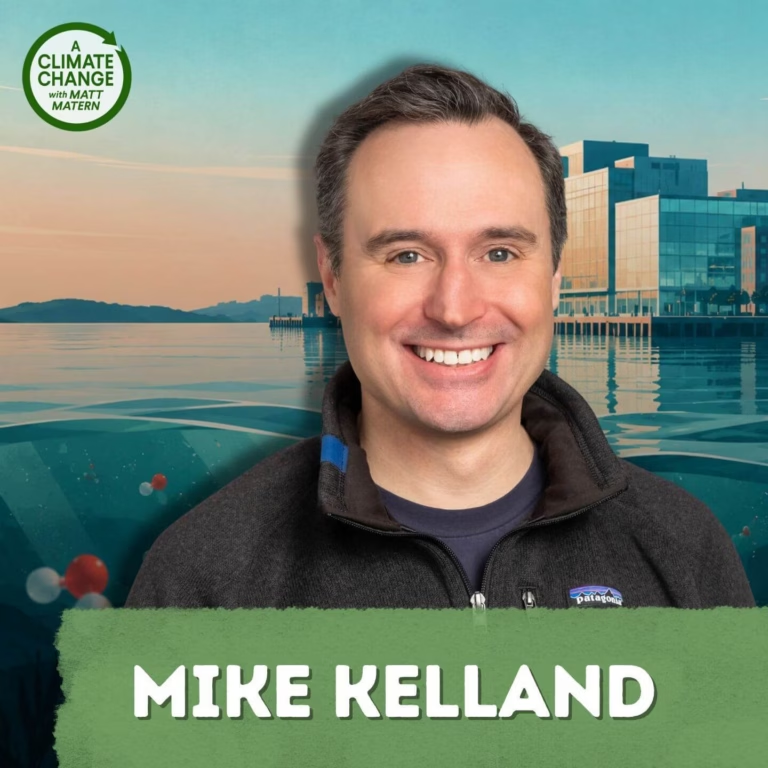
Matt speaks with Mike Kelland, Co-founder & CEO of Planetary, about using the ocean to pull carbon dioxide out of the air. Planetary adds calcium and magnesium minerals, basically an antacid, to water flowing out of coastal facilities. That lowers local acidity and lets the ocean absorb more CO2 from the atmosphere.
Mike breaks down the UN’s new Limiting Overshoot report, which he says puts the carbon removal we need at about 23 gigatons a year, and explains why trees, machines and every other land-based approach top out around 15, leaving the ocean to close the gap. He and Matt also get into the safety question people are afraid to ask, how Planetary’s Halifax plant reached 8,000 tons removed, why compliance carbon markets are the key to scaling, and the all-hands, middle-of-winter push that won Planetary an XPRIZE.
What we do very simply is we give the ocean an antacid. It reduces that acidity in the local region, which is restorative to those ecosystems, which is why we call it seawater restoration. But it also soaks up that extra CO2 and it neutralizes it. And what that means is that the ocean can breathe again. The old proverb of like, if you want to go fast, go alone. If you want to go far, go together, right? And and we have to go together. I think this is the thing about climate that we lose track of. What is the biggest impediment to us scaling as fast as we possibly can? It’s acceptance as people and their acceptance of getting this into the systems that make things move at scale.
You’re listening to A Climate Change. I’m Matt Matern, your host, and I’ve got a great guest on the program, Mike Kelland. Mike is the co-founder and CEO of Planetary, and Planetary has an interesting mission: seawater restoration to rebalance the climate. And Mike, great to have you on the program.
Happy to be here, Matt. Thanks for having me.
So, tell us a little bit about your background. You know what brought you into this this area, and how you ended up co-founding Planetary.
Sure. I think you know for me, it was. I’ve been an entrepreneur for 25 years. I I was in the software space mostly, and it’s funny when you look across climate and and carbon removal in particular. There’s a lot of a lot of us software refugees, kind of like in the in the space at this point. But I sold my last company, and I was looking for something a little more impact. Ended up working with a co-founder of mine, Brock, and he and I went through and called researchers around the world. We were like really looking for something that had a big climate impact.
And 2018, the the IPCC report had come out and said, “Hey, carbon removals are going to be a thing. They’re going to be really important, and we ended up running into our co-founder, Dr. Greg Rao, who is, you know, was working at Lawrence Livermore National Labs on on ocean carbon cycle work, and had been sort of a leader in the field for a long time. And he kind of, after a year of calling researchers, he said, “Why don’t you just do this? And he sent us his his paper, and we were like, oh man, this is so cool! You know, it was one of these things that we really felt that a startup could actually make a difference in the space. There wasn’t a lot of capital going into ocean-based carbon removal work at that point, and we we felt we could sort of bring it to the forefront and make it into the kind of climate solution that we think it needs to be. So that that was really the genesis of the of the company.
Well, that’s a that’s a great story, and and certainly that’s a question many of us may have asked at some point time: is how can we make an impact? And and sometimes the perfect isn’t the enemy of the good. So you have to kind of at one point in time just choose one of them because there are literally 10,000 things or a million things we could do, and and you kind of have to just start getting on a horse and riding it. So tell us a little bit about what what does sea seawater restoration look like? You know, I read a little bit about it on your website, but probably better getting it from the horse’s mouth rather than me trying to regurgitate something I don’t really understand.
Sure, yeah, it’s it’s actually a really simple concept. So we work a lot with Indigenous communities in Canada around our our central site, our our initial site, is in Halifax, Nova Scotia, and that’s where we’re headquartered in Canada on the east coast. And I I remember at one point a teacher of mine from from McMague, which is which is the indigenous nation in the east coast of Canada, Ken Paul said, you know, you got to think about the ocean as a living being, as like one living entity.
So it’s got like fish in it that live, but it itself is also alive. And the ocean, as an entity, you can think of the ocean as as something that breathes. And so, as the ocean breathes, it breathes in whatever’s in the atmosphere. So if we put a bunch of extra CO two in the atmosphere. The ocean is going to breathe that in. The challenge with that is that when CO two gets into water, it forms an acid, and acid the the amount of CO two that we’re putting in the air means that there’s a massive amount of acid building up in our oceans, right?
So that has a lot of negative impact on all kinds of ecosystems. What we do very simply is we give the ocean an antacid, and as we give the ocean an antacid, it reduces that acidity in the local region, which is restorative to those those ecosystems, which is why we call it seawater restoration. But it also soaks up that extra CO two, and it it neutralizes it. And what that means is that the ocean can breathe again. So the ocean can breathe, and it can draw more carbon dioxide in from the atmosphere. And as it does that, we’re we’re reducing that that concentration of CO two in the atmosphere. So we’re we’re actually affecting climate change by healing the ocean at the same time.
Well, if I if I get it, it seems like a takeoff on the old plop plop fizz fizz. Oh, what a relief it is antacids, right?
Alka Seltzer outright, yeah, exactly, yeah.
So, so how are you doing that at scale? What what are the antacids that you’re putting into the ocean, and and how does that work in in real time?
Yeah. So the the real the industrialized sort of the process of this, if you will, is that those antacids, what we call antacids, are really made up of calcium and magnesium. And so, when we, if you go to the store and you buy, you know, milk of magnesia, or you buy a Rolades or a Tums or whatever, these are calcium and magnesium at the end of the day, and that’s that’s all we’re doing. We’re adding calcium and magnesium ions to seawater, and so that that’s something that in in ocean water is a very natural thing.
You know, there’s more carbon dioxide locked up in magnesium and and calcium minerals in seawater than you know almost anywhere else on Earth, so it’s the largest store of carbon dioxide in these sort of forms on the surface of the Earth, and and so what you can do is that if you just have a little bit of a change to that sort of calcium and magnesium pool in the ocean, you know a massive impact on the atmosphere. We’d only need to increase that those sort of minerals in the ocean by about 1.7% to bring us back to pre-industrial levels of CO two in the atmosphere. So it’s actually this like really interesting system where we can have a really small effect on the ocean and have a massive effect on the atmosphere and and really restore the climate. The minerals we use come from industrial processes, so we try to have a really light touch in in terms of what we’re doing, and and really try to build in sort of a circular economy type approach to to what we’re doing.
So we work with producers of lime and magnesia, of cement, of steel, and even like power production facilities, and these are all producing these byproducts that would otherwise go into a landfill. And we can extract the pure calcium ions with our technology out of those out of those feedstocks. We typically will do that at power plants, and the reason we do that at power plants is because they’re pumping a lot of water already through, so we can minimize the amount of you know emissions that we have, or the the impact we have on the atmosphere in our process, and maximize the amount of carbon that we we remove on a net basis by making use of that existing infrastructure.
Well, I guess one question in terms of the 1.7% sounds like a relatively small number, but when we’re talking about an entire set of oceans, 1.7% of that could be a large number. So it’s huge. Yeah.
How how many you know gigatons of calcium and magnesium do we have to get our hands on to to make that kind of a shift?
It’s tremendous. I mean, you know, when you when you look at it realistically, right? And this was the subject of a report that came out a couple weeks ago from the UN Environmental Program, the UNEP, which was the Eliminating Overshoot Report, and they talked about how much carbon removal is actually required. So, if you look at the ocean, what you you know that 1.7% really another way of saying that is the scale potential of carbon removal using the ocean with these you know minerals is unlimited, right?
Like if we wanted to scale this up, we could scale it up as much as we need to to remove as much carbon as we want now that would be a worldwide monumental undertaking to get to that point, and so the realistic sort of scale up that we’re looking at is you know into the sort of I mean the the UNEP report came back with about 23 gigatons a year as as to what we need right so if we need 23 gigatons a year to just hit net zero, right? To keep us at that 1.8 degrees Celsius that they say is the best we’re going to be able to do. That even that is a tremendous amount, right? 23 gigatons a year.
If we look at all of the land based systems in the world put together, from planting trees to you know building giant machines to suck it out of the air and put it underground, all of that together gives you about 15 gigatons a year, and so that extra eight right is kind of where the oceans I think are going to be required is to fill in the gap that we have on on the carbon removal that we need to hit net zero, and and the ocean, like I say, it’s just. So tremendously large and has so much carbon in it in this form, it’s such a natural part of the the system that it gives us that ability to sort of do that additional scale up that we really just can’t do just by doing things on land.
So in terms of the 15 gigatons that you said that are, I guess hoped to be achieved through planting trees and all the other things that we’re doing. What, where are we at actually at you know getting close to 15 gigatons? Are we at one gigaton? Are we at two? Or where where are we at on that on that curve?
We’re we’re right now at about 2.2, so that’s that’s the number we’re at. But but 2.2 gigatons a year in in carbon removals, and that largely is in temporary removals. So so things that are like forestry, things that are not going to store the the carbon for very long, but they’re sort of you know removing it for now. What are called novel or more permanent removals is a is a tiny fraction of that, right? So this is a this is a space that is still very very small. All of that existing 2.2, the the kind of max scale on that portion of it all is about five total. So if we’re talking 23 and and you know that that 2.2 is you know that forestry piece probably about five is the max that we can do worldwide with that.
Then you get into sort of the novel permanent forms of removal. So these are the big direct air capture machines or bioenergy with carbon capture and things like this, and and various novel forms of of carbon removal, biochar and stuff. That’s where you can get up to maybe 15, and then the rest is is going to have to be the ocean. You just run out of space, you run out of biomass, you run out of even you know what the UNEP report was saying was you know challenges with geological storage at that scale, so you you you end up with sort of real physical limitations before we get to to beyond that. So so the oceans I think are going to be required. I think this is one of those things where we we’re going to have to have this solution be part of the suite of solutions that we have, if we are going to address climate change.
Well, I guess a tough question that may come up. I assume somebody else has asked you this is like, well, what is the negative impact when we’re kind of tinkering with the oceans?
Yeah, totally. I mean, I I I often prompt this question, right? Like people come and like they’ll be like, “Oh, I have a question, but I don’t know how to ask you. I’m like, “Are you asking me if we’re going to kill all the fish? Because we’re not going to kill all the fish. Don’t worry. the The bottom line with this is that the there are risks to every single solution, and everything that we do in the world has some sort of risk associated with it, and and this is no different, right?
In terms of ocean carbon removal, there are risks associated with it. The nice thing about what we’re doing is that it is a geologic process, and so it’s something where the risks are very controllable, and things where we can really monitor those risks really effectively to ensure that we know what we’re doing. So, what what we see is this sort of core risks to this is really comes down to three things. One of them is as you’re using a mineral in the ocean, the calcium and magnesium are very you know very very natural in seawater. There’s never going to be a point where you have kind of too much of that. Like it’s almost impossible. We talked about that 1.7% Like you’re not going to have a problem with that, but you can with certain minerals have heavy metals that piggyback on the feedstock, and so that’s something that you always have to watch out for.
So for us, what we do is we do a tremendous amount of testing of every single batch of feedstock that we use to make sure that we understand that those heavy metals are staying underneath the environmental quality standards of the permitted, you know, sort of areas that we’re working in, and and those those are you know very well understood sort of limits of heavy metals within ocean environments, and you know we’re able to very easily sort of look through our feedstocks and say, okay, we we’ve analyzed this. We know how much heavy metal there is in there. We know that it’s well below whatever would cause a problem in the ocean. So that’s sort of one of them. The second one is pH, right?
So change of the acidity of the ocean. We have to be really cautious that we don’t spike anything too much within a very local region. One of the fun parts of what we’re doing, of fun or challenging parts of what we’re doing, is that there’s impacts are much more likely to be happening right at the outlet of of where this goes into the ocean. Rather than sort of like more globally, right? As soon as it gets diluted by the ocean, it’s it’s goes back to background. This is such a natural part of seawater that it’s it’s almost immeasurable, and so or becomes immeasurable at a certain distance away, and so we have to watch for those local peaks in things like pH, and that again is just a matter of how much you put in at one time, and so we monitor that on a five-minute basis. So every five minutes, we take a measurement.
If it’s heading towards the limit, you know, we scale it back. And then the third one is is what’s called total suspended solids, which is this idea of shading the marine environment again in the local region. So we’re measuring that every five minutes as well, making sure that we stay within those limits. So those are sort of you know three key risks that we manage really carefully at the at the sort of engineering level of what we’re doing. We’ve managed to publish a bunch of you know sort of peer reviewed papers along with our academic collaborators that show that as soon as you turn this off, all of those effects stop. And so it’s one of those really neat things because it’s not a biological system. There’s not this potential for a runaway, you know, sort of like it escapes the lab, that kind of stuff.
It’s it’s really something where we’ve shown with peer-reviewed science that you turn it off and 20 minutes later it’s done, and it’s just as if you know, sort of it hasn’t happened almost in the in the local ocean, and so that gives you a really nice safety limit, where you can sort of very slowly turn up the dial on the scale of this, and we can study and research and watch and watch and watch, and then if if we start to hit a threshold or a limit, you can turn it back down again, and you really haven’t caused any harm. So that’s really nice. That’s sort of what’s really nice about this approach. But I will also say that like there’s a an abundance of caution that goes around this.
So we do things like ecotoxicology studies, where we look at all kinds of different species of the most sort of vulnerable species in the ocean. So things like lobster larvae and all these other things, and we expose them to increasing concentrations in the lab of you know the mineral that we use, and see if there’s any mortality. And if there is, then we stay. We know we can stay well below sort of those limits in the ocean as well. So there’s there’s a lot of work that we do around that sort of safety side of things. And there’s been now you know the the pace of publishing is increasing at a massive rate, and we’ve had a huge amount of trust built with academic communities in the ocean sciences space, as well as with you know verifiers and buyers and regulators around that the level of diligence we put around the safety side of our work.
So I guess one question is where are you testing it? Is it allowed to be used in say in the U.S. or is it you know are other countries objecting to it? Where are you at in terms of the regulatory process?
I think regulators tend to be some of our biggest allies, which is which is kind of interesting to think about, right? Typically, a regulator lives within a climate group, right? A group that is responsible for climate outcomes, but a regulator is responsible really for safe water. And so, because what we’re doing is very similar from a regulatory standpoint to a wastewater facility. The minerals we’re using of same minerals as they use to clean up wastewater and all these kinds of things.
There is generally not only a deep understanding of our process built into the regulatory environment in in almost every country, but there’s a desire then to be able to use that regulatory knowledge to safely have a climate positive climate impact, so it’s really great from that perspective. We’ve operated in four different jurisdictions so far in the U.S. Actually, it’s it’s a great setup because we are able to partner in the U.S. directly with facilities that are already discharging to the ocean that have permits already, and the EPA has published an explainer that says, “Okay, if you’re not going to breach any of their existing permit limits, right? If if you’re not if you’re staying within those permit limits, which we can very easily do, it you can piggyback on that permit.
You don’t actually need your own separate permit for this. It’s understood to be such a well understood and safe process that you know if your wastewater facility already has a a permit that says you can go up to pH nine, which is you know your typical limit. If you’re not asking to change that, then you can actually just do this within those facilities. In other jurisdictions where we’ve worked, we’ve often had to get our own permits, but that’s always been something that has been relatively straightforward for us to do.
So, when when did the EPA come down and say that you can you can work within kind of an existing permit? Was this recently or you know 510 years ago?
I think it was about three years ago that they published that.
Okay, yeah. So in terms of scaling this, where where are you guys at in terms of scaling it, and what are kind of future plans to ramp it up to five gigatons or whatever?
Five gigatons, yeah. This can take a while to get to five gigajons. I will say, you know, there’s a lot of work to do. The today we’re operating in Halifax, Nova Scotia. That’s our that’s our primary site. We have a couple of other projects that we’re we’re exploring at the moment, but nothing sort of, you know, developed to the point where we’re sort of out there announcing this. But but the the the plant in Halifax, Nova Scotia, has been operating since 2023, and so far we’ve sort of incrementally turned up the dial. The first year we we operated there, we removed about 137 tons of carbon dioxide from the atmosphere, and we’ve just now put our our most recent removal has gone through third party validation and verification has gone into the registry, and so we’re now up to a total of 8000 tons removed.
So we’re turning that dial relatively gradually. We’re definitely not at gigaton scale yet, right? This is it’s a ways away, but but we are able to sort of incrementally scale up in a way that is monitored by third parties and and very closely aligned with independent research projects from from academic institutions, and we’re looking at that site in Halifax to have a maximum scale of somewhere in the 100,000 ton per year scale, so that’s where we think it can get to over the course of the next few years, and and once we do that, then then we’ll have the opportunity to go and create additional projects around the world.
So, in terms of getting compensated for this, are you selling like carbon credits, or how is how is the business model working?
Yeah, it’s it’s carbon removals is is what we sell. So essentially, a form of carbon credit. A little different than a lot of the carbon credits you might have heard of before. So things like offset credits are are sort of a a promise that I was going to admit this ton, and now I’m not going to. And then there’s you know sort of nature-based credits, which are a little bit more temporary in terms of their removals.
So these carbon removal credits transact in a very similar way, though they’re they’re essentially a credit is worth a ton of carbon removed from the atmosphere, and we’ve sold a fair amount. We sold about $35 million of of forward offtakes for these carbon removals from our site in Halifax to a variety of different customers. So customers in the technology space, a lot of hyperscalers, customers that are are you know looking to accelerate you know, carbon removal as a as a business, but also to airlines, to financial institutions, to automakers, different organizations that are kind of dipping their toe in carbon removal, and you know, have an understanding that this is going to be required as part of the climate calculus that we have forward.
So, in terms of you know, kind of getting this up to scale even faster, are there other organizations that are working on this same set of problems in the in a similar way? You know, how do you see it scaling to kind of the level where it’s it’s truly making a big impact.
I think that you know we’re in a phase which is sort of that place between research first of a kind and like scaling up, right? So we always have to balance between what we do in the ocean, being safe, you know, well monitored, you know, understand exactly what we’re doing before we take that next scale step forward, and so to get to where we are today, which I think is a it’s a pretty big success to get to 8000 tons. This this is actually a really big deal, even though it seems small in the context of the of the gigaton scale, you know it’s about 1100 times increase over our very first dosing, and we’re we’re you know continuing to sort of turn that dial in terms of almost 10x per year in terms of the scale up, but we’re definitely not doing it alone.
And I would say that the organizations that are around us range from academic institutions. Dhaza University has been a huge collaborator in terms of of their independent research that that happens around our plant. Phil and traffic organizations like Carbon to Sea is a is an organization that is, you know, accelerating the field and and helping to ensure that this becomes successful. A variety of funders, our off-takers, and and then our local community as well. You know, working with the indigenous groups in the local community. One of the things I’m actually really proud of that I think is going to be a really key part of scaling this up is that we’ve established what’s called a two-eyed seeing committee with the Mi’kmaq in Nova Scotia, and a two-wide scene committee is essentially the ability for us to bring indigenous knowledge systems together with sort of colonial science in order to come up with a better solution overall.
Something that will be more in tune with the environment, in tune with local communities and the and the sort of the more traditional caretakers of the land, and and I think that those kinds of things are really critical to scale this type of approach. Right, we need not only to understand the science, we need to understand the ecotoxicology or the or the ecological benefits. Right, showing you know positive impacts on on shellfish growth, for example, has been one you know big thing. A lot of people are are getting excited about with the work that we do, showing the positive impact on the on the climate system and all those things.
But but it’s also we have to bring people in and and we have to have a large you know, sort of community around the world that says, “Hey, we want this solution, and we know we need it, and we we want to sort of build it together in a way that’s really productive. So that’s what we’re seeing more and more is is people coming in under the tent and saying, “Hey, this is something that we have to explore. Some people will come in and say, “We want to be part of this just because we want to make sure that it’s done well and it’s done right, others because they think it’s a solution that we truly need. But that community really is forming around this, and I think that’s how we’re going to get to scale ultimately.
Well, I just want to clarify: I didn’t necessarily, you know, object to your moving at a reasonable pace, as opposed to the move fast and break things philosophy of Silicon Valley, which you know, God knows what we’d end up with if people of that ilk would be running something like this. They they might just do something super crazy and like, oh, sorry, didn’t work. We ruined the ocean. Though it kind of seems like, well, you’ve now done the due diligence. You’ve done the science. It’s kind of basic science that isn’t something extraordinarily new in the respect that you know that they’ve been doing water treatment, as you said, for you know at least 100, 150 years.
So this isn’t like as extreme. You know, I guess it’s kind of balance between, hey, this notion that we’re in an emergency. This is this an emergency. We kind of have to move fast, and we don’t have the we don’t have time to go at a methodical pace. In part because of all of our past, you know, actions that have set up this horrendous situation, we we are now under the gun, and that’s that’s kind of my concern as the listener is like, we we got to move, and you know, and I and I appreciate the amazing amount of movement that you guys have done. I’m saying, you know, move faster from my armchair in Venice, get a move on this, come on.
Well, but I, I, I would, I would make the same point, right? Which is, you know, the the the old proverb of like, if you want to go fast, go alone. If you want to go far, go together, right? And, and we have to go together. Like, I think this is the thing about climate that we lose track of is like what is the biggest impediment to us scaling as fast as we possibly can? It’s it’s it’s acceptance. It’s people. It’s people’s you know sort of you know being able to you know get this into the systems and their acceptance of getting this into the systems that you know make things move at scale.
So I’ll give you an example, right? So California has a you know trading system for carbon, right? And and you know this world leading stuff like the low carbon fuel standard and things like this that that fundamentally trade carbon. We as a company have a lot of opportunity right now in what’s called the voluntary space, where you know companies will pay us to remove carbon on their behalf. But that has a limit, right? There’s a limit to how big that voluntary space can be. What we really need to get into is those kinds of. Systems within within you know that California has where they’ve got what are called compliance markets for carbon, and I I kind of give the analogy maybe if people aren’t familiar with what a compliance market for carbon is, the analogy that I often give is like waste management, right?
So if your city decided one day, hey, we’re we’re going to let you just drop your garbage outside your house, right? Like you can just leave it on your lawn, and it’s fine, and nobody’s going to pick it up, and whatever. Well, waste management’s business would contract a lot, right? They would be now only going to the wealthiest people who are willing to pay them to pick up their garbage. Everybody else would just leave it on the lawn. It’s no big deal, right? And that’s what we do with carbon dioxide right now. We emit it, we leave it in the the atmosphere, and it’s just like nobody’s paying to clean that up, right? It’s just like everybody’s trash is going up into the air.
So a compliance market for carbon is really just the same as your, you know, waste management coming and picking up your garbage at the end of your road. We, you know, need to get into that market, and and that’s just going to be based on people demanding it, right? And that’s what’s going to be the major lever for scale. Because as soon as you’re into one of those compliance markets, then you know the capital is going to come behind that because it’s it’s you know low risk and it’s you know sort of investable in that context. We know the market’s there.
We know the market’s size and scale, and you can work against it. And that probably is the biggest lever to rapidly scale these kinds of systems in that context. And we’re just we’re just nearly there, right? We’re at the point where we’ve proven out the science, as you said. It’s pretty straightforward. We’ve shown that we can scale it up. We’re continuing to scale it up, and now the next step is let’s get into those compliance markets and let’s go into those systems that allow us to have that underpinning that brings the capital in and lets us move incredibly quickly.
So, in terms of your company, are you looking at getting on investors, or or how how is this working?
Yeah, so we’re we’re venture backed right now. We’re definitely looking for additional investors right now, and we’re just opening up a funding round right now to to continue the work that we’re doing and and progress the mission. We’re we’re also working with you know more philanthropic style funders who are helping us with R and D and research that you know really supports the entire field. So those are those are two areas that we’re we’re focused on right now for sure.
How much are you guys looking to raise with your your funding round on the venture side?
Like we’d ideally like to raise about a $20 million round right now.
Okay. Well, it’s exciting stuff. What’s what’s happening like with the EU? Usually they’re slightly ahead of where we are in the U.S. Sometimes a lot ahead in terms of working with them, and and are they doing things that allow you to expand into that area?
Yeah, there’s a program in the UU called the CRCF, which is the Carbon Removal and Carbon Farming Initiative, that’s sort of the the you know on ramp into their emissions trading system for carbon removals, and so there’s been some good work happening there for our pathway to be included in that in that you know sort of scheme in the in the EU, and that would be sort of the the entry point for us. So we’re hoping that that happens within the next couple of years that we get involved and included there. But but certainly that’s moving faster than a lot of the other jurisdictions, as you said.
Any any other jurisdiction around the world that you think is furthest ahead on these issues?
Japan really interesting because they’ve got a compliance program called the J Blue Credit, which is the first ocean-based carbon removal credit that’s included within sort of a compliance market for carbon. That’s right now only applies to biological removals, so so kelp based removals, but there has been some interest in potentially expanding it to include our pathway. You know, something that’ll have to be developed in concert with a project that we do in in Japan, I would assume, but but sort of some interest there that that could move us forward.
There’s also been some interest in sort of country to country trading of of these kinds of removals, and and we could see that sort of maybe evolve outside of just you know sort of compliance based markets as well. So what are called Article Six international trading obligations for for carbon. So there’s a couple of different places that that we’re seeing some motion, but the EU and Japan are quite interesting for us right now. I say California is actually very interesting as well because they’ve actually included within some of the more recent legislation that marine-based reservoirs should be included, which is. Which is essentially, you know, storing carbon in the ocean within their compliance program, and there’s a so a lot of work happening in that space in California as well. So that could be an interesting place to work as well.
What do you see happening in China? Do they, you know, they’re such an industrial power, and it seems as though, you know, in terms of this type of material that they would have in in scale beyond any other country. What are they doing? What are they thinking? Are they following you guys? You following what they’re doing?
You know, yeah. There’s there’s a fair amount of work that’s going on in China in the space. I mean, especially in academia over there, that we’re seeing papers and some really good research coming out of some of the institutions there. You’re absolutely right, right? Like in terms of industrial byproducts, they’re probably one of the one of the best places for deployment. We haven’t done any work there yet, and we haven’t really engaged yet. But I could see it being a future place to to do some of this work for sure.
Okay, well, it’s a tremendous project that you guys you know started off and have gone gone quite a distance. So, kudos to you and your team for having taken it so far. And it seems like you’re you’re on the the edge of breaking through to another level. So great work on that front.
Thanks so much, Matt, and really appreciate this conversation. It’s been a lot of fun.
Yeah, certainly. Yeah, tell us anything else. That’s I mean, you you two time XPrize carbon removal winner-that’s kind of a big deal. So, tell us about that journey, maybe.
I mean, that was the XPrize was a lot of fun, and it was-it’s interesting because the headline is, “Oh, you win a you win an XPrize, right? But what that hides behind is is it was you know a four year competition that we worked really closely, and you know as you get to the more finalist stages, you work increasingly closely with the XPrize folks, and they’re incredible. Like they are, you know if you want to find a mission driven, super intelligent group of people. Like it’s it’s awesome, but it pushes you.
You know, like when we did the win for the XPrize in 2024, we were we were down to the wire. You know, we we had to remove 1000 tons of carbon over the course of that year, and we had until january 31 to do it. I think it was january 31, 2025, and we I think we accomplished it on like january 29. You know, so it was like, and it was like 3o’clock in the morning. Like we were we were out in Halifax, Nova Scotia, which you can imagine gets a little cold in January, up in Canada, and you know we were we were working as fast and as hard as we could. We had all all hands on site. I was there for six weeks of 12 hour shifts. I think personally, doing sort of like you know getting getting this alkalinity into the tank and like mixing it up and ensuring that we were doing it in in a way that was safe, but you know, really sort of pushing to get that done.
And it was it was an incredible for us. It was an incredible time. It was even just the accomplishment, even if we hadn’t won the prize, but just getting to that 1000 tons was incredible to progress the science and the team forward. And the fact that we were chasing the XPrize-I mean, it brought the whole city together around what we were doing. You know, we were able to talk to the port and say, “Hey, if we’re going to win this thing, we’ve got to expedite these these containers through the port and get them to our get them to our site. And everybody’s like, “All right, we’re going to get together and win an XPrize together, and there was really something to it. So it was a really cool, a really cool experience.
That’s that’s fantastic. Yeah, there’s no like XPrize TV show, is there?
Sometimes it feels like there is. You get onto panels and things like that to talk with them, but no, there’s not like an XPrize TV show, unfortunately.
That actually be pretty cool from what you’re describing, and it kind of would, you know, show people here. Here’s what’s happening actually out in the field. Yeah, this is this is what’s happening. Some amazing people out there working in the field, pushing the boundaries, just doing incredible work. Because I I think that that is essentially invisible to about 90 to 95% of the world, and and I think that some degree of visibility of that would be helpful to to the whole process.
Yeah, I mean they they do a good job to to get out the message as much as they can. They do it from videos and things. There was actually a movie made, so I don’t know if this is something that that you want to look up. But a group called Tree Media did a movie about carbon removal and all the different forms of carbon removal and where people were working, and that was back in 2024 as well. I believe that was released maybe 2025, and and so there’s there’s been some work around this, but there certainly could be more, and and I think we could see more and more people engaging with this as much as possible because it really is what we need, right?
We need people to understand that we’re not at the point where, I mean, maybe this is one of those things about climate change, and I’ve been saying this for a long time. But like, we lose track in the in the numbers. We talk about 1.5. We talk about two degrees Celsius, and we sort of have these arbitrary numbers there. And we’re like, oh, okay, we’re not going to make one 1.5. Okay, well, I guess we lost. And it’s like that’s that’s not how this works, right? Like 1.6 is worse than 1.5. 1.7 is worse than 1.6. Like you, you.
We are going to continue working on climate change, and we might have like lapses in our willpower on it. But at the end of the day, we have to continue working on climate change for the rest of our lives, for the rest of our children’s lives. This is not something where you’re like we win or we lose, right? It’s something where we are pushing to limit our losses, and we never stop, you know, sort of working on it. We never stop fighting, and and I think we need to get people into that mindset. We need to get them out of that mindset of like, you know, oh well, we we’re going to get to two degrees Celsius. Who cares, right? It’s like no, every point 01 of a degree matters, and we have to be doing everything we can in every way we can to keep it as as low as possible.
Right, and I think that’s very well said, and and just a risk mitigation. Okay, we may hit 1.5, but we can keep this below two if we do a lot of good work, and and that’s going to be, in some sense, a win as opposed to getting a 2.5 or three. Like that’s insanely disastrous. So like you know we can still kind of pull something out of the fire, but we have to, you know, work our butts off to to get to that point.
Yeah, and we don’t stop, right? I think that’s the other thing, right? Like, it’s not, you know, the political will around climate change ebbs and flows, right? It comes up and it goes down, but it’s not, it’s not something that we can just stop doing at any point. And the more we, the less we do now, the more we have to do later, or the more our children have to do later. You know, one of those things that I throw out there a lot is like, at two degrees Celsius, we lose 99% of the corals on Earth, right? And so you go and say, well, you know, okay, you’re losing all the corals on Earth. Do I care? Like, I mean, I’m not a scuba diver. Like, what? Why do I care about the corals on Earth, right?
But that’s 500 million people’s livelihoods directly rely on corals directly, and so if you’re somebody who cares about, you know, sort of if if you think right now, and I know this is a big topic in the U.S. is like if you think you have a migration crisis or a challenge right now. Well, where do 500 people who lose their livelihoods go? Right. I mean, you you you end up in a situation where we’re rebuilding sort of you know what what we consider to be a crisis on on Earth in a in a multitude of little ways when we get to sort of two degrees Celsius, and so I think it’s important. Like we have to think in that way. We have to say how do we keep people, you know, in their homes.
How do we make them make sure that they can thrive as a family in their and you know get the futures they want for their children in an ecosystem that you know supports them at the end of the day. And that’s that’s true of all of us. We can’t get so disconnected from from the natural world like we live on an Earth, and so it really is something that we have to try our best to keep these temperatures as low as we can, and and we really need every solution at this point in order to do that.
Yeah, the the parade of potential horribles on that front is just a long list of, you know, people not being able to farm in certain areas, droughts that are, you know, so bad that you know 400 million people might have to move out of the Sahel, you know, you know, and where are they all going to go? Where are they going to go?
Yeah, and what kind of crisis are we talking? We’ve never had a crisis of that magnitude ever, and it will be way too big to manage, and and will make make us look really stupid why we didn’t do something before to to to deal with these issues. Thanks, Mike. You know, pleasure talking with you, and I. Appreciate the great work you’re doing very thoughtfully, and you know, all of us should be very thankful for what you guys are doing. Found co-founder and CEO of Planetary, winner of the XPrize. A lot of a lot of accolades already. I’m looking forward to bigger ones to come from you, so keep keep up the good work.
Thanks so much, Matt.
To learn more about our work at A Climate Change, visit aclimatechange.com. Don’t forget to subscribe to our podcast on Apple, Spotify, YouTube, or wherever you get your podcasts. If you like this episode, please share it with a friend. See you next time.
(Note: this is an automatic transcription and may have errors in formatting and grammar.)