
Hear us on Apple Podcasts, iHeart, and Spotify Podcasts. Subscribe now!
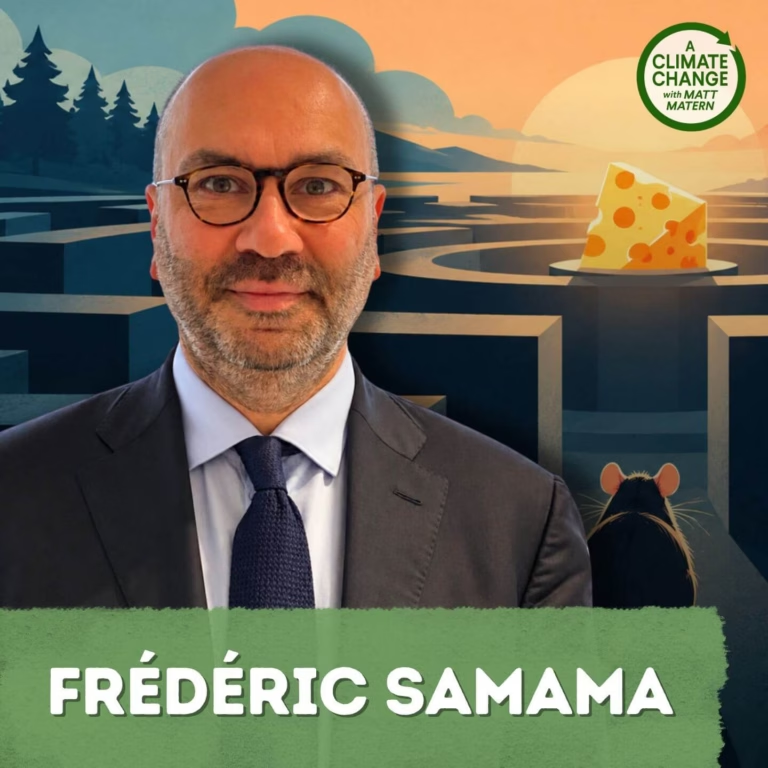
Matt speaks with Frédéric Samama, adjunct professor at Sciences Po and author of The Enigma of Climate Inaction, about a simple question: if almost everyone knows about climate change, why aren’t we acting? Fred, a pioneer of green finance, explains his idea of “societal bubbles.” Like a rat that learns its way to the cheese in a maze, humans got so good at getting resources through farming, capitalism and modern science that we became overconfident in the models that got us here. Now those same models are working against us, and climate change is the first crisis that puts a limit on the resources we’ve built everything around. He and Matt also get into what astronauts’ view of Earth can teach us, why climate disasters can make people believe less in climate change, and his work with Nobel laureate Joseph Stiglitz that helped bring $800 billion in investor commitments to the Paris climate talks.
For the first time ever, we face a problem that puts a limit to the access to resources. If you can take a very concrete example of a rat in a maze with a piece of cheese, the rat faces a challenge to find the cheese because the rat doesn’t know the mapping of the maze, and then there is a point where the rat becomes very confident and goes directly to the cheese. Why? Because it’s accurate. There’s always a piece of cheese, and that fits with its motivation: cheese surviving.
You’re listening to A Climate Change. This is Matt Matern, your host. I’ve got a great guest on the program, Dr. Fred Samama, Doctor, you’re coming to us from Paris, France, and your adjunct professor there. Great to have you on the program.
Hello, Matt, everyone, and yes, you will hear a French accent, so I think I hope that you you will accept it.
Okay. Well, gladly is obviously France, the foundation of American democracy, and Marquis de Lafayette, and all the great help that we receive from France. We wouldn’t be here today without it. So, vive la France!
Thank you.
So, tell us a little bit about your background. I know you’ve written a book called “The Enigma of Climate and Action. Why are we doing nothing or almost nothing in the face of catastrophe?
The book is very much related to my journey. About 15 years ago, I started one of the first, if not the first, academic center dedicated to climate change and investors in partnership with the Nobel Prize laureate Joseph Stiglitz and Patrick Bolton. We were in 2009, just after the financial crisis. I could observe that we had been pretty close from a total catastrophe, and and and then a new crisis was looming.
And I thought, if we have not been that good at solving the first crisis, a pretty standard one, what about the new one that is looming, and so I thought we we should think out of the box, and that’s why I created this center. And one thing brings another one. I’ve developed the first mainstream low carbon indices, a technology that now almost all the pension funds around the planet, like Calpers, Calsters, GPIF, NBM, they’re all using this technology that I pioneered during these years.
I’ve launched the largest green bond fund at this time. I’ve developed the first coalition of investors dedicated to taking action on climate change that will represent the anti-finance sector at the COP21, and so on and so on. I even testified before the U.S. Senate in 2022, and then I really thought that if we had the instruments, if we had the messaging, if we had the social pressure, capital markets should should make the make the job, and obviously it’s not the case.
So five seven years ago, I started another journey that is that is this book, and to ask why, although almost everyone on the planet knows about climate change, although we have created a problem, although we have we we are threatened as a species, why are we not taking action?
Good question. And the answer, the answer is that we we know the usual answers, short termism, and so on and so on. But when you compare this crisis with the other crises, the problem becomes slightly more complicated because we tackled the ozone layer, we tackled the Y 2k, we tackled the COVID. So why this problem different from the other problems?
Usually, when we understand that we are facing a problem, even the long-term one like the other layer, we are able to get mobilized and to find solutions. And here we are not. So again, why this problem different from the other ones? And to bring a fresh answer to this question, I thought that maybe we could think out of the box and make the hypothesis that our worldviews, our collective worldviews, function like the brain.
Okay, how’s it going?
And and so, what about the brain? How is the brain functioning or learning? And here there are very interesting developments in cognitive science, saying that we keep on making models based on observations. So if you can take a very concrete example of a rat in a maze with a piece of cheese, the rat faces a challenge to find the cheese in the maze, and so first the rat wanders because the rat doesn’t know the the mapping of the maze, and then the rat starts saying right, right, left piece of cheese and keeps on wandering, and then there is a point where the rat becomes very confident into its understanding of the of the of the mapping of the of of the maze, right, right, left, and stop wandering, and goes directly to the cheese.
Why? Because it’s simple, right, right, left. It’s accurate. There’s always a piece of cheese, and that fits with its motivation: cheese surviving. And the theory of the book is to say that maybe we, the human beings, we had three men cheese moments in our history. Moments where suddenly we got access to resources, and we got very confident in the way that we can access them, and so confident that we became overconfident, and that’s why I coined the terms of societal bubbles, like the financial bubbles, but here the societal bubbles.
So the first moment where we got access to resources was with agriculture and modern science, where we got access to natural resources, and suddenly we, the human beings, we could exploit nature. The second moment was was with capitalism and neoliberalism, where we could access human resources. Very concretely, we could have the Chinese workers working for everyone around the planet, and the third moment that is more subtle, the access to cognitive resources when we started to model the world, and all of that has incredibly well worked well, but to the very same reason that it worked well, we are now paying the cost of our success.
We are paying the cost of our success, like the rat in the in the maze, and we are trapped in these bubbles. Also, the three mechanisms are not aligned with the specificities of climate change. So we are paying the cost of our success into worldviews that have worked extremely well to create wealth, but they’re not aligned with the specificities of climate change, and that’s the problem we are facing.
So, given that you’ve identified the problem, how do we solve it now? And what’s what’s the new construct that we have to come up with if you’ve if you come up with one?
You’re right. the The book has eight chapters, and the first seven chapters are about understanding the deep, deep reasons why we are facing why we are failing when we are facing this problem, and it was very important to me to to to have an explanation of the mechanisms of societies. And then the last chapter says, okay, now that we have this new toolbox, again that our worldviews are functioning like our brains. Can we use the very same toolbox for a solution? Usually, when you talk about climate change, it’s it’s a debate between the corporations and the governments. But I say, based on some academic papers.
You you have a third pillar, civil society, and how can we mobilize civil society? We have tried many things. We have tried the movies like the one from Al Gore when we see the the catastrophic consequences of climate change. We have tried the the images of fires on TV or drought and so on. All of that has not worked so well. So I try a new avenue that says, can we have as we we keep on making models based on observations, is there a new form of signal, a new signal that could help us reshape our worldviews.
And here, all the astronauts who went into space say that seeing the planet. Space changed their relationship with the planet. The term coined here is the overview effect. All the astronauts are saying, and you know the astronauts are selected to survive in very hostile environments. It’s a very specific psychological profile, but when they are seeing the planet from space, they say it’s fragile, it’s beautiful, and that the only thing being alive with us, everything else is dead. And here I say maybe with the three elements we can activate different brain mechanisms.
The first one is fragility. Here the the specialists are saying we the human beings were different from our cousins, the monkeys, because we do babies that are pre-born. Most of the animals, when they do babies, you know, the baby elephant, the baby giraffe, and so on, they can deal by themselves. The human babies, it takes years before being independent. From the group perspective, it means that they have to take care of the fragile one of the baby. So it’s not like with the other animals where they cooperate. You help me, I help you. Here, there is a form of asymmetry, where you help someone without any reciprocity, and the one that we talk about is a fragile one.
There is a French philosopher who said, and that’s unique in the among the animals of our in our category. And there is a French philosopher who said Emmanuel Levinas that this relationship with fragility triggers responsibility and ethics. You take care of someone who is fragile, and then all the astronauts are saying it’s beautiful. And here you can say with Emmanuel Kant, the German philosopher, when you see something beautiful, you have no interest, and by having no interest, it prepares you for moral sentiment.
It sounds very abstract, but if you read Anna Arendt, the other German philosopher, she said that the Greeks, 2000 years ago, were using that mechanism to coordinate people in the Greek city. the The Greeks were facing a challenge because they didn’t have a common religion, and they have had a wide range of beliefs. And so, how to coordinate people? They were creating beautiful temples that everyone could see, and through the shared moment of perception of beauty, it was creating a social bond. And the third thing is, everyone says everything else is dead, but the planet, and we are part of it.
So we have a special bond because we we are part of the same universe, the planet and us. And here Spinoza said yes, everything is about nature. So what I’m trying to say here is that the view of the planet from space triggers forms of solidarity or sociability with the planet. Of course, we will not send 8 billion people into space, but if we could share these moments at school, if we could teach to our kids how the plants are communicating, how the animals are cooperating, how we are part of nature-not above nature, but part of nature-and we need it to survive, then maybe it could, you know, activate all the mechanisms again to reinforce social bonds with nature.
Well, it’s a beautiful, you know, template there, and yeah, it it it seems to make sense to me, and I guess trying to roll that out so that people have more of this experience, and I and I think that it aligns with other thinkers that I’ve talked to over the years about the environment and the importance of people getting out into nature, for example, connecting to nature, really having the experience of it is important to shift the mindset.
And you know, one of the last things you said, being part of it, nature versus not above it, and that I I think that. That is a human fallacy. Is that we we have this sense of being above it, like we really don’t need any of these bugs or you know creepy crawly things or whatever. Like you know we kind of survive on this different plane of existence, which obviously is false. But it’s easy to kind of buy into that because that’s essentially what we’re sold or what we kind of experience is that we trample on nature all the time and we get away with it.
You’re absolutely right, and that’s why I talk about a bubble-the fact that we are entrenched into a model, a world view, and and when we try to to to to identify when it started, this belief that we were above nature, many thinkers think that it started with agriculture, so about 10,000 years ago, because suddenly we could access wheat, rice. We could domesticate animals. So that’s when we invented verticality. That’s why. That’s when we invented sacrifices because it was a way to communicate with the forces controlling nature, and it shaped our the first big shift. It shifted our worldviews.
How do we know that? There’s a very interesting book recently published that analyzes the paintings in the caverns before and after Agriculture, and interestingly, before agriculture, our ancestors were painting mainly animals, women, and very few men. So, animals, women, human. After agriculture, the animals were wounded or dead. The women had disappeared, and it was all about men with archers, meaning in a position of power, control, and domination.
And so, really, the the first men shift in our in our worldviews, certainly happened with the access to natural resources, where we thought that we could control and later possess with the modern ages nature, and so the point is to be back to a more cooperative and friendly relationship with nature.
Well, I kind of feel like that our yin and yang is out of balance, and that obviously men have had a outsized role in the development of the world post agriculture, and and and that as such we’ve used that kind of male energy, which is is good, but if it’s unbalanced, it leads to kind of the situation we’re in currently, which is on the edge of disaster because we’ve overused our resources and power, and think that we can force ourselves over nature, and yeah, when we’re trying to force ourselves upon the situation, we end up kind of destroying the soils and the land and the air and the water, and it’s been a disaster. But how can we pull ourselves out of it is is the question now.
Absolutely, you’re absolutely right. The point is not to be back to before agriculture, and again, as I said, it has worked incredibly well. Our way of living is way better than 50 years ago, 500 years ago, 5000 years ago, 50,000 years ago. So it has worked very well, but to the very same reason that it has worked well, we got overconfident into our models, and we got entrenched in our worldviews. And the problem is that the very same mechanism that helped access resources is now destroying the planet.
So the point is not to to to go away from capitalism, modern science, and so on, but to have another force, as you said, yin and yang, another force that counterbalances a dominant one, a one that is overconfident and that has no limit, and to make a long story short, we are talking here about moral values. How can we reinforce moral values as a second pillar in our societies to to respect nature and not to say that we control and possess nature? We need to get access.
To natural resources, but to a certain limit, and we have to to stick within the limits and not to go too far. And the book goes even one step further because the book says, if it’s about social bonds with nature, it’s maybe as well social bonds between with the human beings. And here I make the parallel with the 30s. Some philosophers, like Anna Arendt or the economist Carl Polanyi, said, “Why did we have fascism in the 30s in Europe? And the point is to say that one of the main reasons is because we had a strong liberalism in the 19th century, where all the social bounds weakened. You were walking in the countryside.
You you were joining a city, where the social bounds were lower. You were traveling, you were living in a country that was not your your your your initial place of of birth, you and so on and so on, and the pushback from societies from that weakening of the social bounds was a call for joining very inclusive social structures, fascisms, communism, Nazism, and we see the parallel 100 years later. And and here, if we take one step back, if we reinvent social bonds with nature, maybe we can reinvent social bonds between we the human beings, and here it’s quite fascinating because capitalism reached a universal level, but based on selfish values.
Religions were very good at creating social bounds, but they were competing with each other, and so they could not reach a universal level. And here, fundamentally, we have in front of us the first universal value of responsibility. And then, climate change is not only the biggest threat that we have been talking up to now, but it then appears Like the first again universal value of responsibility, so it’s not no more the bigger threat. That’s maybe the biggest opportunity to reinvent a way of living altogether.
Well, I think so, and you know, speaking of kind of economic models, you know, we’ve been using like gross net gross national product to essentially assess whether or not we’re doing well or not, and it’s such a antiquated model which does not measure whether we’re doing well with nature, and are we polluting nature? Are we destroying our species essentially and destroying the world? Is not measured by GNP. We could have astronomically high GNP and be killing ourselves. And to me, it makes sense that we need to revise that model because that model drives so much of our societies to say, “Oh, well, we’re doing well on this metric, which is a it’s a very archaic metric.
I 1% agree, and it’s back to how do we select our models? If we are back to the red, the light in the maze, we select our models based on, as I said previously, on simplicity, accuracy, and motivation. And what is the best, the most important motivation for a living entity to survive? And to survive, what do we need? Resources. So all our models have a bias with access to resources. And so the example that you give is okay.
We measure everything based on GDP, access to resources, but to a point that the mean to live is becoming the end, is becoming the objective. So we reverse, we reversed the objective. The initial objective was to live, and the means to live became the objective, because the model was selected to reach that access to resources, and to a point that we see that to access resources we are killing ourselves, and we are blind, we are deaf. Because again, we became so confident into the model that was allowing the access to resources that was supposed to be a means and not an end, that we reversed the the the objectives, and so it’s it’s to be back to let’s stay alive.
Well, you know, just to kind of look at some of the the positive elements of how you know many humans, millions, maybe even billions of people believe in the importance of preserving nature and protecting our environment, and in some places they’re doing incredible work to have that happen, and yet, yeah, we’re we’re facing pushback to those to those forces in you know, well, probably for the last number of decades, there there have been, of course, pushback from oil companies, from fossil fuel companies, from various places that you know are profiting from polluting.
So there is-it’s kind of a you know-it’s a scale that some days the forces protecting nature seem to be ascendant, and some days they see you know the other forces protecting fossil fuel seem to be ascendant. So how do we how do we deal with that situation and kind of convince people or fossil fuel adherents that that’s not the way to go.
It’s it’s it’s about the third pillar that I spoke about. It’s civil society saying we are in charge of the of the of the social norms of our societies, and these social norms can shift, and they can shift sometimes faster than we could think, and so it happens that values can shape or help coordinate people because suddenly they all have.
There’s an alignment of values among the people, and it creates a coordination. And when I spoke earlier about the fragility, beauty, and uniqueness of life, it was about because we we haven’t found the the the great man or the great woman who will convey that message. So I say let’s try let’s try with an image let’s try with a signal that will help align the the values of everyone.
I hate to be something of a fatalist, but I feel like as humans, we act when things are imperatives and emergencies get our attention better than anything else. And maybe this El Nino year, which is probably going to hit California hard or other and other places, may kind of wake people up a little bit to hear the risks are enormous, and we’re just at the the beginning of the curve of how bad it’s going to get.
Absolutely, we we absolutely that the that the that the that two comments here, and it’s not. Yes, and some studies show that when something bad happened to you, actually you you want to forget, and there are some studies that are showing that when there is a climate event, people believe less after the climate event into climate change than before.
That’s really tracking.
Yeah, because some it’s kind of okay. You know, I went through that. Okay, I want to I want to move on, and I don’t want to talk about going out and getting drunk and feeling bad, and then weeks or so later, you kind of ah, wasn’t that bad?
Exactly, kind of. And COVID, for example, nobody talks about the COVID. Or after WW two, nobody wanted to talk about WW two. And my parents were kids, and they survived WW two, and they always said, “You know, Frederick, we were never talking about that because we survived and wanted to move on. And so that second element, but maybe this problem, this very specific problem of climate. Change is different from the other ones because that was your very first question. Because for the first time ever, we face a problem that puts a limit to the access to resources.
Also, the access of resources is part of how we select our models. You talked about GDP, and said it’s archaic. Yes, but it’s access to resources. The COVID, the Y2K, the other layer were not a constraint on the access to resources. Climate change is, and that’s maybe the deepest reason why we are so embarrassed. We are not mobilized enough facing this very specific problem. That the first time ever, that although we have selected our models based on the fact that they were allowing an access to resources, and now for the first time, the very same access to resources is the problem.
Well, some of the positive things that I see are rights of movements across the world where governments are recognizing the rights of nature, kind of similar to how indigenous peoples had given rights to nature and seeing it here bubbling to the forefront in indigenous communities and and other places around the country, and hopefully that will that will continue. It’s unknown how how it will continue, but hopefully it will.
Absolutely, and here there are many experiments with economies that are quite interesting. The fact that the nature of the constraint that you are imposing changes the reactions. There is an experiment done by two economists with a daycare. With a daycare, the parents are late, so it means that someone has to take care of the babies, and so all the economists will say, “Oh, that’s a negative externality.
You do something, and someone else has to pay the cost of your behavior. So all the economists are saying, “Oops, we should have a Pigovian tax, a tax that will bring the people back to the attitude that we want. And so the two economists said, “Okay, fine, let’s do that with the daycare because we have a negative externality, and let’s have a tax that is about the equivalent of the cost of a babysitter. So the economic theory says then people should be on time, and what happened is that the parents were even more late, And wow, that means that when you impose a tax, boom, you have exactly the opposite effect. And then the economy said, “Okay, okay, okay, let’s suppress the tax.
The people were staying with the new standard of being late, and so it says something very important. You say then, when you deal with a moral attitude, a moral attitude, by imposing attacks, you shift the behavior from moral constraints toward Something that accelerates the the the attitude that you don’t want. Another example is that if you make a blood, if you if if you want to to receive blood from people, and you have two groups, there is one group that you pay and one group that you don’t pay. With one, which group do you receive more blood for society?
The group that doesn’t receive money, and it has been observed since the 70s. So here it says something very fundamental: that it’s like societies is functioning with two spheres: the sphere of creating wealth, and the sphere of social bonds. And the sphere of social bonds is not regulated with money, with your partner, with your parents, with your kids. You don’t have an Excel spreadsheet that says if you do that you receive $5, if you do that, blah blah blah blah blah blah.
You have multiple social bonds in your family, and and there is no money being exchanged all the time. So, what is true for a family is true for for wider groups. We keep on exchanging relationships. Relationships meaning we are keep on helping each other. And when you put a price on this, you get exactly the opposite effect that you wanted.
That’s fascinating. It’s fascinating studies there. I, you know, before I let you go, I’m going to have to ask you about your work with Joseph Stiglitz, the Nobel Prize winner, and what you did with him, and and what was it like to work with a Nobel Prize winner, it was in 2009 when I knocked his door, and and just after the financial crisis, I as I started with, and this man is absolutely incredible because he’s he’s incredibly smart, of course, but is very generous of his time, and he’s very courageous.
How do we know that? That when he was chief economist of the World Bank in 1997, he didn’t have a Nobel Prize at that time, and and he was there was financial crisis in Asia, and the World Bank was in favor of the austerity, and he said no, it’s wrong decision, and he said that louder and louder to a point that he was fired, and and when I knocked his door, I had this project that looked like very unlikely to mobilize investors to tackle climate change.
And after one hour of the most intense conversation I ever had, was like it was the hardest exam of my life. It was on december 28 at eight a.m. Everyone is on vacation on december 28, but Joe Stiglitz and I had a meeting with him that day and that morning. And after one hour of very intense conversation, very intense conversation, he said, “Frederick, we work together.
Ah.
And I could not believe it. I said, “What, sir? Said, “Yes, okay. You convince me. Let’s go. Let’s do a conference. Let’s invite Al Gore, Jossor Rose, and so on and so on. So I was almost shocked how you know we had one hour conversation and and we did conferences in New York, Paris. We and with Patrick Bolton, we published a book. We published an article and so on. So I I’ve I have a lot of respect for this man. Really.
Tell us about the book that you wrote with them.
It was the content of the conference. It was Seven Wells Fund and long-term investing. When I started to work on climate change, I thought who could be the best players within the within the industry, and Sowen Welson’s were very good candidates because they had a lot of money at that time. They had $5 trillion, and the beliefs were that they could reach $20 trillion. They had long-term investment horizons.
They had no liability, and they were supposed to transfer wealth to next generations. So they were the perfect candidates to internalize the externalities, with the view that would it make sense for them to make money with polluting companies? Also, their their principles will pay the cost. The governments.
So, so with Joe, Patrick, and others, we organized a conference where we brought all the sovereign wealth from the planet, from China, from Norway, from the from the Middle East, with practitioners, with policymakers, and with the view that if we could bring everyone to the table, and if we could bring some concrete solutions like the low carbon indices that you mentioned, then maybe something would happen, and it happened.
And one thing brings another one. I was selected by the United Nations to launch the first coalition ever of investors dedicated to taking action, and I will bring at the COP 21 in Paris their commitments, and their commitments were representing 800 billion dollars. At that time, that was a huge number, so big that it this project represented the anti-finance sector at the COP 21 at the action day.
And Laurent Fabius, the negotiator, used that figure to say to the to the negotiators, you see, the finance sector is anticipating your success because I could bring this number before the COP 21 agreement. So it was a way to reduce the pressure on the negotiators because they knew that by agreeing, it would create tensions within societies, and if they could have the the figure that says, “Hey, the finance sector is anticipating your success, it was a way to dilute the the pressure. And so Laurent Fabius used many times this figure to to help get an an agreement. It was only a small element of his success because he did very well, but it helped the process.
Well, thank you so much, Doctor. It’s been a pleasure talking with you, and love to you know continue the conversation at some point in time in the future. Everybody should get a copy of your book, “The Enigma of Climate in Action” Why are we not doing? Why we are doing nothing? Or parentheses, almost nothing in the face of catastrophe. Fascinating set of ideas that you are proposing, and something that we all should be thinking about and engaging with to to change the conversation so that we can protect our environment.
Thank you, Matt. Thank you, everyone.
To learn more about our work at A Climate Change, visit AClimateChange.com. Don’t forget to subscribe to our podcast on Apple, Spotify, YouTube, or wherever you get your podcasts. If you like this episode, please share it with a friend. See you next time.
(Note: this is an automatic transcription and may have errors in formatting and grammar.)