
Hear us on Apple Podcasts, iHeart, and Spotify Podcasts. Subscribe now!
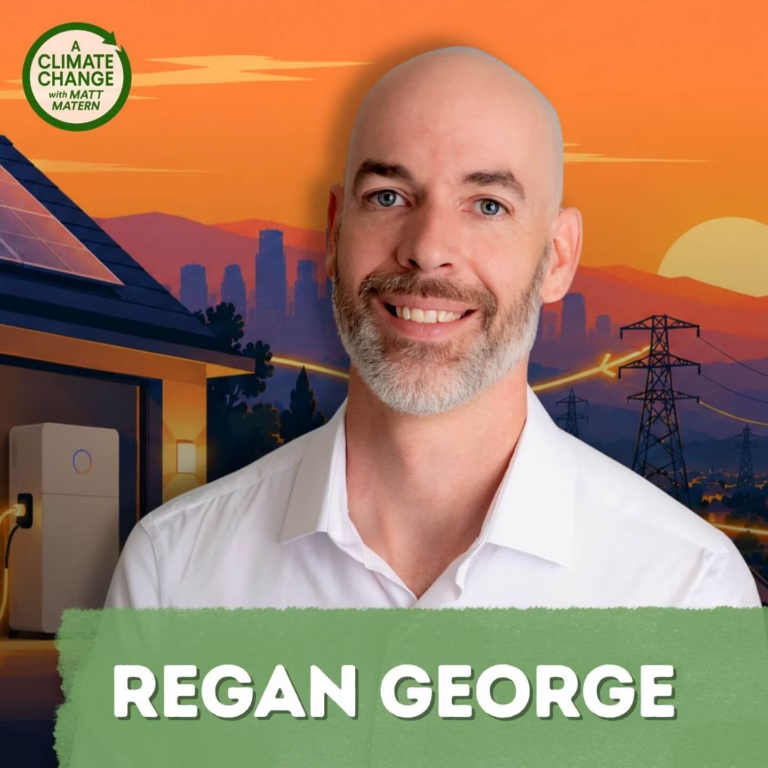
Matt speaks with Regan George, Founder and CEO of SOLRITE Energy, about turning home batteries into a power plant that helps homeowners and the grid at the same time. Regan explains why rooftop solar stopped paying off once net metering went away, and why big, smart batteries are the fix. He breaks down what a virtual power plant actually is, why most of them barely get used, and why he tells utilities to cycle his batteries two and a half times a day.
Regan also shares a simple way to picture the grid’s problem: widening the freeway never ends rush hour, but controlling when cars get on the road does. Plus, how SOLRITE is helping “solar orphans” get their savings back, why data centers should pay for batteries in the neighborhoods around them, and how his team is bringing power back to Eagle Point, Utah after the Cottonwood Fire.
We’re creating so much electricity in the summer, and then we’re forced to sell it to neighboring states. The entire grid needs to be built for the most congested day, but most of the time it operates at 40% of that. What a virtual power plant does when comparing it to like highway traffic, it controls when cars are on the road. We essentially eliminate rush hour, so you don’t need to add extra lanes on the freeway in order to get all the cars through because you’re controlling at what time they come through.
You’re listening to A Climate Change. This is Matt Matern, your host. I’ve got a great guest on the program, Regan George. Regan is the founder and CEO of Soul Right. Welcome to the show, Regan. Thank you, Matt. Super excited to be here. So, tell us a little bit about your background and what led you into this into this space. Yeah, it was one thing led to another. So, I I started my career in renewables, working for a company called Vivint Solar in Southern California, opening up in in 2012. Worked with that company through their IPO and into 2016, where you know I made a stint as I left the company was made a stint as a president of sales of a smaller solar installation company, and then we decided to go our own way and found a solar sales and installation company starting in Southern California, and then we spread throughout California and then into Texas.
Right, and so we’d worked with many of the different, maybe all of the different solar and renewable financing companies that were available at that time, but we found gaps in in the offerings that were that were we were able to present to homeowners, and we felt like there was a there was a better way to do it. And so most of the financing companies at that time to facilitate solar and renewable energy installations had come from the other side of the world.
They’d come from the financing world, and then were were stepping into the renewable energy space to finance renewable energy products. We felt like the understanding of the actual nuts and bolts of how the process worked and and the renewable energy projects worked was was missing, right? And so we decided to come at the financing angel of of solar projects and renewable energy projects, but from a a boots on the ground point of view, from a customer centric point of view, and that’s how Soul Right became an idea, right? Well, that’s
that’s interesting because you know, not that I want to get into it too much, but my my law firm had a case against some of these solar companies for not treating their customers well. So I see there is a there is room for a more customer centric Approach to to dealing with this, so customers really feel like they’ve been treated effectively and and with compassion, I guess.
Yeah, there are a number of different issues that a quick you know internet search will will bring to people’s attention. You know, namely with our our Soul Right offering, we wanted to make sure that we had fixed pricing that was that was guaranteed savings for the homeowners, and was not adjustable at the kitchen table by a by a sales representative. So, fixed pricing, fixed offering, so that we could ensure uniform and honestly, just good customer experience. So we were able to deliver on on on what was being promised.
I guess the other thing is is whether or not customers are kind of getting a good rate for the excess electricity that they’re generating. That’s beyond what their home needs, and and how do you guys address that?
That’s market specific, right? Based on the utilities that there are, and to take the next step to answer the question, it’s really the transition that happened that where Soul Right became Soul Right happened as we were launching. Well, actually, it was right before we were launching. The NEM 3.0 was signed in California, which effectively eliminated net metering as we knew it.
Right up until that point, solar as a standalone product for a customer was a pretty good economic decision. You know, you would be able to create your electricity at a lower price point than what you were buying it from the utility, especially in California, and then you were able to create as much electricity as you could from your solar, and then you know the as you sent the extra on. To the grid, right, that wasn’t being consumed in your home at the time, you would get a one-to-one credit from the utility, which was great for homeowners.
Unfortunately, what happens in an area, and it happened here in California, we followed the same path as what happened in Europe before us. Every time early adoption of renewables in an area is subsidized by the is subsidized by the utility company, right? What happened in Europe and what happened in California at that point is mass adoption, and the problem with solar in and of it in and of itself, when mass adoption happens in an area is you generate more electricity at noon than the grid or the utility wants at that time.
At noon, when solar is making electricity, it’s not it’s not a very expensive time for utilities to create electricity at that time and or or buy it in the wholesale market. So it’s not very valuable electricity that’s being created by by the solar panels, and then you get what we have in California now, where we’re creating so much electricity in the summer, we’re creating more than what the the demand of the grid is at that time, and we’re forced to sell it to neighboring states, right? So that’s where the economics break down, and that’s where you know the the solar industry begins to fight against the utilities, right?
Because the utilities don’t want to give a give a homeowner a full credit for electricity that is is delivered to the utility at noon when the utility just had to pay another state to take that electricity. They had to pay to give that electricity away, right? So the economics break down there for the utilities. So it’s a long way of answering your question, but the answer to both of those things are batteries, right? So, so solar is an amazing way to create electricity as long as you have a second device added in, like a battery, where you can control at what time you want to, you’re going to deliver that electricity.
So, the way you create what we do with customers with all the excess electricity they make is it gets stored in the batteries. We catch it in batteries, and then they use it whenever whenever their their home demands that electricity, and so that’s taken the place. So that’s that’s when Soul Right became Soul Right is it became necessary in California, and then the rest of the markets in the U.S. are taking also following this this trend, where you need to you’re not getting a full one to one credit from your net metering when you create electricity.
And so you have to store that electricity for later in the evening and other times when, and then you instead of pulling it back from the grid itself, essentially using the grid as a giant battery, which is what we were doing for a long time, is you pull it from your own batteries on on site.
Yeah, so this seems like second generation problems or second generation solutions is and kind of pivoting to what I understand you guys do is is virtual power plants and and how is that solving the problem and how do you see that going forward? You know, I I’d seen that you know it’s incredible the rate of adoption of solar across the country in terms of you know moving the needle in terms of generating electricity. How how is it being harnessed more effectively with these virtual power plants?
Yeah, virtual power plants solves the second issue, right? What we ran into in in this switch in California, this all part of the same story, is for the customers to to receive the same savings as they were receiving before from a solar, you needed to add the batteries. The issue with that is batteries are very expensive comparatively, right? And so, for a customer to receive the same amount of savings, the cost of the a solar system plus batteries was quite a bit substantially more than the cost of just solar alone.
And so, that was the economic problem that we were trying to solve is how do we effectively, how do we market this? How do we come out with a financial product that makes sense for homeowners so they can still maintain a high level of savings and have the solar and batteries and and the solution comes through smart batteries. Most batteries in the United States were are primarily made just to provide some basic backup power in the home, right? Those are not the batteries that we use. So along the way, we met and were introduced to and partnered with a German battery company named Sonnen. Sonnen operates the most advanced.
Virtual power plant in the world in Belgium, and they’ve been operating virtual power plants in Germany and other parts of Europe for the past 15 years. Europe preceded us on this renewable energy transition, right? And so they’d already kind of gone through these these these challenges, right? And so, with the way we solve the economic problem for to be able to have a financial offering that makes sense for homeowners is by using these smart batteries and integrating them into a virtual power plant. And we have varying levels of that.
In California, it helped. So in California, the virtual power plant features, and we just had some legislation passed passed in California that is it will open this up in the future. So we are very excited for that. We can use our batteries a little bit in California in in cooperation with the utilities, and the key is it we’re able to generate some revenue with the batteries. We’re able to use that revenue that we can generate with the batteries by being networked in a virtual power plant to subsidize the cost, so we make so the deal looks better. And that was California. But our real flag.
Tell us a little bit about that legislation. What does it What does it do? And do you think it is the model for for other states, or do you think it should be tweaked?
I think California is following the model of other states. the The gold standard is Texas, where where it’s deregulated, where you don’t have to ask permission to do a lot of these things that we do with the batteries. So the batteries are are our batteries are incredibly active in in in Texas, right? We have we have modeling where we’re when people hear virtual power plants. I guess if I take a step back, there there are varying levels of what a virtual power plant is and what people claim to be a virtual power plant.
So typically, when you hear the virtual power plant, it’s a level zero virtual power plant, and virtual power plants go from level zero to level four. So four is is the top level. Level zero virtual power plants is what most people advertise. It’s a very it’s a typical it’s a very limited demand response program where a handful of times a year, the utilities call on the batteries to dispatch some electricity onto the grid. Very basic, and most batteries can do it, right? But because it’s only a couple times a year, it doesn’t generate.
It generates a little bit of of revenue, but not not substantial revenue. What we build, and we’re unique in this in this aspect, is a level four virtual power plant. What a level virtual power plant is is from a grid operator’s point of view, from the people running the utility. Our network of batteries is indistinguishable from a traditional peaking power plant, so we can actually respond faster. But we have the added, we have the added capability of power plants supply electricity to the grid when it’s needed, and you know in short bursts and provide do grid services like regulating the frequency of the grid and and doing that sort of thing.
Ours takes it also the next step of we can also generate demand when it’s needed to the grid, where we can we can create demand and become a we can soak up electricity from the grid when there’s there’s excess or when they need us to take it. So that’s the that’s the difference between the virtual power plants and what we’re building. Texas is our gold standard for that, and we’ve seen other utilities are are seeing the benefits and are catching up quick. California is on its way. It’s taken its first step, and it’s the legislation opens the door absolutely.
We’re very active in Illinois. Illinois’s more thought forward on it and is little ahead of California. They they’re highly incentivizing the battery projects that we build and network them into the VPPs. The Northeast in New England, the New England ISOS as well in Massachusetts, Connecticut, Maine are also moving quite forward in the virtual power plant space.
Yeah, we’ve seen that that on days probably over a year ago, where California generated over 100% of its electricity needs from renewable sources, and then there was a battery issue, and it seemed as though a lot of batteries got put into place. Is that has that problem been solved, or is it continuing to be challenging because a lot of new solar capabilities continue to be brought online.
That’s an interesting question. The California definitely has the battery capacity to solve that problem. They could they could definitely solve. Up that additional demand into the batteries, right? Without having to export it to other states, the issue with California is the legislation to be able to do that to let it run. So they say that you know we have the capacity. Why would you not allow the batteries to soak up that extra electricity.
r\Right? And it’s built, and it’s there. And California didn’t have to pay for. That’s the beauty of these virtual power plants: is the infrastructure’s there, right? This isn’t new infrastructure that has to be built. That’s what we’re running into. Not to jump topics, but in a lot of areas with data centers that are struggling to interconnect in areas, and they’re they’re you know we were at the ERCOT conference in Texas, and their their estimates are they’re going to have to 4x their entire power grid to be able to hit the energy demands of the upcoming years.
A lot of it to do with the data centers coming online, and that’s that’s the old way of thinking, but when you factor in distributed energy resources, which these batteries are positioned locally at the meters where the where the electricity is being used, right? You can significantly reduce the strain on the electric grid in California, in Texas, in any market, right?
And you significantly reduce the cost and the amount of infrastructure that needs to be in place, because you transmission lines and the entire grid needs to be built for the the most congested day on the worst hour of the worst day of the year. Right, but most of the time it operates at 40% of that. Right, so what the batteries are able to do is they’re able to create demand when there isn’t any, and then they’re able to add supply when the demand’s too much.
Maybe you could tell the listeners why you think that what you guys are doing would alleviate the gridlock that is likely to come, or is here already?
Right. So I think everybody, especially if you live in California the way some of us do, or in most states now, you’ve you experience rush hour, right? And then a lot of times you’re stuck in in construction traffic because they’re trying to widen the lane, and then what happens is they they spend a couple years trying to widen the lane, and they add two lanes on.
And as soon as they’re done with the widening the lane, it needs to be two lanes two lanes wider again, and so it goes right under construction again. That’s how I see what’s happening with the power grid. Like the power grid needs to be upgraded in Texas. It needs to go 4x, but that’s over like short term projections, right? If if that’s the way we go, where we just keep building, building, building, and trying to keep up with the demand space just with infrastructure, as soon as you’re done upgrading the grid, you got to start the project all over again
So, what a virtual power plant does in when comparing it to like highway traffic, is it it controls when cars are on the road. So by using the batteries to fluctuate when cars are going on the road, we essentially eliminate rush hour, and so you eliminate the need to to you know quote unquote add those additional lanes, because we control when cars are are coming on and off the freeway. So you don’t need to add those extra lanes on the freeway in order to get all the cars through, because you’re controlling at what time they come through.
That’s a great analogy. So, what do you see as the changes that are necessary in the in the law that would support you know California being even more effective as a energy provider and you know source for its its customers.
So the first step is there, but we just need it needs to be allowed to compete, right? The virtual power plants need to be able to compete in the same markets in the same way as the traditional power plants.
So basically, like utilities, I assume the utilities are blocking that effort. They don’t want they want competition. I assume.
Yeah, it depends on the state and the utilities, but there are certain utilities in certain states who kind of have a cannot fail business model. They’re they’re regulated, but they don’t have any competition. And when you don’t have any competition, you don’t really have the push to innovate unless the push comes from outside, unless the push comes from the voters, right? Putting pressure on the regulatory committee.
So yes, what what we’d like to see is the ability to compete. And these, but this legislation does. That’s the direction this is going. You know, not as fast as some of us would want, but but that is the that is the people are seeing. That this this is the way that things can be paid paired again. Solar and wind are it’s they’re both different, but they’re also in and of themselves not not reliable sources of power because you can’t control when the power is being generated. But paired with intelligent batteries, there aren’t really more efficient or cost-effective ways to generate electricity.
So, tell us a little bit about what your company is up to as far as next steps and where you see the future kind of playing out.
Yeah, and I see the future just leaning more and more in, so we went all in on this direction in early 2023, and when we went full virtual power plant as our future and building a level four virtual power plant, as I told, I mentioned, which is a very different thing from you know an entry level level zero VPP, we were kind of out in left field, you know. But we we felt like I felt as I looked at the economics, it was the only model that made sense where it aligned the economic interest of the homeowner, of the solar and and renewable energy contractor, and the utilities themselves.
It was the only one where everyone got to win, and so we. I saw that as the future. Now we don’t put in for that to work. We don’t put in small battery capacity. We put in very large battery capacity. On average, we put in 60 kilowatt hours of battery at every home, and the way the Soul Right model works is we own the systems that are on at the homes, and in Texas, for example, we have two different models.
One is a solar and battery combined model, where we put up solar to charge the batteries and provide some electricity at the home, we provide all that at a very low rate of about 12 cents a kilowatt hour for for power, which is roughly 30 to 40% savings over the retail rate in that area, and then we add 60 kilowatt hours of battery to the home, working as as long as there’s space to to fit that. So, what that allows us to do is when the grid is up and operating, those batteries are doing all sorts of fun things for us. Right there, our batteries are very active, and it and it brings a smile to my face every time that I talk to a grid operator, whether it’s a retail electric provider or you know the large, the conversation always kind of goes the same way when we start.
They always look at me and say, “Now don’t worry, we’re only going to use your batteries a little bit. We’re only going to use them in this situation. And I always have to stop them right there and correct them and say, “That’s not what we do. We I we cycle our batteries. I want you to cycle my batteries two and a half times a day, not a handful of times a year. And their eyes get big because they’ve never heard that before. Because most of the batteries that are that are installed in the United States currently were primarily originated to just provide some backup power to the home, and not do virtual power plant services.
They can do some basic things like the demand response, but that’s it. But if you tried to do what we do with our batteries, with those batteries, they wouldn’t last six months. We would burn them up, right? And so we’re, but that’s the to be able to do what we want to do in the services we had to we had to put we had to build different. We took virtual power plant specific designed batteries, and we and those are the ones that we brought to the United States, and that’s what we that’s what we install in the home.
So we do it, you know, they’re they’re totally active all the time, and then what happens is if the if there’s a power outage in the home sudden, or we have storm watch, which means one that’s predicted that we can see maybe a storm coming that is likely to knock power out of the area, right? The batteries, if that’s the case, if there’s a storm, the batteries charge for full immediately, right?
They hold level, and if the power goes out, those batteries switch over immediately to providing backup power for the home. So the homeowners get to have backup resiliency in the home in their home in case the power goes out for an extended period of time, especially with the solar recharging the batteries. But the batteries themselves have a very sufficient, you know, reserve of power is what we’re installing, without having to pay additional for it.
That’s the that’s the exchange. Is we we install the batteries at no cost to the homeowners. We enter them into the virtual power plant. We have them do all sorts of fun virtual power plant things for us, which generate. The revenue needed to warrant the cost of installing them, and then if there’s such thing happens as a power outage, they immediately switch over to providing backup power to the home, and that’s universal across markets.
How how big is a 60 kilowatt hour battery in terms of compared to like an average homeowner’s needs? How much? How long would that run an average home?
Well, it’s the equivalent about five Tesla Powerwalls if you’re comparing it to something like that. So it’s equivalent of about five Tesla Powerwalls. Obviously, homes average home 2000 square feet. I mean, it’ll run it for probably about three days before running it, and it that’s all relative, right?
Some homes, you know, obviously, draw a lot more power. You’re going to want to maybe not back up some things. Like if you have a pool, you’re not going to want the pool pump running because that’ll that’ll draw it down quick. You know, you’re going to want to. And if you so, if you’re kind of smart with it, but the nice part about having the solar attachment that we offer as well is the next day the sun comes out and the solar charging back up.
Yeah, you know, and so, but 60 kilowatt hours is definitely sufficient. And what we’ve what we’ve able to do on one other aspect of our battery only is there were a lot of people in Texas and a lot of markets across the country who installed solar originally on their homes with expectations of these savings, but they’ve seen their net metering agreements evaporate, and so they’ve seen the savings that they expected when they so when they installed solar only.
They haven’t been able to realize those savings because the net metering agreements with the utility just don’t exist now in their area that existed when they installed solar, so we’re able to go and add our battery-only product onto their home, right? And now instead of relying on the utility to do net metering with their solar, their solar is able to create its electricity, be stored in our batteries, and then be consumed at the house later, which in which it restores the savings to those home homeowners that they were originally expecting when they installed solar.
We call those solar orphans who have been abandoned, and so that’s our our solar orphan battery program where we install the 60 kilowatt hours of of batteries on on homeowners’ homes who specifically in Texas, because most of the net metering deals there were only a couple years to begin with, and now as those couple years have gone up, they’ve been looking for renewal for another net metering deal, and they haven’t been able to find a good deal in their area that where they can where they can get that one to one exchange and and see the savings they were expecting.
Well, it definitely has the potential of kind of saving the day when there is a storm or there’s a power outage for any period of time. If there are enough people that have these batteries, they can kind of keep the grid going and save the save the day, right?
Exactly, and so it’s for the home, but also, if you look at the numbers, the way a virtual power plant supports the grid, having a number of your neighbors in the area with our batteries actually significantly reduces that area’s chance of brownouts or the power going out in the first place. Too, so there’s a lot of other benefits to it than not just for the home itself that’s connected to the grid there with the batteries but all the all the homes surrounding it.
I would imagine another benefit to it is that here in California, when there’s fire season and and we’ve got Santa Ana winds blowing at 60 or 80, 100 miles an hour, and it’s hot as hell. That then the utilities can kind of take down the power in those dangerous areas, and then people could survive off of these batteries more easily.
Absolutely, yes. That’s one of the huge ask. You know, that’s what, from a homeowner’s point of view, that’s the value add, right? Most homeowners think it’s neat, but I don’t think there’s that many homeowners that are like really super excited about all the grid services and virtual power plant capabilities of our batteries, I don’t think they’re as excited about that as I get. But they, what, what, what they’re very excited about is the fact that now they have some amazing batteries, you know, in their garage ready to back up their home in those exact situations that you just spoke of.
Well, it’s it’s kind of becoming incumbent upon us as a society when you think of the cost of the fires out here in California of billion 10s of billions of dollars. That’s you know we could afford to put a lot of batteries out there in people’s homes for that kind of money. To To ensure that we don’t have that kind of fire sparking up again, and of course, with you know it only getting hotter here and across the country, and more wildfires brewing, it seems though it’s something of a no-brainer that we should be putting more money into these battery systems.
It absolutely is. If you run the economic modeling, it is by far it is factors of magnitude less expensive to put distributed energy resources, these batteries, on locations than it is to consider any of the other solutions that are being proposed. You know.
So let’s talk about the data centers. You brought it up, and there’s certainly a very hot controversy. And it seems as though both ends of the political spectrum is are rallying against data centers. What What are your thoughts on this?
I try not to have a political thought on it about good or bad. It does seem like we’re in an arms race, and it it seems like every business conversation that you’ll ever have centers around data centers, right? So the number one cost of these data centers and the and the difficulty of getting data centers online, regardless of political or not, right? If you have a data center that you want to get online, is how do you interconnect it? How do you power the data center, right?
And so it it speaks back to what I thought I talked about about these batteries being able to deliver a shape of load to the grid. So, what we’ve been able to model is if in an area where a data center wants to connect, if we were to put our Solrite batteries right at the homes around the area, right, we would able be able to significantly reduce the cost of interconnection in that area because of the the relief we would be able to give to the grid. So that’s that’s my my thought on it.
I do feel like politically, if you were trying to get your data center connected and apart, and the area that you’re in, the homeowners don’t want a data center close to them. The hope is that if you, the data center, were to pay for you know large batteries to be installed at their home that they could use to interconnect the data center.
So if the homeowners got something out of it, if the homeowners got you know a sole right batteries or significant batteries installed in their garage to back up their home, paid for by the data center, and maybe get paid a lease payment from the data center for use of those batteries, so that the data center can interconnect. Maybe they’re more amenable to to having the data center close to their home, so so the homeowners can get some benefit of of having it there. Yeah, I guess that that would certainly make some sense.
And and given the amount of money that they’re throwing at these data centers, it seems as though it wouldn’t be unreasonable to say, hey, that the homes that are within a mile radius or two miles radius, or you know, sometimes they’re out in the middle of nowhere. Maybe it’s three or four or five miles radius would would get that kind of benefit, or maybe you’d even throw solar and batteries on on you know the homes just to say, hey, this is this is some repayment for the externalities that you may suffer from having a data center in your neighborhood 100% right?
Financed by the data center because the the costs, the bids to interconnect these data centers are astronomical, right? It would be by far, and some other word, some part of that bid might still need to be paid by the data centers to be able to interconnect in the area. But for the goodwill of the towns, the goodwill of the people, to be able to have that paid, have the data centers lease access to the batteries, and yeah, 100% I agree.
Solar should be added into to provide that power and to be able to charge up those batteries when the when the power goes out and just add to you know charge up that part of the grid. Everywhere that would share that that node that connection point of the grid with the data center should receive that right, and then they could receive a payment from the data centers, in order for access to those batteries and for the lease, so that’s the that’s the modeling, right?
So tell us. Oh, switch gears a bit here and and tell us about this wildfire recovery at Eagle Point. There was a Cottonwood fire that started back in June. More than 97,000 acres contributed to the loss of 145 homes and condos. Governor Cox called it possibly the most destructive fire in Utah history by property loss, and you owned a home in the Aspen Crest neighborhood. There, power to the mountain still isn’t fully restored, and the ski resort is closed for 2627. So, tell us a little bit about that experience, and maybe how Soul Right and other companies like you could help that from not occurring in the in the future.
Yeah, so the. the the fire was tragic. It was catastrophic. So it started. Eagle Point, Utah, is located above a city called Beaver, Utah, off the I-15 in kind of central southern Utah. And I do. I I was in the process of beginning to build a home there. I purchased a lot, and our our building plans have now been delayed by a year because of the fire coming through. But I’ve gotten to know very well the owner of the ski resort.
His name is Shane Gadbois. He’s a great guy, and unfortunately, there was a lot of property loss up there. A lot of the older homes unfortunately burned, but there were a lot of homes that did not that that were up there. But as a lot of times happens after this, after the power, after the fire came through and did its devastation, there were rains that caused catastrophic flooding.
And so the road up to Eagle Point, the main road completely washed out as well, and so not only is there not power, there’s not a way to restore the power because there’s no road for the the utility trucks to go up. So there’s there is a back way to get up there, which we’ve I’ve talked with a lot of the remaining cabin homeowners up there, as well as the resort.
So we’ve we’ve partnered with our partners at Sonan. Sonan Batteries have been amazing. ES Solar is our partner in Utah who will be performing the actual installations there, and so and with Rocky Mountain Power. So Rocky Mountain Power has a program called Watt Smart, where it was a very early VPP that is operated by our battery partner Sonnen, and so we up at Eagle Point, Utah, are are building what is called what we are deeming internally here as Watt Smart 2.0 by networking, taking Rocky Mountain Power’s entry-level PPP of what it is now, and being able to advance it in a in a community.
So we’re we are we’re adding solar and batteries to all the remaining cabins up there for the homeowners. Our crews are doing it right now, so that home, those homes can have basic power over the winter. It is not projected for power to be restored or a road to be restored up the main side of the the mountain until late spring, early summer.
Wow! So I, I’m sure they’re very grateful to have the power installed in a way that they don’t have to deal with in a utility.
Yeah, and and it’s it’s it’s fun too because we’re able to you know really showcase in an area like this, what a fully integrated VPP can be, right on a on an individual in in a in an isolated section of the grid, right, that has its own its own interconnection point up there. So it’s it’s fun for us, but more than anything, we’re we’re really, I mean, it was it was really tragic.
We’re so, you know, relieved to hear that there’s been no loss of life. It’s only been loss of property, which is terrible. But you know, not nearly as bad as if if lives had been lost. The firefighters did an amazing job, and you know, so we’re just we’re just really happy. I love the area. I love the community, and we’re just really happy that we can we can help, and and kind of do something cool at the same time.
Does this put utilities out of business ultimately, or certainly diminishes them in some respect, or they just don’t grow as as big because they have competition.
No, I don’t think. I mean, utilities are going to be doing great. What it it relieves a little stress from them, where it’s just all on them, you know. Because at this time, like we are in this, we are in this boom, this electrification of America boom, right? And and they’re struggling to. It’s it’s hard to keep up to build because they’re building infrastructure like real infrastructure that doesn’t just appear overnight.
And so but it’s just nice that you know it can they can use these batteries as assets now now we’re working in conjunction and hand in hand with the utilities as opposed to you know a traditional kind of solar point of view, which was, you know, working against the utilities. You know, and so I think we need to shift the mindset. The utilities aren’t the big evil gorilla, you know, that that everyone needs to be mad at. You know, there we we can work hand in hand with them to find better solutions and and be an asset to the community and to the to the utilities.
Well, that’s that’s a good way of putting it. And you know, demonification isn’t doing us that much good here. We we’d be better off looking at these entities as partners and seeing how we can do things more effectively. So, tell us about the future of your company. Are you looking to go public? Are you looking to raise some more money? What’s what’s kind of going on on that front?
Yeah, we’re we’re we’re going well. We’re we’re worrying about our long term vision and our strategy is monetizing the VPPs, which is is going really well, and all the markets are are moving towards that. No interest in in going public currently. I like I like the way we’re we’re operating now.
It suits us very well at this at this stage of the game, and we’ve been able to grow with our partners extraordinarily well, so our future is training more and more electricians, more more boots on the ground, more infrastructure builders from the ground up, and that’s our that’s our growth strategy. Is you know we need to this building of the electrification of of of America needs high paid skilled laborers. You know, as we as we move into these next steps.
Well, I guess that’s a benefit that AI can’t wipe that out just yet. So there’s there’s value in people who can you know do that kind of work. So thank you, Regan, so much for being on the program. Love to hear about what you guys are doing at Soul Rights, kind of the next generation of this renewable revolution that we’re in. So, kudos to you guys for doing the hard work, and it sounds like you’re making incredible progress. So, keep doing what you’re doing.
Thank you, Matt. It’s been an absolute pleasure.
To learn more about our work at A Climate Change, visit aclimatechange.com. Don’t forget to subscribe to our podcast on Apple, Spotify, YouTube, or wherever you get your podcasts. If you like this episode, please share it with a friend. See you next time.
(Note: this is an automatic transcription and may have errors in formatting and grammar.)