
Hear us on Apple Podcasts, iHeart, and Spotify Podcasts. Subscribe now!
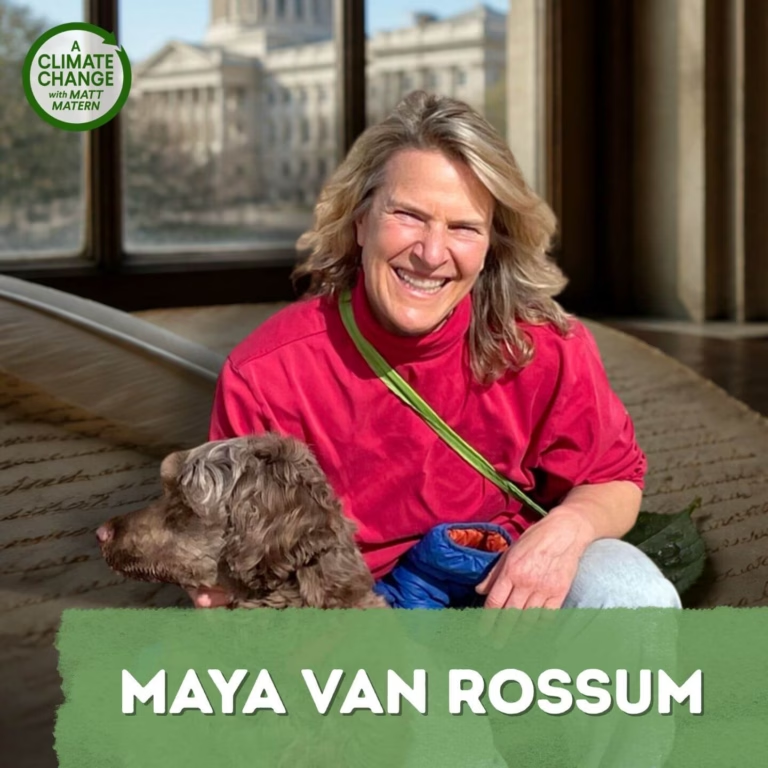
Matt speaks with Maya van Rossum, founder of Green Amendments For The Generations and the Delaware Riverkeeper, about putting the right to clean air, pure water and a healthy environment into state constitutions. Maya tells the story of how she and seven municipalities challenged Pennsylvania’s pro-fracking law using a constitutional right that had been ignored for 40 years, and won at the state Supreme Court in 2013. She explains what makes a Green Amendment different from the environmental laws already on the books, why it was the key to the youth climate win in Held v. Montana, and what happened when California’s version started to get watered down.
Plus, how communities are using the Green Amendment to push back on data centers, her new lawsuit over projects that get “deemed approved” without a single public hearing, and why a Capitol rally in Pennsylvania brought progressives and Trump supporters together on the same side.
You can’t protect my right to clean water, clean air, and you know be all in on data centers. There’s a state law that says that if local governments don’t hold hearings and render decisions on development applications within certain constrained timelines, that project is deemed approved. We have a couple of data centers that have been deemed approved without a single public hearing. We filed a lawsuit to say that deemed approval is stripping people of their constitutional rights when it comes to the environment. I’m confident we’ll win.
You’re listening to A Climate Chnage. This is Matt Matern, your host. I’ve got a great guest on the program today, Maya Van Rossum. Maya is the founder of Green Amendments for the Generations. Great to have you on the show, Maya.
Oh, thanks so much, Matt. I’ve been looking forward to talking with you.
Well, tell us a little bit. I always like to get a bit of the backstory of how your journey came to, you know, become a founder of.
Oh well. So I the the shortened version is though there’s no real short version, but I really feel like the universe put me in the place where I needed to be when I needed to be there, and so I really started off my environmental advocacy and law career in the role I serve in to this day, being the Delaware Riverkeeper and leader of a four-state advocacy and litigation organization, the Delaware Riverkeeper Network, which fights the good fight to protect the beautiful Delaware River. One of the things that we had to do, starting around 2008, was we had to start to battle to protect our Delaware River watershed from the incursion of fracking for fossil fuels, and we did that quite successfully just through advocacy and and actually got in place one of the first moratoriums in the nation, and one of the very few that’s done on a watershed basis to prevent fracking from coming into the Delaware River watershed.
But we, while we were able to protect the portions of Pennsylvania, New York, New Jersey, and Delaware that are in the watershed, we weren’t able to protect the portions outside of the watershed. And so, Pennsylvania, a vast majority of Pennsylvania, is outside of the Delaware River watershed. It’s a state where there are a lot of the targeted shales for fossil fuel extraction by fracking, and the industry came very quickly into the state of Pennsylvania with its industrial fracking operations. The given the state of the law, the fracking wreaked havoc on communities and on our environment, certainly on the climate. But rather than recognizing that the laws weren’t strong enough to protect communities and the environment from fracking for fossil fuels, the Pennsylvania legislators decided that oh maybe our laws are too stringent, and I’m saying that very sarcastically because they definitely were not right.
A lot of damage was being inflicted, and so the legislators passed a law that was very pro fossil fuel, and the long and the short of it is, was going to allow for the exponential expansion of fracking in Pennsylvania, with no part of the state being able to be untouched from fracking if this law had gone into place. In my role as the Delaware Riverkeeper, I knew we had to challenge and stop this law because fracking anywhere is bad for all of us everywhere. But it also would have pumped up the pressure to remove the ban on or the moratorium on fracking that we had secured. And so I thought with my legal team, well, how do you how do you stop a law that’s been passed by the legislators and signed by the governor? The only way you can really do that is if you have some sort of higher power.
We recognize that in the Pennsylvania Constitution there was this long ignored higher power, the constitutional right of the people of Pennsylvania to pure water, clean air, and a healthy environment. To say it simply, and we that law had been or the the amendment had been in the Constitution for decades, but it had been ignored by the legislators and by the courts. And we felt like this positive fossil fuel fracking law was such an egregious overreach on behalf of the industry that maybe we could breathe legal life into that constitutional environmental rights amendment and get the the lawmakers and the courts to view it differently.
So we challenge this law as being a violation of the Pennsylvanians the Pennsylvania right to pure water, clean air, and a healthy environment. Seven municipalities joined us. The long and the short of it is the case went all the way up. To the Pennsylvania Supreme Court, and we were victorious, and we defeated that law before it could unleash its devastating harms. But at the same time, we breathed legal life into this constitutional right of the people to a clean, safe, and healthy environment. Let’s give you a round of applause for that! Come on, well done! Come on, that’s that’s amazing stuff. That’s like grand slam as a lawyer. So, as a lawyer, my as a lawyer myself, I can appreciate how amazing that result is.
Well, and and Matt, and as you can imagine, right? It was we we hoped for it, we argued for it, but we didn’t expect it, right?
You dream about those, you know. You you you you certainly visualize it, but yeah, that’s a long shot to a certain extent because courts don’t like to overturn the legislature if you know for the most part, right, and certainly not 40 years of court precedent that said that this constitutional environmental rights amendment was just a policy statement, which is what it had said. And so, you know, I was like, “Wow, what a powerful victory!” And that was in December 2013. But you know, you look at a victory this powerful, and you say, “Is this all there is?” There’s got to be more, and so of course we started to use the amendment in more and more cases and advocacy in Pennsylvania, as did our environmental colleagues, who, by the way, so many of them suddenly claimed credit for our victory when they had nothing to do with it, but that’s okay. But I thought to myself, there’s got to be something more in this than just for the people of Pennsylvania.
And so I looked at Pennsylvania’s constitutional environmental rights amendment. What made it so powerful? And then I looked at and came up with a list. And then I looked at every state constitution across our nation, and found that only Montana had something similar. And I decided, based on the power of our victory, that you know we needed to change that, and that that I wanted to change that. I wanted to take that on, and so I founded the Green Amendment Movement and started going around the nation trying to inspire and encourage communities to follow this this pathway for constitutional environmental rights protection, and that’s the that’s the Green Amendment movement.
So those of us who follow the environment closely know that in Montana there was a big victory related to their constitutional right for a clean environment, and a bunch of young people brought a case, which the the Montana Supreme Court, which I assume is pretty conservative Supreme Court, ruled in their favor. Which another amazing victory.
And the thing that you know, when that that held v. Montana case came down, it really was you know absolute verification for the power of what I call a green a green amendment. Right there, there are many, many, many environmental rights amendments in state constitutions across the nation, but a green amendment is an environmental rights amendment that meets these certain criteria that I’ve identified that that are that are the criteria that gave Pennsylvania’s amendment so much power, right? And what I would do is I was reflecting on the really powerful litigation that our Children’s Trust was pursuing on behalf of the of the youth climate plaintiffs, largely on constitutional grounds, public trust grounds.
You know it was fascinating, but when you when the cases actually got to court, they were dismissed for a variety of reasons, including the federal case. But I always believed and shared with people that when a case was brought, one of their youth climate litigation cases was brought with the the a green amendment at at it as its foundation, that’s when the case would be victorious, and that’s exactly what happened. Montana, like I said, was the only other state at the time to have a constitutional green amendment, an environmental rights amendment meeting these criteria.
That was the core foundation of the legal argument that was allowed to go forward all the way to the Supreme Court, and that is the reason why the Health v. Montana case was victorious. So it was a great victory for our Children’s Trust, a great victory for the climate, but it was a really also a great victory for what it means to have a green amendment, and allowed me to really show people in a very clear way: this is how a green amendment makes a difference. It gives you a path to victory when otherwise you don’t have one.
Tell us kind of the state of play in terms of how many states have adopted green amendments other than Montana and Pennsylvania, and kind of where where other states. Are in the path of adoption.
So we have secured a green amendment in New York. New York’s language is not as robust as Pennsylvania’s. Pennsylvania actually has the best constitutional green amendment language that exists in in the nation, and actually is the model that I rely upon for you know my encouragement of of what language should be utilized in other states, but it does fulfill the basics. So that was passed in voted by over 70% of the of of New York voters voted in support of adding the New York Green Amendment to its constitution. It was added in 2022, so it’s early days, and it’s now being tested in the courts.
And we’re having some positive victories and some not so positive victories. But eventually, we’ll get there. Just like in Pennsylvania, eventually we got there. So at this point, there are three states with a constitutional amendment that meets the Green Amendment definition. But there are over 20 other states where a green amendment proposal has been put forth, and they go from west coast to east coast in the middle, and include the Hawaiian Islands, right? So we’ve got Oregon and Washington and Colorado and New Mexico, Arizona. We’ve got Michigan, Connecticut, New Jersey, Maine. You know Wisconsin. They’re you know they’re they’re like I said they’re over 20. I can eventually list them all off. But the really interesting.
What about California?
Well, so California came late to the game. They did have there was a California Green Amendment proposal, and it was it was along the lines of New York’s. It it it fulfilled the basics. It started to go through the progress, go through the process, the legislative process. It got support, and then in the final analysis, it looked like a deal was going to be cut to modify the language in ways that would have just eviscerated it. And so I reached out to the legislative champion and said, “Please don’t do that. You know, there’s no point in going to all the work to amend your constitution if you’ve changed nothing.” And so they stepped back.
The amendment did not progress, and now we’re sort of waiting to see when there’ll be another one. It’s fascinating to me. So I’ve learned so much about all the different states, their personalities, their legal personalities, their advocacy personalities, certainly their constitutional personalities. But the thing is, is from really from year one, right, of the founding of movement, which would have been 2014, the year after our our victory, people always said, “Oh, and what about California?” And I always had to say, “Nope, not in California.”
And then in two years, you know, two years ago, I was I was able to say California, though I just told you how it played out. But when I’ve talked with actual Californians and advocates, they were always less enthusiastic about the amendment because there was this strong sense of you know as progressive as California is on the environment and high profile as it is in terms of its environmental progress, there seems to be this broad recognition amongst the grassroots that at this point really good stuff doesn’t advance anymore. And I don’t know, Matt, if that’s your perception, but that’s sort of what I hear. And they’re like, “That’s too progressive for California.”
Curious, kind of turning back to Pennsylvania, and you know, you guys got the victory there in the Supreme Court, and you know, they’re definitely still doing some fracking there. What has changed after your your victory in terms of cleaning up their act?
Yeah, so that’s always the question. You’ve got this great green amendment, Maya. Tell us how awesome it is, but there’s still fracking. And so the the first thing that I do express and explain to people is, you know, if we were, for example, to pass a green amendment in California, right? Right now, today, all the bad stuff doesn’t disappear, right? You’ve got all the bad things that are happening in California, and so once the amendment gets passed, you’ve got to do the work of kind of clawing back the ground from the industry and brick by brick, case by case, building up protections.
So that’s the thing in Pennsylvania was the frackers got there first. If we had had the amendment, I really believe we could have kept it out, but we didn’t have the amendment. So we we now are working to get greater greater protections in the fossil fuel context and also out of the fossil fuel context. And so there are a variety of victories that have happened on both fronts. I sort of like try to try to use examples to highlight these are victories that would not have been achieved but for the Green Amendment. The Green Amendment has been used to clean up a long ignored supersaturated. Toxic site, right?
It’s the soils were soaked, the groundwater was soaked, the stream was soaked. The government had known about this supersaturated toxic condition since 1985, and rather than hold responsible, wealthy, responsible corporations accountable under existing law to clean up the toxic site, the government said we’re going to negotiate a sweetheart deal with a developer, and so they could build 200 residential homes there. Once the Green Amendment got vibrant, we were able to use it through advocacy and litigation to prevent the the sweetheart deal, and now the government is on track for cleanup. So that’s a really powerful and important victory. Of course, there’s the Held v. Montana case. The amendment has been used proactively by local government to protect that last little piece of natural green space in urban and urbanizing communities from being developed.
So there, people didn’t have to litigate; they were able to advocate and say, “Local government, you have a constitutional obligation to protect our environmental rights and our natural resources for the benefit of the people.” And the government said, “You know what? You’re right.” And they use the amendment proactively to stop the development and and have the site preserved, and I use these kinds of examples just to say, you know, that there there are a vast myriad of ways that the amendment has been used to really make a difference, but they’re all diverse and different, and they’re not all in the fossil fuel context.
But they are victories that would not have been achieved, but for the amendment, and so it’s really making a powerful positive difference. We’ve only had a living, breathing green amendment in Pennsylvania for just over 10 years. You know, so we’re doing that work of building the wall of protection, and we’re starting to get a really good understanding. And we don’t just have people relying on the amendment to make a difference. We have local governments. We have the state government has relied upon it now to take on, you know, to take on Monsanto, and now we’re using the Green Amendment to defend communities from data centers in a wide variety of ways.
Well, let’s let’s switch into that area. But I first want to just ask a question about kind of the rights of nature, and that certainly I’ve talked to some guests about that, and it seems like that has some value. And and whether or not you’ve considered putting rights of nature into the Green Amendment.
So it’s it often comes up as a question and a conversation, and I’m always open to the conversation. the The thing is, the the the concepts, and I believe in rights of nature. I talk to the trees all the time. You know, before I do a really important talk or podcast like this, I make sure that I I check in with nature so that I’m being a voice of nature, not a voice of whatever Maya wants, right? But really, the rights of nature are about getting nature into the courtroom, right, to enforce the laws that are on the boats when they’ve been violated and nature is being harmed, right?
The river is being polluted, rather than have a person that’s harmed going into the courtroom to to enforce the law that’s being violated, nature gets to go there itself. But as I say, it sort of to me it doesn’t matter who’s in the courtroom, whether it’s nature or a person, if the laws suck and are written to allow so much contamination of our rivers and our streams that it devastates our natural ecosystems and it gives kids cancer. Who cares who went into the courtroom? The law is still bad, and it’s really not going to provide the quality of protection that we need. What a green amendment does is it really raises the bar. It’s not about the enforcement of the laws on the books that the legislators decided to write and enforce or not enforce.
It’s about this right of the people to pure water, clean air, a safe climate, and healthy environments, and using that as the check on everything that government does legislatively, you know, regulatorily in terms of enforcement actions, whatever it is they do. So we’re creating a higher bar of protection.
Yeah, I get it.
And what we’re also doing is really whatever people think about it. Our our U.S. Constitution is based on the rights of people, and our legal structure isn’t doesn’t work well with the rights of nature concept as of this time. So what we’re doing is we’re using that most powerful tool that so often has been used against us, you know, in the property rights context and things, in ways that would harm the environment. We’re using that most powerful tool to raise up our environmental rights and give it a higher level of protection, and we’re doing it in a way where we can get support across the political spectrum, right?
Not everybody believes in the rights of rivers, trees, and fish, right to have a voice in our in our legal concept and structure. Everybody believes in the right of people to have clean water and clean air. So when you’re advancing this kind of constitutional entitlement, you really win the room very quickly when you when you start with the rights of people. So I always say, in the Green Amendment movement, let’s go forth. Let’s use our constitutional amendments to protect the rights of people. Use that construct to raise the bar on environmental protection, to change the way people think about nature and our connectivity with nature and its importance to us. And when we get everybody up to that level of thinking, then let’s do a step two, and let’s add rights of nature to our green amendments.
It sounds like a reasonable plan. You got to go to base number one before you go to base number two. Let’s talk about data centers. They’re in the new frontier. How are you using the green amendment in Pennsylvania and other places to combat those.
Yeah. So you know the Green Amendment it does create a right of the people substantively to a healthy environment. So of course when people are going in, so many of in my experience, so much of what’s happening with data centers, and I don’t know, Matt, if this is yours, you know, on the on the West Coast. But so much of what’s happening is happening at that local government level first, and so communities are going into their local government, and of course they’re saying, “I have a right to clean water, clean air. If you approve this data center, you’re violating that right.” And they’re trying to convince their government officials to fulfill their constitutional responsibility to protect natural resources and the environment, but there’s another piece of of the Green Amendment construct that’s really really important.
In order to defend any decision that involves the environment, governments have to do a really a an analysis of whether or not their action or decision is going to infringe on environmental rights. They have to do that analysis. It’s got to be substantive, meaningful, and demonstrated. And they have to do that analysis before they render their decision. So what I encourage people to do and train them to do is look. You go in before the local town council and you say the data center hasn’t given you the information you need to do that constitutional review because the data centers never give accurate information, full information. Their information often is conflicting. It’s shallow. It’s qualitative. It’s not quantitative. So in fact, truly, government officials can’t do that constitutional review in support of, you know, the the a pro data center decision.
So that becomes part of the argument, and and both both strategies have been. The other thing is that we’ve recently filed a lawsuit, so there’s a state law that says that if local governments don’t hold hearings and render decisions on development applications within certain constrained timelines, and don’t get the developer’s approval for a an extension of that timeline, then that project is deemed approved without any hearings, nothing. And so we have a couple of data centers that have been deemed approved without a single public hearing at the local level. Nothing. We challenged. We filed a lawsuit to say that deemed approval is stripping people of their constitutional rights when it comes to the environment because you haven’t had that process, you haven’t had that informed decision making, and they’re being stripped of their due process and free speech rights.
So on those three pillars, that state law that’s been around for decades, giving all the power to the developers and now to the data centers. We’re saying that’s unconstitutional, and that entire part of the law should fall away. So we filed that, and I’m confident we’ll win.
Well, that would be a great victory, and certainly that what is happening around the country. People are really fired up on both left and right regarding the data centers, and kind of exactly or very closely related to what you just said, which is things being ramrodded through without proper due diligence and not listening to the people who live there, and people are just pissed. So it seems like maybe this data center issue can reignite the environmental movement to have it be bipartisan again, and and everybody kind of join in to that we’re all affected by this, we had this really powerful rally at the Capitol in in Pennsylvania around data centers and environmental rights. That was the core thing, right? You can’t protect my right to clean water, clean air, and you know be all in on data centers.
And we, it was across the political spectrum. We had the very very liberal, and we had the Trumpsters, and they were all in the same place and the same space, singing the same tune when it came to data centers. It was really when it came to data centers and environmental rights, because now people are like, oh wait a second, now I see we even have Republicans putting forth legislation to to allow for moratoriums on data centers based on the environmental rights of the people. These are the very same legislators that used to balk at the Pennsylvania Green Amendment, you know, and and they raised their hands and their hair was on fire that this was such a bad thing. Now suddenly they see, oh no, this is not a bad thing. It’s a tool we can use when we need it.
Well, when 75% of the voters say they’re they’re fed up and they’re going to vote against the guys to put the data centers in there, all of a sudden the politicians start waking up. So this is to me that’s the fire that reignites the environmental movement in a real positive way, and certainly harnessing that in any way, shape, or form is is to the benefit of everyone.
Am I allowed to ask you a question?
Sure, fire away.
So you know, one of I think one of the most horrifying movements for the environment that has come around in the last few years. I understand began in California, right? It’s the abundance movement, right? If we want abundance, we’ve got to throw environmental regulations out the door. I’m wondering now that we have the data center cabal, and there’s the abundance movement. Is are you, you know, how are they intersecting? Do you see that?
I I think there probably would be some intersection there. It’s kind of like let’s throw permitting out the window so we can build faster. And and I’m not against some permitting reform. I think that that probably makes sense in certain situations, but it it it also is there for a reason. So and and to do development responsibly, you know, does take some guardrails. We we just need guardrails because unfettered capitalism would would I mean they would pave the you know the whole area over from the ocean to the mountains you know if somebody could make some money off of it there’d be some idiot who would do it like they they would just do it and be like I can make a lot of money off it I really don’t care that I destroy everything in its path so you know there has to be guardrails, and anybody who says there shouldn’t be is is a fool.
And I feel like the data centers are this great example of that because we have local government tends to have very little to no power. We’ve got state government going all in with data centers. Of course, we have the federal government stripping everything away, and I feel like this is a moment, just like with green amendments and environmental rights. It shows how and why they’re so valuable. It’s also a demonstration for these people who maybe at one point said, “Oh, abundance! To get abundance, we need to throw all regulations out the window when it comes to the environment.” Are saying, “Well, wait a second. There is a place and a space.
If we want to protect people, we have to protect their water and their air. So maybe these regulations aren’t so bad. So I sort of feel like maybe this is also a pushback. It’s a push forward for green amendments, but it’s also a pushback on what I think was a real overreach by that abundance movement, as you said, casting aside everything to make $1, you know. And I think the other thing is the people are starting to see that their local government is those local government meetings is an important place to be, you know.
So so many of those meetings, it’s just a few people in a little room, but now you’ve got these local government meetings having to be moved to the local fire hall because they’re overflowing, and suddenly people see like, oh, wait a second, who I elect to this local office really matters, right? I don’t want this person with no knowledge or this person with clear, you know, a clear predetermined outcome on everything. Like I want somebody who’s really thoughtful and cares about the community, and they’re coming in. So I think that’s another. It’s the other version, right? The the local government is really important, and the people are starting to recognize it and get involved.
So, just in kind of wrapping it up, what what are. The things that you would encourage listeners to go out and do that would make kind of the most difference at this point in time.
So, of course, I want them to get involved in the Green Amendment movement. And the thing is, is every Green Amendment has to be led by the people of that state, right? Like, I’m not going to get a Green Amendment in California. You are, right. So what I but my role is to partner up and to share my knowledge and to empower and to be part of the team, right? With the knowledge I have. So I really encourage people if you’re in a state where there is a green amendment, you know, get in touch and let me try to loop you in. Some of the green amendment movements are really robust.
Some are very small and just you know you know trying to get along and figure it out, but all of them are filled with people who care, and and really demonstrating that one person makes a difference. So if there is a green amendment, get in touch. If you go to greenamendment.org, there’s an active states page. You can see if your state has something happening, and if your state’s not on the list, get in touch because you might be the person that makes it happen. The Green Amendment movement in New New Mexico, the one in Michigan, the one in Maine, the one in Connecticut are all because one person called me up and said, “I think this is a really powerful idea. How can we make it happen in my state?
And they’re like, I’m just one person. I can’t do it. But we talked, right? And we figured out how to get others involved. And now they’re really great efforts in those states. So, you know, that’s what I think. And you don’t have to, you know, to join and see sort of just generally what’s going on. Nobody has to pay. You don’t have to pay to have a voice in the environment. Join, you know, the Green Amendment movement. Find out what’s happening in your state, and let’s work together to make it happen.
That sounds amazing. I will sign up for California. You know, let’s let’s work together and get this done.
Awesome, awesome, Matt.
Okay, well, Maya, it’s been great having you on the show. Everybody should check out the Green Amendment and get it done in your state, so we can all have a cleaner environment. To learn more about our work at A Climate Chnage, visit aclimatechange.com. Don’t forget to subscribe to our podcast on Apple, Spotify, YouTube, or wherever you get your podcast. If you like this episode, please share it with a friend. See you next time.
(Note: this is an automatic transcription and may have errors in formatting and grammar.)