
Hear us on Apple Podcasts, iHeart, and Spotify Podcasts. Subscribe now!
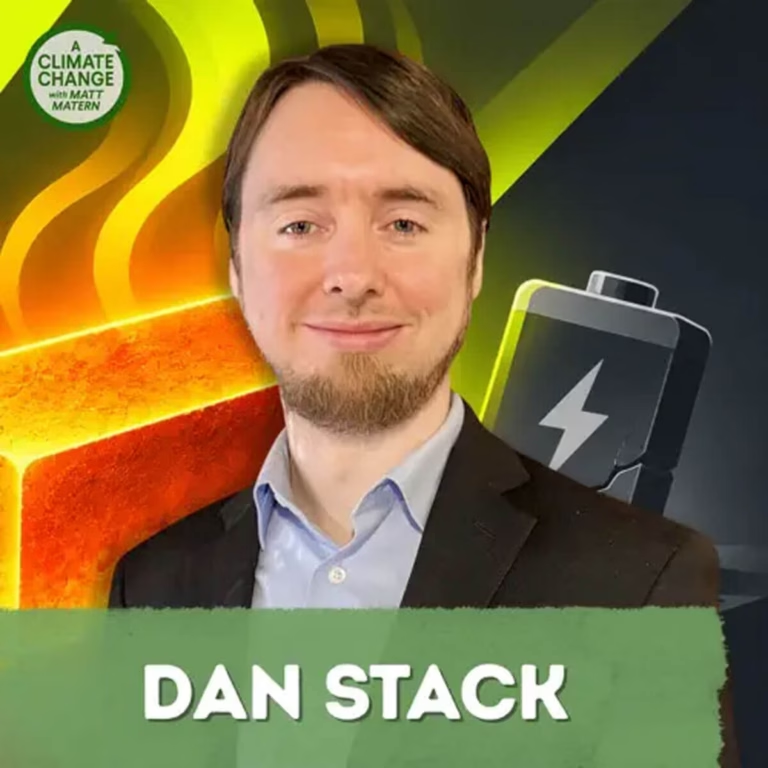
Matt speaks with Dan Stack, co-founder and CEO of Electrified Thermal Solutions, about cleaning up one of the biggest and least talked about sources of climate pollution: the heat that factories burn fossil fuels to make. Dan explains how a grad school assignment to “figure out the best way to heat up bricks” became the Joule Hive thermal battery, why storing power as heat in bricks is far cheaper than lithium-ion for heavy industry, and how factories can cut their energy bills 10 to 30% while cutting emissions one for one.
He said, “I got a great project. You’re going to figure out the best way to heat up bricks.” The idea was kind of elegant and simple at the time. It was that we have electricity from nuclear, hydro, solar, and wind power, so we can use that as an on-demand heat source, store it for later as heat. It is way cheaper than any kind of electrochemical storage, like a lithium-ion battery, just because the material is so dirt cheap, it’s made of dirt.
You’re listening to A Climate Change. This is Matt Matern, your host. I’ve got a great guest on the program, Dan Stack. He is the co-founder and CEO of Electrified Thermal Solutions, a climate tech company helping heavy industries quit fossil fuels. Dan studied nuclear science and engineering at MIT. Welcome to the program, Dan.
Thanks, Matt. Great to be here.
Well, tell us the tell us a bit about your journey and and how you ended up starting this this company, and and kind of what what are the things that you’re hoping to achieve with the company?
Yeah, happy to do so. It’s been quite a journey so far, and I think there’s plenty more to go. But you know, as you mentioned, I was studying nuclear science and engineering, I started that about 12 years ago now, and I kind of got to MIT very passionate, hoping to be at the forefront of energy innovation, try to tackle the emissions problems that we have, the climate problems that we have, and I wanted to work on next gen nuclear reactors, and my advisor, or who became my advisor, he said, “I got a great project.
You’re going to figure out the best way to heat up bricks.” And I said, “Why the heck would I want to be heating up bricks?” And it really was as outrageous as it sounded at the time to me, and I would never have believed at that moment that I’d be doing this, you know, many years on here. But the idea was kind of elegant and simple at the time.
It was that we have electricity from nuclear, from hydro, from solar and wind power, and they’re all available at certain times of the day, and but they’re not very good at load following, and they’re not always available if you’re wind or solar. So we can use that as an on-demand heat source, store it for later as heat.
We could do all sorts of things with that, and so that’s kind of been the the genesis of the idea. Here is you know at electrified thermal, you know, we take that electricity from solar, wind, nuclear, hydro, and we turn it into an on-demand heat source for heavy industry. You know, at the time, I didn’t understand how big of a problem it really is to be able to do this step, but roughly 20% of global energy goes towards heat for industry, and also roughly 20% of emissions come from making that heat for industry.
So it’s not a small problem; it’s a massive problem, and it might not sound like a sexy problem, but if we could turn that electricity from those sources I named into an on-demand heat source, we could tackle that nexus where we’re we’re using energy today, and we can cut emissions and save folks money while we do it if we can store it as high-temperature heat. So been living and breathing that for some time here.
Well, that’s that’s great, and I love the story of you’re going to change your direction from nuclear reactors to heating up bricks. That’s I’m sure you thought, what you know, but just kind of, kind of cutting to the chase a little bit in terms of lay audience like myself. Why is this heating up of bricks a better kind of storage of heat than say lithium-ion batteries? Or I’ve I’ve read they’re coming out with zinc batteries. Why is this kind of a more efficient source of storing that that energy?
Great question, and yeah, we’ve gotten a lot of. There’s been a lot of new ways to take this electricity that we see that’s available sometimes for low price. You know, taking our solar, our wind power, and shifting it. You got lithium ion getting pretty cheap. You got zinc. You got other, you know, lots of different creative approaches. What’s really nice about thermal storage is a couple things.
One is that it is pretty much always, unless you’re doing it wrong, way. Cheaper than any kind of electrochemical storage, like a lithium-ion battery, just because the material is so dirt cheap. It’s made of dirt and minerals. That’s what we’re heating up, and you can get these brick materials that go to you know almost 2000 Celsius, which means they can hold a lot of heat.
You can get that for really cheap, and they can hold that heat really well. The other point is, well, because of the use case, right? You know, getting heat into these bricks means you can get the heat out as heat, and that’s what industry Runs on, so the extra cost of those you know lithium-ion batteries that can be worth it because you want electricity in and electricity back out. But if what we need at the end of the day, what industry needs, you know, we’re talking about by the way, pretty much the entire built environment.
You know, the the table your your computer’s sitting on the the concrete at your foundation at your of your home is built out of the metal beams that that build our our skyscrapers. All these things need heat really to run, not electricity. So we can save all that money on the storage side by just storing it as heat and giving it out. So cheaper and actually doing the temperatures and and energy form that industry needs is why we go for these hot bricks instead of the lithium-ion battery.
And so, tell us how much energy savings there is in using these bricks instead of, I guess, not using them.
Sure. So you know, if you if you go to the industry today, you say, “What are we actually doing for them or solving for them?” They’re business as usual. They’re burning natural gas usually. And what’s remarkable is we’re at a moment now where in much of the U.S., much of Europe, much of the industrialized world, we can take in electricity, store it as heat, give it as heat, and beat the price of natural gas in much of the world, much of the time.
And so, what they stand to gain is, you know, cutting their energy bill, cutting their heating bill by 1020, 30%, depending on on you know how we set it up here, while cutting their emissions right and and cutting the C02 and and NOx and other things that their business as usual does today. So it’s a really special time to be doing what we’re doing.
So in terms of well, just the cost savings alone is is pretty sexy to business. If you’re talking 10 to 30%, that’s a that’s a big number. What’s the the rate of cutting these C02 emissions if you’re using bricks versus just natural gas, so it’s basically one to one. So you know when we’re taking in electricity and we’re turning into heat, and you know you can picture it, right?
What’s what we’re literally doing is we’re putting shipping container sized systems on a on a plant site where they’re you know doing whatever we said they could be making potato chips or steel it doesn’t matter you know you put those units there electricity goes into them hot air comes out and when we give them the hot air from our box instead of the hot air of combustion it’s basically a one to one replacement, so we’re knocking out CO2.
Every unit of gas that we’re not burning is a unit of C02 that they’re not emitting. So, and as far as you know, you got to look at how clean the electrons are on the other side of that. Almost universally, what we’re running on is the cleanest electrons. So we could be hooking up straight to the solar farm or the wind farm. We could hook up to the grid with those assets on it, and we only charge at the times when the prices are the lowest.
This is also when the electricity is the greenest. And so for those, you know, dynamics in place, it’s a one-to-one replacement. If I replace half your natural gas with this. I’m also knocking out half your emissions.
Now, in terms of other benefits from this, if you’re not using the natural gas, you’re also probably not having the methane emissions that go with natural gas extraction, right?
That’s true, and actually, what I just said doesn’t include that part. So, to be to be fair, actually, depending on where you want to draw the boundary on the plant, there they could be leaking methane along the way or on the on the site potentially, and yeah, you could cut down on on. Some of that as well, which you want to cut down a not as much as you can always, because that’s got a much bigger factor on it.
Right, it’s 80 times more powerful in the short term than the C02. So, in a lot of ways, that’s the most important thing for us to be cutting out as soon as we can.
Right, it’s a high leverage point, absolutely.
Are there other, you know, chemicals like nitrous oxide, which I understand is even more powerful than methane, as far as a polluting, you know, emission?
Yeah, I haven’t checked the the carbon intensity those in a while. As far as I know, most of them are weird in C02. You know, when you have those, especially for the NOx, it’s also a health hazard. Just you know, for for local air pollution. So we usually think about it in terms of that. And you know, if we could cut the emissions, you know, cut the operations of the fossil fuel across the world, here you’re talking about millions of premature deaths, mostly from NOx. That if you start to cut into that, you could you could save lives as well. On top of the you know the carbon impact, or sorry, the the climate impact of those gasses.
That’s a pretty important technology we’re talking about here. So, and amazingly, coming from bricks, which are about as ancient of a technology as as is out there. And what I had read was that the materials that you’re using are 98 percent similar to the bricks that we might have in our homes, or and this is what we kind of restricted ourselves to for how to go about solving the problem
So the bricks are practically the same as what you’ll find in certain high temperature furnaces. Maybe not quite in your fireplace, but as one example, you know where you’re melting glass, you know, glass for your your you know kitchenware or wherever else. The floor of where they’re melting that glass is actually made out of these bricks, or very very similar to these bricks, is one spot where they get used a lot.
And so anyone who’s making bricks for the glass industry can make these bricks. We’ve just added some secret sauce and secret know-how to make them electrically conductive, and that was kind of the trick to otherwise take a very benign off-the-shelf material and unlock its electrical properties. So that’s yeah, it’s very very commonplace stuff.
So, in terms of others in this space, are there other companies trying to do similar stuff, or are you the the unicorn in this area?
There’s a few others putting in great effort, and I’d say we’re all pushing in the right direction here, the market is massive. So I’ve been thinking about this and working on this longer than most of them have existed. So I think we’ve got some some unique capabilities here. But yeah, certainly it’s a it’s a space that’s been heating up. No pun intended.
Well, it seems like there’s enough room in the market for lots of players, so there’s no shortage of opportunities. So, tell us kind of how the rollout looks like. I know you’ve gotten, you know, placed some of your materials in a cement facility, correct? And where do you, where else do you see this rolling out, and how quickly?
Yeah, we’re deploying that one right now, so it’ll be live next year. As exciting, exciting one for us, and we’re, you know, we’ve got customers across the globe. We got several other projects that aren’t announced, but but are fully inked, and we’re filled up for basically 27, and now going into 28 for shipping these containers are what we call the dual high thermal battery. That’s the actual product name.
Rolling these out to industrial sites, especially across U.S. and Europe, but we’ve also got some others that we expect to be deploying in the near term here, and that’s kind of the vision. You know, we have we’ve got our partners on the brick side. You know, I mentioned that these are 98% the same to what’s out there? We’ve spun that up now. We can support you know gigawatt hour a year today, easily scalable to 10s of gigawatt hours a year in the coming period here with our partners and with our current capabilities to roll these units off factory floor and get them out to folks and.
The unique ability of those is that we can, you know, the unit we ship you, it can go to flame temps and last for decades, and also plug into high voltage, medium to high voltage in the 10 to 100 kilovolts range. So we’re offering today that industrial, you know, kind of one size fits all system that can plug into anything from the potato chip frying to the steel making, and that’s the vision over the next couple of years. Here is you’re going to see this at you know almost every major industrial vertical that you could imagine.
That is that’s pretty groundbreaking. So so in terms of just industrial capacity to produce your units. It seems like you’ve got a problem of or challenge. I don’t know of producing enough of your product to meet the potential enormous demand.
Good problems. Yes, good problems on our side.
And so, in terms of raising capital, how much how much have you raised? Are you going public? What’s your status on that front?
Yeah, so we raised. We’ve gone pretty fast, I’d say, relatively lean year. You know, we had a seed round in 22, about $5 million, a little under, and then raised about another 20 million after that, mostly from industrials who want the product. Along the way, even earlier than that, we had a few million from government grants. That was really catalytic early on, and has kind of continued to support us in ways that we’re you know that we’re really happy about and proud to be part of those programs through ARPA-E and the DOE.
So all in, yeah, around around $30 million from those sources. You know what comes next for us is a bigger cash influx, so we can really mass produce these units now. The first one that we’ve had running now, they’ve got good logs, you know, logs good hours on, good time. We’ve got our first commercial projects throughout next year, so now we’re raising a growth round. Currently, can talk more on that maybe offline, but yeah, we we see a really really bright bright path here for the next couple of years.
Yeah, it sounds amazing. Speaking of the DOE, I I had Jigger Shaw, who was, you know, running I guess the loan side or grant side of the DOE back on the show a few years ago. I don’t know if you guys had any contact with him when you were getting any grants that you got?
Not directly, but you know, Duke Shaw is a legend around the space, so he’s done incredible work.
Yeah, it’s great to see some of those dollars, those seed dollars, helping companies like yours get off the ground. So the the effect of that is incredible downstream. Some people forget, including the one of the founders of Tesla, that they got a lot of government grants to start that company, And maybe maybe the world should remember that many startup companies did get government money to help help them get off the ground.
It’s good to pay it forward, I’d say. Certainly, we’re we’ve we’ve been getting some good benefits now. I’m happy to sing the praise of ARPA-E and the DOE projects that have helped us along our journey here, and I think it’ll be a net good for certainly for the taxpayers and for you know U.S. industry. So I couldn’t agree more with you.
So in terms of job creation, what how many people are you employing and kind of how how big do you see this rolling out, or are you going to be employing all the people who are manufacturing it, or are you outsourcing that to other companies?
So it’s going to be you know it sounds cliche, but when you’re in this kind of hockey stick, this hockey stick moment where you have mass production, mass demand. You know we’re going to have to put bring a lot of people to bear on this and have all hands on deck for manufacturing. You know we are basically operating factory floors as we march forward here of people stacking bricks into containers, doing electrical wiring into the tops of those, doing welding and and and pipe fitting for the hot air pipe, you know, pipe that comes out of it.
So there’s a lot of kind of manual labor. Some of this. Can be automated with robotics, but you’re always going to need some folks in the loop here who are skilled masons, who are skilled metal workers to get these units rolling out well. And so, you know, when we talk about the next couple years, we’re talking about our our kind of gigafactory where we’re rolling out you know several gigawatt hours a year of units, and that’s going to have a lot of people, I’d say, being put to work across the U.S. And eventually, you know, we’ll have regional factories for regional deployments in different areas of the world.
That’s very exciting stuff. Where do you see it being implemented first, and and where do you think the kind of most challenging areas to deploy this kind of technology into that that may really need it, but there are some barriers to to entry.
So right now, Europe is kind of in a unique moment where, if you asked me a few years ago, you know what the kind of value prop is of this, I’d say, okay, we can show up on your site, give you these units, live systems, offset your heat, and save you, you know, 10, 20%, 30% on your energy bill in some cases. Now, with the Strait of Hormuz closed, natural gas prices in Europe have gone from about 30 bucks a megawatt hour up to 90. It’s roughly tripled, and it’s only been climbing over the the time here. So, it’s kind of gone from a a good investment decision to a serious pain point.
That you know, just in general, you’re seeing these price shocks. It’s it’s having folks looking for ways, looking for alternatives to get their heat, just so at least they can have a hedge against you know the uncertainty in the the geopolitics right now, so that’s an area where we have a lot of a lot of engagement, a lot of movement. It’s where some of the first systems are definitely going to be going, and including the one with Wholesome that we announced. Areas that are tougher, I would say, any area that has basically no energy mix other than just fossil fuels today, where the flexibility that we can bring isn’t directly valued, but that’s an envelope we’ve seen shrinking over time.
Where as you deploy more solar, more wind, I mean, solar is being deployed at you know faster than anything right now. Wherever that is rolled out, the ability to soak up the cheap electricity, the surplus electricity, can pretty much always offer value and beat the price of of the fossil fuel in the area. But if you look at the map now, you could imagine you know areas where there’s very little solar or wind or nuclear deployments, that when those other assets come, will will be there.
Yeah, well, there are certainly some very substantial areas that have excess solar and wind, and such as Texas and California, where there are plenty of days where we’re producing more than 100% of our electricity needs in California, as well as Texas, and so they just need a place to put it. And sounds like your your storage capacity would be a good fit for that.
Exactly, and these are not small markets, right? I mean, roughly 70% of industrialized Europe has solar, wind, nuclear excess that beats the price of gas. You know, anywhere from 30 to 50% of the year. Texas, California, not small markets. You know, the whole the whole wind belt and sun belt of the U.S. has so much excess generation, and this is all happening, by the way, even with the rise of data centers and what have you, where really the flexibility of our asset allows us to synergize with those with those growing loads on the data center side, so it’s yeah, it’s not a a small market at all. It’s it’s massive.
So, do you see yourself or your company being able to facilitate a cleaner, greener data center so that it would be less of a drain on on local communities.
Yeah, we see a couple opportunities there. The interplay between the thermal batteries and the data centers has a couple of interesting plays here. Number one, despite. Some of the the talk about data centers kind of load following with the clean electrons. The reality is they want to run all the time. They spend a lot of money on these sites. They see the you know the greatest value by running 24/7.
So they haven’t really lent themselves to being flexible assets, so when you have thermal batteries nearby, what you usually have, or just in the grid itself, you’ll have a build out of you know more power assets. There’s a lot of talk on nuclear with data centers. There’s a lot of solar and wind build out. Gas turbines, of course, are way back ordered now, so folks are looking for alternatives. When you put thermal batteries in the mix, you can have the surplus power being generated by the large solar farms being built.
And take that surplus that the data center can’t even use at that time, and give it to the local or or you know on the grid at all industry, so you can help make the most value out of those new electricity assets that are coming online for this for this base load. The other avenue is we’ve actually been in deep explorations here, hooking up our thermal battery to the power grid of the data center itself, where basically we take in the cheap electrons, turn it into 24/7 power by running a turbine on site or on you know nearby on the grid for the service of the data center.
So you could either siphon off that cheap electricity and give it to the industry, which is happening increasingly because of the data center, or you can give the power back to the data center later, and that kind of looks like a lithium-ion battery play in that case. But there’s actually the ability to be even cheaper than that when you go to the scales we’re talking about here.
Uh huh. Oh, it’s definitely a leap forward, and appreciate the great work that you’re doing over there at Electrified Thermal Solutions. And everybody should check you guys out and and pass pass the word along to you know local industry to to tap into this power source that is cleaner and greener. So, thank you again for being on the show.
Thanks, Matt. Appreciate it.
To learn more about our work at A Climate Change, visit aclimatechange.com. Don’t forget to subscribe to our podcast on Apple, Spotify, YouTube, or wherever you get your podcasts. If you like this episode, please share it with a friend. See you next time.
(Note: this is an automatic transcription and may have errors in formatting and grammar.)