
Hear us on Apple Podcasts, iHeart, and Spotify Podcasts. Subscribe now!
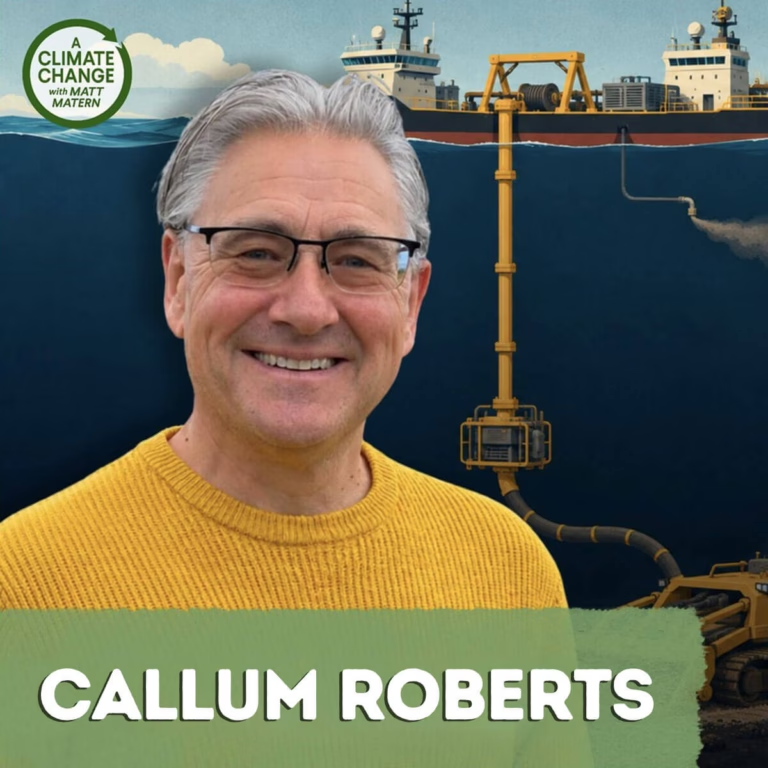
Today, Matt speaks with Dr. Callum Roberts, Professor of Marine Conservation at the University of Exeter and Chief Scientist of the Convex Seascape Survey, about the ocean’s role in slowing climate change. Dr. Roberts explains how a super El Niño is putting coral reefs at risk, why deep-sea mining would be reckless when land reserves already cover our needs, and how bottom trawling disturbs carbon that has sat in seabed mud for thousands of years. They also talk about why only a fraction of “protected” ocean is actually protected, what Blue Planet III hopes to change, and what Roberts wants to see at COP31.
Seabed disturbance by industry, particularly bottom trawling, released carbon emissions equivalent to the world’s aviation industry every year. Hundreds of square kilometers of seabed are being ripped up by a single vessel in the space of a few days or a week. Sponges in the deep sea that can be 10,000 years old, which is just an incredible thought, but they can be swept away in an instant by a trawl net.
You’re listening to A Climate Change. This is Matt Matern, your host. I’ve got a great guest on the program, Dr. Callum Roberts.
Dr. Roberts has an incredible resume, professor of marine conservation at the University of Exeter. He’s been the lead science advisor on Blue Planet Two and is advising on Blue Planet Three. He’s written a whole lot. He’s worked with the UN on their program of 30 by 30, which is I think 30% of land preserved by 2030, and done a tremendous amount of work. We’ll just dive right in. Thanks for joining us, Dr. Roberts.
It’s a pleasure. Nice to be here.
So tell us a little bit about your journey and and what led you to become a professor of marine conservation.
Well, I started out as a biology student in the 1980s, and I got the chance to go and dive on a coral reef in the Red Sea when I was 20, and this was just an incredible experience. You, unlike anything I’d seen up to that time, which was mostly the waters of Scotland, which were cold, rather empty at the time, and definitely impacted by people. So the Red Sea was a revelation.
It contained this extraordinary diversity and abundance of fish. They were just like this incredible multicolored kaleidoscope as you dived over the reef edge, and then we’re confronted with this abyss in front of you, which is just full of fish-like jewels. And that convinced me at that moment there was no other career that I wanted to pursue than marine biologist.
That is a pretty spectacular start to a career. So, yeah, it’s a great story, and and so then where did that lead you next in terms of you know special specializing?
Well, I started out really studying coral reef fish behavior and the geographic distribution, and that’s very interesting. You know, it teaches you how to do science when you when you study things like that. But I quickly realized that the world was changing, and coral reefs were impacted by things people do, like fishing or like coastal development, tourism, and so I got the bug for studying how to protect marine life and to safeguard habitats that were under pressure, and I’ve I’ve never turned back from that.
So, in terms of coral reefs and and temperature rise of the sea, we’re seeing continuing to continuing rising temperatures that are very destructive to the coral reefs. I know here off the coast of California, I think they said the temperature is something like six, 810 degrees above normal. And I don’t think we have a whole lot of coral reefs here, but it certainly is causing tumult on in this area, what are your what are your thoughts on on how quickly sea level temperatures are rising, and what can we expect in the next decades to come?
Well, this this year we’re faced with this super El Nino, which is forecast to become one of the biggest ever. Already a few months before its arrival, the temperatures have been a whole degree centigrade higher than they have been at the same time in the El Nino cycle previously, and that’s you know it doesn’t sound like much, but when you’re talking about ocean heat, this is a huge amount of energy that’s involved. So this El Nino is sort of unfolding in front of it. It’s already causing some chaos, as you say. The waters of California unseasonably warm. The sea level there is higher than it should be.
That’s sort of building up this this higher level as a result of pressure shifts across the Pacific Ocean, but over the course of the coming year, that that hot blob of of water is going to move from the Pacific into the Indian Ocean, and as it goes across the the equator and the equatorial regions, then we will see coral reefs beginning to suffer. And the problem is that corals depend on a relationship with a single cellular plant that lives in their tissues. So the coral is actually animal and plant at the same time, and the plant provides most of the corals’ food. But when the temperature rises more than about one degree centigrade above the normal maximum that they experience, this relationship breaks down.
You know, it’s a it’s a beautiful relationship until it’s not, and then the coral has to get rid of the the seaweed very quickly, or it will die. And after it’s got rid of the seaweed, it’s a starving coral. So, unless the temperatures go down significantly over the following weeks, the coral will die anyway, and that’s what we see across the world: is this kind of mass widening of corals, this coral bleaching, as it’s called, and and then mass coral death.
And I work in a place in the middle of the Indian Ocean, which has been particularly badly affected by these warming events, and in 1997-98, the first of these global kind of mass heating events happened as a result of a very, very strong El Nino, and that caused 90% of the coral in the Maldives to die. It’s experienced repeated episodes like that in in 2016 and 2024, again causing coral death. So we’re we’re sort of looking out for the same kind of impacts to happen this year, and and just hoping that they’re not. But all the signs are that this is going to be a bad year.
Everybody that I’ve spoken to, who who’s been to the Maldives, have said that it’s just such an incredible place, and it’s such a disaster to you know to destroy the sea life there or anywhere else. But it’s such a a treasure for the world to have it have it be destroyed.
Well, it really is a beautiful place, and in fact, the coral reefs there are in better condition than in many parts of the world. One of the reasons for that is that they sit right out in the middle of the ocean, well away from any continental coast. And it’s you know the kind of impacts that you get affecting coral reefs on continental coasts also include things like runoff from agricultural fields, which includes sediment and agrochemicals, and that causes serious impacts on the corals as well. So, in the Maldives, you know, temperature stress is one of the one of the few things that they have to deal with there. Whereas they’re they’re sort of in multiple jeopardy in some other places.
Are you seeing? I’ve I’ve read a bit about efforts to revive coral reefs and how good are those efforts getting in terms of restoring coral reefs after a die off? And and at some point in time, will those efforts, you know, be unsustainable because sea level temperatures just rise to a point where it those efforts won’t work?
Well, that’s that’s one of the problems. You know, people are getting better at coral restoration; they’re getting more sophisticated in the in the things that they’re doing. But ultimately, unless the corals that you’re using are tolerant of higher temperatures, then it’s it’s not going to work in the long term. So at the moment, there’s a race on to try and develop more heat tolerant corals.
Also, efforts to broaden away from just looking at the the corals themselves, and thinking about how do we sustain some of the other elements of the reef into the future, you know, because these are very very diverse ecosystems which are made up of much more than just coral, and these kind of regenerative approaches, which would would be targeted more widely, I think, have a half decent chance of success. If we don’t try, we know that we will fail, and so you know you’ve got to try even if the odds seem against you at the moment.
Let’s switch gears a little bit and talk about the book that you wrote, “The Unnatural History of the Sea, Ocean, Ocean of Life, and reef life, an underwater memoir. What led you to write the book, and what do you think? Kind of, if you can give us a synopsis of you know the main points in the book.
Well, that’s actually three books that you mentioned. So, the unnatural history of the sea, the unnatural history of the sea is about the effects of 1000 years of fishing and hunting on the ocean. And one of the things that motivated me to write it was reading these incredible accounts from historical travelers, scientists, people who were experiencing the ocean. In different parts of the world, and saw things that none of us see today. You know, the ocean was very different. There were huge numbers of whales and seabirds and sharks, and they were really full of life. And I wondered, you know, how how different were they in the past?
What caused them to become the way they are today, and you know, I just wanted to tell this story of the ocean, which really wasn’t very much appreciated outside the realm of science and history at the time. And since then, you know, we’ve all seen many, many more studies of how life in the sea has changed over time, how overfishing has driven the loss of marine life, not just commercial species, and how habitats have degraded. But also, you know, one of the things that motivated me to write *The Ocean of Life*, which was my second book, is seeing the ocean’s power of regeneration.
And it really is remarkable when you offer places real protection from damage and exploitation; they can really bounce back very quickly. And and you see, you know, in some places, I dived in Belize, for example, and one of the places was a a very strongly protected marine park, and inside that, there were so many fish, and they were so big that you couldn’t actually see the coral behind them. You know, just walls of fish as you went into this channel through the reef.
And and I thought, this is incredible. It tells me two things. One is that protection really works, but the other thing is that you know we have had a major impact all across the ocean on fish populations. When Columbus crossed the Atlantic in the 1400s, the reefs of the Caribbean were very, very different. You know, they were thriving; they they had huge amounts of life. Today, they have far less, and of course, Caribbean reefs are under particular pressure now from from the warming that we’ve just discussed.
Yeah, I had the pleasure of diving in Belize myself, and it is an incredibly beautiful area. And and I guess this goes back to the 30 by 30 in that the restoration of of 30% of our planet. Where where are we at this point in terms of restoration or setting those lands aside? And what what types of things do we need to do to kind of increase that number to get to 30% by 2030? Only four years from now.
That’s right. Well, this this is a new target that was set in 2022. The world agreed to it at the Convention on Biological Diversity meeting in Canada, and the the target is for 30% of the ocean and the land to be protected by 2030. And this is actually a science-based target, which supersedes different targets that were set for 2020. So in 2020, the target for ocean protection was 10% of the ocean, and that was more of a political target.
You know, when the when the architects of that target set it, they they didn’t want to scare the horses. They didn’t want countries to sort of shy away from setting a target of any kind. And at the time, only 1% of the sea had been protected, so 10% seemed like a lot. And actually, we’ve only just achieved 10% ocean protection in 2026, which leaves us with 20% to go by 2030, which is a a big ask. We are hoping to see that extended to the waters, the international waters of the high seas, in the coming years, because just this year, the United Nations agreed the High Seas Treaty, and this is a treaty that will enable the creation of marine protected areas in this vast expanse of ocean that lies beyond the 200 nautical mile limits of national sovereignty.
And that’s important because those waters occupy 61% of the surface of the ocean, and if you take into account the third dimension of depth, the average depth in the high seas is 4,100 meters. Then we’re looking at 75% of the volume of living space on planet Earth is at the moment relatively unprotected and urgently needs being safeguarded for the wildlife that lives there.
Yeah, previously done a show or two about mining on the seabed, seabed, and how a kind of a offshoot of the UN had been given this. Authority and the U.S. is not a part of this organization, and the Chinese and and Russians and others who want to commercialize mining are kind of pushing forward with with this. What’s do you have some knowledge as to that area and and what the status of that seabed mining is?
Yeah, seabed mining has been on the cards for for decades. In fact, you know, right in the 1960s and 70s, the U.S. and other countries were out there drilling holes in the in the deep sea and taking samples from the the seabed and finding that there were there were some deposits that were rich in important minerals. Those those minerals are still of great interest. They include things like cobalt and nickel and manganese, and there are proposals to go out and mine those. For example, across the eastern Pacific Ocean, there’s vast areas, you know, 10s of 1000s of square kilometers of seabed, which are scattered with manganese nodules, and these are about potato-sized rocks which have formed by very, very slow precipitation of minerals from the water, and that’s taken place over millions of years.
So you know, good-sized, a fist-sized nodule is is going to be, you know, one or 2 million years old. And these these minerals, which are on the seabed, you know, they’re attractive for for various reasons, but they’re not in short supply on land. And in fact, I’ve done an analysis with some colleagues from the Camborne School of Mines in in the UK, and we’ve found that the proven reserves of these minerals on land are far more than adequate to, you know, suffice for us for for the next half century or so, and that those resources are more easily accessible; they can be mined with more environmental safeguards and greater oversight and scrutiny than the deep sea.
And it would be reckless for us to go into the deep sea, given the scale and uncontrollable nature of the impacts that mining would cause. We just don’t need to go there for one thing. But you know, once we’ve unleashed those impacts, like stirring up all of this seabed sediment and carbon, which is stored in the deep sea, that’s that’s when we would really get into trouble. I’ve been leading up a project for the last four and a half years called the Convex Seascape Survey, which is very interested in ocean carbon stores. And one thing that we we know is that the ocean takes up carbon in various ways. You know, some some runs off the land with terrestrial runoff.
A lot of that carbon is from the the fixation of carbon dioxide by phytoplankton. Some of that ends up landing on the seabed, and then it gets buried by the marine life that lives there. And that that carbon is then stored over the long term. And what happens is that if you disturb it, then you sort of reintegrate it back into the the living system, and that carbon then has the potential to be transferred back into the atmosphere as carbon dioxide. So, you know that will accelerate the rate of climate change.
So, really, in the ocean, we want to leave carbon undisturbed on the seabed so that it’s out of harm’s way and isn’t going to come back and bite us, and that means really making sure that we we protect the seabed from the kinds of impacts like mining, which would would lead to it being remobilized in vast quantities, which could then threaten the climate system.
Are we being effective at actually holding back the the floodgates from that seabed mining occurring?
Well, there’s a growing coalition of countries that are either calling for a complete abandonment of deep sea mining before it even starts, or a moratorium on deep sea mining until we are able to adequately understand the risks that it has and develop ways of containing those risks in the exploitation of the deep. So it’s hard to know exactly without being in the meetings in Jamaica of the International Seabed Authority, who is sort of has the upper hand at any particular point, but I think there is a growing body of organizations and governments around the world who want to put the brakes on this activity before we we get into harm’s way.
Of course, in the United States. That the Trump administration has made it very clear that they want to exploit the deep sea and prepared to sort of go against international norms and laws and start anyway, regardless of what international opinion is here. So there’s there’s there’s various risks. There are companies that are ready to start as soon as the green light is given. Those companies are busy lobbying hard to be given the permits to get going.
But there is a huge risk in in starting something which will cause enormous impacts. And of course, those impacts, the cost of those impacts, will be felt across the spectrum of everybody on the planet because they they are literally uncontainable, even if the the benefits are given privately to the companies that are busy exploiting those minerals. So, really, you know, I’m part of a group of people who want to see deep sea mining never start, and that’s part of the ocean, given permanent protection, given the impossibility of us controlling those impacts.
You mentioned phytoplankton, and I’m kind of curious. I’ve I’ve had guests on the show talking about how the symbiotic relationship between whales and and phytoplankton and and whether or not we’re seeing destruction of phytoplankton to a level that would cause you know, kind of irreversible damage because my understanding is they also have a great role in processing CO two and kind of neutral. Or maybe I’m mistaken. It’s a oh, you’re right. The phytoplankton are you know plants, and they take up carbon dioxide. And as far as we have in terms of technologies to remove carbon dioxide from the atmosphere, plants are the best way to do it.
Still, there’s no chemical pathway other than plants which is as good. So that that fertility of the ocean is really vital to the uptake of carbon dioxide and its fixation and then the locking away of some of that in ocean sediments. But you know, phytoplankton depend on nutrients to be able to survive, and and in the surface of the ocean, the the nutrients tend to sink, and they’re they’re sort of lost to the sunlit surface layers where the phytoplankton thrive. So you have lots of sunshine, but few nutrients in large areas of the world ocean, and that relationship is sort of maintained by the fact that the ocean has a lid on it, and that that lid is created by the warming of the surface waters.
So what you get is this layer of warmer, less dense water floating on top of cool, dense water underneath. The warm, less dense water has all the sunshine. The cool, dense, nutrient-rich water has no sunshine, but lots of nutrients, and so somehow you’ve got to mix those nutrients back up to the surface. And the whales that you mention fulfill this role. You know, some whale species they dive down deep, even to 1000s of meters, and then they come up to the surface and they shit at the surface and they bring those nutrients back up, and the phytoplankton love it. So that that’s one way.
But you know, phytoplankton productivity is being impacted by global warming because the lid at the surface is becoming more stable as a result of that warming. And so you know, it’s even more important for whales to be busy transferring nutrients back to the surface, but you know one thing we expect to see that most of the ocean models that we have predict is that ocean fertility will decrease slowly as the oceans warm. So that’s yet another reason for us to do something about greenhouse gas emissions.
Yeah, well, so what are you seeing as some of the best ways that we can make a difference in terms of having a positive impact on the oceans? If you if you could name say three or four or five, what do what would you say people should be rallying to those particular causes?
Yeah, yeah. Well, that’s a that’s a good question. I think one of them is wrapped up in the way that we go fishing, and for centuries we’ve been out there fishing using a gear called the bottom trawl, which is dragged across the seabed. And as it goes, it destroys marine life there, but it also stirs up the sediment and the carbon, and exposes it to remineralization back into carbon dioxide and potential loss to the atmosphere. So trawl fishing is a really easy way to sort of dial down the the problem of carbon dioxide emissions from the sea, but also boost the storage of carbon in those ocean sediments, and it’s something which can be controlled by fisheries management.
You know, regulations catch fish some other way, which doesn’t go destroying as you as you tow your gear across you know hundreds of square kilometers of seabed are being ripped up by a single vessel in the space of you know a few days or a week, and so the the the impacts of fishing are something we need to be very aware of and try and control. We we need more ocean protection. Protected areas do work. If you don’t kill stuff, animals live longer. They become more numerous. They they reproduce more. The the ocean becomes more prolific in terms of life, and that’s good for fishing in the areas around those protected areas. They get replenished by animals that are moving out from there and from their offspring.
But also, those oceans then do more for us. You know, they are more effective at you know processing nutrients. For example, they’re they’re going to sustain us through this period of rapid global change, much better than they would in a depleted and degraded state. So we really need to look after the ocean, which is incredibly important for planetary habitability. And if you think about the ocean, you know I mentioned at the beginning of this interview that the ocean, the high seas, the waters of the high seas occupy something like three quarters of the living space on Earth.
Well, the ocean, in its entirety, occupies something like 97% of the volume of living space. Which means that you know we all depend on the sea. Even even the most land-bound person in the Midwest is totally dependent on the sea because the sea sustains the habitability of the planet, and we need to look after the sea to look after ourselves.
Well, you know, certainly grave concerns there. I guess the question I have is in terms of limiting this bottom trawling. What successes are being had? I have certainly read about Chinese trawlers and and others around the Galapagos Islands, and you know just staying outside the the protected area, and but you know doing damage to the whole area because they’re trolling so much. Is there some progress in in limiting that type of activity? And what what else can we be doing to talking to our representatives to to take steps to limit it further.
Well, in some ways, bottom trawling is self-limiting in the sense that you know many of these trawl fisheries are actually not financially viable because the costs of fuel are so high. You know, if you’re towing a huge net behind a boat, you’re burning an enormous amount of diesel fuel, and that means that you are dependent on handouts from the government. And governments are becoming more reluctant to just hand out to industries to subsidize them in things that they shouldn’t be doing in the first place.
I know it’s been popular for a long time to support the the dirty industries and so on because of jobs, but actually, you know, overfishing is putting fisheries out of business, and so we we really need to transition the industry to using less destructive and damaging methods, wasting less that they catch, protecting more because that way the fishing industry has a future. But also it will help us to to tackle climate change too because protected ecosystems are better at protecting us from climate change. And as I mentioned, storing carbon that seabed carbon store is so vitally important, as our research with the convex seascape survey is showing.
I know that California, I believe that California has more protected areas or has moved to protect more areas along the coastline. Is this something that is going to have to be done state by state and country by? Country, are there any things on the agenda at the UN that would expand it further? I realize the current administration in the U.S. is probably not likely to get on board with anything like that, but maybe in a few years that things will change.
Well, that’s that’s a good question. You know, we are committed. We’re on a pathway towards establishing 30% of the ocean as protected areas. So expansion is the name of the game. Some countries, though, are claiming to be there already, and the United States has made very significant inroads into ocean protection around its overseas territories in the Pacific, places like Palmyra Atoll in the middle of the Pacific, which is given a high level of protection from exploitation and harm.
So, you know, doing great there, but around the the lower 48, there’s far less protection. California is doing a pretty good job, though it has a a good statewide network of marine protected areas. But other other states are lagging behind this, and really, that network needs to be actively built at a higher rate if we’re going to see an ocean comeback. The Trump administration again was very hostile towards ocean conservation and has been trying to remove some of those protections over the last few years. But you know, I think it’s it’s harder than it looks to remove ocean protections, and they’ve run into some roadblocks there.
What types of things do you see happening in Europe that give you hope that they will be maybe leading the charge on this front.
Well, France has just agreed to a size limit on fishing vessels of 25 meters, which is about I guess 80 feet long. And you know, fishing vessels that are built to bigger sizes, there are some fishing vessels that are well in excess of 300 feet long, even 400 feet. You know, those those vessels are taking so much fish that they haven’t a hope of being sustainable. They’re just kind of mining the resource and and moving from place to place around the ocean and taking too much everywhere they go, and so you know once once you get into this profit-driven mode of bigger is better, the economies of scale for catching fish appeal to the investors, and and but they’re they’re not aligned with the way that the planet produces seafood.
So we need to shrink down those boats in that fleet so that they’re more aligned to the productivity of of the ocean. So that’s good progress in Europe. The deep sea, which is much more vulnerable to damage and harm because it has no light, it’s under immense pressure. Things down there grow incredibly slowly. I mean, you have sponges in the deep sea that can be 10,000 years old, which is just an incredible thought. But they can be swept away in an instant by a trawl net. So, really, these areas can’t be fished at all like that. They just cannot sustain an economically viable fishery that is not going to destroy the resource that it depends on. So the deep sea is being protected below 800 meters in Europe, and that’s another promising policy that I would hope to see rolled out across the entire ocean.
It’s great progress. Obviously, we’ve got kind of a impending deadline in that if we continue to ratchet up our CO two emissions, it’s just going to make it the ocean hotter and hotter. And I guess will will those protections alone hold back the the wave of heating the ocean, or are they just part of many things that we can do?
Well, what we what we know is that healthier ecosystems are more resistant and resilient to climate change. So warming oceans do less damage to healthy ecosystems on the whole. That said, relentlessly warming oceans will eventually, you know, destroy marine life pretty comprehensively. So we need to be working very actively to try and bring down greenhouse gas emissions, not just to net zero, but to really, you know, phase out the use of fossil fuels altogether because they are, you know, incredibly difficult to control, and the the added emissions are things which will keep us in trouble for 1000s of years to come if we keep burning them.
So, you know, there’s this. The the political targets are all around net zero at the moment, but I think the the emerging front on this is a movement towards real zero, being spearheaded, for example, by an Australian mining magnate Andrew Forrest, who’s who’s really keen to see heavy industry transferring to you know complete abandonment of fossil fuels, and he’s been remarkably successful in converting mining machinery to be electric powered, for example, based on renewables.
So it is possible that there’s a lot of pushback from the fossil fuel industry. Of course, they they see this kind of shift as a threat, but actually, you know, there’s opportunity in every transition. And the smart companies are putting their money into renewables, and they’re they’re they’re going to be the ones that will be making money in 100 years’ time. The the dinosaurs who won’t change will be out of business.
Kind of just changing gears a bit to the convex seascape survey, and maybe you could explain what your work on that has been, and and why that is maybe some cause of optimism or some cause of concern.
Well, that’s right. You know, we’ve been talking about ocean carbon stores, and there was a study in 2021 which suggested that seabed disturbance by industry, particularly bottom trawling, released carbon emissions equivalent to the world’s aviation industry every year, and that’s a very large sum. And if true, you know we need to do something about it urgently. And so we’ve been studying those those figures, who of course were immediately controversial. There were scientists who were batting them down, saying you got your calculations wrong, the assumptions that you’ve used are wrong.
And so we’ve been working for the last five years to to test the assumptions to figure out with much much greater precision. I think how much carbon dioxide is being released as a result of human disturbance. And our focus is on the shallow seas that surround continents, the the so-called continental shelves. They go down to about 200 meters deep or so, around 600, 700 feet, and those those continental shelves are where 99% of the human disturbance of the seabed goes on, and so the carbon stores there are particularly at risk from industry. You know, it’s not just fishing; it’s also things like oil and gas development.
Even wind farms, offshore wind, can cause disturbance and damage during the construction phase, although they make up for it later. But we’re we’re particularly keen to revise those figures. We’ve got another four or five months to go. We are reestimating emissions. There are reasons for thinking that the number might be even larger because there’s more impact than was included in the calculations last time around. But then there are other reasons to think that the the numbers will come down because some of the assumptions prove to be a bit pessimistic, and so in in the end, we’re going to come up with a more balanced figure.
But one of the things that we have found is that there are some parts of the seabed which are really really important for carbon, and they they’re these big mud deposition centers. You know, mud is something which holds a great deal more carbon than sand does. So wherever you get muddy sediment, really really fine particles, they it stores carbon very effectively because those sediments tend to be devoid of oxygen. So they the carbon doesn’t break down; it just sits there as it would in a in a bog, for example, or frozen into the permafrost, those those are stores that are you know kind of fixed in time.
But of course, those those muddy sediments are being fished just like sandy sediments are. And one of the reasons is that prawns love them. You know, they these prawns dig their burrows into the mud, and of course, people love prawns. So we are seeing them being fished more and more intensively. You don’t have to go in there with bottom trawls, though. Prawns can also be caught using traps, and they will they will enter those. That is fishing without seabed disturbance and produces a higher quality product too, so we’re we’re figuring out what the problem is. We’re figuring out solutions, and we we will be you know promoting those to governments and the international community as the project comes to a close.
In terms of protection and hope, what’s the difference between. A marine protected area and one that’s and one that’s actually protected.
Yeah, that’s a good question. And there are many places that are nominally protected. You know, somebody says this is a great place. We’re going to declare a marine protected area, but then they do nothing to protect it. It it it’s not a protected area if it makes no difference to the animals that live there. You know, if they don’t notice in the water that you know they’re they’re not getting hit so often by fishing gears or whatever, then it’s it’s not doing its job.
So what we’ve done is to study you know what level of protection is necessary for a marine protected area to do its work, and it has to have a high level or a complete protection from extractive use. So that means fishing and damaging activities, and so those are the ones that do the heavy lifting in terms of ocean conservation. And unfortunately, they’re few and far between at the moment. 10% of the ocean is protected right now, but only about a third of that is protected sufficiently that marine life can really see the difference. And the other thing, which is very important for protected areas to work, is you’ve got to bring the people along with you.
You know, hearts and minds. And if people love their area. They will look after it. They will comply with the regulations and rules. They will, you know, chase people out of town who, who, who don’t obey those rules. So, protection really comes down to the individual and the community to to try and enact. So, winning those hearts and minds is very important, but it’s also costly and time-consuming. And you know, when you see it work, you get a beautiful result.
So, Blue Planet Two changed how people thought about plastics. What do you hope Blue Planet Three changes, and what’s the desired impact.
Well, I hope that Blue Planet Three reminds people of how wonderful the ocean is. For the for one thing, it’s an incredible place. There’s still huge amounts of glorious marine life out there that is surprising and entertaining and uplifting in many ways, but it’s under pressure, and I hope that it also reminds us about the need more than ever to protect that marine life and to get behind driving ocean protection up towards 30% of the sea in really effective protected areas.
But I also think that there’s a message in there of positivity because life is adapting to changing oceans. We’re seeing the emergence of of new kind of communities underwater that we haven’t seen before because the conditions are changing and they’re evolving and adapting towards those new conditions. So there’s there’s a a sense of hope, I think, coming from the series as well.
Yeah, that’s that’s great. Well, everybody should keep their eyes out for Blue Planet Three, and if they haven’t seen Blue Planet Two or One, take a look at it. You’re going to COP 31. What do you? What types of things are you looking to do while you’re there, and and what are your hopes for potential movement on the negotiations?
Well, you know, cops come around every year, and the newspapers always make me feel a little bit depressed after these meetings because progress is never as good as you would like. It’s very hard to achieve consensus on things that are going to cost the world community money in the short run, even if the the benefits are enormous in the long run. You know, people tend to favor the money in their pocket right now and what they’re doing with it, that think about the next generation to come.
But we do have to think about the next generation to come. This this COP is being held in Turkey, and for quite a while, there’s been a lot of work by people who are interested in the ocean and its role in climate change and its role in slowing the rate of climate change. So it’s been sort of dubbed the ocean cop. I think Turkey have leaned into this as hosts. So I would like to see a lot more discussion of of ocean solutions to climate change, of how ocean carbon stores can be recognized as contributing towards countries achieving their net zero targets.
I’d like to see faster progress, of course, because we are dragging our heels here very badly, and every year as we go into these negotiations. It becomes just that little bit harder to to to slow things down, you know, to to rein in the the changes that we see unfolding all around us. You know, we are now living a one and a half degree centigrade hotter planet, and that is a level of energy which is hard for communities.
You know, we’re getting flooding, we’re getting wildfires, we’re we’re seeing the impacts of unrestrained energy consumption, fossil fuel burning becoming emergent all around us. And it’s only going to get worse unless we take action on the global stage to move away from fossil fuels to renewables. So that’s that’s what these conferences are all about. It’s hard negotiating with hundreds of countries, but I think there’s a shared understanding that we need to get there.
Thoughts as to what what could speed progress up, and and what are the what are the things that we all should be kind of demanding from our governments to to take action on.
Number one is to remove the subsidies that fossil fuel companies enjoy, and you know government handouts to companies that are damaging the planet. It’s it’s just no longer sustainable, no longer tenable. But what is interesting, you know, one of the things that’s holding back renewable energy is that it doesn’t receive these subsidies, so it appears more expensive than it really is.
In fact, the economics now are swinging wildly in favor of renewables like solar energy or wind power, and that is what will flip flop the world system in the coming decade because we’re we’re already seeing it, you know, across Europe that the uptake of electric vehicles is is huge. People, you know, adding solar power to their houses. It’s um, you know, that we’re in the middle of this tipping point, really, towards renewable energy, and I think the the removal of government subsidies, the recognition that we need to accelerate that progress, would be one way to really speed things along at at COP.
Well, I think that that’s something that everybody should be able to get behind, or certainly majority of people that subsidizing companies that are incredibly profitable already just doesn’t make any sense. So, what are some of the most meaningful things that someone listening to this right now can do to help protect the ocean?
Well, you know, there’s a lot to play for politically at the moment, and I think you know you can contact your representatives in Congress in the Senate to ask them to act on behalf of the ocean and to protect it, to really fulfill the obligations that America has committed to on the international stage to protect more, to to also prevent America going it alone on deep sea mining, that would be a very very important action. So, you know, people do make a difference.
If you if you contact your representatives, they really want to hear from you. They want to know what’s bugging you, and I think that making that connection is something which will help speed progress in in policy making. Of course, your personal choices are important too. You know, to to go for the renewable energy, to think about your you know how much energy that you’re using in your daily lives. But but at the macro level, the planetary level, you know, it’s all about national and international policy, and we need to speed the transition away from fossil fuels and see that you know start personally using more in the way of renewables.
That’s a great message, and greatly appreciate having you on the program, Dr. Callum Roberts, great to see all the work that you’re doing over decades of time. Really doing what you can to push the needle and put a spotlight on these problems, so that we can understand them and and solve them.
Well, it’s a pleasure talking to you.
It was great pleasure talking to you as well, and we look forward to following the next steps of your career. And we’ll all tune in to Blue Planet Three to to check that out and and the work that you have done on on that series.
Thank you.
To learn more about our work at A Climate Change, visit aclimatechange.com. Don’t forget to subscribe to our podcast on Apple, Spotify, YouTube, or wherever you get your podcasts. If you like this episode, please share it with a friend. See you next time.
(Note: this is an automatic transcription and may have errors in formatting and grammar.)