
Hear us on Apple Podcasts, iHeart, and Spotify Podcasts. Subscribe now!
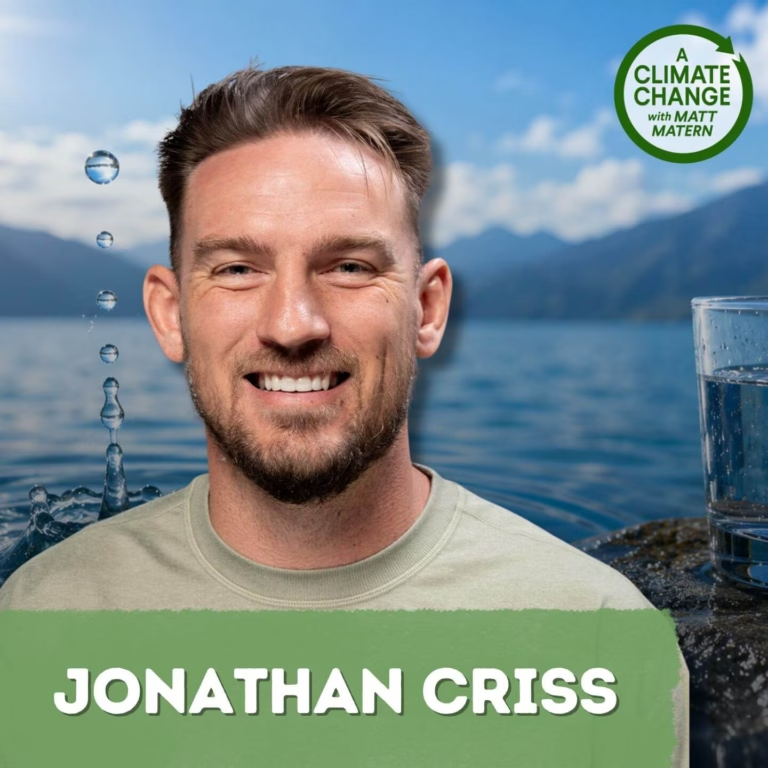
Matt speaks with Jonathan Criss, CEO and co-founder of Vital Lyfe, about reinventing how the world gets clean drinking water. After 13 years at SpaceX working on the Starlink and Dragon programs, Jonathan set out to apply the same first-principles engineering to desalination – starting with a unit he built in his garage that cleaned ocean water. They talk about why the water crisis is really an infrastructure problem rather than a scarcity one, how Vital Lyfe’s portable “Access” device makes drinking water from nearly any natural source without the energy and problems of big desalination plants, and where this technology could go next – from off-grid communities to AI data centers.
Honestly, just got our heads wrapped around answering that question that every eight year old kid has, of how could there be water scarcity when there’s oceans everywhere, and really just started digging in from there, like, oh, how does desalination work? We’re both engineers, these are high pressure fluid systems, at the end of the day, pretty good at fluids, that’s what rockets and spacecraft are functioned on.
So, I bet you can build one. So, we built one in my garage, right there in the Long Beach Harbor in relatively short order. We were cleaning ocean water one day. My co-founder just grabbed a cup of it and drank it, and I was like, oh man, either he’s about to poop his pants or this is our thing.
You’re listening to A Climate Change. This is Matt Matern, your host. I’ve got a great guest on the program today, Jonathan Criss. Jonathan’s background is working at SpaceX for 13 years on the Starling program, on the Dragon program, very exciting engineering projects. And now he’s gone on to be the CEO and co-founder of Vital Life, which is a desalination and clean drinking water on Company, and really excited to have you on the program, Jonathan.
Thank you so much for having me. Very excited.
Okay. Well, tell us a little bit. I always like to go back into people’s history as to what kind of brought them in this direction towards the environmental space,
I think a lot of our background at SpaceX, my co-founder, myself really led us to where we are now. We both spent a lot of time on the Starlink team, and you could go out in, you know, we did a lot of field visits, deployments around the world, and you could see the meaningful impact that Starlink was making in people’s lives. So, when we wanted to start our company, we wanted to work on a hard problem, something that had like a rate manufacturing aspect to it, but then also can make that meaningful impact in the world, and that’s kind of how we started formulating our idea around something with those with that criteria.
When we, when we, you know, funnel all that together, there’s not a lot of things in the world that you know make a massive impact that have these all these criteria, and honestly, just got our heads wrapped around answering that question that every eight year old kid has of how could there be water scarcity when there’s oceans everywhere, and really just started digging it from there.
Yeah. Well, that’s that’s fascinating. So, where did that lead you next? And how long have you had Vital Lyfe in business?
Yeah, that, that’s my, my favorite part of the story is when we started digging, you were like, oh, how does, how does desalination work? And really, you know, we’re both engineers, and I was like, oh, these are high-pressure fluid systems. At the end of the day, I’m pretty good at fluids, that’s what rockets and spacecraft are permanently functioned on. And was like, I bet you can build one. So we built one in my garage, right there in the Long Beach Harbor, in relatively short order, we were, we were cleaning, cleaning ocean water.
It actually hit very soon after that. One day, we were cleaning water. My co-founder just grabbed a cup of it and drank it, and I was like, “Oh man, either he’s about to poop his pants or this is our thing. So, from here, we, we had a bunch of contacts in the venture world. They were, they’re very excited to partner with us, and then you know, fast forward a year and a half now, we just moved into our new facility here in Torrance, about 40,000 square feet, and we’re getting ready to launch our first consumer product.
That’s very exciting and very quick to make that leap, so congratulations to you guys for doing that, take us a little bit into why this is going to make a high impact, because we’ve had water desalination for a long time, though there are there are problems with the current systems of it taking a lot of energy and having a lot of byproducts, the briny stuff that is the byproduct of that, what, what differentiates your product from from those?
Yeah, I think that we believe that we’re on a paradigm shift, and we’ve seen this with Starlink, where you could take large centralized systems, scale them down, given them to an individual, and allow them to get access to that infrastructure themselves. I used my sister as an example all the time. She’s a photographer that lives on Nono or Kansas, and she would have to upload her photos over Hughes Net overnight and hope that they were done in the morning.
Quite literally, that gave her a Starlink beta, and her life changed in 15 minutes, so she can now upload her photos and watch, watch Netflix like the rest of us, so we wanted to approach desal in that same aspect. Can we take a traditional large centralized system, scale it down, give it to an individual, and allow them to get access to this technology themselves?
When you, when you look at it from a first principle standpoint and a consumer product, you really start to push. The boundaries of how the technology has generally been designed and operated, so we’re allowed to really circumvent a lot of those energy costs and chemical byproduct problems that at large diesel has.
So not to give us your patented technology, but what, how are you able to do it with, with less energy?
Well, it’s not the energy aspect, is not where we really lean into. Well, it’s more so the form factor, so smaller or lower flow rate is lower energy, that’s just basic math. So, when you grab the corner of the box, and you’re not cleaning 10s of millions of gallons of water, you’re cleaning liters or gallons of water, it becomes a much, much lower energy perspective.
The real change in the IP is how we use our manufacturing and aerospace backgrounds to go design the hardware for that lower upfront cost. We believe that lowering the cost is the true barrier of entry that has priced out not only individuals but developing nations from this technology.
Okay, so kind of using it at source, maybe at a village that has this, a small village, and just doesn’t have the infrastructure of piping and that type of thing that is required when you’re building a big desalination plant, something like that.
100% there’s a lot of problems that small communities face when trying to get access to fresh drinking water. We actually did a pilot program in Cartagena, on a small island off the coast of Cartagena, Colombia, Tierra Bomba. This is an island that is solely reliant on a boat showing up maybe every couple weeks to bring them water, it’s like you’re surrounded by water, so bringing the smaller units that we could deploy in the field, hand to people, they could just go to access themselves, was an immediate change in that person’s life, and very inspiring at the same time.
Yeah, I guess it would also save the energy cost of bringing a boat across the water, which is probably pretty inefficient usage of energy as well.
Yeah, we did start looking into the full carbon chain of delivering water and is extremely impactful on the environment, right?
I assume, or maybe I’m incorrect in assuming, this could also be used on water sources that aren’t salt water but are just undrinkable without some degree of filtration.
Yeah, exactly. So, what we say is any naturally occurring water source, for the most part, so fresh water, brackish water, ocean water, ocean water being the hardest to clean, because salt molecules are extremely small and difficult to remove, you get about a six hour, six gallons an hour flow rate, but on fresh water it’ll be almost double that.
I understand that you’ve gotten a pretty big tranche of capital coming in the company, $24 million What are.. what are your designs of using that, and kind of maybe what’s the next thing, maybe next product or product improvement that you’re looking to roll out after you’ve accomplished this first one.
Yeah, we were very fortunate to get a group of very awesome investors for both our pre-seed and seed rounds going into that $24 million that you talked about.
That has built out our our team and the manufacturing facility behind me that gave us the capability to build out the high rate manufacturing line that we mentioned earlier, which will be able to produce more desal devices over the course of a month than currently exist, which is very exciting. That gives us our go to market, that gives us our cost down, that gives us the opportunity to get this product into the people’s hands that actually need it. The next steps, we have some very exciting products that are in the works right now. I just can’t, can’t really talk about them at the moment, but I get very excited when I start thinking about.
Well, that’s cool. Yeah, it’s, it’s kind of mind blowing what you’re saying, in terms of that you’re going to create more in a month than than exist anywhere like this seems like such a fundamental piece of technology. How is it that people haven’t cracked this code earlier?
Yeah, I think that the reason why this industry is slow is it’s dominated by academia and government bodies, essentially those industries are designed to go slow, or that those mechanisms are designed to go slow. When, when you think of desal, you think of large centralized clients, those systems take a decade to deploy, so every innovation. Has gone into the large form factor design architecture. We just really rethought that all the way from the beginning and rebuilt from first principles with that same technology, and that’s kind of how you ended up with with Access.
Our first consumer product, are you looking at making those products, so that they can kick out greater volume, or what’s the trajectory that you see as far as uses. Yeah, we would love to go in both directions. So we see access is the first product that gets our global test bed going. We get the feedback from general consumers. People really go use the hardware, and, and tell us what’s good and bad about it. You know, we designed this product with what we thought everyone wants, with a good user experience in mind, but no one will give you better feedback than a keyboard warrior on Reddit.
So, they’re gonna go, they’re gonna go beat up the hardware, tell us what’s good, what’s bad, and then we’ll innovate around that. That first product access in itself, the next products both go in larger form factor and smaller form factor, and start targeting up and down markets for different both consumers and industry, and then B to G event, eventually as well.
Help our audience understand the scale of the water problem. Who is actually going without, and why.
The water problem gets talked about all the time, but it feels like in back alleys it’s two thirds or a fourth of the world’s population doesn’t have reliable access to clean drinking water, that’s billions of people that just go without clean drinking water on the daily, that’s like the global view of it, but even here in Southern California, you know, there’s five states on the West Coast arguing over water rights out of the Colorado that are over 100 years old with assumptions that were incorrect at the time for acre feet of water allocation.
So this impacts not just people in developing nations and people in Africa, which is like the most common one you think about, but you know, my co-founder grew up in West Virginia, he was actively poisoned by a large chemical company there in West Virginia, and has had a history of health impacts from that, so reliable to clean water is is a fundamental problem globally, not just in the United States, but around the world, and there’s a ton of problems that lead into that, from access to contamination, old infrastructure, and then you know impact by by availability and cost.
So where are you starting to sell some of your product? Where is it going to?
Yeah, access is a great product. It’s more geared in the middle market right now. People that, like we talked about earlier, really push the boundaries of this type of hardware, so maritime industry, they’re notorious for beating up beating up hardware, overlanders, RVers, off-grid lovers, people, people that are into, like, prepping a little bit more excited to pay for cool technology.
That’s our general consumer that we’re going after first in retail and distributing the like future state is we want to really drive down the cost enough to where we can get the product into the hands of the people that truly need it, you know. Vital Lyfe was built around the mission of making a meaningful impact in that number of people that have reliable access to clean drinking water. We believe that the best way to do that is continue to drive down the cost and get it into the hands of people in developing nations.
You frame this as an infrastructure problem rather than a scarcity problem. Why is the reframing so important?
I think that reframing the problem is important because then you can start to address it from multiple angles, you can look at what resources are available, and then what technologies solve for the specific problems that you’re looking at. It helps, it helps really frame the question around, okay, what, what do we have access to, and what can we do to get more access to that. So one of my favorite things I always say is 71% of earth surfaces is covered by water, but yet only 1% of all drinking water globally is desalinated. That is a resource mismatch, not a technology technology mismatch. We have abundant resources, there’s plenty of water on earth, we just have a bit of a salt problem, and removing salt is kind of difficult.
Well, you know, certainly cracking that code could make an enormous difference, and particularly we’re seeing more and more water shortages across the world. You point to the massive problems that we have just here on the West Coast, and particularly California and Arizona. And Utah and Nevada and Colorado all are having water issues. I understand Corpus Christi, Texas, is having an enormous water problem because they haven’t had enough rain for a long time, and, and that’s maybe going to shut down the petrochemical industry, or you know, push it to the brink, because they don’t have enough water to process all that, those, those things.
100% there’s there’s issues like this around the world. Cyprus is another one. They need to increase, increase water production by 6% like now, not, not in a decade from now, but immediately, in order to really help that nation come up with the shortages that they have for their general population, which is super impactful in everyday people’s lives.
We really think that bringing this technology to the masses at this scale is the right approach, and I think something that your audience might resonate with is when you clean water at a large scale, there’s a lot of pre treatment, both chemical and filtration, that they do in order to ensure that the membranes or the technology inside their treatment plant last as long as possible, which makes sense when you, when you build a billion dollar plant, if it’s not running and it’s not running officially, you’re losing money, the only problem is they run these things at a super high recovery rate.
So the water is not only chemical dope coming out the backside, but it’s also two or sometimes two and a half times saltier, which could have quite an impact in the environmental ecosystem nearby that treatment plant. Plus, it’s usually hotter, which raising the salinity and making water temperature and adding chemicals to the local ecosystem is super, super bad, or can be bad if not treated correctly. We looked at it from the other side, like, how do we run these systems efficiently without adding any of those pre-treatment or the super high recovery rate, and definitely not the heat exchange, so our system doesn’t do any, any chemical pretreat.
So we don’t have to worry about any chemicals inside of our byproduct, but then also we run our system at a much lower recovery rate, so our system essentially the waters a fraction of as salty as a large scale system, so you don’t have that that chemical or that brine bride product that makes that environmental impact. Essentially, we always say, as long as your source water that you’re like cleaning, cleaning back in, is greater than five gallons, and you don’t have to worry about the dilution of the salt, which is really nice.
So, do you see your systems being used, say, in Cyprus or other areas like that, where there’s kind of a mega crisis at hand?
100% in the future, 100% that is our goal. We want to be a partner with these larger utilities and really be the system that they can plug in when they need search support. I think this is another one of those angles of the problem that you run into specifically in California. So, California needs additional water now, but that’s because we’re in a mega drought.
So they don’t want to go spend another billion dollars on a large infrastructure project that’s going to be utilized for the next couple years, but then maybe not 10 years after that. So, when you run into that type of problem, it’s difficult to go address the problem when you need to scale up immediately, but then not to the scale that they need. We think that we can be a step in replacement of a partner with these utilities and not, not so much a replacement. We want to go and help you guys out for a short period of time, and then remove our hardware and go deploy in other places around the world.
So, is it possible to use your technology on those big systems to reduce the amount of chemicals, and you know, reduce the lower recovery rate, as you said, and those things to adapt to those bigger systems, the current system, no, but future systems that I’m very excited to talk about in the future.
Yes, so we have to put that on hold. They can’t get that out.
No, no, no. I get very excited to talk about it, but, but just not yet.
Okay. Well, I’m happy to hear that there are some solutions on the on the forefront, and you know, one of the things about doing this podcast, it does get me excited that so many amazing people are out there doing stuff like you’re doing to address these problems and to solve problems that we’ve had that are long standing, so thanks for thanks for doing that. So, what is Access in Plain Terms, and what makes it different from everything on the market?
Access in plain terms is an affordable, portable water water maker that can clean any naturally occurring water source that’s. I try to try to always think, for we design for Terry. Terry’s my mom. I love her to death, but she’s not the most sophisticated user. So we always try to build our products in the mobile, easy to use products that anyone can can own and operate. So that’s kind of, kind of what the simplest terms is, and what access is. It’s the water maker designed for anybody.
Most water products specialized filtration desalination. You’ve gone modular. Why does that matter?
We think that modularity gives people the ability to clean any. It gives people the ability to use these things in a much different way than have it has ever been done before. So traditional desal has been large scale that we’ve talked about it quite at length so far, or mini filtration, like a lifestyle or small product that only has a limited life and only can be used on streams and rivers.
As you look at the water crisis, there is no silver bullet that kind of hits all of them, but you can get most of the way there with this, this technology, which is really nice. So, give people the access to as many available water sources as possible, and then that kind of opens up the door. Okay, now that you’ve opened up the access to different water sources, how do you get into the hands of the people that need it, which is, you know, the whole point of the company.
So, how much is of the SpaceX engineering culture, the precision, the systems thinking has actually carried over into building this.
The vast majority of file length is built around a lot of the same first principles that we operate, operated on at SpaceX. We, we’ve taken a, we’ve taken a lot of the same fundamental approach that was drilled into us over the last decade and just applied it to a new problem. I think that’s what I always tell everyone is the things that we learned at SpaceX was how to be excellent problem solvers.
So we could be working on Dragon one day, but in order to get you that part that you need that’s stuck in a port in some developing country or something like that, you’re like just getting good at solving problems in real time, and that’s what we do here every day. What we always say is, as long as you’re not breaking physics, everything is possible, it’s just a resource or a cost trade.
So, tell us about the field demonstrations you did one at Tierra Bomba off the coast of Colombia. What does that look like on the ground?
The Tierra Bomba experience was quite impactful to me, being there. The interesting thing about Tierra Bomba is that whole pilot got set up through a contact that I was in Africa with, shooting Starlink content, when we started Vital Lyfe, I was talking to him, and he was like, “You really need to meet this NGO here on this small island, they have serious water problems. And then my co-founder just happened to be in Colombia when we had that conversation, went and stopped by there, and this was maybe the first or second week of Violet starting.
Fast forward one year, we’re back, we have working hardware, we’re interacting with the people and seeing people’s just like light up in, we didn’t know this is possible. How is this magic real? You’re drinking the ocean, that’s crazy, and that, that just seeing people who are dependent on on a third party to deliver drinking water be able to get access was was super exciting. That’s how we actually came up with the name access is you’re giving access to to a resource that was was out of out of grasp before.
So those those things are super important to us, we want to continue to partner with NGOs and humanitarian groups and try to do pilgrimage pilgrimages for some of the engineers and make sure the team is super, super locked in, and what the point of the company is, and that’s that making that impact. So we want to keep growing those relationships for sure.
So you’ve raised $24 million and opened the factory in Torrance. What does this capital let you do that you couldn’t do before?
Well, it was build the manufacturing line. It is quite capital intensive to go build a high rate manufacturing line, and we did this in complete reverse of every other business. No, no business class is going to tell you to go build a product with zero customers and then dump a bunch of capital into a high rate manufacturing line, and then produce the parts, and then go find customers. Generally, they’re always still, oh, you need, you need your, your customer base in orders, and then you scale up later.
We did the opposite, where we’re scaling straight up, and I’m, you know, I talked to my sales teams, like, all right, well, the lines gonna turn on. We got to make sure the customers are there, luckily, or, you know, obviously, we did our background in our research, but we’ve had a great response from, from now. Just our personal funnels, but then retailers and distributors around the world.
We have 26 countries that have placed pre-orders right now, with six region-specific retail exclusivity deals that we’re talking through, so you know, global is, or water is a global problem, and building to that high rate, was it was inevitable, and you have to do it, so just go there first was kind of kind of a game plan.
So, how many units are you kicking out, say a month or a week?
When the line turns on, so the line is, is, is where we call crawl, you’re you’re doing rate verifications right now. When the line is up and fully run, you could do up to about 6000 to 10,000 a week, and that’s assuming multiple shifts with with a good solid supply chain, but we’re planning on building around 30,000 this year.
Okay, that’s fantastic. And in terms of, there’s essentially nobody who’s building similar products around the world.
People build REO devices all the time, they have very large skids or portable devices. The problem is they were never designed to be built at any real rate. So our whole product is built at a very high rate manufacturing cadence. So we say there’s a beating heart in this factory. That beating heart is 30 seconds. Every 30 seconds a operation on that manufacturing line was being completed.
So that gives you the capability to go turn the knob on. Okay, I want to scale up from one shift, completing a few, a few 100 a day to a few 1000 a day, and by scheduling multiple shifts, overlapping, increasing your, your total line throughput, you can really just increase those numbers, those volumes really fast, which is exciting.
Yeah, that’s that’s pretty incredible. So hopefully people get the word out or hear the word and start using the product even more. So, what’s your plan to ship out 30,000 this year? What’s what’s the plan for next year, in the following year.
Next year in the 120 to 150,000 and then hopefully another increase the following year moves be significantly higher with our next products in the 300 to 500,000 ish range, depending on timelines of development of those next two products.
Okay, well, that’s that’s a pretty rap, pretty steep curve for a company that started in 2024 So, kudos to you guys for getting out the door pretty quickly.
You know, time, time, time is the only thing you can’t get back, and people have this problem every single day. So, we need to go and move as fast as we can to get people the access they need. The water crisis is only getting worse. We want to make as much of an impact as fast as we can, so we have to, we have to move as fast as we can.
Do you see your, your product being used in the service of AI in terms of all those data centers that need tons of water, or is that a possible use?
Yeah, we’ve been having a ton of conversations inside of the hyperscaler ecosystem, the you, you want to help alleviate some of the stress that they put on local water supplies, so if you’re building a data center, you need energy, a lot of space, and access to clean water, not only just clean water, but they need like super clean water, so if you need all those things, those are like local, local cities, you’re pulling from local population in order to build that, that can have an impact, that’s not, that’s not great if it’s not already sized for that.
So, what we’re looking at is, are there other options from polling from dirtier water sources that that we can, we can give access to that they wouldn’t have initially. So, if your options are, hey, go pay or go go buy from the local municipality, and then that’s pulling from everyone’s freshwater source, or you can clean brackish water from a local bore hole that no one has need for. We want to provide that secondary option of, hey, you can clean this secondary source of water, you’re not going to make any impact on the local community, and you can get access to the water you need in order to give your systems the cooling that is required.
So there’s a lot of really fun conversations in there. We can also move extremely fast. Hyperscalers need to put compute online now or yesterday, even in order to keep up with the pace of demand or the pace of AI growth, we can. We can provide these systems in a much faster timeline than anyone right now, so that’s the two things that we’re trying to make the biggest impact in that space, really alleviate the problem that is impacting local communities, and then give them hardware as fast as possible.
Now, some of your hardware is, you know, for their, for their use? They’re using just huge amounts of water. Would they take 10 or 100 of your pieces, you know, pieces of equipment to to create enough clean water for a system as big as a big data center?
Yeah, that they use much greater volumes of water than access can provide, so future future products are in the larger scale that help produce much greater amounts of water.
There’s a lot of fun design constraints or design conversations that are going on with them, but again, these are all future designs that we were not talking publicly about right now.
We, we clearly see that for greater amounts of water being pumped into not only just AI, but of course lots of places around the world that are experiencing huge droughts. I think San Paulo and Brazil, like a city of well over 10 million people, I think, close to, they were having conversations about having to essentially have people evacuate because of not enough water, which is mind blowing.
It’s super unfortunate, you see, not only the resilience aspect of clean water, but the financial impact on people’s lives. I think the thing I was reading the other day was saying every household income in Mexico spends 11% on bottled water, or some crazy statistic like that. It’s like, man, these people actually have access to water in most regions, but it’s got to be reclaimed, which is unfortunate.
Wow, that is, that is mind-boggling. 11% of income on on water, just unbelievable. Yeah, I’ve, I’ve read a bit about the drought-like conditions in Mexico City, and and steps they’ve taken to kind of address it, but it’s, it’s far from complete what they’ve done.
Yeah, and I think that’s another thing that we can make that impact on, is is the systems traditionally centralized water plants just take a really long time to build and deploy, you know, cutting down on a, on a 10 year plan, and bringing it in, even by a few years, that’s a lot of people’s lives that can be impacted just by shortening a timeline. So we kind of try to hit it from both ends on the cost and the speed of deployment.
For listeners who’ve never thought about where their water comes from, what do you want them kind of to walk away with, as far as understanding?
That’s a fantastic question. I think a lot of people don’t, don’t think about where the water comes from at all, which is, I guess, good and bad, because then you do have access to some, some amount of water. I think that the the thing that’s most important to think about is, is this is a solvable problem. We have plenty of technology, plenty of smart people, and plenty of the water resource here, here on earth, and we can, we can make that meaningful impact.
The thing to think about is, okay, how do we go get everyone access to it in, in the regions that matter, and really just, you know, being conscious of, okay, here’s how I, my daily life is impacting the overall water supply in my region. I think, you know, if you live in Nevada, you’re already getting cut back on your amount of water you’re allowed to use. I, since starting a Vital Life, I am much more cost conscious of how long are my showers, am I leaving the faucet, or washing my dishes, and things like that, because it’s super unfortunate that you know we have, we have a large population of people on this planet that don’t, don’t have any water at all.
Yeah, it’s pretty mind blowing. So, what’s one meaningful thing that you think someone listening right now can do about water.
Oh man, there’s a lot of, a lot of things you can.. there’s a lot of really great organizations out that really help with water around the world. One thing that I do personally is I try to cut my bottled water consumption, not only bottled water plastic quite impactful to the environment, but a lot of the things that we’re learning about plastic bottle and your personal health impact is not great. And then you know, be Michael, do your own research, learn what you want to learn. I always say, unfortunately, learning about water was one of those.
Things where you watch an avocado video on Netflix, and now you don’t want to eat avocados anymore. So I’ve had the very same impact with my water consumption now. I think I think those are like a couple handful things. Just, you know, be aware of what you’re drinking, local tap water. There’s quite a bit of information on the internet that you can find about that, or you get it tested yourself.
Bottled water, also looking, being mindful of the amount of plastic waste that we put into the environment, and also thermal cycling plastic is not great from a chemical leaching. And then also, there’s a lot of really great organizations out there that help with developing nations in this problem.
Well, I thank you for the great work that you’re doing out there, Jonathan. Everybody should check out the company Vital Lyfe, and follow you guys, and follow the incredible trajectory that you’ve had. Tell us, you know, anything in terms of investment front, is is it possible for someone to invest in the company now, are they going to have to wait? Maybe you guys go public, or I don’t know about that, but not, not right now.
From we’re going to remain private as long as we can. We’ve seen, I mean, I grew up in SpaceX, right. We’ve seen the ability to go make rapid improvements in technology by arraigning public or private as long as possible. If there comes a day where we need a very large infusion of cash in order to go make, make a make the product make the impact that we want, then maybe public could be an opportunity, but right now we’re gonna keep bringing, keep trying to do what we can with the private markets.
Okay. Well, keep doing what you’re doing. Great to learn about this, and kind of brightens my day to hear that we’re making progress on what is a hard problem and can impact millions, millions, maybe billions of people to do this well. So, thank you.
It’s really the goal. Thank you for having us. It’s been a blast.
To learn more about our work at A Climate Change, visit aclimatechange.com. Don’t forget to subscribe to our podcast on Apple, Spotify, YouTube, or wherever you get your podcasts. If you liked this episode, please share it with a friend. See you next time.
(Note: this is an automatic transcription and may have errors in formatting and grammar.)