
Hear us on Apple Podcasts, iHeart, and Spotify Podcasts. Subscribe now!
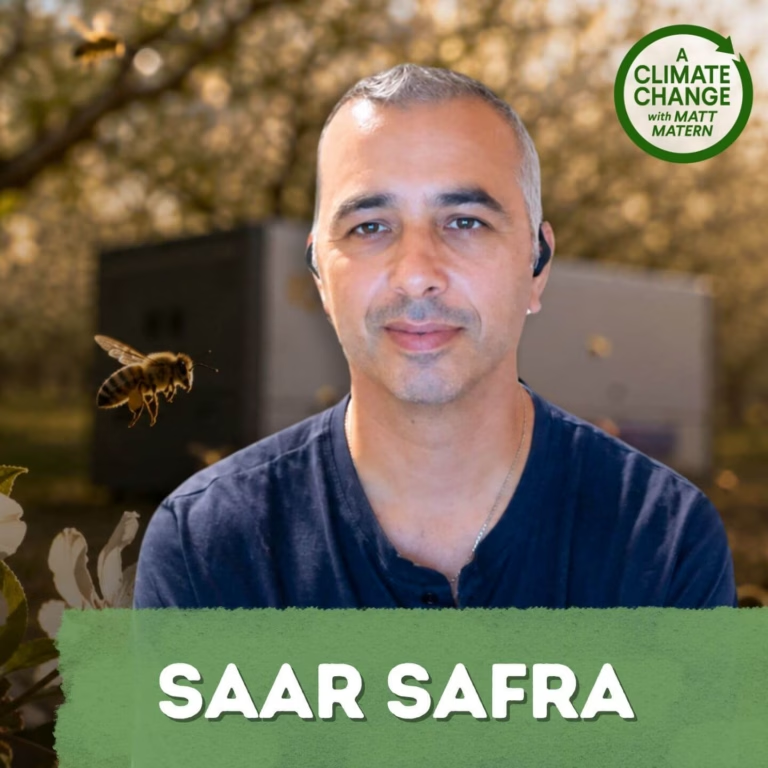
Matt is joined by Saar Safra, co-founder and CEO of Beewise, to talk about one of the quietest threats to our food supply – the collapse of the world’s bee colonies. Saar shares how he teamed up with a commercial beekeeper to build the BeeHome: a solar-powered, AI-driven robotic hive that monitors bees around the clock and treats problems automatically, without chemicals. They dig into why bees pollinate roughly 75% of the crops we eat, how monoculture and pesticides have turned farmland into a desert for pollinators, and how Beewise has cut colony collapse from 40–60% down to under 10%. And Saar gives Matt a peak at the company’s new Bees for Buildings program bringing pollinators into cities and their goal of scaling this technology to help communities around the world.
Honeybees are literally on life support, and luckily enough for them, we depend on them. So we humans spend a lot of time and a lot of effort managing bees. Today, I can say we have the best beekeeper on the planet. Every device has about a million bees in it, and we have 2,000 devices. So the AI understands hive number five is hungry.
They don’t have resources, so the AI will tell the robot go fetch food. Hive number three has a disease, so it will apply treatment to hive number three. Managing about 20,000 colonies is just a very tiny share of the bees. We need to scale to manufacture 200,000 robots and apply them all around the globe because the bee problem is a global problem.
You’re listening to A Climate Change. This is Matt Matern, your host. I’ve got a great guest on the program, Saar Safra, the co-founder and CEO of BeeWise, an agricultural technology company, on a mission to save the world’s bees and with them our food supply. Welcome to the show, Saar.
Hey, Matt. Thanks for having me.
You’ve led a number of different companies, and you’re a serial entrepreneur. And you took on this problem that most people think maybe it’s too late. Bees are dying at alarming rates, and they pollinate roughly three quarters of the crops we eat. Bee Wise’s answer is the Bee Home, a solar-powered, AI-driven robotic hive that watches over bees around the clock and catches problems early and treats them automatically without chemicals.
That’s pretty amazing technology. I was really excited when I heard you you were coming on the program because we’ve talked about bees a few times over the last five years, and and there wasn’t a great solution out there until I heard what you guys are doing.
Yeah, you know, and and the problem with the solution for it to be great, it had to it had to scale. So even us, I mean, despite being fantastic for the bees at a unit level, right, at a hive level, scaling the solution is is expensive. It’s it’s it’s timely, and we’ll have to see how we can actually change the course for the bees.
So tell us, how did what was the genesis of this story in terms of you getting into the B world?
So, as you mentioned, this is company number six for me. I’ve I’ve dabbled in startups and and entrepreneurship for my whole throughout my whole my whole career, and as I was looking for the next thing to do about seven and a half years ago, I met my co-founder Elia, and he he was a commercial beekeeper.
He he didn’t really know about the startup worlds or how to you know raise capital and and apply it towards a product and technology and innovation, but he definitely knew the world of the bees very well, and knew the problems we’re facing. And eight, you know, eight nine years ago, the problems weren’t as severe as they are today. But they were, they were the the trends were alarming even back then, almost 10 years ago, to a point where we sat down and he he he educated me.
I went through that education curve about the bees and you know the birds and the bees, and but without the birds. And at some point, we realized we have to apply some kind of technology. And even back then, you had AI and you had robotics. They were much more nascent than they are Today, but the idea was how to apply modern existing technology for the benefit of the bees, and and that was the premise of the company.
What made you kind of look for tech solution for this, and how did that come about?
So I’m a technologist. I I come from the product side of things. I always believe that there is a technological solution to almost every problem on the planet. Sometimes the technology doesn’t exist yet, but you know the the you can you can pond on the idea of technology can solve almost anything, and so combinedly, me bringing that aspect of the business and him bringing the subject matter expertise.
We were able to think and dissect what are the actual challenges that affect that that have an adverse effect on bees, and then what technological solutions can you apply towards every kind of you compartmentalize every problem? Then you you apply technology solution. Then you wrap it up in a more comprehensive robotic beehive that can actually address issues. With the sole goal of lowering colony collapse, which is the one metric that we’re, I would say, obsessed about.
So, a very substantial portion of USB colonies die every year, and commercial beekeepers are losing very, you know, I don’t know, up to 50% 60% more of their colonies. So bees pollinate 75% of the crops Americans eat: almonds, berries, produce. So what what are you guys doing that has reduced the colony collapse.
It’s kind of a paradox, Matt. You know we are so dependent on bee pollination, not only for almonds, but you know many other crops, as you mentioned, avocados, but also for cotton, for coffee. You wouldn’t be able to have access to coffee in such a scalable manner all around the globe. There’s 8 billion people on the planet, we all want fresh produce in almost every street corner, right? You know, whether it be coffee or your tomatoes or almonds or what have you, even watermelon, or you know, again, 75% of fruit and vegetable, and so and so there’s a high dependence on bee pollination. This is not pollination that happens on its own in nature.
No long that that’s no longer the case. We are talking about commercial pollination, just like irrigation. Right? You bring in, you know, tubes to irrigate farms. You need pollination to pollinate your crops. And so, on one hand, we’re highly dependent on bee pollination because everybody in the stands today there there’s a there’s education around a healthy diet if you will right on the other hand we’re losing our bees in in very dramatic numbers and those two stats don’t bode well and so and so, as you mentioned, what we try and do is we try and lower colony collapse, meaning that our technology has a goal of keeping bees alive throughout a course of a year. Colony collapse is a metric that is measured over a course of a year, and then you can measure yourself.
First of all. I believe that you can only succeed at what you can measure. So you can measure yourself on your success if you’re able to lower colony collapse where your reference point is a traditional hive that is being used in a commercial setting. By the way, all around the globe, you know, we talk about the U.S. We’re only operational in the U.S. today, you know we’re a U.S. firm. We were incorporated in Delaware, headquartered in California, but we’re only operational in the U.S. But when you look at the whole globe, it’s insane.
The problem is exactly the same: global warming, climate change is is pretty universe around the planet, and when you look at the whole world from China to the U.S. and everything in between, commercial pollination happens the same way. The technology that is being used, those wooden boxes that were invented in 1850, is uniform. It’s the same, and so and so we’re focused on the U.S. market and the commercial on the on the U.S. commercial market, but the same piece of technology is applicable globally.
So you know, I’ve I remember watching one of the documentaries about the bees, and they were saying, “Well, part of the problem is the monoculture of crops that are grown, you know, just a huge area, just corn or just soybeans or whatever, and that can be a bit of a problem, as well as the fertilizers and stuff like that. Are your is your technology able to kind of deal with those particular concerns and and get good results, even with the fertilizers and the monoculture.
I would say monoculture is the best, worst invention ever invented. I think you know you have to feed 8 billion people, so you need to mechanize agriculture. You need to automate, streamline, and mechanize agriculture, so you build machines. Now, the machines we’ve been building since the early 1900s are relatively dumb machines. They don’t have a lot of smarts in them, but they’re very, very efficient and effective in doing repetitive work. We replace the the human muscle with with metal, so you have a tractor or a combine that can do to take huge fields and huge areas and basically automate all the the labor intensive tasks, which is genius.
But for that, you need monoculture because if you build a machine that works for almonds, now it costs a million dollars, and you need to. Optimize the utilization of that machine, so you need to run it all day and all night long as much as you can. So you need vast areas. If you had very small patches of almonds, you wouldn’t be optimizing your machine, your very expensive machines. So this is where where monoculture was kind of invented, giving us the ability to apply the same method across vast areas, right? But why is it so bad? Because it’s it’s counter to nature. Take bees, not only for bees, but take bees for example. Bees feed on on on. They need bloom to to feed, so they need nectar from flowers.
That’s their carbs, and the the pollen is their protein. That’s their their food source, but flowers bloom for a very short amount of time throughout the year. You know, month, a month and a half, two months. Almonds, avocado, what have you. After that, you get fruit set and fruit and so on. But that for us it would look like a very good-looking, healthy grove. But for the bees, it’s a desert because there’s no flowers for the rest of the 10 months throughout the year. Now, when you have a million acres of almond or half a million acres of avocado, the bees can only fly three miles radius, so they can’t really live in those monocultural areas because they have no food sources.
So I’m just giving you a small example of how monoculture basically took away nature from nature. All the insects, all the pollinators, many of them are just gone. Either died from starvation or lack of access to food source and biodiversity, or just left and moved to other places. And since we have many areas that are that are part of monoculture, and then you have cities, you’re basically taking away a lot of the biodiversity and and and kind of free areas for a lot of the insects and and even for for trees and flowers. So so the way we cope with these things is is just just like this. We we understand what are the adverse effects of monoculture.
For example, access to food sources, and within our robotic beehive, we give the robot the ability to feed the bees, to provide the bees with water, to to provide the bees with medicine, and so and so all these things are being done by the robot. I’ll explain more about the technology in a minute, but but to answer your question, same thing with pesticides or herbicides or fungicides. When they’re applied in a field. They have to be applied because the farmer wants to save their crop. You know, it comes to reason that they they have to apply pesticides, otherwise they will lose their crop. But when applying pesticides, it has an adverse effect on bees as well.
So we’re able to shut down the hive and protect the bees from pesticides coming in. It’s a very simple mechanism if you think about it, just like a a hatch that opens or closes, and the robot can open it. But that small, you know, mechanical apparatus is extremely effective for saving bees from pesticide. Just a couple of small examples to show you how you don’t need to build, you don’t need rocket science to really apply technological solutions toward towards saving bees.
So, how long do you say close the hive during the period of time that say pesticides are being applied?
So, this is something most people are not aware of. Bees can stay in their hive for three months straight. They don’t need to go out if they have enough resources in their hive. They will stay in their hive. For example, bees don’t go out at night. They never go out when it rains. They don’t go out when it’s cold. You know, when it gets below 50, let’s call it 5045. They never leave their hive, so at winter they stay clustered in their hive for months. So we shut down the hive for 12 hours until the pesticides dissipate or until the the harmful substances are gone. They’re usually gone in within an hour, but we close the hive for about 10 to 12 hours. Then we open it back up in the morning. The bees can go out, no harm, no Foul, yeah.
Well, that’s that’s fascinating. So, what’s the next step for for the company? You’ve got your hives working across 300,000 acres, hundreds of different growers, including Blue Diamond, Driscolls, Taylor Farms. You’ve raised 170 million dollars and are nearing profitability. What’s what are the next steps for BYs?
So, as I alluded to earlier, we have about 2,000 of these robots scattered in the field, and this is something I’m, on one hand, very proud of, but. But at the same time, it’s really just you know, it’s just the beginning of of the process because I’m very proud of it because there is very few companies out there, let alone startups, seven year old companies that have 1000s of robots operating in the field autonomously, doing good for humanity. Our devices are. bee homes, as they’re called, instead of experiencing 4050, 60% colony collapse, we experience less than 10% colony collapse, and so they’re constantly in the field.
They’re all solar powered. They don’t need external power source, and they just operate throughout the year with the sole intention of keeping bees alive and helping bees survive in the face of modern stressors, that’s something I’m very proud of. But really, 2,000 devices managing about 20,000 colonies is just-it’s a very tiny share of the bees. And so, to your question, what we need now is we need to scale it.
We need more rocket fuel to really scale our solution to manufacture 200,000 robots, 2 million robots, and so on and so forth, and apply them all around the globe because the B problem is a global problem. It’s not just here in the U.S. so you know, 170 million dollars seems like a fair amount of money. But as we’re talking about serving 8 billion people, that’s kind of a drop in the bucket. How much would it take to scale this solution out to you know, 8 billion people, hundreds of millions of dollars.
Okay.
But but but the idea is that once you become a profitable company, that’s the flywheel, right? You can take profits and apply them towards manufacturing more biomes, which increase profitability, both EBITDA and cash flow, and and and so on and so forth. So there is a point. There’s kind of a tipping point that if you pass it, this company can really start scaling dramatically. We haven’t gotten to that point yet. We’re close, not there yet.
So what’s what’s kind of the target for profitability? And I do believe that profitability is kind of the metric by which the environmental world will will kind of scale to the next level. When we have environmental companies that are actually profitable, like the solar companies, as they became profitable, it it just you know rocketed their growth because they they could beat standard power companies like coal and and gas and and others and nuclear because they just economically made sense. So how far are you kind of away from that point where your solution is, you know, making economic sense, making profits for your company.
So I call I call I totally agree with you, and that’s that’s a very smart observation. I call it the inflection point, and we measure it in number of B homes. So at 4000 B homes, that will be our inflection point. That’s when you cover the cost of the company. You know the R and D, SG&A, and so on. Allows you to every new you know every new unit that is being manufactured automatically kind of helps the bottom line. So we’re 2000 devices away, and this is what we’re working on right now.
We’re about three quarters away from there. So by Q3 next year, we’re supposed to be profitable, and then we’ll we’ll go out to the market and we’ll try and kind of shop around towards how can we actually find that you know that rocket fuel that we discussed really kind of give us that escape velocity, really to start flying flying high, and then also expanding geographically, expanding to other solutions, kind of increase the product speed.
Today we’re very very focused, narrowly focused on one thing, make it work really well. The honeybees with one solution. Tomorrow, there’s other types of bees that need help: bumblebees, leafcutter bees. You know, there’s many types of bees we can apply technology towards. There’s other geographies. There’s other areas that need help. More crops. So a lot to do.
I’m, I’m just curious as to the other types of bees that you mentioned, like the bumblebees and the like. What what challenges are they facing? The similar challenges as the the bees that you’re. Working with are different.
Yeah, yeah. You know, Matt, I’ll tell you. You know, most of the challenges bees are facing are are pretty much common challenges that many insects and many animals on the planet face. So we see a lot of insects on the verge of being Extinct bees are the same thing, by the way. If we didn’t have commercial beekeepers, the honey bee would have been much closer to extinction, if not already extinct, because honey bees cannot survive. They find it very hard to survive on their own in nature today, for the reasons we discussed.
And so, and so, honeybees are literally on life support, and luckily enough for them, we depend on them. So we humans we spend a lot of time and a lot of effort managing bees. That’s the idea of beekeeping. Plus, they produce honey, which other types of bees do not. And so, and so, human throughout you know, millennia have been focused on the honeybee because of a food source, and then because of pollination from many, many 1000s of years ago. But other bee species need similar help, and the technology can be relatively easily applied to other types of bees without too many modifications, and then you grow your market share. You diversify, right?
You’re not focused on a single type of of pollinator, and you add more. You know, there’s the idea of helping the planet, which is why we’re all here, part of this company. You know, me and my 150 employees, we could have all easily found a different job, working for areas that are less challenging, or or in industries that are less challenging, like cybersecurity, enterprise software, you know, but but but we all choose to do this because it’s part of the passion we bring towards the cause, the mission, and so applying a similar technology to other types of challenged species, bees or otherwise, would be a natural evolution of our solution, as long as it makes financial sense. We are a for-profit company, so everything has to make financial sense compared to the you know opportunity cost.
I’m curious as to you mentioned honey. Are your beehives producing honey, or is that you know kind of a secondary piece of The puzzle.
Very much so, and you mentioned this at the beginning in passing, and I want to kind of just double click on that. Bees have disease; they have different types of disease. They have diarrhea. They have euzema. They have different types of disease. They also have pests like the varroa, the varroa destructor. That’s a pest the bees have, and it will be safe to say that 100% of the bees have this pest. It’s like a tick on their body that eats their their body fat. It’s a horrible thing.
I don’t want to go into it too much, but it it it’s a big reason why we’re losing a lot of the bees. And at scale, at a commercial level, almost the only way to fight this pest is using chemicals, pesticides, and that’s what most beekeepers do; they don’t have a choice. They have to use pesticides to fight off the pest. Otherwise, they would lose their hive. We, on the onset when we founded the company, we decided we did not want to use any chemicals in our hives whatsoever, and so we found an alternate technological solution to fight off the pest without using pesticides. We use a a heat treatment, so there’s a there’s a difference in temperature that bees can sustain versus the varroa, the pest.
And so, if you can take the bees and put them in that temperature range, the pest will die. The bees will survive. It’s a similar mechanism that we use humans. We humans use of fever, right? When you when you have fever, your body it can sustain you know 100 105 degrees, but your your your pathogens can’t. And so we use a similar mechanism. It’s easy to do with technology, because you can take a hive and warm it up for an hour or two. It’s really hard to do it in the field when you do manual labor.
You can’t come with a microwave and basically heat up every hive for two hours. It’s just, it’s just not scalable. And this is the idea. I mean, I’ll take this as an example, but I’ll. Just gonna kind of expand on that and say, with a robot and AI, which I’d love to touch on in a minute, and energy, sense, energy, and communication, you can almost take any non-scalable manual labor task, and basically streamline, automate it, and make it fully scalable because you don’t need people involved in the process.
Well, tell us a little bit more about the the manufacturing of this and where it’s occurring and how it’s occurring and and the changes that you made to kind of the standard hive that was created in 1850 to kind of meet the modern world and using AI and robotics. Tell us a bit more about that journey.
So first and foremost, you know, we had to choose what we want to focus on, and so we decided again on the onset not to change anything in terms of the bees’ experience. So the frames that we use in our our robot are the same frames that are being used in the wooden hives, and so the bee experience is a very similar experience that as as what they were used to forever.
We did not want to change anything in the biological setting of the bees because it’s hard enough to build a new technology, introduce it to market, test it, and and you know improve it. So you want to focus on very specific things and not touch anything else. So that helps a lot with the population of the bee home. When you move your bees to the bee home from traditional hives, you basically take the same frames, the same honeycombs, if you will, and move them around with the bees. And within our device, the bees feel just the same as they would in the wooden hive. The bees are agnostic to the fact that that that a robot arm moves the frames versus a human arm.
They’re agnostic to the fact that cameras are looking at them and not humans, so for them the experience is comparable. I would say the other thing I would I would say regarding that is that also allowed us to focus on the manufacturing of the of the technology of the robotics and mostly the AI, which I’ll touch on, and not focus on changing the hive itself, so the hive remains the same. It’s backwards compatible. You can put them in the device in the bee home. You can take them back out if you like. But now there’s a robot that monitors the bees 24/7 using many cameras. There’s an AI model, multiple AI models that analyze all the data, vision.
There’s sound sensors, vibration sensors, humidity, temperature, but it’s mostly based on vision because this is what we do, humans. We use our eyes to understand what bees need, and then we apply a treatment, right? And so the know-how exists. All we had to do is take that know-how and train a robotic system that has cameras and actuators as arms, and train it to be as good as a beekeeper. Today, I can say we have the best beekeepers, the best beekeeper on the planet.
It’s in the cloud. It’s a it’s a digital beekeeper, if you will, because all these devices are connected, and they all look at all these bees. Every device has about a million bees in it, and we have 2000 devices. And so you can imagine the scale and all the data that flows into the cloud. We have a centralized AI model that absorbs all that data, learns, analyzes it in real time and makes decisions. So the AI understands that in a specific bee home, hive number five is hungry. They don’t have resources, so the AI will tell the robot go fetch, you know, food and apply it towards the hive. Then it can see that hive number three has a disease.
They have a virus or something, or they have a pest, varroa. We talked about varroa, so it will apply a treatment to hive number three, an anti-varoa heat treatment, and so on and so forth. And the more data you have, I mean, we we we throughout the years, our AI has been trained over trillions, trillions of videos and images, so the accuracy level is very, very high. And our, you know, our digital beekeeper is, I would say, excellent. It’s very, very smart today because it really applies treatments in real time, based on location, needs, the type of forage, the bees, you know, temperature, and and everything-all these parameters.
Tell us a little bit about your new program, Bees for Buildings, that launched in April of 2026. That puts bee homes in commercial. Residential properties.
You know, that’s a very interesting program that we. I wish we could take credit for, but we didn’t. It’s really kind of our customers. It’s more of a pull versus a push. Our customers were asking us for it. Think of it as urban pollination. We live in cities, and Matt, if you take bees out of cities tomorrow, your cities will be dead.
I mean, trees need pollination not only for fruit or for optimization of yield. Trees need pollination to grow and continue growing and expand, and so on 95% of flowers, colorful flowers we see, are are pollinated by bees without any relation to food whatsoever. So when you go out to your city or to your town, wherever you live, and you see nice gardens and you see green areas, I call them green lungs. We have to be thankful for the bees, and so we started a program that can actually apply our solution to bees that you know city dweller bees, if you will, right? Bees that are actually inside cities, so that you and I can enjoy our city a little bit more.
It’s not just a concrete jungle; it’s a little bit of a non-concrete jungle as well, and and so we do that. We work with a lot of organizations that have you know kind of green areas and and want to make sure that they’re being pollinated and taken care of, and and it’s like magic. You you bring the device, the bee home. You put in a certain area. You come three months later. It looks completely different. It looks completely different. You see life, and and I’m not exaggerating. We we’ve seen this over and over again. Now you could achieve the same thing with a traditional hive. This has nothing to do with the bee home. This has everything to do with the bees.
But if you take a traditional bee beehive and you put it in an urban area, it will actually die even faster, because you know they don’t always have the food sources they need, and so on. When you take a bee home, you can actually treat the bees well. It’s like a five-star hotel for bees, and then they do their thing. They go out and they forage, and when they forage, that is something that you can benefit from in terms of food, food supply, or the global food supply. Or you can enjoy a more colorful, healthy environment in cities, and it it caught on very quickly. I mean, we have dozens, if not over 100, of these devices already scattered all over the U.S. and and many many more to come.
Well, that’s that’s good work, and I’ve read a fair amount about you know the fact that we have a lack of trees in in many urban areas, and that that causes heat islands, and and a lot of times these are in poorer areas because they haven’t been given the kind of you know care that some of the wealthier areas have been given, so they they could use you know a shot in the arm kind of thing to to get their you know their nature going. So that’s that’s great work, and you know love to see that happening more. What’s kind of the rollout there, and and you working with nonprofits or cities, or what are the the primary buyers of these?
You know, again, I I will emphasize the fact that we are a for profit company, so we we are looking to make a profit with everything we do. Again, we have raised capital, so we have shareholders to answer to, but I like the fact that everything we do can also make money and do good, right? Doing well by doing good, and so. But we work with a lot of nonprofits, and with nonprofits, we have different arrangements. We you know cost less, and we try and be more flexible. We work with with municipalities, as you mentioned.
We work with a lot of private organizations, large employers, right? Think about companies that have campuses, multiple buildings, and and and and they absolutely need this, right? They invest a lot in landscaping, irrigation, many other things, but the the B component is is an integral. It’s a natural part of of such a such an environment. So we work with. I think we just launched Workday is one of the large organizations in the Bay Area that that deployed our our solution for urban pollination or campus pollination, and there’s many others.
Banks have put us on the top of their building where they have a green kind of a roof garden, if you will, and they have trees on the roof, and they have a bee home. So you you’d be you’d be surprised the settings where you find these these bees and the bee home, which takes care of bees in different settings and different areas all around the U.S.
Well, when yeah, when you talk about the landscaping cost, which can be substantial to to do landscaping, if you put all this money into landscaping, and you don’t, you know, your your crops, you know, your landscape is dying, you know that’s a huge problem. So it’s it’s just I would imagine a small component of you know keeping a healthy landscape alive. So tell us what what are you up to? What are some of the next projects that you’re working on, and and where do you see the company going over the next year, two years, five years.
So obviously, I would say I would say that ag and feeding people around the planet is probably our our primary focus. This is why we do pollination and we do the hunting component with with our with our solution. But if there are other adjacent industries where bees are involved and bees can be saved, and they’re they’re a profitable endeavor for us.
We’re definitely looking to kind of penetrate those. As I mentioned, we’re looking to we’re a very focused company, and so we’re looking to grow the number of bee homes that we have deployed, and from a point, when a certain point really expand and start start growing dramatically, I think the next seven years will look very different than the the previous seven years because of the growth trajectory that we’re that we’re projecting, and and that’s our primary focus. Look, the technology is there; it’s working. It can always be improved, and it is being improved. But we have a good piece of technology. It’s a magic box that helps be survive.
And now the whole idea is: Can you manufacture fast enough? Can you apply it where it really matters? And then, can you expand outside of the U.S. area, I mean, we’re we’re we’re lucky in the U.S. You know, I’m I’m uh you know I I I spend most of my life in Seattle, and so you know we have we have abundance of water in California as well. Even even in in harsh years, we have an abundance of water and access to technology. But there’s areas on the planet that do not, and and in these areas specifically, bees can help because our device is solar powered. The next iteration of our device that has come out this year is connected via satellite, and so you can really take these devices and deploy them anywhere on the planet. Think small villages where people are really dependent on on pollination and bees.
You can throw these devices there if there’s a program that allows kind of the the economic aspect of it, and really start helping people in in less fortunate areas than what we have here in the U.S. and to me that that excites me a lot. I have to say because helping the planet is not a binary thing. You help or not, right? It’s kind of an axis where today we’re in the bottom third of that axis, and we can help much much more as we go up on on that axis of really saving the bees, but also helping communities cope, and and and you know, just as an example, India, for example, a lot of families their livelihood depends on bees.
They have a few hives, 1020, hives, and that’s what the whole family does. That’s their income. That’s what they do. They sell the honey. They do pollination. Provide pollination services, and so on. And so, giving these people tools, better tools, to do better. Not they lose bees just as we lose, right? They have colony collapse as much as we have it here, and so this is kind of how I think about it. When you ask me what’s coming next in the next 510, years, these things excite me. You have to find the right timing. You have to refine the right setting, but we’re we’re actively looking for these opportunities to increase the footprint or the the impact footprint of a technology that already works well. That makes sense.
Yeah, that’s exciting to to scale it and to help you know millions, if not billions, of people around the world. That’s that’s pretty exciting stuff. So, as you said, doing well by doing good. I love the. Idea and tell us a little bit about investing in your company in terms of is it available for regular folks to invest in at this time or…
We’re private company so we’re not publicly traded yet so the only way to invest in a company like this is through venture capital which is what we’ve raised, or or or PE growth capital. It’s not intuitive to invest in a B company, Matt, as you can imagine, right? Imagine I always imagine like my investors how they hear all day long cybersecurity, enterprise software, you know, AI, AI, I. Then I come in the door and like, hey, we can help save bees. I always see their look in the face. They’re they’re somewhat confused, somewhat like you know checking their phone for email. You know they’re like they’re looking for exit points, and the few that actually stay long enough to hear me through.
You know, we were very fortunate to have strong backers. You know, we have on our cap table folks like Insight Partners from from the East Coast, Corner Ventures from the West Coast. We have APG from Europe. We have a few Israeli investors for Tissimo, Lul, which we’re very proud of. And point being is that you know I I I I um it’s not easy to raise capital it’s less easy to raise capital for ag and even more so for a specific niche in ag which is bees so you can imagine the efforts that were required here to to really kind of bring us to a point where we have the resources to develop technology. Most of our capital raised, most of the proceeds were applied towards inventing the technology.
It took us years, years. Our R and D team is 60 people strong. Just R and D research development, you know, mechanical engineering, electric engineering, optical engineering, plastic, metal-the whole thing. You need to have it all. And then when you start manufacturing at scale, this is like manufacturing a car, a vehicle, right? It has motors. It has a metal casting. It’s it’s like a small motor, except the motor doesn’t have a solar panel, so it’s actually even harder manufacturing our device.
I’m kidding, but but but point being is like that that requires significant investment, and we were fortunate enough to have amazing backers that back us all the way through through the hard times and the the better times, you know, in a startup, there’s ups and downs every other day, and so and so, you know, if there’s anyone who is interested in investing and and they kind of operate within the confines of a VC or of venture capital, I I’m looking for them always.
Okay, well, you heard it here on A Climate Change. Give Saar a call and do the right thing. Help out a company that’s really helping the planet. That’s it’s as good as you can get. So yeah, I think that probably you know this is where the profitability factor comes in in creating a better product, and that I assume that all these guys who are investing money, they are kicking the tires hard and saying, “Hey, sir, how are you doing this? and and and making making it a better, you know, company, a better product, and and because you need to make it profitable. That’s that’s a metric that guides all of your efforts to make sure hey you’re doing it in the best way to to convince investors to take the chance on on the company.
That’s exactly right. And you know, again, the the brain power we have around the table with regards to our investors, shareholders, board of directors is is is second to none. We have the brightest minds. I feel because because of our mission, people are attracted, and it’s a kind of a self filtering system, right? They invest in us because they’re actually interested in our mission, and then you have around you in the in the table or in the room the right people who are thinking the same thing as you are. Same same for people who who work for BYs, right?
They they can work anywhere else, but they work for us because of the mission. So you have this beyond partaking in in the same endeavor or company or journey, there’s another thread that that that that is shared, kind of a common denominator that that is passion towards our mission, and and so people don’t work at V Wise just because it’s a great work. They work at BYs because of what we do. Otherwise, they don’t work at BYs. They have to throughout our interview process, and I’ll I’ll I’ll tell you a little tip because nobody’s hearing us throughout throughout our interview process. You have to unsolicited mention that you’re passionate towards our cause.
If you didn’t say that throughout all the interviews, maybe you come to work here because the technology is amazing. Maybe you’re coming because the people are great. These are not good enough reasons to be hired to be wise. You will not be. You can be the most talented person on the planet in your specific domain. You will not be hired if you don’t specifically mention that what really attracts you is the mission, and when you say that and you’re serious about it, we know that you know that that criteria has been met. Now you’re hireable. Now you also need to be good, and you need to be talented, and all those good things, right? And this is how we filter, and this is how the investors kind of filter themselves.
It’s a fantastic feature and and a great company, great mission. It you know you wake up in the morning feeling hey you’re doing some good, which is is a fantastic feeling. So thank you, Saar, for being on the show. Really appreciate the conversation and and more appreciate the great work that you are all doing at B Wise and want to stay hooked in with you guys and follow you your journey and certainly have you come back on the show at some point in time to tell us all the wins that you’ve had in the coming years.
Thank you, Matt. Thank you for giving us a platform to evangelize the bees and how important they are. And we’ll definitely keep keep you abreast of our progress, and hopefully come back to the show when we’ve kind of hit the the success metrics you and I have been talking about.
That would be great. So, thank you, and we’ll stay in touch.
All right. Thank you, Matt. Take care.
To learn more about our work at A Climate Change, visit aclimatechange.com. Don’t forget to subscribe to our podcast on Apple, Spotify, YouTube, or wherever get your podcasts. If you like this episode, please share it with a friend. See you next time.
(Note: this is an automatic transcription and may have errors in formatting and grammar.)