
Hear us on Apple Podcasts, iHeart, and Spotify Podcasts. Subscribe now!
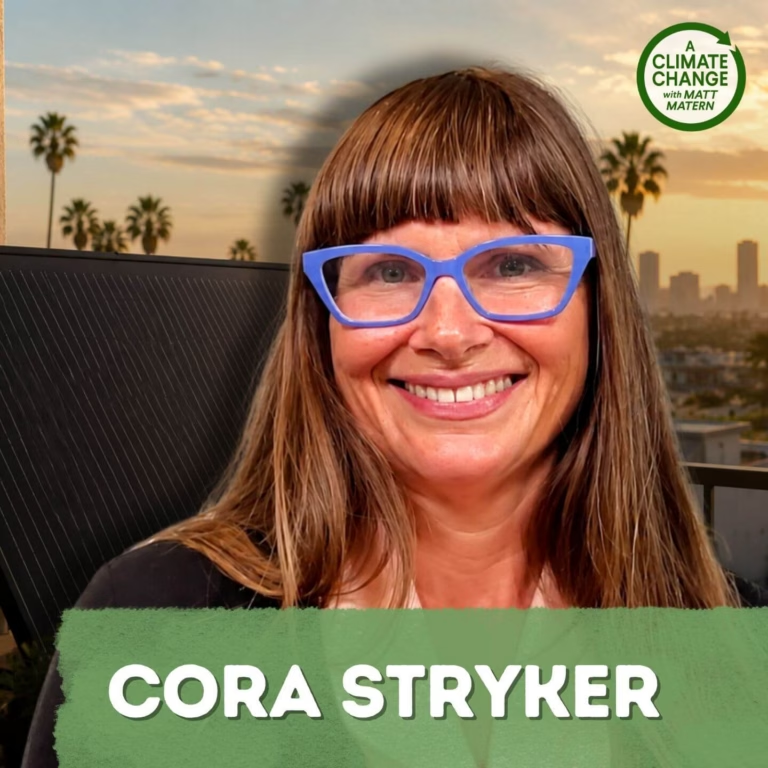
Matt is joined again by Cora Stryker, co-founder of Bright Saver. One year after first joining us on the show, a lot has changed. When she was last on, plug-in solar was legal in exactly one state and nobody in the country was selling it. Since then, 35 states plus DC have introduced legislation, nine have signed it into law, and Bright Saver has started shipping kits nationwide at exactly what they cost: $285.30, no markup. Here in California, SB 868 – the Plug and Play Solar Act – just cleared both houses of the legislature and is now sitting on Governor Newsom’s desk awaiting his signature.
Cora argues that the climate movement’s biggest opportunity is affordability, as only about 3% of Americans rank climate as their top voting priority, while 54% name the economy and household expenses.
There will be a clean energy transition, but guess what? The fossil fuel companies know that too, and they want it to happen on their time schedule. And they’re thinking 2030, years from now we’ll be dominant clean energy just because it’s cheaper and the economics will drive it that way. Our job as a climate and environmental movement is to make that happen a whole lot faster, and that’s what Brightsaver’s here to do.
You’re listening to A Climate Change. I’m Matt Matern, your host, and I’ve got a great guest on the program, Cora Stryker. She’s the CEO of Bright Saver, and we had Cora on the show about a year ago, and Cora, you’ve had a great year. You run a nonprofit that’s working on making solar power something anyone can buy, plug into a wall, and start saving on.
And a year ago, when you were on the show, exactly one American state allowed this, and no one in the country was selling it. Since then, eight states have signed in, signed up for plug-in solar into law. California legislature just passed a bill of its own, and Bright Savers started shipping its kits nationwide. So that’s a pretty substantial move in the last year. Well done.
Yeah, it’s been an incredible year. We’ve seen folks line up from across the political spectrum to say, “Hey, plug in solar is something that our state needs. People need relief from rising energy bills right now, and plug in solar is a way to reach everyone with solar energy.
Well, it’s definitely the democratizing of the grid, and and I feel like it’s just empowerment for everybody to be able to have one of these on their roof or hanging out at their balcony and and generating some electricity themselves. And it’s been remarkable what it’s done in other countries. I have read about Pakistan and the the amount of people of hanging these off their walls in Pakistan has reduced the need to build power plants.
Pakistan’s a great example, actually, because I talked to a fellow there, and he says to me, “This has nothing to do with climate in Pakistan. It is only about household expenses and energy bills, and that’s our vision at Brightsaber. Actually, I mean, we are climate first folks, but we also realize that climate is the number one voting priority for a tiny majority of Americans. I just looked at the numbers; it’s about 3% of us rank climate and environment as our top voting priority, and we’re not going to get anywhere if that’s where we’re at. By contrast, 54% of Americans say the economy is their top priority and household expenses affordability. So, Bright Savers’ whole theory of change is let’s yoke affordability to climate, and we have way more than half of the U.S. population on our side.
So tell us about what what does this do when we plug it in? I just recently got a unit here at my house, and thank you for for sending that to me. I really appreciate it, and maybe a little bit later in the show, we’ll go out and take a look at it. But tell us a little bit about what what this does for the average household.
It’s quite simple. It is like an appliance that functions as a solar system. So in Germany, let’s talk about Germany first. You go to IKEA, you buy it, you bring it home, plug it in, and that day immediately you’re reducing your household expenses pretty significantly. You know, for the average apartment in Germany, it’s around 20 to 25% of your energy bill is offset. So that means a couple things: you’re buying less energy from the grid, and you’re saving on your household bills at the same time, and that’s really the power of plug-in solar, and that’s where we get to what we see is the huge impact this can make on climate. It’s a little bit the gigawatts of clean energy we’re adding to the grid, but more than that, we think it’s the psychological shift in a huge chunk of Americans and and people worldwide who think they can’t afford literally to care about climate, but will make choices as a consumer that lower their energy.
Yeah, it’s those little choices. I feel like when I go through life, it’s the little things that matter. If I do this one thing well right now, it’ll lead to the next good thing, and so this is a perfect example of it. It’s a modest, a modest investment, but it it has some immediate impact, and then just it shifts the consciousness. I’ve got solar in my house. I’m you know, and if enough people do it. Then there’s less need for building out polluting sources of power, and I think it just cues people into here’s here’s a way that I can make a contribution.
Yeah, 100% And you know, you mentioned we’ve seen this kind of legislative wave sweep the nation? I think the last time I talked to you, Utah had passed plug and solar legislation. I think I said to you, maybe we’ll get two more states to do it. In the end, it was 35 states plus DC, so well over half the United States introduced this legislation. And as you say, we’ve had we’ve had eight signed into law.
We’ve had 11 that have passed both chambers that we feel hopeful will be signed into law, and I think that it’s just been extraordinary. And we, you know, we’re bright, we’re a nonprofit, Bright Saver, and when we look at what we’ve accomplished this year, there is the real concrete solution of affordable clean energy for people in those 11 states that now have plug-in solar legislation. But more than that, we think the most extraordinary thing is this coalition that has raised their hands and said, “Yes, this is a no-brainer.
Cheap energy, of clean energy. If they’re the same thing, why are we not doubling down in this? And so that’s kind of what’s next for Bright Saver. Is we want to take that coalition that has been really excited about balcony solar-that’s folks right, left, center, libertarian, progressive-and say, hey, if we all stood together to shape clean energy policy and drive clean energy product prices down, what could we do? I mean that like we think there is no stopping the clean energy transition in a very rapid manner if we can stand together like that.
For sure, and it’s kind of reminiscent of how the environmental movement got started in the late ’60s, early ’70s. There was basically unanimous support across the spectrum for for all this. So the fact that you are kind of jumpstarting that that kind of coalition is is hugely important and and really exciting.
Totally. And it’s become so partisan environmentalism and the climate, and that is just insane in a world where where clean energy is cheaper. So that we’re gonna get there. Honestly, like there will be a green transition, there will be a clean energy transition. But guess what? The fossil fuel companies know that too, and they want it to happen on their time schedule. And they’re thinking 2030, years from now we’ll be dominant clean energy just because it’s cheaper and the economics will drive it that way. Our job as a climate and environmental movement is to make that happen a whole lot faster, and that’s what Bright Savers here to do.
Well, amazing work. Tell us a little bit about where it’s at in California. I know that it’s passed the both houses of the legislature and sitting on the governor’s desk. The fact that it’s wobbling there at all is a little bit of concern. Like, why? Why should this wobble at all? But what what’s the word from the governor from from what you can tell?
So we’re really hopeful, and and it didn’t just pass; it passed unanimously through our Senate and Assembly. So I think it’s self evident that that people want this, legislators want this for their constituency. We hope the governor does the right thing and signs, and we really see no reason he wouldn’t.
Right, I you know I don’t see it written about much here, but I assume there’s a legislative overrule of a veto if he were to veto it, I I did not sure actually.
Right, I should I should know this living in California, but it’s it seems kind of self evident. But I haven’t haven’t seen it talked about much recently.
I can tell you this. I mean, there have been some hard won battles that have been won in the legislature that that Newsom has vetoed environmental solar policies in particular, and that’s been incredibly discouraging. And that’s one of the reasons that California advocates are so excited about this plug-in solar law because they and we also feel that it has the chance to reset the political boundaries that have been drawn for for truly nonsensical reasons, and of course, here in California we have super majorities. So we’re not talking about Democrat versus Republican. We’re really talking about factions within the Democratic Party that just honestly have different. Interests in in who they support and money is for sure tied up in it.
Well, I feel like the the argument that this is kind of a small government type move in funding Balcony Solar. Okay, taking taking literally power back into the people’s hands, literally, power to the people. I mean, this should sell on both sides of the political spectrum. Is that I no longer need as much from big corporate America. I I can survive without them dictating as much as they do.
That’s right, and and that’s why this really has the potential to reset those voting priorities of Americans to take that 3% of us who rank climate environmentalism as our top voting priority and really expand that by making it an affordability issue. And if you look at the campaigns that have swept the nation this year, it really is more about energy affordability than climate, and you know, as climate people, we’re fine with that.
You know, we think that we need to honestly reset the environmental movement and and broaden it, and we know that from its inception, there have been a small, dedicated minority of Americans deeply, deeply concerned and working hard on climate and environmentalism. Guess what? We need to take that off the shoulders of the very small, dedicated few, and we need to make that a half of Americans, more than half of Americans, are going to stand for clean energy because it’s going to lower their bills.
Well, let’s let’s take a step in that direction by going out on my balcony and taking a look at your solar system. See the bright saber in action.
Oh, I can’t wait to see it.
And here on the the canals of Venice, California, we’ve got a balcony, and here is the solar panel. And right underneath it is the I don’t know what do you call that?
I think that’s the inverter.
The inverter, right? Yeah, it’s all out there, and you know, it just feels good to be generating some of my own electricity. I’ve I’ve been wanting to to have solar in my house for a long time, and for various reasons, it’s not an easy place to install solar. So, because of my roof being a little wonky, so yeah, it feels great to finally plug in.
Yeah, exactly. And look, what you just showed is how we are going to expand the Viramon movement, because the little panel you just showed is incredibly cheap. We’re we’re a nonprofit. We’re not selling it at any profit. So as of today, we’re able to sell it for 285 30. That’s exactly what it costs us. That will change actually as tariffs go up and down. We’ll have to reprice it.
But that is how we get that 54% of Americans who care about affordability in the door of the climate movement, because we want them to to buy one of those and to become a member of Bright Saver, so that we can create a huge coalition of us, sort of like the AARP of clean energy. And the whole idea that we have is that if we stand collectively, we can negotiate really rock bottom rock bottom prices on these clean energy products at the same time as we shape clean energy policy as we have this year across 35 states. We think that that is the winning formula to accelerating the clean energy transition way faster than the powers that be wanted to go well.
I love it. And then I guess you’ve set your sight on batteries being the next product, and heat pumps financing, insurance, and you called membership a flywheel and says, and you think that 65 million Americans will eventually have one of these.
Absolutely, I do. I mean, I think that that’s not a crazy estimate. That’s when we follow the German playbook. That’s already happened in Germany. We’re at 4 million now, and we’re much larger population. And arguably, we have more renters, more people who who really want access, and of course, the affordability crisis is only getting worse. So, yeah, we think we could end up above that, and we think we could end up there even more quickly than we projected in our white paper, which I think you’re quoting from from last year.
I’m curious as to you know how much. Power would that generate if we had 65 million American households with one of these units?
Many gigawatts. It would be many power plants that never have to be built. In Germany, we’re at about two traditional power plants that never had to be built, and here we’re going to we’re going to quadruple that just based on population alone. So, so the sky’s the limit. But again, you know, I think this is about way more than the gigawatts, even more than the number of power plants we don’t have to build that that pollute our air.
It’s really about this movement of folks across the political spectrum, across the socioeconomic spectrum, who say, “Hey, this is a no-brainer. Clean energy is the cheapest energy. Why can’t we make this happen so that we can have it right now? We want we want more than 65 million of those, and guess what? We want bigger panels too. This is where we start, but when we talk a couple years from now, we’ll be looking at panels twice, maybe three times the size of what you have.
That’s awesome. So obviously, two or three times as much energy, clean energy can be produced, and and hopefully even cheaper because that’s one of the kind of miracles of the solar phenomenon is the cost curve has has continued to go down and efficiency has continued to go up. So last time we talked, you know, it was barely legal. Now you’re legal in eight states.
It’s yeah, it’s extraordinary. I mean, look, I’m an optimistic person, but I even I didn’t think it would happen that quickly. And by the way, we’re not done. So, so New Jersey was just signed into law, and that is a really aggressive piece of legislation that that attacks both the legality of the systems themselves, and also renters’ rights. So in Germany, we got to 4 million folks having these bypassing both both the interconnection reform that has been in all 35 of these bills that have moved this year, but then also renters’ rights.
It took them a few years to do it. Guess what? A couple states this session did it in one fell swoop: Germany, Colorado, Virginia, and possibly Massachusetts and DC that haven’t haven’t gone through the the legislative cycle yet. So, so we are well on our way. And you know, honestly, I’ve never been more hopeful about climate. I used to teach community college. Actually, I was-we talked about this last time. My first job out of college was as a rare and endangered plant biologist in Hawaii.
But my second job was I taught basic writing skills at community college to folks, some of whom had never read a book, they told me my class was the first time they ever finished a book, and the last thing on their minds was endangered species and the climate. And it really, you know, I really think of them when I think of bright what Brightsavers doing because I think of them standing with us in this movement, and how becoming a member will get them a solar panel as cheaply as possible, and that they’ll suddenly think to themselves, “Oh, wait a second! You know, this climate is not something that’s just for the affluent. Like this is something I can care about because it’s actually going to make life cheaper for me.
Yeah, that’s a an enormous shift in consciousness. Tell me a bit more about how the renters’ rights component works. And I mean, I know you’re kind of touching on it already, but how do we get more of these panels in the hands of folks that $285 is is maybe a stretch for them.
Yeah, I mean there are a couple ways to attack that. I mean it’s interesting you you put it that way. So I was in the first hearing for the California bill, and it passed unanimously, except that there were two abstentions. This was the Energy Committee, I believe, and both legislators who abstained said, “Hey, this is fantastic, but 300, $500 for one of these systems, my constituents still can’t afford that. So, in that case, there might be some incentive programs, some rebate programs.
I’ll say one of the pilots Brightsaver is working on right now is in low-income communities, we’re partnering with a foundation to serve a neighborhood. I don’t think I can say which one yet, but there will be room for programs like that that deliver these systems for free, either through government funding, in some cases maybe utility funding, and of course, in some cases. Through foundations and nonprofits like us, but it’s more than that. In terms of the legislation, the reason New Jersey and Colorado are so powerful is that they say essentially, “Hey, landlords cannot prevent tenants from getting these, except in the case that it poses safety hazards. Say it blocks fire egress.
That is so powerful because what it means is that land renters do not need to ask their landlord’s approval. I was I was just thinking we our first pilot here in California we were surprised that there were not more renters who wanted these and you know when we topped them we found out pretty quickly why I mean many had rent control and didn’t want to ask for too much from the landlords. I remember one fellow here in in the San Francisco Bay Area. He did get landlord permission, and then we found out his landlord was his mom.
So you know, I think that we can’t count on that, and we have to make sure that renters have the right to plug these in, regardless of what their landlord says, and so that is going to be a huge priority for us next year. This year, we just wanted the maximum number of states to say, “Hey, we want this. We definitely got that this year. Next year, we’re going to go for much more aggressive legislation that is specifically targeted at renters’ rights.
That’s awesome, yeah. Certainly, we have a little foundation as part of my law firm. It’s called the Satyagraha Alliance, and we’d be happy to contribute to getting some of these units in lower income folks’ homes or condos, apartments, so that you know they could get the benefits of this too.
Oh, that would be fantastic, and you know that’s wonderful. And folks who don’t have foundations can also contribute. You know, this is a movement where we’re on the S curve. We’re in the early adopter phase, and everyone has a part to play in a movement, some of us can lobby our Congress, our our legislature tours, and there’s room absolutely for donations. We accept them at BrightSaver.org, and the more donations we get, the more people we can get these little solar panels to.
Yeah, I think that we all have a part to play, and and I appreciate the great work that you’re doing, Cora, out there, and and the tremendous results that you’ve had over the last year. And you know, tell us what are the next steps. You know, you talk about you know insurance and and other issues. How do you how do you see that playing out?
Well, step one is to build a massive membership, and since we started offering this membership just a couple months ago, we’re in the 1000s of members. We need to we need to raise that by an order of magnitude to really make the big impact we see. So once we have enough members, we can negotiate on behalf of we hope the 10s of 1000s, maybe millions someday. We can negotiate the lowest prices, and that goes for all clean energy technologies. It starts with balcony solar, like the one you have on your deck, but it certainly doesn’t end there.
Yeah, within the year, we hope to offer batteries that are compatible with that balcony solar unit. Insurance is another watershed. So, so when folks join the Brightsaver membership, you’re signing up for the whole ecosystem of pieces that have to fall into place in order for clean energy to become the dominant source of energy very quickly. Like I said, that’s going to happen. The economics themselves are going to drive clean energy to be the dominant energy in this country, but we don’t want it to happen 2030, years from now. We want it to happen now.
Well, certainly batteries are fairly expensive. The ones that I looked at, and I, I’m curious as to the price ranges that you you think you could make a battery available to kind of the average household.
They change every day, honestly. And as we were talking about with with PV technology, the price keeps going down. The price is a little more volatile these days. Actually, with with tariffs and changes in Chinese subsidies, primarily, I think that that the answer to that question actually depends on how many people become Brightsaver members by that time, and the reason for that is the more people we have, the lower we can get the price.
So, so I would encourage people to think about the $29 a year membership because even if you don’t want a balcony solar system, maybe you want to help drive this movement from all directions. You’re right, battery. Right now, are are quite expensive relative to the cost of these systems, but we’re hoping that by the time we sit down to negotiate the lowest price, we’ll have such a massive membership we can offer them for a less than $1,000, hopefully a few $100.
Well, that would be awesome. So yeah, it’s all part of the the ecosystem of creating a cleaner power system, and and as I kind of studied putting in solar, I started to realize well, certainly one would like to have a battery to to hold that energy after you’ve after you’ve created it for the times of day when when it’s not sunny, obviously, and and it kind of creates a mini grid as more people get battery technology, then you have what these micro grids, which creates even more opportunities to no longer be feeding at the tit, you know, the at the big utility company’s mercy.
Absolutely, and and when you pair these with a battery, they provide resilience. Of course, I mean, here in California, we’re all familiar with the the power outages, some plan, some not, and you know, this problem is going to become ever more apparent to to folks. I mean, we have a fragile grid. The grid needs updating desperately, and so the more load we can take off of it, the the more we will preserve that grid, and the more we can get batteries into people’s hands.
I mean, this is also for us a human health issue. There are folks who need cool medicine. There are you. You have to keep your food cool. You know the heat waves in Europe. We just had a lot of people died primarily from overheating. So so this for us is the beginning of a cleaner grid and a healthier population, because we can be resistant to forces beyond our control, and safer as far as wildfires, because part of that problem results from the grid being running hot.
And at times they would make it safer if they could shut down parts of the grid when those dangers are the highest, and and of course it’s problematic when you don’t have people who have their own power source. But as more people have their own power source and have battery technology, they could they could actually turn off the grid during those high danger times, so it’d be less likelihood of having fire sparked from from utility line.
That’s absolutely true, and and I also don’t want to overstate the impact that these little systems will have. I mean, what you described is certainly a dynamic, but again, we see the real opportunity here with the enthusiasm around balcony solar. We see the opportunity as forming a movement that goes far beyond those of us who love to hike into the wilderness and disappear for days at a time, of which I am one, because we have to. We have to go beyond the small minority of us, and so we see that as the big impact.
I mean, just imagine, imagine when we do have membership in the hundreds of 1000s, millions, we will become as formidable a force as the AARP is in shaping policy. And and the dynamic you describe, there are a lot of moving pieces, right? Like virtual power plants can have an impact on on resilience, certainly, and producing clean energy and reducing fossil fuel energy sources. There’s honestly no limit to the number of clean energy solutions. There’s a limit to our political will, and that’s why we already are going beyond balcony solar to that bigger problem that we have to solve quickly.
Well, another great idea, Cora, and everybody sign up for Bright Saver membership and tell everybody how they do that, and how easy it is to to join this movement.
Thank you so much. You know, I I love your show. I watch, I think, almost every guest, and it’s an honor to be here. And you know, really to talk about the the environmental movement that has been being built since the days of Roosevelt, and think about okay, what’s next for us? And it’s just such a joy to to be on with you and talk about the future.
I appreciate that, and yeah, everybody should check out Bright Saver.
Brightsaver with a “b” dot org.
There we go. Brightsaver.org. You heard it here, and follow them. Become a member. Join this movement. Get a balcony solar unit, and plug in.
Thank you. This has been so fun.
To learn more about our work at A Climate Change, visit aclimatechange.com. Don’t forget to subscribe to our podcast on Apple, Spotify, YouTube, or wherever you get your podcasts. If you like this episode, please share it with a friend. See you next time.
(Note: this is an automatic transcription and may have errors in formatting and grammar.)